Mallikarjuna Temple, Inavolu
The Mallikarjuna temple at Inavolu is the temple of Mailaradeva named in its inscription. Scholars date it to the Kakatiya period on grounds of style and local tradition. No Kakatiya inscription has been published from the village. The records there include Western Chalukya grants of 1076 and 1118 and a grant of 1369 by the Recherla chief Anapota.
- Period
- Kakatiya on grounds of style and tradition. No inscription dates the building. The village records run from the 10th century to 1369
- Location
- 17.8664° N, 79.5457° E
Source of the position: Wikidata Q121296447. OpenStreetMap way 1193897717, Mallanna temple, lies within about 10 m
- Condition
- A temple in worship. The Department of Heritage has re-erected the north torana. Photographs of 2021 show the toranas and the pillared mandapa standing.
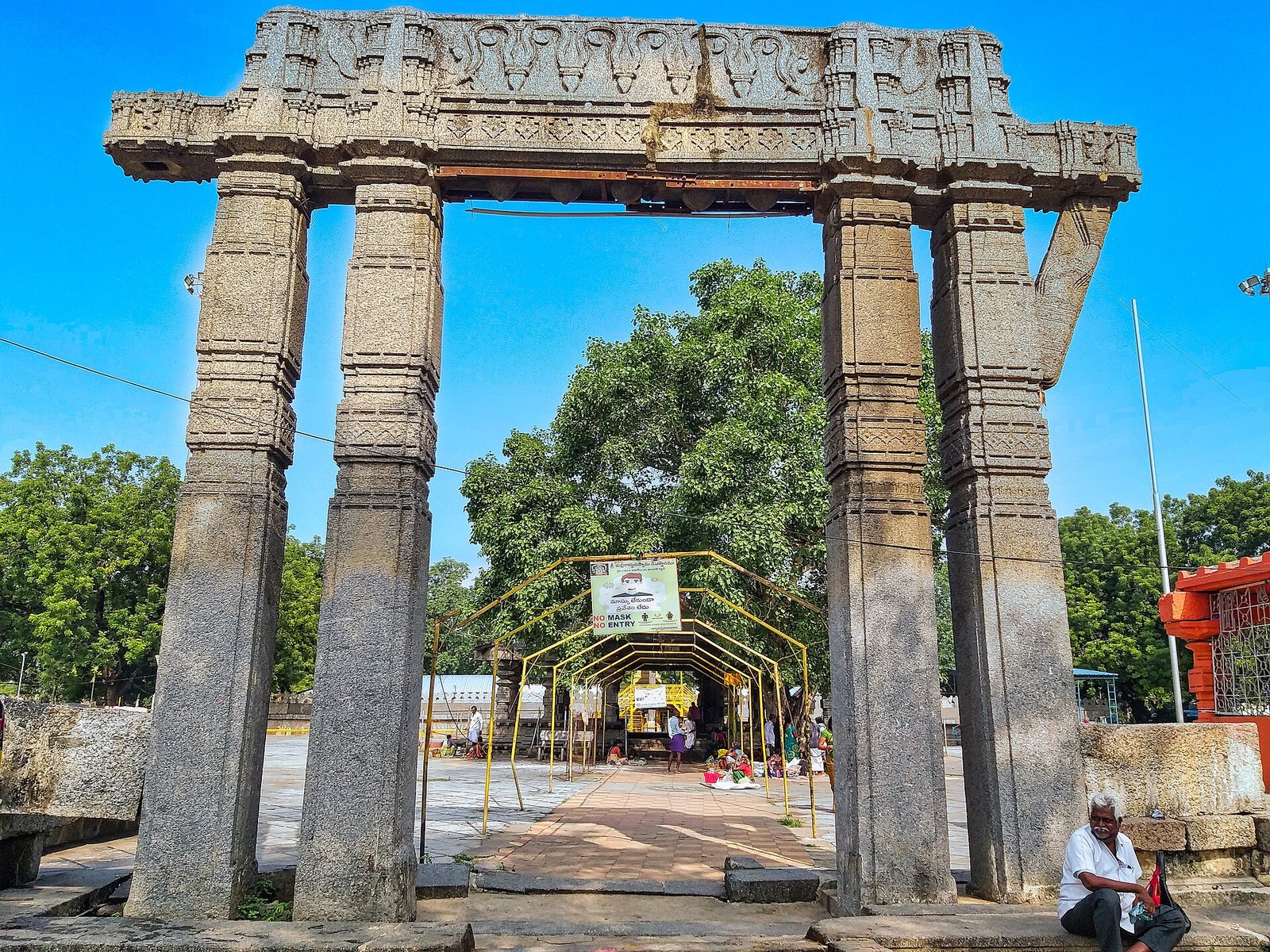
Photographed 2021
One of the stone toranas of the Inavolu temple, photographed in 2021. Each side of the gateway has a pair of tall pillars under a broad carved beam.
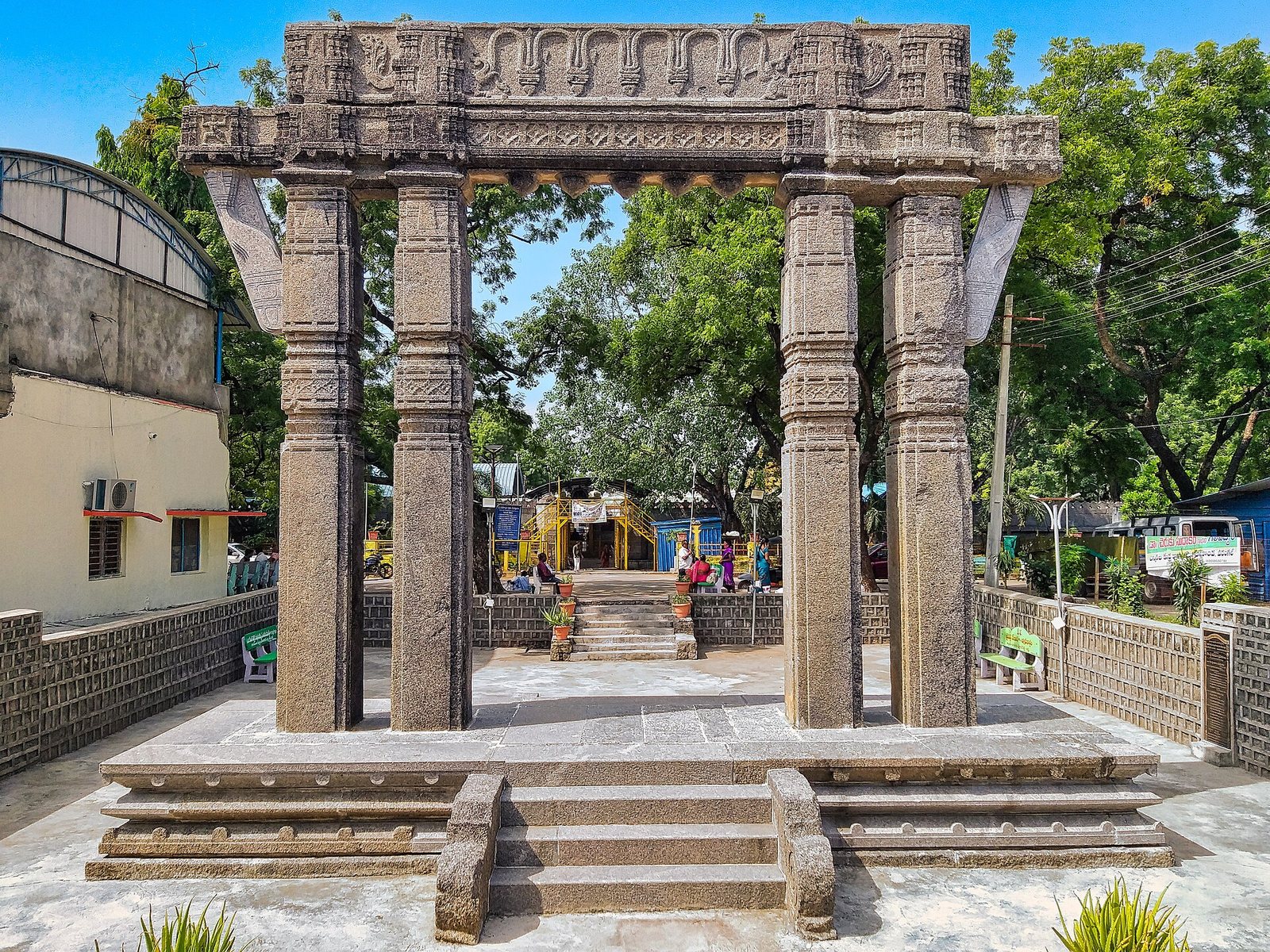
Photographed 2021
A torana at Inavolu standing on a stepped platform, photographed in 2021. The platform and the paving around it are recent.
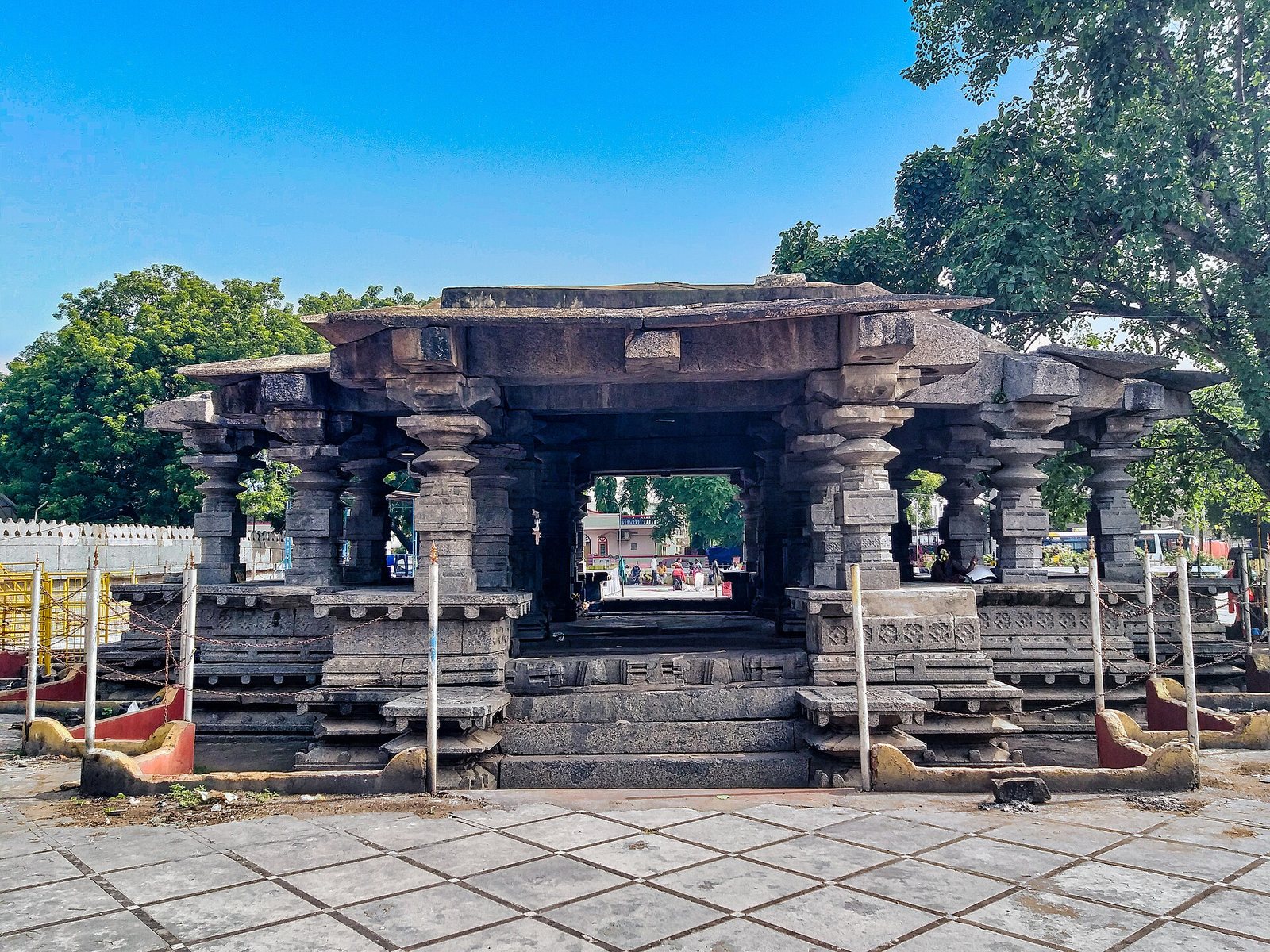
Photographed 2021
The pillared mandapa in front of the shrine, photographed in 2021. The plinth and the edge of the roof step in and out round the hall.
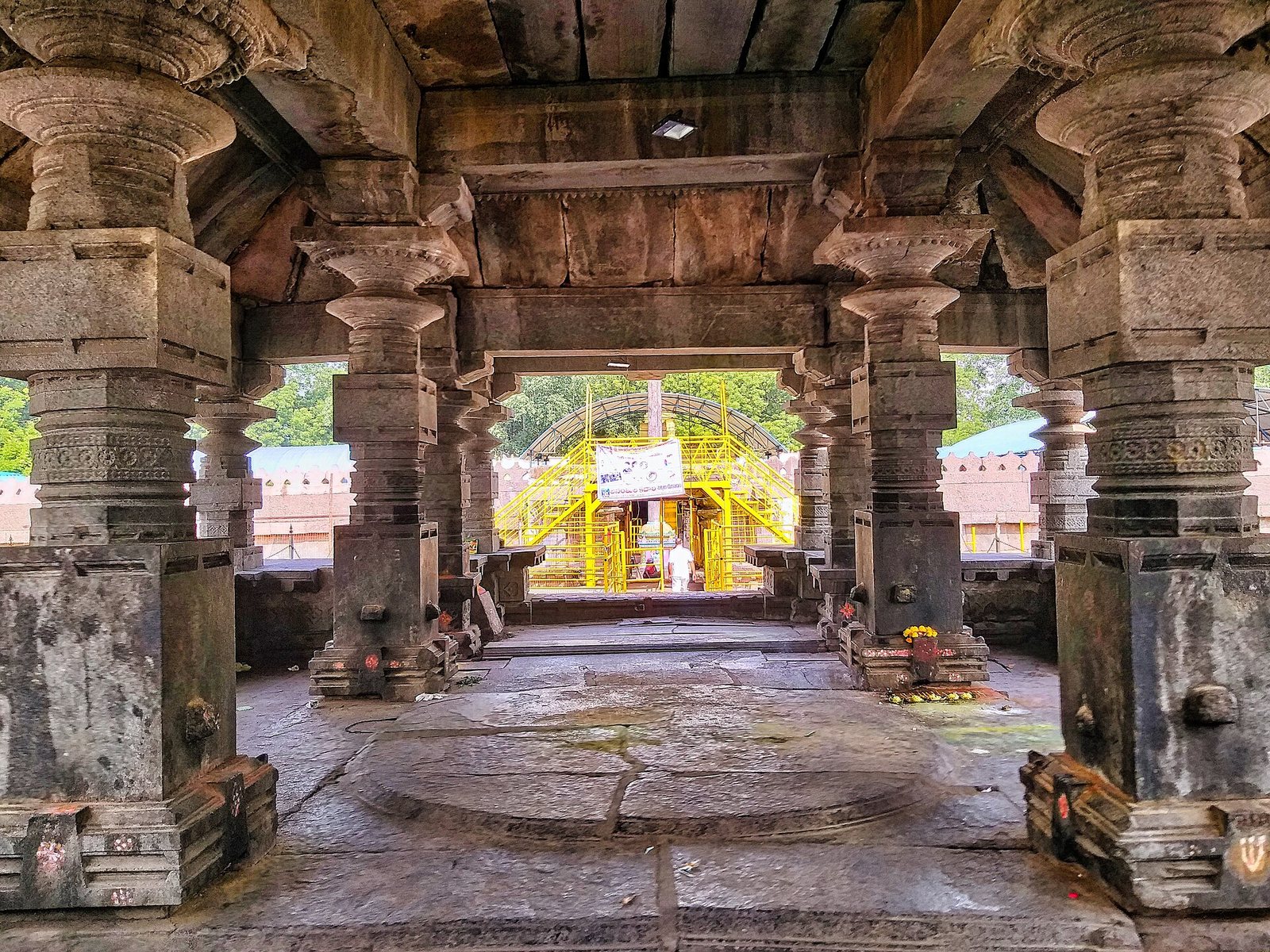
Photographed 2021
Inside the mandapa, photographed in 2021. Turned stone pillars stand around a round platform in the centre of the hall.
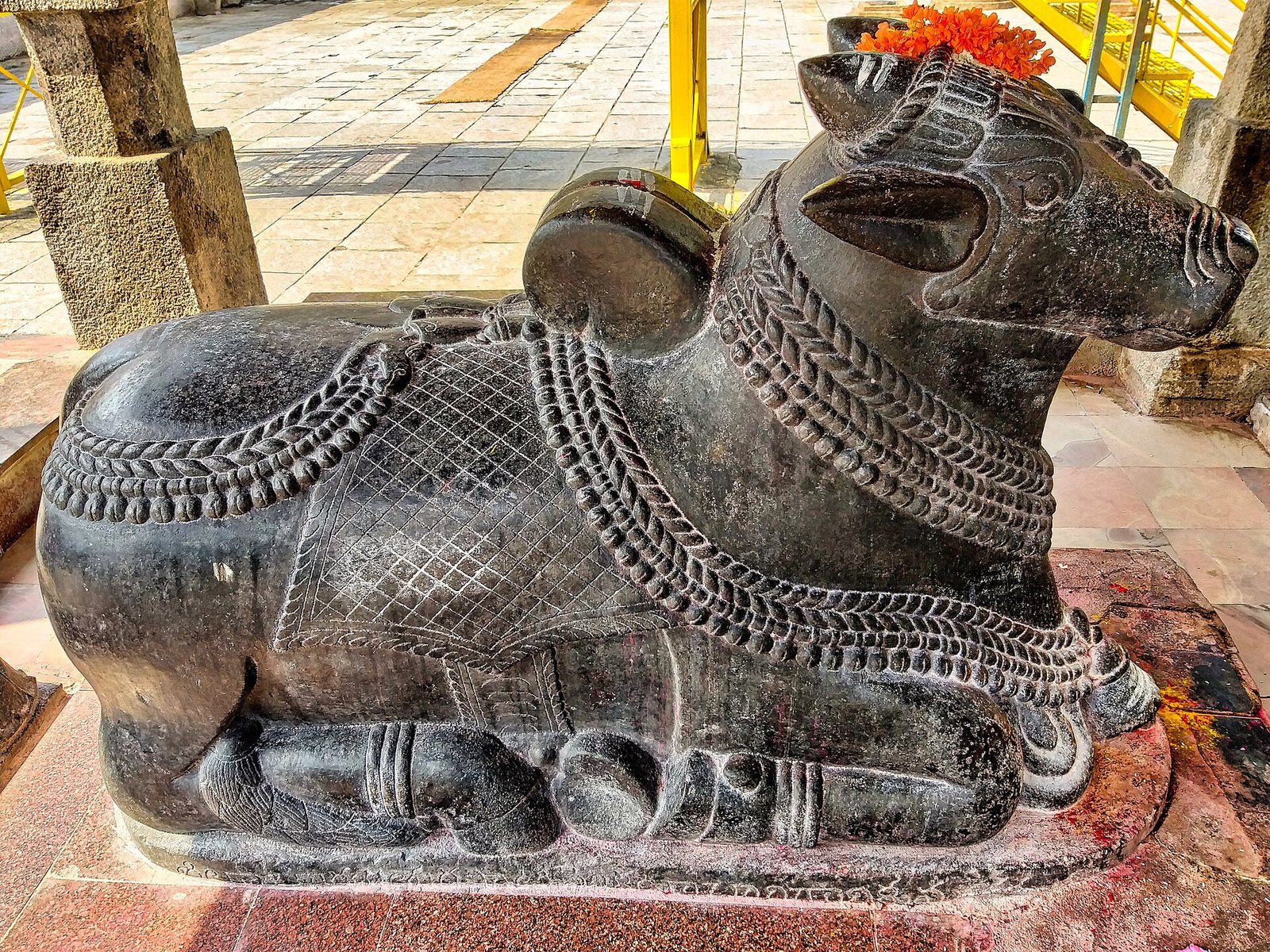
Photographed 2021
A Nandi, the bull of Siva, carved in dark stone at the Inavolu temple. The photograph was taken in 2021.
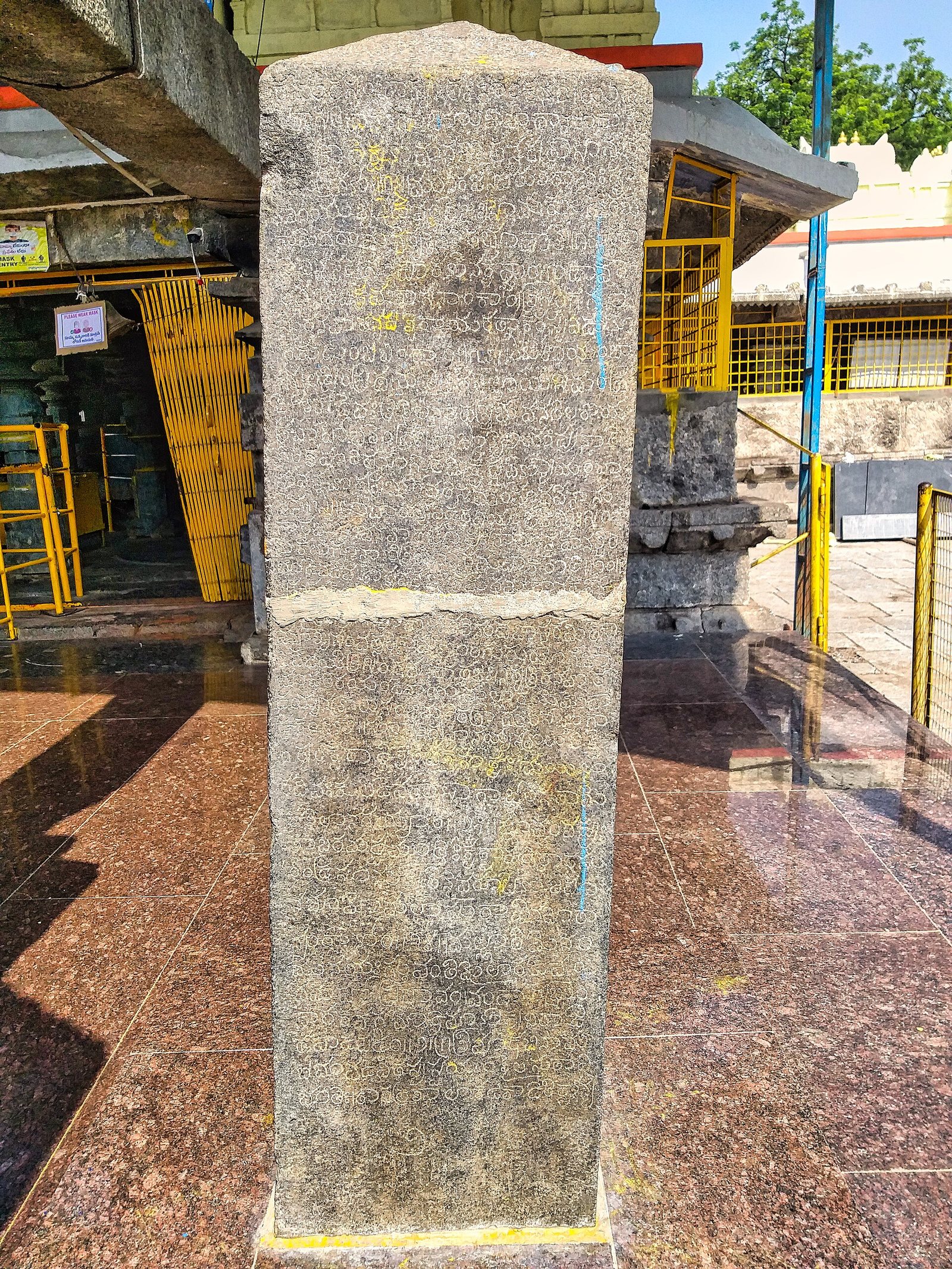
Photographed 2021
An inscribed stone pillar in the temple court, broken across and joined again, photographed in 2021. The grant of 1369 is also on a broken four-sided pillar, but this photograph has not been matched to it.
Detail
- No published inscription dates the temple. Epigraphia Telanganica lists records from the village of the 10th century, of 1076, of 1118 and of 1369, and none of them is a Kakatiya record. The Kakatiya date of the temple rests on style and on local tradition.Epigraphia Telanganica 2023Gopalakrishna Murthy 1964
- Two older government works link an inscription to a Kakatiya date. The Census volume of 1964 says that the temple was built in the time of Ganapati Deva, "in the middle of 11th century", and that the inscription at the temple corroborates this.Census 1961, Fairs and Festivals: Warangal
- The Warangal District Gazetteer of 1976 says that, according to an inscription in the temple premises, the temple was built in the reign of Ganapatideva. Neither work quotes the inscription. The Census volume describes a stone inscription beside a small mandapa, "believed to be of the Kakatiya Kings".Warangal District Gazetteer 1976Census 1961, Fairs and Festivals: Warangal
- The inscription that the epigraphic editions place at the temple is the grant of 1369 by the Recherla chief Anapota. That record is a gift of the village to the god, not a record of building.Epigraphia Telanganica 2023
- The Department of Heritage, Telangana, dates the temple to the 12th and 13th centuries on architectural grounds. In its view the temple was built in the early Kakatiya period, and the mandapa and the toranas were added under Rudradeva, who ruled from 1158 to 1195.Department of Heritage, Telangana
- S. Gopalakrishna Murthy records a tradition that Rudra built the Mailaradeva temple at Ainavolu, together with the temples at Kasibugga and Mogilicherla. He accepts this tradition because it fits as a preparation for the Thousand Pillared Temple, which Rudra raised in 1162. He also writes that the main temple was built by Rudra "according to local records".Gopalakrishna Murthy 1964
- Gopalakrishna Murthy says that the plan of the temple follows the Somesvara temple at Kolanupaka. He suggests that one of Ganapati's generals perhaps built the star-shaped mandapa in front of the temple.Gopalakrishna Murthy 1964
- Telangana Tourism says that Kakatiya rulers built the temple in the 11th century. The same page names the builder as Ayyanna Deva, a minister of the Kakatiya kingdom, and derives the name Inavolu from him.Telangana Tourism, Inavolu Mallanna Jaatara
- Press reports repeat the attribution to Ayyanna Deva. The Deccan Chronicle placed the building in the 12th century in 2016, and Telangana Today placed it in the 11th century in 2022.Deccan Chronicle 2016Telangana Today, December 2022
- The village name is recorded before the Kakatiya kings ruled in their own right. The Department of Heritage calls Rudradeva the first sovereign ruler of the dynasty. A record of 1007 at Punnavolu, which the department calls a nearby village, grants land by the eastern tank of Ayyanavola.Department of Heritage, TelanganaEpigraphia Telanganica 2023
- A record of 1118 at Ainavolu, of the Western Chalukya king Vikramaditya VI, names the god of Ayyanavolu. The Department of Heritage derives the name from Ayyanavole, which it explains as the holy village of priests.Epigraphia Telanganica 2023Department of Heritage, Telangana
- Epigraphia Telanganica lists two Kannada records from Inavol, taken from Indian Archaeology 1980-81. The first record belongs to the 10th century. Epigraphia Telanganica places it under the Rashtrakuta king Krishna III, but its summary calls the donor an officer of a king Satyasraya.Epigraphia Telanganica 2023
- The second record from Inavol is dated 1076, in the reign of the Western Chalukya king Somesvara II.Epigraphia Telanganica 2023
- In the record of 1118, the general Surayya gave land for the worship of the god and for feeding ascetics. Indian Archaeology 1957-58 names the god as Suresvaradeva of Ayyanavolu. The Annual Report on Indian Epigraphy for 1957-58 reads Sivesvaradeva, and it places the record on a broken slab near the sluice of the tank.Epigraphia Telanganica 2023
- The Department of Heritage describes the record of 1118 as a gift to Lakulesvara Pandita by a subordinate of the king.Department of Heritage, Telangana
- On 19 July 1369 the Recherla chief Anapota gave the village of Ayyanavolu to the god Mailaradeva. He made the gift during a campaign of conquest. The record says that he ruled Orugallu, Tribhuvanagiri, Rajukonda and Singavaram.Epigraphia Telanganica 2023
- The record of 1369 traces the Recherla family back to Vennaya. It says that the Kakatiyas honoured the family, and that Dachaya conquered the Pandyas at the command of Prataparudra. The record calls the god Mallara and his consort Madaci a form of Parvati. The poet Naganatha, son of Pasupati, composed it.Epigraphia Telanganica 2023
- The editions place the stone of 1369 differently. The Corpus of 1956 puts it on a broken stone near the flag staff of the Mailaru temple. The Annual Report for 1957-58 puts it on a pillar in the compound of the Malleswara temple. The Census volume of 1964 says that the temple has no flag staff at all.Epigraphia Telanganica 2023Census 1961, Fairs and Festivals: Warangal
- One passage in the third volume of Epigraphia Telanganica gives the date of Anapota's inscription at Ayyanavolu as 1396.Epigraphia Telanganica 2023
- According to a tradition recorded in the Census volume, Anapota came to Inole after he avenged his father. There he worshipped Mailaru Deva, gave his weight in gold to Brahmins, and set up a stone inscription that called him Kaliyuga Parasurama.Census 1961, Fairs and Festivals: Warangal
- Gopalakrishna Murthy sees the gateways of Ainavolu as one stage in the Kakatiya torana. In his words, the form "started at Hanumakonda, improved at Kolanupaka and beautified at Ainavolu". He describes a stone torana at each of the three entrances of the stone enclosure.Gopalakrishna Murthy 1964
- The sources count the toranas differently. The Department of Heritage places them on the south, east and north, with no trace of one on the west. The Census volume of 1964 says that the north gate had completely fallen. Telangana Tourism speaks of four entrance gates.Department of Heritage, TelanganaCensus 1961, Fairs and Festivals: WarangalTelangana Tourism, Inavolu Mallanna Jaatara
- The Census volume gives the front gate as about fifty feet high and the south gate as forty-nine feet high. It says that the temple covers about fourteen acres.Census 1961, Fairs and Festivals: Warangal
- The Department of Heritage says that the south and east toranas stood and that the remains of the north torana lay on the ground. It says that the department re-erected the fallen north torana in its original place.Department of Heritage, Telangana
- In November 2016 the Deccan Chronicle reported that carved torana pillars had been found lying near a hillock less than a kilometre from the temple. The report called this the fourth torana.Deccan Chronicle 2016
- In November 2017 the Deccan Chronicle reported that work had begun to erect this torana on the north side of the temple, and called it the third torana. Telangana Today reported in 2022 that the third torana was installed and inaugurated in 2018.Deccan Chronicle 2017Telangana Today, December 2022
- A large pillared mandapa stands in front of the shrine. The Department of Heritage calls it a 24-pillared ranga mandapa. Telangana Tourism says that the temple was built with 108 pillars. The Census volume says that the mandapa has carved pillars, and it gives its extent as over one hundred feet radius.Department of Heritage, TelanganaTelangana Tourism, Inavolu Mallanna JaataraCensus 1961, Fairs and Festivals: Warangal
- Gopalakrishna Murthy writes that the roof of the star-shaped mandapa is not flat but a short cone of several facets. He found this kind of roof again only on a small triple shrine to the west of the great temple at Palampet.Gopalakrishna Murthy 1964
- Gopalakrishna Murthy describes the mandapa of the temple as rectangular, with a corridor that runs round the temple. The Department of Heritage calls the temple a sandhara shrine, with an inner path for walking round the sanctum.Gopalakrishna Murthy 1964Department of Heritage, Telangana
- Gopalakrishna Murthy lists stray sculptures round the temple, including naginis, hero stones and broken images of the goddess Kakati. He illustrates a Saraswati from Ainavolu with an oval halo like Rashtrakuta work. He judges that it could not be later than Rudra.Gopalakrishna Murthy 1964
- Gopalakrishna Murthy also notes a hero stone at Ainavolu that shows a lancer with his shield. The Census volume lists naginis, a Nandi, Ganapati, attendants of Siva and Jain tirthankaras in a small mandapa in front of the temple.Gopalakrishna Murthy 1964Census 1961, Fairs and Festivals: Warangal
- The image of Mailaru Deva is about six feet high, seated and facing east, between his consorts Balija Medalamma and Golla Ketamma. The god holds a sword and a drum in his right hands, and a lotus and a trident in his left hands.Census 1961, Fairs and Festivals: WarangalDepartment of Heritage, Telangana
- Gopalakrishna Murthy calls Mailaradeva a popular deity of the north-east of Andhra and of Maharashtra, where he is known as Khanderaya.Gopalakrishna Murthy 1964
- According to the tradition recorded in the Census volume, Rudra Deva, Ganapati Deva and Rudrama Devi worshipped Mylaru Deva of Inole daily. The same volume says that Rudrama Devi held secret conferences here during her wars with Kalinga and the Yadavas.Census 1961, Fairs and Festivals: Warangal
- Gopalakrishna Murthy writes that Rudrama made frequent pilgrimages to Ainavolu and supported its festivals.Gopalakrishna Murthy 1964
- The Gazetteer of 1976 says that the village was the seat of some generals and commanders of the Kakatiya kings. The Census volume mentions two other old temples to the east and the north of the village.Warangal District Gazetteer 1976Census 1961, Fairs and Festivals: Warangal
- The Census volume and the Gazetteer both count the Mylarudeva temple at Inole among the nine big temples of Warangal district. In 1976 the temple earned more than Rs. 10,000 a year, according to the Gazetteer.Census 1961, Fairs and Festivals: WarangalWarangal District Gazetteer 1976
- The Mallanna festival is held on Sundays and Wednesdays from Sankranti to Ugadi. Most of the worshippers at the festival are Yadavas, and its priests are Thammallas and Yadavas.Census 1961, Fairs and Festivals: WarangalWarangal District Gazetteer 1976
Inscriptions on this monument
These images show the inscriptions themselves. The ink impressions come from the published editions, and the photographs show the stones today. How to read a Kakatiya inscription
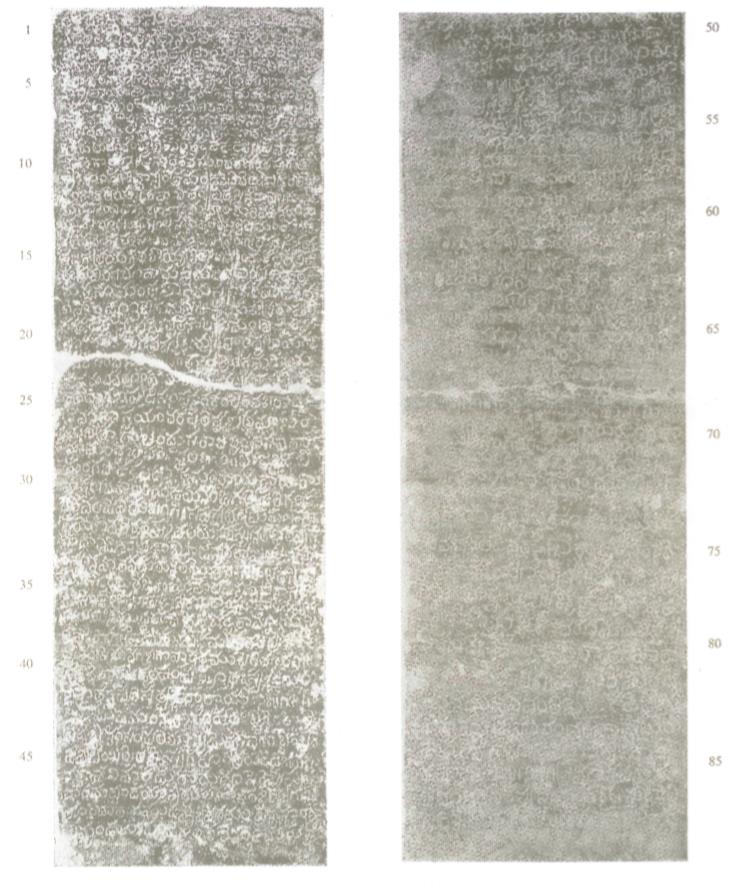
Estampage (ink impression)
This ink impression shows the first and second sides of the inscription of Anapota Nayaka at Ainavolu, dated 19 July 1369. The second side is very faint.
Epigraphia Telanganica, Vol. IV (Dr MCR HRD Institute, Government of Telangana, 2023), plate 1, p. 250. Reproduced for non-commercial educational use, as the publisher permits. · Non-commercial use permitted by the publisher · This record in the database
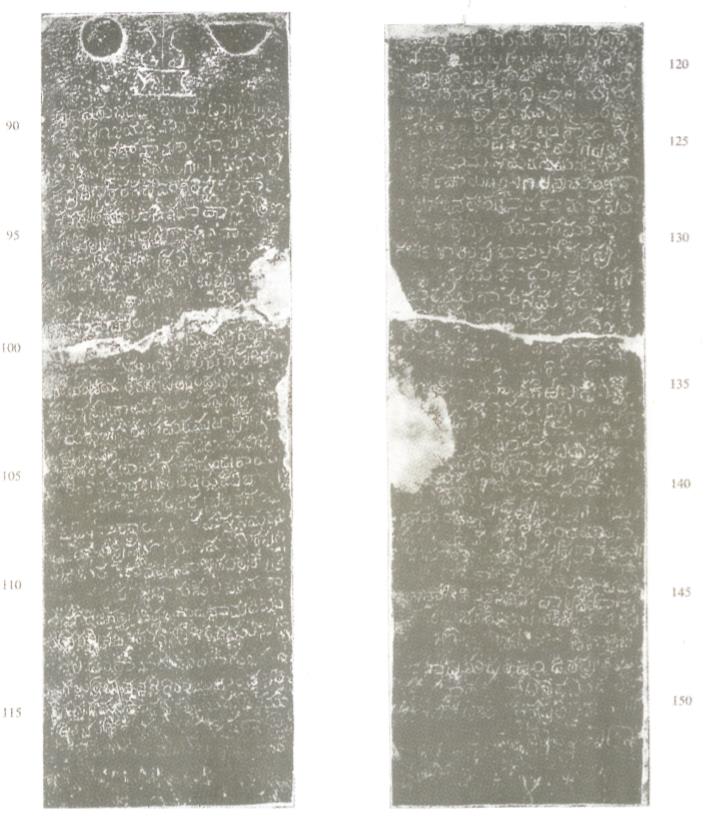
Estampage (ink impression)
This ink impression shows the third and fourth sides of the Ainavolu inscription of Anapota Nayaka. The sun and the moon are carved above the text. Anapota gave the village to the god Mailaradeva.
Epigraphia Telanganica, Vol. IV (Dr MCR HRD Institute, Government of Telangana, 2023), plate 1, p. 251. Reproduced for non-commercial educational use, as the publisher permits. · Non-commercial use permitted by the publisher · This record in the database
Also recorded as
- Inavolu
- Ainavolu
- Ainavol
- Inavol
- Inole
- Iloni
- Ayyanavolu
- Ayanavolu
- Ayyanavrolu
- Ayyanavola
- Mailaradeva temple
- Mylarudeva temple
- Mylaru Deva temple
- Mallanna temple
- Mallikarjuna Swamy temple
- Malleswara temple