Dargah of Afzal Shah Biyabani, Kazipet
The dargah of Afzal Shah Biyabani at Kazipet is the tomb of a Muslim saint of the 19th century. Two much older inscribed pillars stand in it. One carries a Kakatiya record of 1090 and 1098, and the other a Rashtrakuta record.
- Period
- Asaf Jahi. The saint died in the 19th century. The two inscribed pillars in the dargah are much older: one Kakatiya, of 1090 and 1098, and one Rashtrakuta, dated 872 or 932-33
- Location
- 17.9773° N, 79.5327° EWarning: approximate
Source of the position: OpenStreetMap node/4068566898, named Afzaliya Mosque, about 2.3 km east of Kazipet Junction station. The dargah itself is not mapped, and this point may be a mosque near it
- Condition
- A living shrine with a yearly urs. Whether both inscribed pillars still stand in the dargah needs checking, because one summary of 2016 states that the Kakatiya slab is missing.
No copyright-free photograph of this site is available yet. Offer a photograph you took
Detail
- Two old inscribed pillars stand in the dargah of Afzal Shah Biyabani. The District Gazetteer of 1976 notes two inscriptions there. In the Nizam's archaeological report for 1933-34, P. Sreenivasachar describes two identical pillars there, one with a Kakatiya inscription and one with a Rashtrakuta inscription.Warangal District Gazetteer 1976Nizam Archaeological Report 1933-34
- Epigraphia Telanganica says that the Kakatiya pillar is "now erected" in the dargah, not far from the railway station. The report of 1933-34 calls the Rashtrakuta record "fixed in the premises" of the dargah. Neither source says where the pillars first stood or when they were brought there.Epigraphia Telanganica 2023Nizam Archaeological Report 1933-34
- The Kakatiya inscription opens with the family history of its donors. Beta I was lord of the city of Kakati. His son Prola I set Chakrakuta in order, put Bhadranga to flight, conquered the Konkana and killed Gonna of Purukuta.Epigraphia Telanganica 2023Parabrahma Sastry 1978
- According to the inscription, Prola I received the Anumakonda district as a permanent fief from the Western Chalukya king Trailokyamalla. Beta II, the son of Prola I, is praised for victories over the Malava and Chola kings.Epigraphia Telanganica 2023Parabrahma Sastry 1978
- The Sanskrit verses were composed by the poet Devanabhatta. The summary of the 2016 volume Inscriptions of Warangal District, given in Epigraphia Telanganica, calls him the poet of Omtikonda and identifies that place with Orugallu. A Kannada part follows the verses.Epigraphia Telanganica 2023Parabrahma Sastry 1978
- The inscription records a grant made on a solar eclipse in Saka 1012, the year Pramoda, which Epigraphia Telanganica equates with Sunday, 24 November 1090. The village of Sivapura, south-west of Anumakonda, was given free of all dues to the Kalamukha teacher Ramesvara Pandita and his disciples.Epigraphia Telanganica 2023Parabrahma Sastry 1978
- Ramesvara Pandita was the head of the Mallikarjuna Silamatha, a Saiva monastery at Sriparvata, the present Srisailam. The donor washed the feet of the teacher before he made the gift.Epigraphia Telanganica 2023
- The sources name the donor of 1090 differently. The catalogue summary in Epigraphia Telanganica says that king Dugga-Tribhuvanamalla, the son of Betarasa, made the grant. The summary of the 2016 volume and Parabrahma Sastry say that Beta II built Sivapura with a temple of Betesvara and gave the village himself.Epigraphia Telanganica 2023Parabrahma Sastry 1978
- The pillar itself was set up later, on the festival of Uttarayana Sankranti in the year Bahudhanya. The summary of the 2016 volume names Dugga-nripati, the son of Betarasa, as the man who set it up in Saka 1020. Epigraphia Telanganica dates the inscription of Durgga to 1098.Epigraphia Telanganica 2023
- Parabrahma Sastry gives two slightly different versions. In one passage he says that Durgaraja, the grandson of Prola I, set up the pillar in 1097-98. In another passage he says that the minister of Durgaraja set it up in 1098.Parabrahma Sastry 1978
- Parabrahma Sastry suggests that Durgaraja copied the record of his father from an earlier inscription of 1090 and added grants of his own in 1098. Sastry also notes that this pillar is the only known record of Durgaraja.Parabrahma Sastry 1978
- The District Gazetteer of 1976 dates the Kazipet inscription of Beta II to 1090. The Gazetteer also says that his son Durganripati succeeded him in 1090 and is known from a single inscription at Kazipet.Warangal District Gazetteer 1976
- The last part of the inscription records a further gift. The merchant guild of Anumakonda gave one mana of oil every day for a perpetual lamp to the god Uma-Betesvara. The catalogue summary calls the god Umamahesvara.Epigraphia Telanganica 2023
- The present state of the Kakatiya pillar is uncertain. The summary of the 2016 volume, given in Epigraphia Telanganica, states that the inscribed slab is now missing. The text was restored from the Corpus of Telangana inscriptions, Part 2.Epigraphia Telanganica 2023
- The Rashtrakuta inscription is on the pillar to the right as one enters, according to Sreenivasachar. He measured the pillar as roughly 5 feet by 15.5 inches by 15.5 inches. The top was broken off, and repeated coats of whitewash covered the stone.Nizam Archaeological Report 1933-34
- Sreenivasachar describes the language as old Kannada, with a Sanskrit verse of curses at the end. Several lines were lost on each side with the top of the pillar.Nizam Archaeological Report 1933-34
- The sources date the Rashtrakuta inscription differently. Sreenivasachar read it as the 58th regnal year of Amoghavarsha I, in the cyclic year Nandana, and calculated the date as 13 July 872.Nizam Archaeological Report 1933-34
- Epigraphia Telanganica, following the catalogue of 1964 and the Kannada Inscriptions volume of 1961, dates the same record to Nandana, 932-33. These sources assign it to Amoghavarsha III, with a question mark in the catalogue.Epigraphia Telanganica 2023
- The Kannada Inscriptions volume, as summarised in Epigraphia Telanganica, says that the king is named Amoghesvara and that only the cyclic year of the date survives. The District Gazetteer of 1976 also assigns the record to Amoghavarsha III.Epigraphia Telanganica 2023Warangal District Gazetteer 1976
- The inscription names a feudatory of the king, Satyasraya Bhimarasa. The record lists cash awards to local officials and fines for certain offences.Epigraphia Telanganica 2023Warangal District Gazetteer 1976
- Sreenivasachar read the record as rules on the customary payments to village officials by the people of Armmakonda, a place he identified with Hanamkonda. On his reading, the pillar is the only contemporary evidence of the success of Amoghavarsha I against the Eastern Chalukyas of Vengi.Nizam Archaeological Report 1933-34
- The dargah is the tomb of Afzal Shah Biyabani. The District Gazetteer of 1976 says that Kazipet was named after him, because he was the Qazi, the Muslim judge, of Warangal in the time of Nizam Ali Khan, Asaf Jah II.Warangal District Gazetteer 1976
- The Settlement Report of 1893 calls him the old Kazi of the Warangal circar, an administrative division of the Nizam's state. The Census volume of 1964 says that the government appointed him Kazi of the place and that his descendants were still the government Kazis of Warangal.Warangal Settlement Report 1893Census 1961, Fairs and Festivals: Warangal
- The sources give different dates for his life. The Census volume of 1964 says that he was born in 1794 and died in 1857, on the 26th day of the Muslim month of Safar. The Settlement Report of 1893 says only that he had died about 30 years earlier.Census 1961, Fairs and Festivals: WarangalWarangal Settlement Report 1893
- The Census volume names his father as Syed Server Biyabani and his grandfather as Syed Gulam Abdul Biyabani. The Census adds that his great-great-grandfather came to Kazipet from Ambur in Aurangabad District and settled there.Census 1961, Fairs and Festivals: Warangal
- The Settlement Report of 1893 names his son, Syed Gulam Surver, as the Kazi of that time. In 1893 the son held the revenue of Kazipet village as a jagir, a land grant, worth 1,300 rupees a year. The Census volume says that the saint was granted three villages as a jagir.Warangal Settlement Report 1893Census 1961, Fairs and Festivals: Warangal
- According to the Census volume, the saint spent 12 years of his early life in penance in a cave on Bhattupalligutta, a hillock about six miles from Kazipet. Soldiers and officers of the army stationed there often came to him for advice.Census 1961, Fairs and Festivals: Warangal
- The Settlement Report of 1893 says that he had many disciples among the Contingent troops garrisoned at Kazipet. The report adds that he was looked upon as a seer, and that Muslims and Hindus of the area venerated his tomb.Warangal Settlement Report 1893
- According to a tradition recorded in the Census volume, soldiers once forced the saint to carry baggage when the army moved from Warangal to Hyderabad. The load is said to have floated in the air above his head, and the soldiers begged his pardon.Census 1961, Fairs and Festivals: Warangal
- Another tradition in the same volume says that the saint told a rich Muslim noble that he would have no sons but a good son-in-law. The daughter later born to the noble is said to have become the mother of Nizamat Jung, foreign minister of the Nizam's state and a poet.Census 1961, Fairs and Festivals: Warangal
- The sources consulted name no builder of the tomb and give no date for its building. The Settlement Report of 1893 describes the tomb as crowned by a dome, about a mile to the east of the Kazipet railway station.Warangal Settlement Report 1893Census 1961, Fairs and Festivals: WarangalWarangal District Gazetteer 1976
- The Census volume of 1964 describes a compound of about two acres. The tomb of the saint stands on a platform about 8 feet high, inside a building. The tombs of his son and grandson are in another block, and more than twenty small tombs surround them.Census 1961, Fairs and Festivals: Warangal
- The urs, the death anniversary festival, is held from the 21st to the 28th of Safar. According to the Census volume, the tomb is washed on the 25th, smeared with sandal paste on the 26th and lit with lamps on the 27th. The Quran is read at the tomb on the 28th.Census 1961, Fairs and Festivals: WarangalWarangal District Gazetteer 1976
- The Census volume says that the urs has been held since 1858 and that 30,000 to 40,000 people of every caste and creed came to it. The District Gazetteer of 1976 gives more than 10,000 people. The Settlement Report of 1893 named it one of the two principal urs festivals of the taluk, with people coming from distant parts.Census 1961, Fairs and Festivals: WarangalWarangal District Gazetteer 1976Warangal Settlement Report 1893
- In the 1960s the descendants of the saint managed the dargah. After the jagirs were taken back by the state, the government paid 50 rupees a month for the upkeep of the dargah, according to the Census volume.Census 1961, Fairs and Festivals: Warangal
Inscriptions on this monument
These images show the inscriptions themselves. The ink impressions come from the published editions, and the photographs show the stones today. How to read a Kakatiya inscription
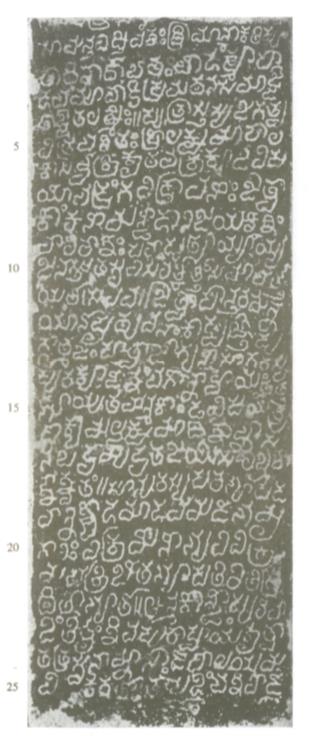
Estampage (ink impression)
This ink impression shows the first side of the Kakatiya pillar inscription at Kazipet, dated 24 November 1090. Epigraphia Telanganica titles it the Kazipet inscription of Duggaraja, the elder son of Beta II. The sources differ on whether Beta II or Duggaraja made the grant.
Epigraphia Telanganica, Vol. II (Dr MCR HRD Institute, Government of Telangana, 2023), plate 1, p. 378. Reproduced for non-commercial educational use, as the publisher permits. · Non-commercial use permitted by the publisher · This record in the database
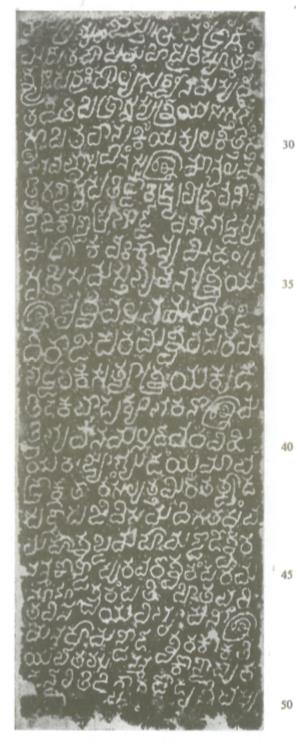
Estampage (ink impression)
This ink impression shows the second side of the Kakatiya pillar inscription at Kazipet. The inscription gives a village to the Kalamukha teacher Ramesvara Pandita of Sriparvata.
Epigraphia Telanganica, Vol. II (Dr MCR HRD Institute, Government of Telangana, 2023), plate 1, p. 378. Reproduced for non-commercial educational use, as the publisher permits. · Non-commercial use permitted by the publisher · This record in the database
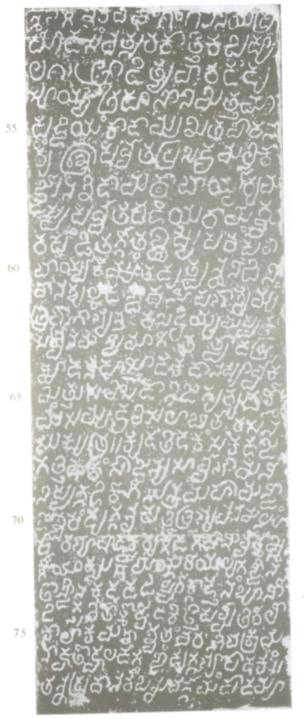
Estampage (ink impression)
This ink impression shows the third side of the Kakatiya pillar inscription at Kazipet, dated 1090.
Epigraphia Telanganica, Vol. II (Dr MCR HRD Institute, Government of Telangana, 2023), plate 1, p. 379. Reproduced for non-commercial educational use, as the publisher permits. · Non-commercial use permitted by the publisher · This record in the database
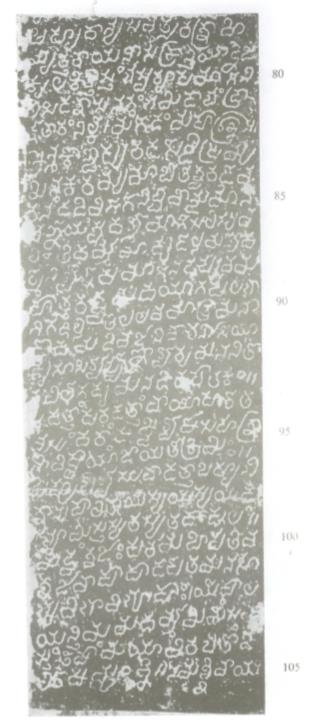
Estampage (ink impression)
This ink impression shows the fourth side of the Kakatiya pillar inscription at Kazipet. The date of the grant is a solar eclipse on 24 November 1090.
Epigraphia Telanganica, Vol. II (Dr MCR HRD Institute, Government of Telangana, 2023), plate 1, p. 379. Reproduced for non-commercial educational use, as the publisher permits. · Non-commercial use permitted by the publisher · This record in the database
Also recorded as
- Kazipet Dargah
- Kazipet Darga
- Qazipet Dargah
- Kajipet
- Afzal Shah Biyabani
- Afzal Biabani
- Hazrat Syed Shah Afzal Biabani
- Shah Afzal Biabani
- Kazipet Jaghir Urs