Inscriptions
553 Kakatiya-related records, 414 of them carrying a usable date, spanning 1010–1325 CE.
What this is. Records extracted from Epigraphia Telanganica (four volumes, MCR HRD Institute, Government of Telangana, 2023), with the editors’ English rendering of each text. The records of Volume II, on the Kakatiyas, come from the clean digital text of the published volume. The records of Volumes I, III and IV come from optical character recognition.
What this is not. The Telugu and Sanskrit text of the inscriptions is not included. Optical character recognition of the Telugu text failed. Only about 11,300 Telugu characters were recovered across the 1,432 pages of the four volumes. What appears here is therefore the editors’ translation and the catalogue details, not a new reading of the stone.
Counting. The corpus states 2,396 inscriptions in the four volumes. This site extracted 869 of these records, and 553 of them matched Kakatiya attribution after normalising ruler and place names. Many records were never extracted, and OCR misread the ruler of some others. Treat 553 as a floor, not a census.
How to read a Kakatiya inscription →
A guide to the script, the parts of a record and the dates, with original impressions and photographs.
Records by decade
The distribution is uneven. The eleventh-century vassal period is thinly represented. The decades from the 1240s to the 1260s are dense, and so is the period from 1290 to 1325 under Pratapa Rudra.
Records by ruler
- 251Ganapati Deva
- 80Pratapa Rudra
- 77Tribhuvanamalla (Western Chalukya)
- 39Rudra Deva
- 38Rudrama Devi
- 9Prola I
- 9Mahadeva
- 7Beta II
- 5Prola II
- 3Beta I
- 1Ambadeva (feudatory)
Tribhuvanamalla (Vikramaditya VI, who died in 1126) was the Western Chalukya ruler of Kalyani and the overlord of the early Kakatiyas. Beta II and Durgaraja took his title. His records appear here because they document the dynasty’s period as vassals.
How to read a record
Most records give the editors’ date in the Common Era, and this site uses that date. The site does not convert Saka years itself.
Source: Epigraphia Telanganica 2023
Place names have been merged across spelling variants, so Hanumakonda, Hanumkonda and Anumakonda are counted as one place. The variant originally printed is preserved in the underlying data.
Source: Epigraphia Telanganica 2023
Ruler names were mapped from 299 distinct OCR spellings onto standard ruler names. Rudrama Devi ruled under the name Rudradeva Maharaja, so her records are matched by date. Records of the Western Chalukya overlord Tribhuvanamalla are labelled as Western Chalukya.
Sources: Epigraphia Telanganica 2023 · Parabrahma Sastry 1978
Abstracts are the volume editors’ English renderings, sometimes abridged by the editors themselves. Where a summary is absent the record shows only its catalogue metadata.
Source: Epigraphia Telanganica 2023
The database
Each record carries its own source reference: the printed volume it was edited from, and its page numbers. Any single entry can therefore be traced back to the volume.
- Pallagutta1010 CE
This inscription is on the pillar in the Museum and dated as S, 933 Sadharana falls in S. 932 and not in 933, A.D. 1010. Mentions certain Maha Samantadhipati who bore epithets Sahaja Turaga Vidyadhara and Ranamukha Bhairava. It registers the gift of flower garden and 105 dwelling site, towards the perpetual lamp and daily offerings to the God (name lost). Bhimarasa mentioned in this record seems to be identical with samanta Kesari Bhimarasa. a feudatory of Satyasraya who held Banawasi from 1002 to 1006. No. 33
Andhra Pradesh Archaeology, A Review 1987-2001. (2002) · p. 132 and 133
- Sanigaram1051 CEBeta I
This inscription is on a stone set up near the Bhimeswara temple. The record states that mahasamantha Kakatiya Beta’s Pergade Vaijaraja’s son Naranayya renovated the Duddhamalla Jainalaya of Sanagara (village) and endowed it with a ratna after obtaining of the consent of the local gamundas named Muppadayya and Punniraddi. The Kakatiya Beta mentioned here is obviously Beta I.
Inscriptions of Karimnagar District (Reprint 2016) · p. 36 to 38
- Sanigaram, Karimnagar1051 CEBeta I
Sanigaram is a village situated at a distance of about fifteen kilometres from its district headquarters Karimnagar on the road to Hyderabad. Item V in the present group was copied about ten years back from a stone pillar set up near a small shrine of Siva in the village. In the course of the recent epigraphical survey conducted by the department four more epigraphs have been discovered in the skirts of the village. Though brief in content, they furnish valuable information regarding the chronology and political status of the early four Kakatiya chief Beta I, Prola I, Beta II and Prola II. They are being separately edited here. I Near the hillock outside the village where some Jain images are hewn in bold relief, a stone pillar containing this inscription is found by the side of a cart track. The record contains 43 lines of writing incised on three sides of the pillar. It is in a good state of preservation. The language is Kannada. The palaeography is common to the eleventh century A.D. and calls for no special remarks. The record begins with the usual Chalukya prasasti and refers to the prosperous reign of Satyasraya-kula-tilaka Chalukyabharana Srimat Trailokyamalladeva. [...]
Epigraphia Andhrica, Volume-IV, 1975. · p. 67 to 90
- Senigram, Karimnagar1051 CEBeta I
Of the five inscriptions, the earliest record dated in Saka 973 (A.D. 1051) is the only record of Beta I available so far. All these five inscriptions reveal certain facts regarding the history of the early members of the family. viz. Beta 1, Prola 1, Beta II and Prola II.
Indian Archaeology 1971-1972, A Review. · p. 52
- Sanigaram1053 CEProla I
This inscription is on a stone pillar in the field near the village. The record states that the king’s subordinate mahasamanta Kakatiya Polalarasar after informing the local gavundas, made a gift of twelve maneya of residential sites, a ratana, twenty mattars of black soil, twenty mattars of kesukadu and with the consent of Kateraddi and others of Bezavanka (village) gave one mattar of wetland to the god Mudhupisvara of Khandi Sanigara (village) installed by pergada Madhuvappayya. The Kakatiya Prola mentioned here is obviously Prola I.
Inscriptions of Karimnagar District (Reprint 2016) · p. 38 to 42
- Ankiraopalli, Kollapur Taluk1067 CETribhuvanamalla (Western Chalukya)
Inscriptions of Andhra Pradesh, Mahabubnagar District. · p. 139 to 142
- Hyderabad1077 CETribhuvanamalla (Western Chalukya)
This inscription is in the State Museum, dated C.V.E. I, Pingala, sravana Purnima, Sunday, (A.D. 1077, August, 6) Lunar eclipse. Records the grant of sovereign right to rule over the village of Temgola in favour of the god Kirti Somesvara by the king's subordinate Tribhuvanamalla vira-Nolamba-Pallava Permanadi who has been identified elsewhere as the King's younger brother Jayasimha. Mahamandalesvara Naga Varma of Kadamba family gave with his manneya Svamya over Tengole in Taidavodi-300 for the angabhoga of the god. No. 188
A Catalogue of Inscriptions copied upto 1964. · p. 126
- Kolanupaka, Bhuvanagiri Mandal1077 CETribhuvanamalla (Western Chalukya)
This inscription is on two lintels of the small Nandi mandapa in the Museum. One single inscriptional pillar has been vertically broken into two pieces for the purpose of two lintels of the mandapa. The inscription is very important in deciding the commencement of Tribhuvanamalla's reign. This date is some day in April A.D. 1077. The following number of Eruva Tondaya is dated in May A.D. 1077, and it does not mention the overlord. Its next number in 14, of Sankaragandarasa dated in August of the same year mentions Tribhuvanamalla as overlord. Surprisingly the present record belongs to [Asa]gamarasa, with the same titles as of No. 14, but dated earlier than that of Tondaya. How this Choda chief came in between the two records in Nos. 12 and 14 at the same place probably belonging to the chief of the same family within a gap of just three-four months is not known. This record registers some gift of some land to the god [A]sagesvara, installed after his name by the chief [Asa]garasar, who bears the titles, Lattalur puravareswara, Rattama[rtanda] etc. Tondarasa of the following record No. 13, is mentioned as only Eruva chief, but not as Kanduru puravaradhisvara or Kodurupurvaradhisvara as is common with the Telugu Chodas of this region. The order of the records is as follows: 192 1. Asagarasa No. 12 dated April 1077- overlord's name missing. 2. Eruva Tondaya No. 13 d
Inscriptions of Andhra Pradesh, Nalgonda District · p. 30 to 33
- Alampur1078 CETribhuvanamalla (Western Chalukya)
This inscription is on a stone slab lying in the Museum. Records the gift to Sri Brahmesvara swami by Kalkada puravaresvara Vaidumba chief Mallamaharaja, the ruler of Aiza 300, who was a feudatory chief of Tribhuvanamalla. The gift was given by Mallamaharaja, after washing the feet of Somesvara rasi Bhattaraka, the mahasthanadhipati of Brahmesvara temple, towards anga ranga bhogas, renovation and white washing of the temple of Brahmesvara deva. It also describes the donor as Siddhavata deva Padaravinda. Present Siddavatam in Cuddapah District. (Also)
Inscriptions of Andhra Pradesh, Mahabubnagar District. · p. 137 to 139
- Hanamkonda1079 CEBeta II
Records the gift of a nanda-diviya to Prolesvara in the temple of Betesvara by Beta.
Corpus of Inscriptions in the Telingana Districts of H.E.H. the Nizam’s Dominions, Part-II, 2017. · p. 25 and 185
- Hanumakonda, Warangal1079 CEBeta II
This inscription is on a huge boulder near Mala Pochamma Gudi in Komarapalli, hamlet of Hanumakonda, dated Saka 1001, Siddharthi, solar eclipse=1079 A.D., December 26. Records a gift of land for a perpetual lamp to the gods Prolesvara and Betesvara by Mahamandalesvara Betaraja who enjoyed the title Vikramachakrin.
Archaeological Survey of India, Annual Report on Indian Epigraphy 1958-1959 · p. 40
- Alampur1080 CETribhuvanamalla (Western Chalukya)
This inscription is on a stone in the Museum. Introduces the king's feudatory mahamadalesvara Malla maharaja of the Vaidumba family with titles. He is said to be the Lord of Kalkadapura governing the district of Aiza 300. It registers the gift of the village to 196 mahasthanadhipati Brahmarshi Bhattaraka for the daily rituals in the temple of Brahmesvara of Alampur. (Also)
Inscriptions of Andhra Pradesh, Mahabubnagar District. · p. 142 to 144
- Patancheru1080 CETribhuvanamalla (Western Chalukya)
The inscription seems to consist of 39 lines: it refers itself to the reign of Tribhuvanamalladeva and mentions his Brahmin subordinate who attained the rank of Brahmadhara evidently appears to be the same as “Kumara Tribhuvanamalla Brahamadiraja Udayadityavan’ of No. 20. (On the same stone) Refers to the reign of Ahavamalla evidently Somesvra-I and mentioned Mahamandalesvara Permanadi. It seems to refer to Mallana, the Mahapratihara. He is said to have made with the consent of all the Pradihanis on the said date, after washing the feet of Sarvapandita the gift of the same land: to Sri Bhogeswara deva of the Tenginomatha in the capital Pattalakere for the worship of the God for the repairs of the temple (for feeding ascetics) and for imparting education. This record is dated Chalukya Vikrama year S Randri Jyeslita Amavasya, Sunday (Sunday 21st June 1080 A.D.) (Another piece on the same stone) It refers to Brahmadhiraja Uderyaditya and his gift of Kuchemuru after washing the feet of Suryabharana pandita. Another piece mentions Pottalakere. No. 198
Corpus of Inscriptions in the Telangana Districts, · p. 32 to 35.
- Chandra, Nalgonda Taluk1081 CETribhuvanamalla (Western Chalukya)
The inscription begins with the genealogical account of the (later) Chalukya- chakreshwara Vikramadityadeva. His feudatory chief named Kamabhupa of [Dur]ijaya family is extolled to have fought several battles with the armies of Utkala, Kerala, Dravida and Magadha kings. Having obtained from the emperor, the samanta lordship of Kollipaka-7000 through a copper plate charter, Mahamandalesvara Kumara Kamarasar made the grant of the village Manugal with tribhogabhyantara-siddhi and sarvana-masya privileges to the god Mallesvaradeva of the village, on the holy occasion of the uttarayana-samkranti. The boundaries of the gift village are said to be Palleru to the east, Vemula to the south, Mogalipaka to the west and Netrakallu to the north. The gift is intended for the repairs and white washing of the temple, worship and offerings to the god Mallesvara and for the feeding of ascetics and students. Obviously the temple is attached with a feeding house and an educational institution. [Also see the record of Kolanupaka of the same chief dated on the same day. The recipient of the grant is named as Srikanthapandita in it.] No. 201
Inscriptions of Andhra Pradesh, Nalgonda District · p. 46 to 51
- Kolanupaka1082 CETribhuvanamalla (Western Chalukya)
This inscription is on a stone in the field of the Gollas. States that, while the Chalukya emperor Tribhuvanamalladeva was ruling the kingdom of the earth from the nelevidu of Kalyana, mahapradhana Maneverggada Dandanayaka Gundamayya who bears among others the titles of Chalukya-rama Rajya Lakshmi Latavarddhana and Saraswati-kucha kalasakalita- vyakta muktabharana, made at the command of Lakshmadevi, a gift of certain sumka, in Burugapalli, the bhatta-grama of Punniya Raddi, the Saudhara of Kollipakke-7000 in C.V.7 Dundubhi, Jyeshtha ba.5 Adivara. This date is irregular for Jyeshtha ba.5 corresponds to Thursday not Sunday. The date intended seems to be Thursday, 19th May, A.D. 1082. No. 203
Inscriptions of Andhra Pradesh, Nalgonda District · p. 21 to 25
- Chendur, Narasapur Taluk, Medak1082 CETribhuvanamalla (Western Chalukya)
This inscription is on a pillar lying in the Ramesvara Temple. Damaged. The inscription records the gift of land towards the daily rites of the god Svayambhu Ramesvara of Chenduru 201 by Bhimayya, the mahapradhana, maneverggade and dandanayaka, at the confluence of the river Jharasamga while his overlord Tribhuvanamalla was ruling from Pottalakere. No. 207
Inscriptions of Andhra Pradesh, Medak District (2001) · p. 126 to 128
- Banjipet1082 CEBeta II
This inscription is on a pillar lying in the east of the village. Registers the gift of some land by Mahamaṇḍalesvara Kakatiya Betarasa to Vira Kamala-Jinalaya built by Mahamandalesvara Medarasa of Ugravadi, a subordinate of the Western Chalukya king Tribhuvanamalladeva (Vikramaditya VI). The inscription is dated S. 1004 Dundubhi, Pushya Su. 3, Adivara (A.D. 1082; December, 25, Sunday). Medarasa is said to belong to Vengonta kula of the lineage of Madhavavarman who had 8,000 elephants, 10 crores of horses and countless foot-soldiers. The inscription is written by Ayyupayya and Sridhara.
Inscriptions of Warangal District. (2016) · p. 26 to 30.
- Lemulavada1083 CETribhuvanamalla (Western Chalukya)
A Catalogue of Inscriptions copied upto 1964. · p. 82 to 85.
- Kasala, Narasapur Taluk, Medak1084 CETribhuvanamalla (Western Chalukya)
This inscription is on a pillar outside the Siva temple near the tank. The inscription records the gift of the grama. Karakura, towards the daily rites of the god Svayambhu Siddhesvaradeva of Kasavala and also for feeding the mendicants by dandanayaka Ventamayya and others. The gift was handed over to Bhavadbhava Pandita at the instance of Rudrabhattopadhyaya, who in turn placed the gift in the custody of the Gavundas of Kasavala. (Also)
Inscriptions of Andhra Pradesh, Medak District (2001) · p. 131 to 134
- Alampur1085 CETribhuvanamalla (Western Chalukya)
This inscription is on a slab fixed in the outer wall of Bala Brahma temple. States that Certain Odaya, son of Preggada Mallinayya, Polalayya son of Bhivanayya and chavunda son of Mailaka sacrificed their lives at the feet of mahasthanadhipati Somarasibhattaraka. This also records some gifts of land in the presence of the Nakara of Brahmapuri in their memory. No. 216
Inscriptions of Andhra Pradesh, Mahabubnagar District. · p. 150 to 152
- Kolanupaka, Bhuvanagiri Taluk1087 CETribhuvanamalla (Western Chalukya)
This inscription is from the old collection of D.V. Ramanacahrlu. Fragmentary. The beginning and the grant portions are missing. It seems to refer to the reign of Chalukya Tribhuvanamalla ruling from Kalyana. His subordinate Mahamandalesvara Kandura Tondaya Chola maharaja of Kasyapa gotra, Karikalan Vaya and solar race and the lord of Kodurpura, ruling Kollipaka-7000 province seems to have made some gift for the amga-ramga bhoga of the god Somesvara. No. 220
Inscriptions of Andhra Pradesh, Nalgonda District · p. 52 to 53
- Puduru, Gadwal Taluk1087 CETribhuvanamalla (Western Chalukya)
This inscription is on a slab in the outskirts of the village. States that while Tribhuvanamalla Vikramaditya VI was ruling in happiness the kingdom of the earth from his Nelevidu at Kalyana, his subordinate mahamandalesvara Hallavarasar installed an image of Parsvanatha and granted the land which was kept in the hands of Jain preceptor Padmanandi Muladhara. No. 223
Inscriptions of Andhra Pradesh, Mahabubnagar District. · p. 153 to 155
- Kolanupaka1088 CETribhuvanamalla (Western Chalukya)
This inscription is on a stone in front of the Anjaneya temple. States that, while the Chalukya emperor, Tribhuvanamalla deva was ruling the kingdom of the earth from the Nelavidu of Kalyanapura, mahamandalesvara Kandura Tondarasamaharaja who was governing Kollipaka-7000, made a gift of a tala-vritti in Kondapi-12 to Ramesvara pandita for the anga-ranga-bhoga of the god Uttaresvara for the maintenance of students studying therein and a satra. Ramesvara pandita was a Kalamukha monk; he was a disciple of Kedara pandita, 210 the latter was a disciple of Devabhakta panditadeva; who was in turn a disciple of Ramesvara pandita. (Also)
Inscriptions of Andhra Pradesh, Nalgonda District · p. 25 to 30
- Senegavaram1089 CEProla I
The inscription is in Kannada language and script mentions and the Western Chalukyan king Tribhuvanamalla (Vikramaditya-VI), his subordinate Mahamandalesvara Kakatiya Polarasu a mistake for Beta-ll the lord of Anumakondapura, the latter's subordinate, Kuruvarasa, the Sarvopalika (Tax Collector) his subordinate Dandanayaka Mandaparasa of Kamma kula and Atreya gotra-The last mentioned having washed the feet of Chandrabharana pantita deva gave on the said date to Parthesvara deva for daily offerings, Nandadiva and for feeding the ascetics some marturs of wetland, the income from twelve marturs, oil mill etc., Mandaparsa is said to have been an ornament of the Gokarna line of kings. The record is dated, Saka 1012, Sukla, Chaitra Su. 15, Guruvara (Thursday, Vishu Sankranti Vyati pata, Somagrahana.) Sukla, Chaitra Su. 15 was Wednesday the 28th March 1089 A.D. but there was no eclipse on that day. There were two lunar eclipses in the cyclic year Sukla. On Monday the 25th of June (Ashadha Purnima or) Thursday 20th December, 1089 A.D. (Pausha Su. Purnima).
Corpus of Inscriptions in the Telangana Districts, Part-VI, 1973. · p. 11 to 14.
- Kazipet1090 CEBeta II
This inscription is in a stone pillar in Dargah. Dated S. 1012 Pramoda, Kartika ba. 15, Sunday, Solar eclipse (A.D. 1090, Nov. 24). Records the grant of a certain village as sarvamanya by king Dugga-Tribhuvana Malla son of Betarasa to the Kalamukha monk Ramesvara Pandita of Parvatavali the head of the famous Mallikarjuna silamatha of Sri Parvata. It also records the grant of one mana of oil everyday for nandadivige by the nakram of Anumakonda to the god Umamahesvara.
A Catalogue of Inscriptions copied upto 1964. · p. 108 and 109.
- Pangallu, Nalgonda Taluk1091 CETribhuvanamalla (Western Chalukya)
This inscription refers to the prosperous reign of the Chalukya_ king Tribhuvanamalladeva. His subordinate, Mahamandalesvara Srimat Tomdaya Choda Maharaja of Suryavamsha (Kasyapa] gotra and Karikalanvaya and his queen [Ya]kamabbe Mahadevi, are stated to have made the gift of some lands in Panagallu to Ayajja Prolamayya who had carried the asthis (=ashes) of his (Tondaya's) father Kanduri Bhima Choda-Maharaja for immersing them in the river Ganga by paruvu (walking all the way) and performing the pimda ceremony at Gaya for the deceased. No. 231
Inscriptions of Andhra Pradesh, Nalgonda District · p. 56 to 57
- Gangapuram1091 CETribhuvanamalla (Western Chalukya)
This inscription is on a slab built into the south-wall (outside) of the shrine of the Chennakeshwara temple. States that the royal preceptor Sakalaprakasa-bhattaraka made a gift of one matter of land in Devarakortur as jyotirvrilli of Trailokyamalla-Keavapura to Aditya- bhattopadhyaya and Viddana-bhatta for the prosperity of the king. No. 235
Archaeological survey of India, Annual Report on · p. 165 to 166
- Kandurg, Shadnagar Taluk1093 CETribhuvanamalla (Western Chalukya)
Inscriptions of Andhra Pradesh, Mahabubnagar District. · p. 161
- Alampur1094 CETribhuvanamalla (Western Chalukya)
This inscription is on a slab lying in the Museum. Records the grant of the village Pulinuru situated in Kanne-300 on the bank of river Tungabhadra, as Tribhogabhyantara siddhi towards anga bhoga, Panchopachara puja‘s, white washing and renovation of the temple of Brahmesvara in Alampur, by a chief (name lost) after washing the feet of Brahmarasi pandita. 220 No. 243
Inscriptions of Andhra Pradesh, Mahabubnagar District. · p. 168 to 169
- Alampur1097 CETribhuvanamalla (Western Chalukya)
Volume-I (2003)
Inscriptions of Andhra Pradesh, Mahabubnagar District. · p. ౨7.
- Gangapuram1097 CETribhuvanamalla (Western Chalukya)
A Catalogue of Inscriptions copied upto 1964. · p. 29.
- Vollala, Suryapet Taluk1097 CETribhuvanamalla (Western Chalukya)
This inscription is on a stone at the local tank bund near the Siva temple. A 225 Damaged. The first side-describes the genealogy of the Kanduru Chola family, beginning with Karikala of the Solar race. Karikala is said to have built the embankments of the river Kaveri and the Dravida-panchaka nadi (?) matrika (irrigated by the rivers). Then there is a mention of Oraiyur, the ancient capital. Then, Choda Bhima, the lord of Panugallu, Tondabhupala, another Bhima who is said to have pleased the emperor by his prowess, and Choda Malla who gave an agrahara to the brahmanas are mentioned. Then there is a reference to a Vijayaditya Deva, who probably granted some land as devabhoga. B On another side of the inscription, it is stated that in C.V.22 Isvara, Jyeshtha su.7, Adityavara (S. 1019, Wednesday no: Sunday, 20th May A.D. 1097) while the Chalukya emperor Tribhuvanamalladeva was ruling, his subordinate Mahamandalesvara Mallikarjuna Choda Maharajulu granted a revadachenu 30 puttis in extent and other fields measured with Sanivarasiddhi-kola in Yendi palli abutting the boundary of Vollala included in the Amanakanti-kampana for havir-ball and archana of the god Kesavadeva installed by Golapati (Kulapati) Appanapeggada of Vollala, an agrahara in the middle of Amanagallu-70. C Another inscription in continuation of the above, records the gift of 50 sheep by Kolapati Appana
Inscriptions of Andhra Pradesh, Nalgonda District · p. 35 to 42.
- Wajidnagar, Bichkunda Mandal1098 CETribhuvanamalla (Western Chalukya)
This inscription is on a pillar near the tankbund. The inscription records the gift of 10 marttars of land for the worship and daily rites as well as repairs of the temple of Somanatha by mahamandalesvara Kalicorarasar, lord of Amaravati Pura, after washing the feet of Rudrasakti Pandita, on the occasion of Uttarayana Sankranti. It also mentions the names of officers viz., Prabhu dandanayaka Simgarasa, Heggade Nagadeva nayaka of the lord (Prabhu) Mallarasa. 227 No. 259
Inscriptions of Telangana Nizamabad District · p. 49 to 53
- Pamulapadu, Nalgonda Taluk1098 CETribhuvanamalla (Western Chalukya)
This inscription is from the old collection of D.V. Ramanacahrlu. Although it does not refer to the Chalukya overlord Tribhuvanamalla, the record is dated in the Chalukya Vikrama year 22, corresponding to A.D. 1098. It records the gift of land (with the showing capacity) of seven puttis of Adlu (grain) to certain Uppari Mallaya, in the field of Amanikallu, the prime badamu (town?) in the division of 70 (villages) by the Kanduri Choda chief Mallikarjuna Choda. The purpose for which the said gift was made is not mentioned. This record and the Ollala inscription of the same Kanduri Choda chief Mallikarjunadeva Choda Maharaja are dated in the same year. These are the only two records of this chief so far known (See Epigraphia Andhrica Vol. IV). No. 262
Inscriptions of Andhra Pradesh, Nalgonda District · p. 62 to 63
- Mittapalli, Saidapet Taluk, Medak1098 CEBeta II
The inscription registers the gift of gadde land measuring two marttars and karamba land measuring 40 marttars, along with ratana and gana [oil mill] after making it free from all encumbrances to the god Somesvara in the agrahara village Mittapalli, towards the daily rites as well as repairs to the temple by Erapareddi, after washing the feet of Tarkavalapandita who was in the service of the temple. The village lies in Pulganuru-70. The said donor was in the service of Kakatiya Tribhuvana Malla Raja i.e., Beta II ruler of Anmakundapura.
Inscriptions of Andhra Pradesh, Medak District (2001) · p. 142 to 145
- Polepalli1100 CETribhuvanamalla (Western Chalukya)
This inscription is on a stone in the middle of the tank. It records the grant of 2 gadde marttars of land by a certain Danndanayaka Rudramayya to the God Rudresvara when he set up Rudratirtha. 230 No. 266
Inscriptions of Andhra Pradesh, Mahabubnagar District. · p. 176
- Malapahad, Sangareddy Taluk, Medak1101 CETribhuvanamalla (Western Chalukya)
This inscription is on a pillar in the Hanuman temple. The inscription introduces a certain Somesvarabhatta of the family who bears a string of birudas which include Pati karyyadurandhara, niyogayaugandhara, Tribhuvanamalladevarajya samuddharana and Karnnata herilala Samdhivigrahi. The donor, who was a minister, registered the gift of land measuring 12 marttars in the village Sirigoppa, his Prabhusvamya to the god Somesvara, towards the daily rites of the god as well as repairs to the temple. The said gift was handed over to Pabbesvarapandita after washing his feet, at the confluence of the two rivers viz., Jara and Gundi. At the end, the two Kannada verses praise the donor as a military general. (Also)
Inscriptions of Andhra Pradesh, Medak District (2001) · p. 149 to 151
- Alampur1101 CETribhuvanamalla (Western Chalukya)
This inscription is in the Museum. Registers the gift of a village as agrahara by queen Mannadevi for the repairs and white washing of Brahmesvara temple and to perform ranga bhogas of the God. Incidentally the record mentions the titles of Tribhuvanamalla such as Asvapala, Narapati, Gajapati and Rajatrayadhipati and describes him as Pamadacharya padaradhaka. Grant portion lost. No. 272
Inscriptions of Andhra Pradesh, Mahabubnagar District. · p. 186 to 187
- K.B. Museum (from Chilkur.)1103 CETribhuvanamalla (Western Chalukya)
Volume-I (2003)
Inscriptions of Andhra Pradesh, Mahabubnagar District. · p. 28 to 31.
- Kolanupaka1104 CETribhuvanamalla (Western Chalukya)
This lengthy inscription in Sanskrit verse describes the Paramara rulers of Malava whose primaeval ancestor was born in the sacrificial fire of the sage Vasistha near the Arbuda mountain. A later king of this family was Udayaditya whose son was Jagaddeva. This prince endeared himself to the great Chalukya emperor Tribhuvanamalla Vikramaditya VI who treated him as his own son. While Jagaddeva was governing the province a Mahamandalesvara, the king's general Somala Dandanayaka holding the designations, Great Minister and High officer in charge of Peace and war, constructed the temple of Jagaddeva Narayana in his capital Kollipaka for the prosperity of the kingdom. The epigraph is dated the Chalukya Vikrama year 29, Tarana, Chaitra purnima, Sunday, lunar eclipse. This date regularly corresponds to A.D. 1104, March 13. On this day Jagaddeva granted with the king’s approval the village Piriya Pembariti for worship and offerings, etc. in the above temple. (Also)
Andhra Pradesh Government Archaeological Series · p. 74 to 78.
- Kolanupaka1104 CETribhuvanamalla (Western Chalukya)
This inscription is in the Vira Narayanaswami temple. States that, Somala Dandanatha, son Sadiga and grandson of Siha Vatanvaya Mahishapura in Pariyatra country, a mahasandhivigrahi and Prachanda dandanayaka in service of Paramara prince Jagaddeva of 236 Dhara, built a temple for the god Jagaddeva Narayana Kollipake, the headquarters of master, who governing the district as subordinate of the Chalukya emperor Tribhuvanamalladeva. Jagaddeva, by the command of the Chalukyan emperor made a gift of village of Pembariti, situated in the middle of the 12 villages attached to town, excluding the two shares which had been assigned to the Appesvara pura-dramma-Vichiti bhattabhaga to God repairs, white washing of temple, anga bhogas of the God and for teaching the Vedas, Svadhyaya and feeding ascetics. He also gave 5, 4 and Uttama Ganda chinnas for each one of villages in centre Kollipaka-7000, in order uttama(best), madhyama (middle) and adhama (lowest). Having declared them as Devabhoga............. he also gave three string flowers to every garland maker's house in town and piece garden land Nidingoluru for flowers, leaves, fruits and creepers. The inscription begins with the description of the Arbuda mountain and the hermitages of sages situated thereon; mentions the hermitage of Vasishtha and the sacrificial pit out which sprang up warrior named Paramara. In his linea
Inscriptions of Andhra Pradesh, Nalgonda District · p. 42 to 48
- Kolanupaka, Nalgonda1104 CETribhuvanamalla (Western Chalukya)
Two Sanskrit epigraphis, one in Nagari and the other in Kannada, the former on wall of the mandapa and the latter on the wall of the shrine of the Vira-Narayana temple, both dated in the Chalukya-Vikrama year 29 (A.D.1104), record endowments of lands and money by the Paramara prince kumara mahamandalesvara Jagaddeva, a feudatory of Tribhuvanamalla, to the god Jagaddeva-Naravana. The money endowment consisted of collections from the villages included in Kollipake-7000. Division at the rates of five, four and three gold coins (called uttama-ganda-chihnas) respectively from the villages classified as uttama madhyama and adhama. The epigraphs vividly describe the Arbuda mountain and trace Jagaddeva's ancestry from Harsha. No. 278
Indian Archaeology 1961-1962, A Review. · p. 80
- Kolanupaka1104 CETribhuvanamalla (Western Chalukya)
238 Three Inscriptions of Paramara Jagaddeva from Kolanupaka (3 Plates) by P.R. Srinivasan and V.S. Subrahmanyam, Mysore. The three inscriptions edited in the following pages are from Kolanupaka, Bhuvanagiri Taluk, Nalgonda District. This place is well-known for its old temples and antiquities which testify to its former glory and importance. It has yielded many more inscriptions. The records under study are for the sake of convenience, called A. B and C. Of these A has been published in Andhra Pradesh Government Archaeological Series, No. 3 (Kannada Inscriptions of Andhra Pradesh). No 45, pp. 57 ff., while B and C are published for the first time here. Several verses of A are repeated in C. All the three belong to the period of a single chief only. While A and B are dated in the same year and are almost identical in their contents couched in different texts, C is dated two years later than the former two and its grant portion is different. The characters of inscriptions A and C are Kannada and those of B in Nagari and they are regular for the period. The language of these records is Sanskrit, but for a few place-names. The inscription A is on a slab built into the wall of the main shrine of the Viranarayanasvamin temple at Kolanupaka. It has 36 lines of writing which is well preserved. The record B is engraved on a slab built into the inner side of the wall of t
Epigraphia Indica, Volume-XXXIX, Part-VII (January 1973) · p. 253 to 272.
- Kolanupaka, Bhuvanagiri Taluk1104 CETribhuvanamalla (Western Chalukya)
Andhra Pradesh Government Archaeological Series · p. 25
- Nidikonda1104 CETribhuvanamalla (Western Chalukya)
Dated C.V.E. 29, Tarana, Uttarayana Samkranti, (A.D. 1104, Dec. 24). Introduced king feudatory Mandalika Duggarasa lord of Natavadi region and records his gift of land to the temple Muppesvara constructed by his wife. No. 280
A Catalogue of Inscriptions copied upto 1964. · p. 96.
- Kolanupaka, Bhuvanagiri Taluk1105 CETribhuvanamalla (Western Chalukya)
Inscriptions of Andhra Pradesh, Nalgonda District · p. 69 to 73
- Alampur1106 CETribhuvanamalla (Western Chalukya)
This inscription is on a slab set up in front of Bala Brahma temple. Records the gift of Pedakallu-800 by mahamandalesvara Ghatiyanka Kara Cholamaharaja, for anga and ranga bhoga, repairs, renovation and white washing, the daily rituals of God Brahmesvaradeva as sarvanamasya after washing the feet of mahasthanadhipati Dharanindra rasi pandita. No. 291
Inscriptions of Andhra Pradesh, Mahabubnagar District. · p. 195 to 197.
- Alampur1107 CETribhuvanamalla (Western Chalukya)
Stone Sculptures in the Alampur Museum (2017). · p. 78 to 80
- Alampur1107 CETribhuvanamalla (Western Chalukya)
Inscriptions of Andhra Pradesh, Mahabubnagar District. · p. 203 to 207.
- Kolanupaka1107 CETribhuvanamalla (Western Chalukya)
This inscription is on a stone in the temple of Somanatha. States that, while the Chalukya emperor Tribhuvanamalladeva was ruling the kingdom of the earth from the nelevidu of Kalyanapura, his subordinate the Mahapradhana, Maha Prachanda Dandanayaka and the Banasavarggade Anantapalayya made a gift of certain taxes in piriya Pembarti in Galavaholalu Hamneradu on the occasion of uttarayana samkranti for the anga-and -ranga-bhogas of the god Jagaddeva Narayana of the capital (rajadhani) Kollipaka. No. 297
Inscriptions of Andhra Pradesh, Nalgonda District · p. 51 to 52
- Alampur1107 CETribhuvanamalla (Western Chalukya)
A Catalogue of Inscriptions copied upto 1964. · p. 60 and 61
- Sanigaram1107 CE
This inscription is on a pillar in front of the old Shiva temple. It mentions the king's subordinate Mahamandalesvara Kakatiya Betarasar and states that the dandanayaka of Mahamandalesvara Jagaddevarasar named Kondamayya made a gift of a ratana and some lands for the worship and offerings of the god Svayambhu Bhimesvaradeva of Baliya Sanagara including in Pulgunuru-70. Kakatiya Beta mentioned here is Beta II and Jagaddeva is likely Paramara Jagaddeva.
Inscriptions of Karimnagar District (Reprint 2016) · p. 49 to 52
- Alampur1108 CETribhuvanamalla (Western Chalukya)
Inscriptions of Karimnagar District (Reprint 2016) · p. ౨7.
- Patancheru, Sangareddy Taluk, Medak1108 CETribhuvanamalla (Western Chalukya)
This inscription is on a pillar in the field of Krishnarao by the side of a stream. The inscription records the gift of land towards naivedya of the god Badesvara of Ramatirtha by mahamandalesvara Mahadevarasar, along with Karana pramukhas of Banavaya, with the concurrence of the prince Somesvara. No. 307
Inscriptions of Andhra Pradesh, Medak District (2001) · p. 152 to 154
- Hyderabad1109 CETribhuvanamalla (Western Chalukya)
Language ౯... This is an epigraph recording endowments to various deities at Gobburu by the mahajanas of Hiriya-Gobburu with the approval of dandanayaka Anantapalayya in the thirty- third regnal year (A.D. 1109) of Tribhuvanamalladeva (Vikramaditya VI): another inscription attributable to the reign of the same monarch and mentioning kumara Somesvara: another record bearing a date in the Chalukya-Vikrama era and registering the grant of some villages in the Gukkadamu-30 and Namikamti-70 divisions to Bhimanapeggade and his brother Doddaya-bhatta by mahaman-dalesvara Kanduri Gokarna-choda-maharaja. No. 311
Indian Archaeology 1960-1961, A Review. · p. 41
- Kolanupaka, Bhuvanagiri Taluk1110 CETribhuvanamalla (Western Chalukya)
The inscription refers to the prosperous reign of the king Chalukya Tribhuvanamalladeva, and introduces the prince Kumara Somesvara, who bears a string of titles and is stated to have made a gift of ten mattars of niru-nela (wetland) to the brahmana named Adityabhatta Somayaji, on the occasion of the lunar eclipse. Another gift of 12 mattars in Gomdura of Kollipaka-nadu and 12 mattars in Ittakayala village, included in Kollipaka- 1000 as paramesvaradatti Mahapradhana Sandhi vigrahi dandanayaka Kalimarasar executed the order. (Also)
Inscriptions of Andhra Pradesh, Nalgonda District · p. 87 to 91
- Alampur1110 CETribhuvanamalla (Western Chalukya)
This inscription is on a slab lying in the Museum. Damaged. This inscription states that by an order of the latter, mahamandalesvara Bikkarasa of Jimutavahana-kula, the lord of Tagarapura, having washed the feet of Dharan indra rasi pandita, the mahasthanadhipati of Brahmesvaradeva temple made some gift for the anga-bhoga to the god. The record was engraved by Sarvasi Bhatta. No. 315
Inscriptions of Andhra Pradesh, Mahabubnagar District. · p. 213 to 215.
- Kolanupaka1111 CETribhuvanamalla (Western Chalukya)
Volume-I (1992).
Inscriptions of Andhra Pradesh, Nalgonda District · p. 135.
- Nekkonda1112 CETribhuvanamalla (Western Chalukya)
Inscriptions of Andhra Pradesh, Mahabubnagar District. · p. 219 to 220.
- Alampur1112 CETribhuvanamalla (Western Chalukya)
No-3 Kannada Inscriptions-1961.
Andhra Pradesh Government Archaeological Series · p. 220 to 222.
- Alampur1114 CETribhuvanamalla (Western Chalukya)
This inscription is on a stone by the side of Brahmesvara temple. Registers a gift to perform bhogas of Brahmesvara deva and for renovation of the temple and white washing by the chief queen Mahadevi of Tribhuvanamalla Vikramaditya. She was praised as Dvitiya Lakshmi, Abhinava Sarasvati, Visalavakshasthala nivasi, Madhura vachana rachana nari, and a gem in Kas'yapa gotra. No. 329
Inscriptions of Andhra Pradesh, Mahabubnagar District. · p. 228 to 229
- Gangapuram1116 CETribhuvanamalla (Western Chalukya)
This inscription is on a slab lying in the ruined temple of Vinayaka temple outside the village, dated Chalukya-Vikrama 28 (wrong for 38), Durmukhi, Pushya ba. 8, Thursday, Uttrayana-samkramana=1116 A.D. December 28. The sumkaramasa occured on December 24. Incomplete. Registers a gift of income from commodities for the worship of god Sailesvara by the settikora, samaya-samuha and ubhaya-nanadesis. (Also)
Archaeological survey of India, Annual Report on · p. 229 to 231
- Hanumakonda1117 CEProla II
This inscription is on a slab fixed in the Museum. The inscription records the construction of the Kadalalaya basadi on the top of the hill by Mailama, the wife of Beta, the minister of Kakati Prola and the gift of two mattars of wet land below the bund of the tank built by her husband Betana-Pergade and two martars of the black soil on the west of the tank and six martars of uncultivated land for the daily worship, incense, lights and oblations in the temple and for the food, clothing etc., of the temple priest in the C.V. 42, Hevalambi, Paushya ba.15 Somavara, Uttarayana samkranti (Monday, 24th December, A.D. 1117). It starts with the prasasti of the Chalukya emperor Tribhuvanamalladēva, that is, Vikramaditya VI and introduces his subordinate Mahamandalesvara Kākati Betarasa, the lord of Anmakonda. His minister, the dandadhi-nayaka Valja, who is said to have induced his master to accompany him to the court of the Chalukya emperor and obtained as a favour from the latter Sabbi-nadu (one) thousand. To Valja-daṇḍadhinatha and his wife Yakamabbe was born Bēta the husband of the donor Mailama who became the minister of Kakati Prola. It also records a subsidiary gift by Mahamandalesvara Medarasa of Ugravadi, who was born in the family of Madhavavarman, of 1 mattar of wetland at the head of the canal Kuchikere (tank) of Orumgallu included within his fief, and 10 mattars of other land in the same place.
Inscriptions of Warangal District (Reprint 2016) · p. 55 to 60→ Site record
- Peruru1119 CETribhuvanamalla (Western Chalukya)
Records the gift of an income of one baga from every one henched heringas on all articles sold out in the market for maintenance of angabhoga to the god Svayambha Somesvara. The gift is said to have been as devabhoga by the people of different communities (specified). It further records that Kibbettaya Vaddlaravula-dandanayaka gave 12 gadyanas to the deity Svayambhu Somesvara of Perur. Vittapayya the Vaddaravula-dandanayaka, also donated the gadyana in exchange for 12 gadyana. No. 339
Archaeological survey of India, Annual Report on · p. 40 and 41
- Abbenda, Narayankhed Taluk, Medak1119 CETribhuvanamalla (Western Chalukya)
This inscription is on a pillar in the fields. The inscription extols the second queen of Vikramaditya viz., Ketaladevi and her qualities. It then registers the gift of land measuring 15 marttars by the mandalikas namely Kakkaraja and Revaraja to Gundabhatta of the grama Abbuda, on the occasion of Uttarayana Sankranti. No. 342
Inscriptions of Andhra Pradesh, Medak District (2001) · p. 163 to 166
- Gudipalli1120 CETribhuvanamalla (Western Chalukya)
This inscription is on a slab lying in the Siva temple. Records a grant of land (details not clear) towards the maintenance of nandadeepa, daily naivedya and anga ranga bhogas of the God Bhimesvara by a certain Kanduri Chola king (name not clear). No. 347
Inscriptions of Andhra Pradesh, Mahabubnagar District. · p. 236 to 238
- Matedu1120 CEProla II
This inscription is in front of Siva temple. States that while the Chalukya emperor Tribhuvanamalladeva was ruling the earth, Vemabola Boddama Mallenayaka, a soldier (bamțu) in the service of the emperor's feudatory Mahamandalesvara Kakatiya Prola Raju, the lord of Anumakondapura, built temples to the gods Isvara, Narayana and Aditya and granted vrittis to them in C.V. 45 (S.1042) Sarvari, Chaitra su.3, Vaddavara (Thursday, 3rd March, A.D. 1120). Mentions the sutradhāri Boloju, son of Malloju of Mānakondruru. The vrittis are described in detail; to Mahadevara, Adityadevara and to the ascetics who smear the floor of the houses with cow-dung 2 marturs in Mallasamudram; for nivedya (offerings) 1 martur to the gods (Mahadevara, Adityadevara) and the ascetics, velichenu (dry field) kha 1; to Narayaṇadevara martur 1; for offerings martu 1; velipolamu (dry field) kha 1; to Vinayaka martu 1; velipolamu (dry-field) kha 1; to Brahmapurulu (Brahmanas of the Brahmapuri, that is the quarter in which brahmanas attached to the temple reside) martu 4. Then follows an account of the family of Mallinayaka also called Malla, in Telugu verse. Vaṇipriya (i.e., the god Brahma) created the four castes, bhudeva (brahmana), kshatra (kshatriya), Vaisya and Sudra and then for the protection of these four, the progenitor of the Pulinda-vamsa. In this family was born Buchana surnamed Nadakotamalla, who became the ornament of the Vemabola family. He had four sons Rama, Appa, Reva and Nacha. [...]
Inscriptions of Warangal District (Reprint 2016) · p. 62 to 69
- Matedu1120 CEProla I
This inscription is on a stone in front of the Vishnu temple. States that Male Nayaka, son of mahasamanta Vemabola and Boddama and a soldier (bantu) of mahamandalesvara Kakatiya Prola Raju granted some land behind the tank Mallasamudra in Maratedu to god Mallesvaradeva set up by him and to Kesava-jiyya the sthanapati of the temple for offerings and worship to the deity. Also records the gift of land to Memje Bhattu, the sthanapati of the god Kesavadeva for offerings, worship nivēdya and lamps in the temple.
Inscriptions of Warangal District (Reprint 2016) · p. 69 to 71
- Nekhonda1121 CETribhuvanamalla (Western Chalukya)
This inscription refers to the reign of the Western Chalukya king Tribhuvanamalla Vikramaditya VI from Jayantipura. It is dated the Chalukya Vikrama year 46, Plava, Shravana amavasya, Sunday. This date regularly corresponds to A.D. 1121, August 14. In the course of the prasasti it recounts the achievements of Mahamandalesvara Kumara Tailapadeva, the king's son by Chandaladevi, and states that he was ruling the territory from his capital Kolur in the company of his queen Lakahmadevi and sons Permadideva and Bikkideva. It registers gift of the Village Budupura situated in Kandur-Seventy, included in the tract of Kanduur-Thousand for worship and offerings of the god Ramesvara of Nekkondi and for feeding the ascetics and servants of the religious establishment, by the prince. (Also)
Andhra Pradesh Government Archaeological Series · p. 12
- Choutkur, Andole Taluk, Medak1121 CETribhuvanamalla (Western Chalukya)
This inscription is on a pillar near the Nagulamba temple. Prasasti and contents seem to be different and thus belong to two different inscriptions. This mentions Gundadandadhisa who is said to have been ruling from Lattala [Lattalurpura] and narrates his exploits in the service of the king Vikramaditya. It refers to some gift made by him to Jnanesvara-Pandita [details lost] in the village Chilkuru, for the daily rites of the god Tribhuvanamalla Gundesvara, evidently named after the said general Gunda. (Also)
Inscriptions of Andhra Pradesh, Medak District (2001) · p. 169 to 171
- Singur, Medak1122 CETribhuvanamalla (Western Chalukya)
The inscription, dated in the Chalukya Vikrama year 47 (A.D 1122), belongs to the reign of Chalukya Tribhuvanamalla (Vikramaditya VI), who is stated to be ruling from the capital city of Jayantipura (modern Banavasi). It records the grant of lands at Chevutakuru, on the occasion of lunar eclipse, by dandanayaka Tejiranayyagalu, the brother-in-law (mayduna) of Mallarasa, mahasamanta of Permmadi Kumara Somesvara Deva, who was a Mahamandalesvara under the ruling king. No. 355
Indian Archaeology 1986-1987, A Review. · p. 104
- Bhuvanagiri1124 CETribhuvanamalla (Western Chalukya)
This inscription is in the ruined Siva temple. It consists of two parts. The first part registers the gift by Mahasamanta Potaya, of the land with sowing capacity of two puttis of vdlu in the field of Jakkavaya for the worship and offerings to the god Mallikarjuna Deva installed by Gundama Surya at Kumchamu kalu (some place). 288 The second part registers the gift of two rukas per month for the perpetual lamps to the same god by Bollamaraja, the vaddaravula-sunka-peggada of Kondapalli-nadu and certain Dudda Bhattu the peru-sumka-veggada, on the occasion of the lunar eclipse. The gift was obviously, out of the amount of the sunkas collected, because the future incumbents are also asked to honour the gift. No. 359
Inscriptions of Andhra Pradesh, Nalgonda District · p. 112 to 113
- Guduru1124 CETribhuvanamalla (Western Chalukya)
This inscription is inscribed on the four sides of a stone pillar set up in the village. A It is stated that while the Chalukys emperor Tribhuvanamalladava was ruling the earth from his nelevidu, at Jayanthipura, his son Chalukya Ganga Permmadi Kumara Somesvara Deva the governor of Kollipaka-7000, at the request of Savipayya his mahapradhana and mane-verggade and the dandanayaka, of the said province, made a gift of the village of Bammarige in the vicinity of Velpugonda-24 in C.V. 49 Krodhi, Pushya ba. 1, Budhavara (A.D. 1124, December 24) for the anga-range-bhogus of the Mallesvaradeva of Gumuduru. The inscription describes the achievements of Kumara Somesvara and the greatness of his maha-pradhana Savipayya who is also referred to as Swami dandanatha, Savideva, and Savidandadhipa. The former is said to have won victory over the Chola and the Ganga kings, and burnt in the fire of his anger the Kalinga-traya i.e., the three Kalingas. The latter is said to have been famous for his prowess, liberality and beauty. B The third side of the inscription in the Kannada verse introduces Sura of the Viriyala family ; his son was Betana, who married Bejjimambika. They had a son named Malla who bore the title Kataka Munniruva. He built a temple to god Siva called Malleswara, excavated a tank and dug wells at Gumuduru. C The fourth side in the Telugu verse mentions a mandalika named Poranti
Inscriptions of Warangal District (Reprint 2016) · p. 76 to 82
- Kolanupaka1125 CETribhuvanamalla (Western Chalukya)
This inscription is on the four sides of the pillar on the Ubagadda in the tank. States that, Mahamandalesvara, Chalukya Ganga-Permadi, Kumara Somesvaradeva, at the request of Sayimayya, his Mahapradhana, Maneverggade and the Dandanatha of Kollipake-7000 granted as sarvamanya, and free from all impediments (badha) the village of Panupurayi for the anga and ranga-bhogas of Ambaratilakada Ambikadevi, known as Chalukya-kulatilaka (crest jewel of the Chalukya family). Kesiraja, the Perggade (minister) of the goddess is the executor of this charity. The deva- bhoga-svamya belonging to the Akkabasadi is excluded from this gift. It praises the liberality, prowess, and the other excellencies of Savi-dandanadhipa. He is said to be the uplifter of the four samayas (Chatus-samaya) and a bee at the lotus feet of Hari (Vishnu) Hara (Siva), Jina (Mahavira) and Buddha. It is stated that, king Somesvara, son of the emperor, pursued after the battle, the king of Trikalinga, plundered his country, and captured his elephants and set up a pillar of victory. Next follow the prasasti of Kumara Somesvara and the praise of his greatness. He is said to have destroyed the elephants, horse, foot and the weapons of the king of Dravila. Then comes once again the praise of Somesvara's commander Swami Dandadhipa. Then the inscription introduces Chandramaladhari of the Kanurgana. His disciple was Padma Nandis
Inscriptions of Andhra Pradesh, Nalgonda District · p. 63 to 70
- Kolanupaka1125 CETribhuvanamalla (Western Chalukya)
This inscription is on a big stone pillar in the tank (on Jaya Stambha). Dated C.V.E. 50, Visvavasu, Chaitra ba. 3, Monday. (A.D. 1125, March 24). This is engraved on a pillar on its four sides which is described at one place as Manastambha according to Jaina terminology, kirtistambha of the general Swamideva and Jaya Stambha of Prince Somesvara. It registers the gift of the village Panupura to the Goddess Ambika of the locality Ambaratilaka by Mahamandalesvara Kumara Somesvara at the request of Savimayya, the army commander of Kollipaka-seven thousand. The second side contains the eulogy of Svamideva and mentions in the end that Somesvara erected this victory pillar after his victory over the lord of Trikalinga; after plundering his kingdom and capture of his elephants and inflicting a defeat over a Kumara whose identity is not disclosed. Svamideva Dandadhipa is said to have been a bee at the lotus feet of Hari, Hara, Jina and Buddha and was known as the uplifter of the four samayas 1.e. of the above four seats. The third side repeats the Prasasti of Kumara Somesvara. Only interesting fact mentioned is his victory over the king of Dravila. He is said to have been the destroyer of the forest namely the horses, elephants and cavalry and the foot of the Dravida king. The fourth side contains an account of the preceptors of Kanurgana. It states that the Manastambha was caused to b
A Catalogue of Inscriptions copied upto 1964. · p. 58 and 60
- Kolanupaka1125 CETribhuvanamalla (Western Chalukya)
This is a unique record. It is engraved on the four faces of a pillar which is described in one place as Manastambha (pillar of eminence) according to Jina terminology, Kirti Stambha (pillar of fame) of the general Svamideva in another Jaya Stambha (pillar of victory) of prince Somesvara elsewhere. It is likely that originally it was set up as a Jaina monument and subsequently, though not much removed from point of time, it was utilised for commemorating the outstanding achievements of the two renowned dignitaries. The entire record appears to belong to the reign of the Western Chalukya king Tribhuvanamalla Vikramaditya VI. It extols prince Somesvara who shortly after becomes the Chalukya sovereign known as Bhulokamalla Somesvara III. A mighty general of Somesvara was Svamideva or Sayimayya Dandanayaka. The inscription on the first face commences by stating that the pillar was the pillar of fame of Svamideva set up in the site called Ambaratilaka. It is dated the Chalukya-Vikrama year 50, Visvavasu, Chaitra ba. 3, Monday, Uttarayana-Sankranti. The Sankranti was Mesha and not Uttarayana. Except for the Week-day which was Tuesday, the other details of the date correspond to A.D. 1125, March 24. It registers gift of the village Panupura to the goddess Ambika of the locality Ambaratilaka, situated in his capital Kollipake by Mahamandalesvara Chalukya Ganga- permadi Kumara Somesvara
Andhra Pradesh Government Archaeological Series · p. 16 and 17
- Sanigaram1128 CEProla I
This inscription is on a stone unearthed in a field near the hillrock. The record states that the king's subordinate Mahamandalesvara Kakatiya Polalarasa’s officer Savadora of Sabbi-sahasra (region) named Repola Kuruvaraju made a gift of one ratana called Brahmanapariya, one oil-mill and some lands for the worship and offerings to the god Kommesvaradeva of Khamdi Sanagara and for feeding the ascetics. The gift was made over to Lokabharana-pandita after washing his feet.
Inscriptions of Karimnagar District (Reprint 2016) · p. 55 to 58
- Etikala, Medak1139 CE
Dated in Saka 1061 (A.D. 1139), it registers some grant for the maintenance of perpetual lamp in the temple of Visvanatha Deva by the members of the Nakharamu from Ittikala, during the time of certain chiefs Gundraju and Hariharadeva belonging to the Kakatiya family ruling from Hanumkonda.
Indian Archaeology 1975-1976, A Review. · p. 61
- Itikala, Gazvel Taluk, Medak1148 CE
This inscription is on a pillar near Siva temple outside the village. The inscription is one of the early inscriptions of the Kakatiya dynasty. The inscription registers the gift of income accrued out of the sale proceeds of items by the Nakhara of Ittukala, towards the daily rites of the god Somanatha on the occasion of Solar eclipse. Details of the gift are enumerated.
Inscriptions of Andhra Pradesh, Medak District (2001) · p. 223 to 225
- Itikala, Gazvel Taluk, Medak1148 CE
This inscription is on a pillar lying near the hillrock in the village. The inscription states that Gumdaraju-Hariharadevaraju of the Kaketiyya family, gifted tax according to tumun-ayamu, for every basket carried on head and sold by all the members of the guild nakharamu of the village Ittukala for maintaining akhanda-dipa in the temple of Somanathadeva. It is further stipulated that irrespective of the number of persons, who sell articles by carrying them in baskets in a house, one tumu and one adda of oil per basket per year should be given to the temple. Note: Summary is given in Inscriptions of the Kakatiyas of Warangal (2011) Editor S.S. Ramachendra Murthy, ICHR Publication, Page no-27 to29.
Journal of Epigraphical Society of India, Volume-IV · p. 56 to 57
- Sanigaram1149 CEProla I
This inscription is on a stone pillar set up near the Shiva temple in the village. The king's subordinate Mahamandalesvara Kakatiya Polalarasar of Anmakondapura is introduced His officer mahasamanta Repola Kuruvarasar's dandanayaka (commander) Mamdaparasar of Atreya gotra is said to have made the gift of a ratana, some lands and an oil mill for the offerings and a perpetual lamp to the god Parthesvaradeva (at Shanigaram) and for feeding and clothing of the ascetics.
Inscriptions of Karimnagar District (Reprint 2016) · p. 60 to 64
- Draksharamam, Ramachandrapuram Taluk, East1160 CERudra Deva
This inscription is on the wall between the fifth and sixth pillars of the Bhimeswara temple at Draksharamam. This inscription is damaged, states that Dannamadevi, the queen of Kakati Rudradevaraja, set up a perpetual lamp (Akanda vatti) with metal stand to the god Bhimeswara and also gifted 50…..dlu (probably cows) for the supply of one Tribhuvana[nkusa]-mana of ghee. The writer of the inscription was Peddanacarya. Note: Summary of the inscription is given in “Inscriptions of Kakatiyas of Warangal” Edited by S.S. Ramachandra Murthy, ICHR Publications, 2011.
South Indian Inscriptions, Volume-IV. · p. 366
- Hanumakonda1163 CERudra Deva
In the temple at Anumkonda, in the Nizam's Dominions, there is a long and highly interesting inscription of Rudradeva of the Kakatya or Kakatiya dynasty. Versions of it have been published in the Journal of Bengal Asiatic Society, Vol. VII., p.901, where the date was interpreted as Saka 1054,-- and in the Journal of Bombay branch of the Royal Asiatic Society, Vol. X., p. 46, by Dr. Bhau Daji, who interpreted the date as Saka 1064. And Mr. Rice,-recognising from these discrepant readings of the date, and from the fact that the samvatsara, the name of which is recorded as Chitrabhanu, does not agree with the above dates by respectively thirty and twenty years, that there was some mistake about the date,- has stamped the inscription as belonging unmistakably to the ninth century A.D., and as recording the fate of Taila-I and Bhima-II of the western Chalukya dynasty. Through the kindness of the Political Authorities at Haidarabad. Now it has been furnished with an excellent ink-impression of this important inscription, and shall shortly publish it in full in this journal. Meanwhile it may be useful to state that the real date of this inscription is Saka 1084 (A.D. 1162-63), the Chitrabhanu samvatsara, and that, therefore, it records the downfall of Taila III, the last but one of the Western Chalukya of Kalyanapura, and not his ancestor Taila-I.
The Indian Antiquary, Volume-X 1881. · p. 211 to 212→ Site record
- Rapati1166 CERudra Deva
This inscription is on the stone pillar in the compound of Kasana-boyani Rajamallu’s house, dated Saka Parthiva, Magha ba. 11 [Saturday]=A.D.1166, January 29. Damaged. Records a gift of land and money probably for the merit of the king. Mentions the names of a number of settis.
Archaeological survey of India, Annual Report on Indian Epigraphy for 1958-59. · p. 41
- Karimnagar1171 CERudra Deva
This inscription is on a pillar in the talukdar’s house. Dated S. 1092, Vikrti, Magha su. 5, Wednesday (A.D. 1171, Jan. 13). Records the gifts and establishment of gods at various places by Gangadhara the minister of Kakati Rudra. The genealogy of the donor is given as follows: Atreya gotra Kommanarya Narayana m. Aytamambika Govinda m. Turukamamba Gangadhara
A Catalogue of Inscriptions copied upto 1964. · p. 112 and 113
- Akunuru1172 CERudra Deva
This inscription is on a stone before the Shiva temple in the fields. States that Mahamandalesvara Kakatiya Rudradeva Maharaja, the Lord of Anumakondapura visited Akunuru in S. 1095 Nandana, Vaisakha Su.5, Guru (Friday 31st March, A.D. 1172) and granted ayas (incomes) on ratnas to certain communities and articles for anga and ranga-bhogas to the God Rudresvara of the temple built in his name by the ekkatis (soldiers) of the village. The king is also said to have granted vrittis to the gods and brahmans on the occasion of the visit and exempted the people from the payment of sunkams and certain quantity of grain grown in the village.
Inscriptions of Warangal District (Reprint 2016) · p. 101 to 104
- Bekkallu, Cheriyal Taluk, Warangal1176 CERudra Deva
This inscription is on a stone pillar lying in the compound of Siva temple near hillrock, dated saka 1097= 1174 A.D. January 17. States that Ekkamati Malli-reddi caused the construction of a temple and installed the images of Mallikarjuna and other deities and granted lands for the worship in the temple, feeding of ascetics and for the purpose of repairs in the temple. It also registered grants of some more lands for the purpose of a perpetual lamp in the temple and to Gundaja (probably the sculptor).
Archaeological Survey of India Annual Reports on Indian Epigraphy 1983-84 · p. 29
- Mydaram1176 CERudra Deva
This inscription is on a broken stone lying near Chinnakondalrao’s house. The first side records a gift of land to the god Kesavadeva and mentions the name Bamdi Brammenayaka. The second side gives the above date and mentions the temple of Trikuta installed by Medaraja. The third side mentions the name of Mahamandalesvara Kaketa Rudradeva. The fourth side records some gifts to Prolesvaradeva. The contents of all the four sides have no connection with each other.
Inscriptions of Karimnagar District (Reprint 2016) · p. 71 to 73
- Tungapadu1180 CERudra Deva
This inscription is on a stone pillar in the field outside the village. States that, Mahamandalesvara Kakatiya Rudradeva Maharaja, the Lord of Anumakondapura made the gift of the village of Ambali palli, pravishta etc. for the anga-ranga bhogas of the God Mahadeva of Elesvaram, the north-eastern gate of Srisailam. Saka 1102, Sarvari, Ashadha is an intercalary month, Adhika Ashadha su. 15 falls on Monday, while Nija Ashadha su.15 falls on Tuesday; but not on Guruvara as stated in the inscription. If the former is the intended day, it corresponds to Monday 9th June A.D. 1180 and if the latter, to Tuesday, 8th July A.D. 1180.
Inscriptions of Andhra Pradesh, Nalgonda District Volume-II (1994) · p. 86 to 89
- Moripirala1181 CE
This inscription in Telugu prose, is inscribed on a slab lying by the roadside in this village situated at a distance of 18 miles from Warangal on the road to Khammamet. The date of the inscription is Saka 1103, in the year Year, Magha sa. 12 Monday, Mesa lagna and Punarvasu nakshatra. Records the construction of Prolesvara temple, digging of well and granting of vritis and mango garden to the deity by Proli-reddi. Proli-reddi also gave vrttis for merit to his son Devi-reddi Betaya who was a servant of Viryala people. The Karnam appointed by Proli-reddi for Viryala house, by name Malapa-raju, set up this inscription. The genealogy of Proli-reddi is given: It starts with Koti-reddi, the pet servant of Somanatha of Kolipaka (Kulpak) and his wife Vallusani who had a son Bali-reddi. The latter had 5 sons through his wife Bollasani and their names are (1) Bhimireddi (2) Kotireddi (3) Bacireddi (4) Proli-reddi and (5) Malli-reddi, Proli-reddi, the donor of the present record had a wife Macamambika.
A Corpus of Inscriptions in the Telangana Districts of Andhra Pradesh. Part III, 1956. · p. 147 to 150
- Warangal1183 CERudra Deva
This inscription is on a broken slab lying in the fort area, dated saka 1105,….dvadasi, Thursday. Fragmentary. Seems to record the grant of the village [Pa]sumadapalli to god Siva by the king.
Archaeological Survey of India Annual Reports on Indian Epigraphy 1957-58 · p. 25→ Site record
- Tripurantakam1185 CERudra Deva
This inscription is on a slab lying in the room of a small mandapa in front of the Ramadeva Shrine in prakara of the Tripurantakesvara temple near Tripurantakam, dated Saka 1107, Visvavasu. Gift of a village on the bank of the river Krishnaverna in the (district of) Kondapalli-nandu for the merit of [Tripu]rantaka deva at Kumaragiri, which was the head jewel of Sri Parvata.
Archaeological Survey of India Annual Reports on Indian Epigraphy 1905-06 · p. 17
- Draksharama, Ramachandrapuram Taluk, East1186 CERudra Deva
This inscription is on a north wall between the fourth and fifth pillars of the Bhimeswara temple. This inscription is dated Saka 1108, Kartika Paurnami, Monday. This record states that the ruler of Anumakonda Mahamandaleshwara Kakatiya Rudradeva maharaja gifted a Perpetual lamp and a metal stand (loha-dandu) to the lord Bhimeswara. Rudra also gifted 50 inupa-yedlu. The gift was entrusted to the boyas of the temple cow-pen (kilaramu) with the stipulation that one Tribhuvanankusa-mana of ghee should be supplied every day for the maintenance of the lamp. It is also stated that four boyas stood surety. The writer of the record was Potanachari. Note: Summary of the inscription is given in “Inscriptions of Kakatiyas of Warangal” Edited by S.S. Ramachandra Murthy, ICHR Publications, 2011.
South Indian Inscriptions, Volume-IV. · p. 394
- Kondapaka, Siddipet Taluk, Medak1194 CERudra Deva
This inscription is on a pillar in the Siva temple. This contains two separate records- No.1: Dated in S. 1116 Ananda, Vai Su: 10, Guruvara A.D. 1194, falling in the reign of Kakatiya Rudradeva. No.2: This contains only the prasasti of the family. The inscription registers the gift of dry land measuring 12 marttars and remission of tax called ‘tumunaya‘ to the god [name lost] by 130 Ekkatis of Kondapaka for the merit of the king.
Inscriptions of Andhra Pradesh, Medak District (2001) · p. 226 to 227
- Pillalamarri1195 CERudra Deva
Recheruvula Nama or Nami Raddi, son of Kama and a subordinate of king Rudradeva built a trikuta (triple-shrine) to God Siva consisting of Kamesvara (in the name of his father). Kachesvara (in the name of his mother) and Namesvara (in his own name) at Pillalamarri and granted for the anga-and ranga-bhogas of the god Namesvara and the worship of the other two deities, lands under Sabbi samudram, Visvanatha samudram and Gaurasamudram at Kudukudi.
Inscriptions of Andhra Pradesh, Nalgonda District Volume-II (1994). · p. 89 to 91→ Site record
- Bekkallu, Cheriyal Taluk, Warangal1195 CERudra Deva
This inscription is on the inner wall of the Siva temple near hillrock, dated saka 1117= 1195 A.D. April 26. Gives an elaborate description of Ranjana and his family. States that Gadadjhara, son of Kullvana and grandson of Pommana caused the construction of the temple of Srikantha. Also refers to the construction of the temples of Goyyesvara and Bayyesvara, within the precincts of Ramesvara temple by Mahamandalesvara Grahicha-ravuta and registers grant of lands of by him for the worship to be conducted in the above temples.
Archaeological Survey of India Annual Reports on Indian Epigraphy 1983-84 · p. 30
- Sundella, Peddapalli Taluk1197 CEMahadeva
This inscription is on a pillar in the field. Incomplete. Mentions the king’s subordinate (name not available).
Inscriptions of Karimnagar District. · p. 73 and 74
- Kummarikunta, Mahaboobabad1197 CEMahadeva
The record is important as it falls during the reign of the king Mahadeva father of Ganapatideva and mentions a series of gifts made by his feudatory mahamandaleshwar Kusumanayaka Lord of Koravi in whose tenure village, Repundi, was built the Trikuta temple by Mallireddi and granted tenures for the daily services of the Gods Mahadeva, Vasudeva and Suryadeva.
Andhra Pradesh Archaeology, A Review 1987-2001. (2002) · p. 132.
- Maturu, Miryalaguda Taluk1197 CEMahadeva
This inscription is on a pillar in the fields outside the village near the Anjaneya image. The inscription registers the grant of the village Lemkala Maruturu to the god Mahesvara of the northern gate of Sri Parvata by Sriman Mahamandalesvara Kakati Mahadeva Maharajulu, the lord of Anmakondapura. It is peculiar to note that the sword is shown on the top standing inverted, unlike the usual way in some of the Kakatiya records. We notice this feature in the Vijayanagara records. This is one perfect record of Kakati Mahadeva.
Inscriptions of Andhra Pradesh, Nalgonda District Volume-I (1992). · p. 160 to 162
- Manthena1199 CEGanapati Deva
This inscription is on a pillar in the Hanuman temple near the tank called Tamma cheruvu. The record refers itself to the first regnal year of Kakatiya Ganapatideva. A chief named Allamprolaraja, who was ruling over Chennuridesa is stated to have made with the consent of the king Ganapatideva, a grant of land to Manchibhattopadyaya, the priest of the latter, the object of the grant being to enable the donee to construct a village and a tank in it. The gift land is stated to have been bounded by Godavari on the south. The donee Manchibhattopadhyaya accordingly founded a village and excavated a tank in the said land and gave house sites to brahmanas of Mantrakuta. He also installed temples for Kesavadeva and Mahadeva and gave a garden to the god Gopijanavallabha of Mantrakuta.
Inscriptions of Karimnagar District (Reprint 2016) · p. 75 to 80
- Pillalamarri1202 CEGanapati Deva
This inscription is inscribed on a stone pillar standing in the courtyard of the Komaresvara temple, the temple inside the village. Records (i) the grant of two tanks called Gudla-ceruvu and Katyakeceruvu with the fields attached to them by Nama to God Namesvara; (ii) the establishment of two images of Siva and the gift of maintenance for them by Aitama (Nama’s wife), Visvanatha (Nama’s son), and Prola (Nama’s nephew, i.e. sister’s son) respectively; (iii) the grant of Neradla tank of Bikkimalya-tank for god Aytesvara; (iv) the grant of 2 maruturs of land east of Pattapu-ravi under the tank she had given for offerings to God Prolesvara, named after her son; (v) the grant of 3 marturus of land behind Hudu-kudiya-Gaura-samudram to God Aytesvara and 2 marturus to god Visvanatha by Aytasani. The genealogy of Receruvula Nami-reddi or Nama is given as follows: Fourth caste:: Bmma Mucca Kata Kama md. Kaca —---------------------------------------------------------------Aitama md Nama md Achama Vallasani Visvanatha Prola A certain Gaurama is also mentioned for whose merit Aytasani or Aitama made a gift. She may be Aitama’s mother.
Corpus of Inscriptions in the Telingana Districts of H.E.H. the Nizam’s Dominions, Part-II, 2017. · p. 114 to 122 and 194.→ Site record
- Jalalpur, Suryapet Taluk1202 CEGanapati Deva
This inscription on the stone is now preserved in the K.B.Museum, Golkonda, Hyderabad. The inscription gives the genealogy of the Cheraku chiefs. The founder of the family was Kata who is said to have obtained the lordship of Cheraku-12 included in the Eruva-mandala from the king Bhima (likely the Telugu Choda chief either Bhima I or Bhima II) owing to which they got the family name as Cheraku. He had three sons named Keta, Sura and Bolla, by his wife Kamambika. Keta by his wife Tikkambika had four sons named Kata, Mara and two Erras, who served Kakati Rudra in securing victory over Chododaya, along with his general Arasalu. Kakati Rudra in return gave them the villages Gumdiyapumdi, Rapumdí, Gottipasumdala, Torruru and Rupurala. Kata had three sons by his wife Kuppambika and they were Kata, Mara and Bolla. Kata was the lord of Gundiyapumdi, Mara of ...parru and Bolla became the lord of Panugallu, Uppunututa etc., by the grace of Ganapatideva. Bolla installed the deities Ketesvara, Katesvara, [Ma]resvara, Surya, Ganesa and Durga at Rampudi village and endowed those deities with gifts of lands at Marikunta and gardens at other places.
Inscriptions of Andhra Pradesh, Nalgonda District Volume-I (1992) · p. 162 to 167
- Katakuru1202 CEGanapati Deva
This inscription is on a stone set up in the shiva temple near the Village. It gives a lengthy genealogy of the Viriyala chiefs, beginning with Sura. His sons were Prola Malla and Beta. Beta in turn had four sons named Sura, Malla, Prola and Komma. Malla among them, had a son called Annaya, whose daughter Mailama married Chaunda of the Malyala family. Dannaya of this family had a son Sabbaya to whom was born a son called Kataya and his sons were Potaraju and Chaunda - senani. The inscription records the construction of two temples to the gods Mrida (Siva), Hari and Bhaskara by Sura son of Beta and further it describes a campaign in which Chaunda participated, at the command of Kakatiya Ganapati and defeated the Chola king and earned the title divi-churakara. Mailama is stated to have constructed temples to the god Siva and endowed the same with tanks and land. The genealogies of these chiefs mentioned in this inscription are as follows:- Viriyala Chiefs: Sura —------—-------—----------------Prola Malla Beta —-------------------------------------------------Sura Malla Prola Komma Annaya m. Aitama Mailama (daughter) c. A.D. 1200 Malyala Chiefs:: Dannaya Sabba Kataya —------------------------------Pota Chaunda senani.
Inscriptions of Karimnagar District (Reprint 2016) · p. 80 to 88
- Kondiparti1203 CEGanapati Deva
This inscription is on a pillar in Venugopalaswamy temple. Dated S. 1125, Rudhirodgari, Vaisakha su. 5, (A.D. 1203, April 17, Thursday). Records the grant of a village called Narukurki to the god Chaundesvara by Chaunda of the Malayala family whose genealogy is given. Chaunda is attributed as Dvipi-lumttaka the plunderer of the island (Divi).
A Catalogue of Inscriptions copied upto 1964. · p. 109.
- Kondaparthi1203 CEGanapati Deva
This inscription is on a stone near Shiva temple in the village. The inscription which is entirely in Sanskrit verse gives an account of the Malyala family and records the construction of a temple dedicated to the god Siva, and the installation therein of a Linga called Chaundesvara named after him by Chaunda-senapati on Vaisakha su. 5 Rudhirodgari, S. 1125 (17th April A.D. 1203). The origin of the family is traced to Durjaya-Damna, the progenitor was the lord of Malyala who was known by the title Padamuttu-ganda and had a son of the name Sabba. He was the lord of Samkisa and had by his wife Achama a son named Kataya, whom king Rudradeva made his minister. He had the title Kota-geluvata (the conqueror of Kota). He married Bollama by whom he had two sons, Pota and Chaunda. The latter became the Commander-in-chief of king Ganapati whose treasury he is stated to have filled with gems plundered from the treasures of other kings. He had the title of Dvipi-lumtaka, evidently acquired by plundering Divi in the Krishna district. Chaunda granted an agrahara called Chaundapura to brahmanas, excavated a tank named Chaunda-samudra and built a temple at Kondaparthi to Siva called Chaundesvara in his own name and consecrated it on Saka 1175, 5 Vaisakha, Su. Rudhirodgari (17th April, A.D. 1203).
Inscriptions of Warangal District (Reprint 2016) · p. 131 to 138
- Inugurthi, Mahaboobabad1206 CEGanapati Deva
This inscription is on a stone set up near the Narasimha Swamy’s temple. The inscription gives the genealogy of the Natavadi chiefs Beta, his son Durga, his son Buddha and his son Rudra who married Mailama, the daughter of Kakatiya Mahadeva and sister of Ganapatideva. It records that Rudra constructed three temples to the god Siva after the names of his parents and himself, and endowed them with the village Chimtapalli.
Inscriptions of Warangal District (Reprint 2016) · p. 138 to 141
- Alugadapa, Miryalaguda Taluk1207 CEGanapati Deva
This inscription is on a stone pillar lying in the fence near the Anjaneya temple. The inscription introduces the chief named Gundapa-nayaka of Penumadu gotra, who bears a string of titles like Suryanvaya rajya-samuddharaṇa, Gadikota Malla and Petluri-puravaradhisvara. His son named Erramanayaka is said to have installed the god Tripurantakadeva to the east of the village Alumgaḍapa. Certain Mahapradhani Siṁgama-nayaka who bears the title Rayasthapanacharya made a gift of some lands to the same deity at the time of installation. Certain Kaideveraju is also said to have made a gift of some land and Krarnnaradeva gave a palmyra grove. Certain Amnu-lemka gave one oil mill, madam-gola-kuncha(?) and one tavva of oil for the lamp of the god.
Inscriptions of Andhra Pradesh, Nalgonda District Volume-I (1992). · p. 168 to 170
- Cina-Kandukur1208 CEGanapati Deva
This inscription is on a pillar in a field near a tank. The inscription begins with the reference to the rule of Kakatiya Ganapatideva-maharaju. It states that savasi Ravva-battu and 60 eitilu (etilu) gifted a tank, 3 martturu of land and a palm-grove for providing food offerings (ogiram) and lamps to the god Bhoganatha, the temple for whom was built by Kasapa-setti. It is stated that the gift was made for the merit of the king Ganapati.
Hyderabad Archaeological Series and Inscriptions of the Kakatiyas of Warangal. · p. 102
- Pillalamarri1208 CEGanapati Deva
This inscription is on a stone Komaresvara temple. Dated S. 1130. Vibhava, Jyestha su. 3, Monday (A.D. 1208, May 10). This also belongs to the members of the same family. Errakkasanamma, wife of Recherla Betireddi established the temple of Erakesvara and made grants of land for the upkeep of the various parts of the temple servants, matha and conducting the worship in the temple. There was another inscription in the same place dated S. 1130, Vibhava, Jyestha su. 3, Monday. (A.D. 1208, May 9), which does not have any text.
A Catalogue of Inscriptions copied upto 1964. · p. 74.→ Site record
- Idupulapadu, Bapatla Taluk, Guntur1209 CEGanapati Deva
This inscription is on a pillar planted before the temple of Chennakesava Swamy. It states that the village of Idupulapadu in the Karmarashtra was originally granted by Mukkanti Pallava to Certain Brahmins of Kanva-Shakha and that king Ganapatideva regranted it to the Brahmins. Contains a list of the donees and their shares.
South Indian Inscriptions, Volume-X · p. 125 to 127
- Tripurantakam1209 CEGanapati Deva
This inscription is on four faces of a pillar set up in the linga on the north side of the Kitchen in the Tripurantantakesvara. It states that Melambika, sister of Kakatiya Ganapatideva and wife of Malla-Rudra, son of Buddaraja, chief of Natavadi consecrated the image of Mailambikesvara in the temple of Tripurantaka and endowed it with land in the village of Dittalu. Gives the Kakatiya genealogy.
South Indian Inscriptions, Volume-X · p. 129 to 131.
- Velpuru, Sattenapalli Taluk, Guntur1209 CEGanapati Deva
This inscription is on a pillar in the outer mandapa of the temple of Ramalingesvara, dated S 1131. This inscription states that Sri Mahamandalesvara Kota Ketaraja’s Bhogastri (Concubine) Gundadevulum in the Saka year 1131 (Pushya Sunday) (A.D. 1209) in the occasion of Uttarayana Samkranti in the name of her mother (name not clear) gave a donation of 55 inupayeddlu (Buffalo’s) for the Perpetual lamp to the temple of Sri Rameshwara Devra. Bhoda boya’s son-in –law Malledana provides ghee for perpetual lamps.
South Indian Inscriptions, Volume-X · p. 128 to 129.
- Kottapalem (hamlet of Morajampadu)1209 CEGanapati Deva
This inscription is on a stone lying near the Siva temple in the village, dated Saka 1131, Pramodut, Poahya, ba. 14, Saturday. Registers grant of the village Akurajupalli in Palinadu for offerings and worship in the temple of Tripurantaka Mahadeva, by Mahapradhani Talara Prola Bhima-Nayudu for the merit of his father Dama-Nayaka and his mother Kamasani and for the welfare of the king.
Archaeological survey of India, Annual Report on Indian Epigraphy for 1929-30. · p. 11
- Velpuru, Sattenapalli Taluk, Guntur1209 CEGanapati Deva
This inscription is on a pillar in the other mandapa of the Ramalingeswara temple. States that Kota Ketaraja’s Bhogastri (Concubine) Kasadi Suramadevi in the Saka year 1131(Chitra, Wednesday) in the occasion of vishuvu sankranti in the name of her mother Yemarasani gave a donation 55 inupayeddlu (Buffalos) for the Perpetual lamp to the temple of Sri Rameswaramaha devara. The son of Prolaboya, Devaboya donated ghee for the lamp.
South Indian Inscriptions, Volume-X · p. 127.
- Akurajupalle, Palnad Taluk1210 CEGanapati Deva
This inscription is on a slab lying in front of the ruined temple of Siva, dated Saka 1[132], Pramoduta, Pushya, ba. 1, Saturday. Registers the grant of the village Akarajupalle in the Palinati-sima for worship of god Tripurantaka Deva by Mahapradhani Areprola Bhima-Nayaka for the merit of his parents Dama-Nayaka and Kamasani, and also for the prosperity of the king. Also mentions another gift by Ayalapeddingaru for the merit of Prataparudradeva Maharaja.
Archaeological survey of India, Annual Report on Indian Epigraphy for 1943-44. · p. 10
- Vadapalli1211 CEGanapati Deva
This inscription is on a slab in the compound of a school. States that, Melu Guntu Komarenayaka, Devarenayaka, Edenayamka, Betanayamka and Rudre Nayamka built a Trikutasthana called Bratukesvaramu in the name of the sovereign Ganapatideva maharaja, their father Kodenayamka and their mother Mailasani and granted for the anga bhoga and the ranga bhoga of the temples and naivedya 30 puttis of velivolamu. As Bhima Jiyya set up the kalasas over them at his own expense, they conferred on him the priest-hood of the sthana.
Inscriptions of Andhra Pradesh, Nalgonda District Volume-II (1994). · p. 106 to 108
- Ippatam1211 CEGanapati Deva
This inscription is on a stone set up in front of the temple of Mallesvara. Gives a list of temples and Brahmins to whom Kota Mummadi Devaraja made a gift of land at Ipata during the reign of Kakatiya Ganapatideva, in Saka 1133 (Vijayarajya samvastarm) (A.D. 1211). Donations were given in the name of his parents. Shares and list of the Brahmans are given, in that shares divided like, Keshava Bhatta Somayajulu Na 10, Sri Mallikarjuna Deva Kha 1, Ramanathadeva Kha 1, Viyanakunaku Na 10, Devata Na 10, Manchiraju gariki Kha 1, Purushottama Peddi gariki Kha 1, Challavedha Kesava Bhattla Kha 1, Vishnumaraju Gariki Kha 1, Yekkamanchi garikiNa 10, Maddempeddi gariki Na 10, Malle Appanaku Na 10, Janardhana Appanam gariki Na 10, Somanatha Appanam gariki Kha 2, Anantapeddi gariki Kha 2, Kuppanna Bhatta Kha 1, Kamadeva appanaku Kha 1, Yerramaraju gariki Kha 1 and Na 10, Kamadevaniki Kha 1, Brahma Raju Kha 1.
South Indian Inscriptions, Volume-X · p. 131 to 132.
- Valpuru1212 CEGanapati Deva
This inscription is on the second stone laying near the gali gopura-mandapa of the Ramalingaswami temple, dated Saka 1134 (mistake for 1138), Dhatu, Chaitra su. 5, Thursday. Registers the agreement entered into between Kota Bhimaraju and Rudraraju the two sons of Kota Setaraju, on the one side and the priests and the Sani-Munnurvuru (?) of Velpnuru on the other about the meras and the sunkam that were granted to the temple of Sri Ramesvara Mahadeva at Velpur when the two brothers partitioned the Kotadesa between themselves.
Archaeological survey of India Annual report on epigraphy 1924-25 · p. 30
- Valpuru1212 CEGanapati Deva
This inscription is on the second stone laying near the gali gopura-mandapa of the Ramalingaswami temple, dated Saka 11[2]9, Pranga (Piavanga ?), Magha, ba. 15, Sunday. Registers the grant of the taxes on the sales of various articles to the temple of Sri Ramesvara-Mahadeva of Velpunuru.
Archaeological survey of India Annual report on epigraphy 1925-26 · p. 30
- Somavaram1213 CE
This inscription is on a stone in the old Shiva temple near Musi river. Records that Recherla Beti Reddi and two others granted for the anga and ranga-bhogas of Sri Swayambhu Somanatha, a tank. Betireddi constructed a kalva behind the tank.
Inscriptions of Andhra Pradesh, Nalgonda District Volume-II (1994). · p. 108 to 110
- Palampet1213 CEGanapati Deva
This inscription is on a pillar standing in the compound of Siva temple. The inscription records that Recherla Rudra, Commander of the army of Kakatiya Ganapatideva consecrated God Rudresvara in Orugallu (Warangal) and granted to the temple the village of Nekkonda, that he built a new town in which he constructed a temple to the God Rudresvara, and granted in S. 1135, Srimukha, Madhu (Chaitra) Su. 8 Bhanuvara, (Sunday, 31st March, A.D. 1213) to the God Gaurisa the villages of Upparapalli and Borlapalli; and that he endowed the temples of Rudresvara, Katesvara and Kamesvara with the village of Nadakude. The inscription describes the glories of the reign of the Kakatiya king Ganapatideva, the overlord of the donor Recherla Rudra and gives incidentally an account of his family, Brahma-senapati the progenitor of the family is said to have flung open the portals of the city of Kanchi, and brought about the marriage of the Kakati monarch with Viralakshmi (the goddess of victory). Of his descendant Kataya nothing of importance is said; but Kama, son of Kataya was a powerful general; he led king Prola's army against Manthenya Gunda and defeated him in battle. His son Kataya was devoted to the worship of Siva. Katayas' son Rudra was a distinguished general. [...]
Inscriptions of Warangal District (Reprint 2016) · p. 141 to 149→ Site record
- Chityalapadu1213 CEGanapati Deva
This inscription is on a pillar lying in the field, dated Saka 1135 (sara-loka-imdu-bhu), Srimukha, Madhu (Chaitra) su. 8, Sunday, Pushya= 1312 A.D. March 31. Damaged. Records that Kataya-senani, son of Kama-chamupati and grandson of Kataya-chamupati constructed the temple along with prakara, consecrated the image of Rudresvara had made some gift for the services, the details of which are lost. Kataya (II) who is described as propaganda bhairava is stated to have received a simhasana, the title of mandalika and two chamaras from his overlord who was pleased with his valour. Published in the Inss. of A.P., Warangal Dt., No. 52.
Archaeological survey of India, Annual Report on Indian Epigraphy for 1977-78. · p. 44.
- Ramanapet1213 CE
States that a certain Mahasamanta Mallireddi of Manma kula, the lord of Marucherlapura built a temple called Muppidisvara in the name of his father Muppareddi; consecrated it on Guruvara, Chaitra su. 13 Srimukha, Ś. 1135 (Thursday 4th April, A.D. 1213), and granted Niynediyuru in Koṭaya Boyunimetta for the anga-bhoga and the ranga-bhogoa of the god. Nollambal kula Venṇa is said to have been the guard of the lamp in the temple of the god (diviya-kaṁpu) in the month of Vaisakha of the cyclic year Svabhanu.
Inscriptions of Warangal District (Reprint 2016) · p. 157 to 159
- Kundavaram1213 CEGanapati Deva
This inscription opens with the expression avighamastu followed by prayer to Varaha, which was the insignia of the lords of the Kakatiya family. The inscription gives the genealogy of the Kakatiya family from Tribhuvanamalla (Beta II). His son was Prola II; and his son was Rudra. Rudra’s capital Orumgallu is described as having had roads called Soma-vidhi and Surya-vidhi. Rudra’s younger brother was Mahadeva to whom were born Ganapati and Kundala-mahadevi or Kundamamba from his queen Bayyalamahadevi. Kundala-mahadevi was given in marriage to Natavadi Rudra, the son of Buddha-bhupala. Her son was Madhava also known as Mahadeva. She is stated to have given away Kundapura-agrahara, named after herself, to several brahmanas belonging to different gotras, details of which are given. The gift village was situated on the north bank of the river Godavari. Kundamamba is also stated to have built the temples of Kundesvara, Hari and Sun as a trikuta resembling the amnaya-tritaya, i.e. three vedas. She also excavated the tank called Kunda-samudram. It is further stated that all the three Viz., Kudapura-agrahara, the Kundesvara temple and the tank Kundasamudra were located on the northern bank of the Gautami. Record is made of the brahmanas making a grant of four nivartanas of land to the gods Siva, Vishnu and Sun. the details of the boundaries of the gift land are given. The inscription was composed by Balabharati-kavi.
Selected Epigraphs of Andhra Pradesh (Summary is given in Inscriptions of the Kakatiyas of Warangal.) · p. 55 and 121 to 125
- Errabadem1213 CEGanapati Deva
This inscription is on the proper right column of the entrance into the temple of Sitaramasvami, dated S. 1135. States that Kota Ketaraju’s concubines Arama and Ketama and their father Srrama nayaka presented an utsavadeva to the temple at Undavelli and gave a putti of land for the worship of that utsavadeva.
South Indian Inscriptions, Volume-X · p. 135.
- Dachepalle1213 CEGanapati Deva
This inscription is on a stone set up in front of the Nageshwara temple, dated Saka 1135, Srimukha, Vaisakha, ba, panchami, Thursday. Damaged. Seems to register grant of half of the village Dachepalli to the temple of Muktesvara by Vimla Vikramaditya and Kama-Nayaka for the merit of their father Mahapradhani Bhima-Nayaka, who receives a number of high-sounding birudu. Mentions Ganapatideva, perhaps the Kakatiya king of that time.
Archaeological survey of India, Annual Report on Indian Epigraphy for 1929-30. · p. 8
- Chebrolu1213 CEGanapati Deva
Jaya was one of the most important people in the reign of Ganapati Deva and Rudrama. He was the Commanding officer of Elephants during the kingship of Ganapati. In the reign of Ganapati Deva the Kakatiya army led by Malayala Chaumda moved forward to the island or Divi near the mouth of the river Krishna. During this period Pinna Chodi of the Ayya family was ruling this island. Kakatiya armies could capture the island fortress with all its occupants. For diplomatic reasons Ganapati did not annex the conquered territory to his kingdom but allowed the Ayya chiefs to rule their land as his subordinates, not only that he married the daughters of Pinna Chodi and Damamba, two Ayya sisters named Naramba and Peramba. Pinna Chodi has three sons named Prithvi, Jaya or Jayana, and Narayana. Ganapati took Jaya or Jayana into his service. Chebrolu Inscription of Jaya This inscription is engraved on the four faces of the right one among two pillars in front of the gopura of the Nageshwara temple at Chebrolu in the Bapatla taluk of Krishna district. The inscriptions alphabet is Telugu and the languages are Sanskrit verse and Telugu prose. The inscription opens with some invocations, then follows the genealogy of the king Ganapati, who traced his descent from the sun, his son Manu and the family of the Raghus. The earliest historical ancestor, mentioned by name is Durjaya, his son Beta is identical with Betma, alias Trabhuvanamalla, of Ekmranatha and Anmakonda inscriptions. [...]
Epigraphia Indica, Volume V · p. 142 to151
- Ganapavaram1214 CEGanapati Deva
This inscription is inscribed on a broken stone pillar lying in the Venkatesa-gudi. It records the establishment of the deity Rudresvara in Ganapati-pura also newly ‘created‘. A certain Devapala, son of Bala-sarasvati, a devoted servant of Jagaddeva and later of Kakatiya king Prola is mentioned. Bala-Sarasvati was at first a servant of Hemmadi-deva from whose service he passed on to that of Jagaddeva who made him his general and minister. The inscription is badly damaged and the main purpose of the grant is not clear. The poet who composed this inscription was Nandi, son of Reci and grandson of a famous scholar called Nandimithra.
Corpus of Inscriptions in the Telingana Districts of H.E.H. the Nizam’s Dominions, Part- II, 2017. · p. 73 to 78 and 189.
- Duggirala1214 CEGanapati Deva
This inscription is on a pillar in the temple of Kesavasamy. Refers to the delimitation of the boundaries between Duggarelapundi on the one hand and Ivani. Duggamapundi and Moramapundi on the other hand, were made by Mallaparia and Rudraraja under the orders of king Ganapatideva, given after he occupied the Velanamadu country.
South Indian Inscriptions Volume-X · p. 135 and 136
- Somavaram1214 CEGanapati Deva
This inscription is on a stone in the field. Dated S. 1136 Bhava. Records the gift of land under Bikkimale cheruvu by kecha Balanayaka of one putti of land to Ramesvara manda son of Konidana Appana who was again a son who was again a son of Proladevara Ratla.
A Catalogue of Inscriptions copied upto 1964. · p. 75.
- China-Kandukur, Khammamet (Khammam)1214 CEGanapati Deva
This Telugu inscription is on a stone pillar a stone pillar standing in a field near the tank, and records that Savasi-Ravva-battu gave 3 marturus for food and light for the shrine of Sri Bhoganatha and the rest of the land for the deity’s anga-ranga bhoga. The inscription is set up by Kasa-Apasetti on Thursday, su. 5 of the month of Vaisakha in the year Vibhava (1214?), while Mahamanadlesvara Kakatiya Ganapatideva-Maharaja was ruling the kingdom of the earth in happiness.
A Corpus of Inscriptions in the Telangana Districts of Andhra Pradesh. Part III, 1956. · p. 3 to 4
- Utukuru1215 CE
This inscription is on a stone set up near the tank. The purpose of the inscription is to record the construction of the tank by Loki Reddi son of Pillalamarri Betireddi of the Recherla family. It was named as Loka-samudra. Beti Reddi as we know from the Pillalarmarri inscription was the son of Kama-senapati. In another inscription at Pillalamarri Beti Reddi's son by Erakasani was Malla. It is likely that Beti Reddi of the present record was the same as the inscriptions.
Inscriptions of Andhra Pradesh, Nalgonda District Volume-I (1992). · p. 337 to 338
- Pillalamarri1216 CEGanapati Deva
This inscription is on a stone in Komaresvara temple. Dated S. 1137, Yuva, Magha ba. 15 Friday, Solar eclipse (A.D. 1216, Feb. 19). Another gift of land to Erakesvaradeva and other deities by Errakesanamma is recorded at the end of the inscription.
A Catalogue of Inscriptions copied upto 1964. · p. 74.→ Site record
- Dichchakunta1217 CEGanapati Deva
The inscription belongs to the reign of the Kakatiya king Maharajadhiraja Ganapatideva Maharaja. It registers that a certain Pradakshinam Mahadeva Manchi obtained as a gift from Kataya Senapati, the son of Recherla Mandalika Rudrireddi, the Mandiadi (Superintendent of Royal Stables) a martur of land watered by Yelesvaram canal, in the village of Dichchakunta, and gave it to Tejodhidevara, who gave it in turn, to Jalesvaradeva of Gollakota. These two appear to be Jangamas. Those who protect this charity obtain Shiva Loka. Those who fail to protect it fall into 28 crores of hells. The record is dated Isvara, Sravana Amavasya, Surya grahana (Solar Eclipse)- 4th August, 1217 A.D.
Corpus of Inscriptions in the Telangana Districts, Part-VI, 1973. · p. 63 to 64.
- Mushampalli1217 CE
This inscription is on a pillar lying near the old Mutyalamma temple. Gives the prasasti of the chief Mahasamanta Kat-reddi and records the gift of the village Nagavuramu for the amga-bhoga and rangabhoga of Lokesvara Deva of Urukonda for his father Kami-reddi’s attainment of Sivaloka.
Archaeological survey of India, Annual Report on Indian Epigraphy for 1973-74. · p. 30.
- Machapur1217 CEGanapati Deva
This inscription is in a stone on a mound in the outskirts of the village. Damaged. States that a certain Vennapareḍdi of Kanta Madhuka family, a devotee of the gods Ramesvaradevara and Sri Parvatha Mallikarjuna Devara seems to have built temples in the name of his father mother in the south of the village of Bodukoḍuru and granted probably the villages of Vennayapalli, Bodukodur etc., for the maintenance of worship therein in S. 1139, Isvara when Recherla Kaṭaya, the mandada (groom) was ruling during the reign of Mahamandalesvara Kakatiya Ganapatideva maharaja. Vennapareddi also excavated a tank and built temples to the gods Kesavadeva, Prolesvaradeva, Ekesvaradeva and Pati- devara (village deity) and granted lands for incense, lights and offerings in them. He also granted probably and behind the tank to the god Ramesvara and vrittis to the brahmanas. The inscription which seems to be partly in verse gives a genealogical account of the family of Vennapa Reddi, the donor. The composer of the inscription was certain Manchiraju kavi.
Inscriptions of Warangal District (Reprint 2016) · p. 160 to 165
- Uppugunduru1218 CEGanapati Deva
This inscription is near Gouresvara temple.
A Collection of the Copper Plate and Stone Inscriptions in the Nellore District, Part-III. · p. 1129 to 1131
- Kopparam1218 CEGanapati Deva
This inscription is on a slab in the compound of the temple of Veerabhadra swamy, dated S. 1140. States that Ekki-Nayaka, Rudri-Nayaka, Pina Rudri-Nayaka, Raji-Nayaka and Proli-Nayaka, sons of Prola Rauta who was the tantrapala of the Kakatiya king Ganapati Deva gave to Preketi Madiraju one martu of wetland and four puttis of dry land in Kopparam.
South Indian Inscriptions, Volume-X · p. 137.
- Hyderabad1218 CEGanapati Deva
Records the grant of land to the deities Betesvara and Bollesvara installed by Lokıraddi, at the Trikuta temple in the village Bhimaraju Palli, for the purpose of various types of worship and offerings in the temple, for the merit of his parents Betiraddi and Bollasanamma. Another below the above inscription seems to record grant of land by Lokiraddi of the Recherula family to the deities Lokesvara and Prachanna Kesavadeva installed by him in the Trikuta temple, for the purpose of worship and offerings.
Archaeological survey of India, Annual Report on Indian Epigraphy for 1980-81. · p. 15
- Velpuur1218 CEGanapati Deva
This inscription is on a slab used as the threshold of the entrance into the temple of Visvanathasvamin, dated Saka 1140, Ashadha, su. 11, Thursday. Mutilated. Registers the remission of tolls, etc., realised at Velpunuru which belonged to the temple of Kamisvaradeva for the merit of the king, by Addavatta Kuchena-Preggada.
Archaeological survey of India, Annual Report on Indian Epigraphy 1934-35. · p. 38
- Gonasapudi1218 CEGanapati Deva
This inscription is situated to the west of Kasivisvesvara temple.
A Collection of the Copper Plate and Stone Inscriptions in the Nellore District, Part-II. · p. 972 to 973
- Bollavaiapadu (hamlet Daivalaravuru), Ongole1218 CEGanapati Deva
This inscription is situated in front of Chenna Kesava temple. From line 22 a second inscription begins. The meaning is doubtful in parts.
A Collection of the Inscriptions on Copper plates & Stones in the Nellore District, Part-II, 1905. · p. 924 to 926.
- Nidigonda, Jangaon1219 CEGanapati Deva
The village Nidigonda is about five miles from its taluk headquarters Jangaon on the road to Hanumakonda. A pillar containing this inscription on its four sides is buried under debris in the compound of a dilapidated temple. By the time when it had been noticed the pillar was broken into pieces leaving the central portion. This is more or less a duplicate of the inscription found at Kundavaram which is about six miles from Nidigonda. In fact, up to the 14th line on the third side this is word for word the same as that of Kundavaram up to 7th line on its fourth side. The remaining grant portions only differ with each other. Both the inscriptions were composed in Sanskrit verse by a poet named Balabharati and set up by Kundamamba daughter of Kakatiya Mahadeva and sister of Ganapatideva. The purpose of the Kundavaram inscription is to record the grant of that village as agrahara to brahmins by Kundamba, the village being so named after the donor. The purpose of this inscription is not mentioned in the available portion, but it seems to record the consecration by Kundamamba, of the gods Kundesvara after herself Rudresa after her husband Natavadi Rudra, Madhava Mahadeva after her father and Surya and Ganapati after her brother. Separate temples were constructed to these Gods and a part of the village Kundavaram was granted for the maintenance of anga ranga bhogas to these Gods and the remaining portion to the brahmans. [...]
Select Epigraphs of Andhra Pradesh by P.V.P. Sastry, 1965. · p. 50 to 61→ Site record
- Papayapalem village1219 CEGanapati Deva
1. GENERAL INTRODUCTION: In Papayapalem village of Sattenapalle Taluk of Guntur district of Andhra Pradesh, a set of copper plate grants was found by Kommuru Tirupataiah and others, while attending to earth work in the Bhringeswaraswami-vari temple land. These were impounded by the Tahsildar, Sattenapalle and were sent to this Department for examination. The plates have since been acquired under the Treasure Trove Act, and are on exhibition in the Epigraphy Section of the State Archaeological Museum at Hyderabad. The plates are 5 in number and measure 26 cm. in length and 13½ cm. in breadth. The rims of the plates are fairly well raised, and they are all connected by a ring passing through a hole in the left side of the plates. The ring was closed by a seal 9 cm. in diameter. The edges of the seal have been connected to the boundary rim by metal rods. This kind of connection is rather unusual in these kinds of seals. A general view of the seal, and a photo of the metallic connection of the seal with the ring, are separately published. Each of the plates weighs 900 gms. The seal and the ring weigh 975 gms. II. DESCRIPTION OF THE WRITING IN THE PLATES: The plates are inscribed on either side, except on the first side of the first plate and the last side of the last plate. There are in all 85 lines of writing in the plates as distributed below. First plate 1st side.. 12 lines. Second plate 2nd side.. 12 lines. Second plate 1st side.. 12 lines Third plate 2nd side.. 10 lines. [...]
Epigraphia Andhrica, Volume-IV, 1975. · p. 93 to 102
- Nagadevapalli, Nagarkurnool Taluk1219 CE
This inscription is on a slab laying in front of Hanuman Temple. Very much damaged. It mentions the chief Gona Ganapayya who made a grant for the merit of his over lord Kakatiya Ganapatideva and his father Buddireddi, who is described as Eruva gonga, Kodvaluri puravaradhisvara and vitaranotsaha.
Inscriptions of Andhra Pradesh, Mahabubnagar District. Volume-II (2003) · p. 1 to 2
- Kolanupaka, Bhuvanagiri Taluk1220 CEGanapati Deva
This inscription is on a broken piece of stone in the museum. The given date is regular in all respects and falls in the reign of Kakati Ganapatideva. As indicated by the mention of several places where Kakati Mailamba is known from her other records to have set up Shiva lingas and Inugurki her capital town, it seems reasonable to believe that Mailama set up this inscription to record the installation of Sahasralinga - Siva at Kollipaka by her, on the said date and endowed it with gifts. Other places where she has installed temples for the god Siva are Srisaila and its four gateways viz Tripurantakam (Siddhavatam or) Pushpagiri, Alampura and Umamahesvara, Mantrakuta, Daksharama, Orugallu, Kalesvara, Kasi, Dannada, Kalturu, Hidimbachala, Chandravelli, Kakolnu, Inumgurki and Setu.
Inscriptions of Andhra Pradesh, Nalgonda District Volume-I (1992). · p. 174 to 177
- Kupriyal1221 CEGanapati Deva
It records the gift of eighty nivartanas of wetland in the village Kuppirela to the God Nilakantha by Malli Chamupati, a general of Ganapatideva. It contains a detailed genealogy of the Kakatiyas and also of the donor which begins with Musa, his sons Beteya and Nacheya. The latter begot a son named Maili Chamuapati, through his wife Suramamba.
Andhra Pradesh Archaeology, A Review 1987-2001. (2002) · p. 115.
- Inugurthy1221 CEGanapati Deva
This inscription is on a stone near Fakir Tekkali. Mentions Kakati Prola, his son Mahadeva and also Buddhabhupati very probably of the Natavadi family, states that the queen Kaketa Mailama known also as Dharmakirti built a temple to God Siva and another to Gopalakrishpa and made gifts of clothes, jewels, cows, land and flower gardens to them on Ravivara. Vaisakhanta (ba.15), Solar eclipse, Vrisha, S. 1143 (=Sunday, 23rd May, A.D. 1221; Solar eclipse).
Inscriptions of Warangal District (Reprint 2016) · p. 179 to 182
- Konidena1221 CEGanapati Deva
This inscription is on a pillar set up in the northern prakara of the Sankara Swami temple. Saka year 1143 on the occasion of Uttarayana Samkranti a lady named Ballasani, set up half-a-lamp (ara-dipambu) to the god Sankaresvara-mahadeva at Kittiyadona the capital ofKamma-nandu, for the merit of Ganapatideva-maharaju. The grant was entrusted to Venna-boya for maintenance.
South Indian Inscriptions, Volume-VI. · p. 223
- Munumaka, Narasaraopet1222 CEGanapati Deva
This inscription is on a field lying in Munumaka. Damaged and partly illegible. Refers to a gift of land to the temple of Amareswara for the merit of Ganapatideva-Maharaja.
South Indian Inscriptions, Volume X. · p. 140
- Kopparam1222 CEGanapati Deva
This inscription is on a pillar set in the courtyard of the temple of Veerabhadra swamy, dated S. 1145. It states that some of Prolrautu, the tanirapala of Kakati Ganapatideva made gifts of land to Maruvada Bramaraja, Kakandi, Shri Ram Peddi, Prolepeddi Lakkanappa and Naranappa.
South Indian Inscriptions, Volume-X · p. 140.
- Gamalapadu1223 CEGanapati Deva
This inscription is on three faces of the Nandi-pillar lying in front of the ruined Sambhu temple, dated Saka 11[44], Chitrabhanu, Ma,gha, su. 13, Thursday. Gives a list of the plots of land granted in various years to the temple Svayambhudeva of Ubbepalli by Kummarikundala, Betaraju, Bhaskaradeva, Ramadeva and Jayapa-Nayaka.
Archaeological survey of India, Annual Report on Indian Epigraphy 1929-30. · p. 8
- Cherukuru, Bapatla1223 CEGanapati Deva
It records that the king Ganapatideva, granted some land to the God Agastesvara of Cherukuru, and to Kumarayya, grandson of Kuppanayya of Atreya Gotra.
Andhra Pradesh Archaeology, A Review 1987-2001. (2002) · p. 114.
- Selapadu (hamlet of Sekuru)1223 CEGanapati Deva
This inscription is on the left (proper) column of the inner storage into the Chandrasekharasvamin temple, dated Saka 1145, Tarana. Damaged. Records a gift of land by Jayapa-Nayudu, for the merit of the king, to a Shiva temple built by Amkada Bimi-setti.
Archaeological Survey of India, Annual Report on Indian Epigraphy 1916-17. · p. 87.
- Vardhamana Puram, Nagar Kurnool Taluk1224 CEGanapati Deva
This inscription is near a banyan tree in the midst of the village. Records some gifts of land in the village Peddapalli, situated to the east of Vaddamanu i.e, madas, oil, ratana etc., at the time of consecrating the Gods Buddhesvara, Bhima Sahasra linga, Ganapatisvara Lakshmi-Narasimha, Narayana and Prasanna Bhairava, towards daily anga and ranga bhogas by Bhimadeva preggada, described as Bappana Tikka bhushana and chief among the Sikaranas, while his master Gona Ganapayya son of Buddhireddi, was a subordinate of Kakatiya Ganapatideva maharaju.
Inscriptions of Andhra Pradesh, Mahabubnagar District. Volume-II (2003) · p. 2 to 6
- Konidena1224 CEGanapati Deva
This inscription is on a pillar set up in the east Prakara of the Sankara Swami temple. This inscription refers to the Telugu Choda Chief Karikala-coda and his adversary Pallana and gives the genealogy of this chief upto mahamandalesvara Opili Siddanadevacoda-maharaju, who conquered Kamma-nadu and was ruling the divisions of Kamma-nadu and Aruvelu by the grace of the king Ganapati. This Opili Siddanadevacoda-maharaju gave away the village Mogadla-ceruvu, as a devabhoga, for conducting various services to the god Samkaresvara-mahadeva of Kottiyadona in Kamma-nadu, which was his capital (nija-rajadhani). Note: Summary of this inscription is given in Inscriptions of the Kakatiyas of Warangal. Edited by S.S. Ramachandra Murthy, ICHR Publications, 2011.
South Indian Inscriptions, Volume-X. · p. 230 to 233
- Kondapaka, Siddipet Taluk, Medak1225 CEGanapati Deva
This inscription is on a slab in the Siva temple. The inscription is broken into pieces. Records the construction of temples named Ayitesvara, Somanatha and Kesavanarayanadeva in Kondapaka and the gift of the land as sarvamanya towards the bhogas of the gods by Kesavamatya at the instance of the hundred ckkatis [soldiers]. The donor's family was extolled for its meritorious deeds along with the genealogy who is referred to as the ruler of Kollipaka- 70 with his seat at Mangalapura. Ganapatimantri granted three vrittis also, comprising mumuppadika towards the daily rites at the instance of the said ekkatis.
Inscriptions of Andhra Pradesh, Medak District (2001) · p. 228 to 232
- Palle Sankarapalli, Chevella, Ranga1225 CEGanapati Deva
It registers the gift to the god Madesvara at Pevanahalli and for the maintenance of the attached matha by the subordinate of Pentamala Rudra nayaka of Manneyajupa family ruling from Potalakereya. The said gift was placed in the custody of Mathapati, (Mathadhipati). The main importance of the inscription, apart from the other details is that the political influence of the Kakatiyas during the time of Ganapatideva extended upto and covered the border areas of the Yadavas and it is for the first time that we know such fact though there is already a solitary inscription of Rudrama, his daughter in the Bedar fort informing about the fact.
Andhra Pradesh Archaeology A Review 1987-2001. (2002) · p. 95.
- Nagadevapalli, Nagarkurnool Taluk1225 CEGanapati Deva
This inscription is on a slab lying near Hanuman Temple. Records the gift of the village Nagadevaranipalli, by a certain feudatory (name lost) of Kakatiya Ganapatideva, for the daily lamps and offerings of Lord Mallikarjuna of Sri Parvata.
Inscriptions of Andhra Pradesh, Mahabubnagar District. Volume-II (2003) · p. 6 to 8
- Durku Banswada, Nizamabad1225 CEGanapati Deva
This record dated Saka 1147 (A.D. 1225) and belonging to the time of Kakatiya Ganapatideva is in Kannada language and characters. It registers the gift of land to God. Madesvara, at Devarahalli and also to the maintenance of matha attached to the temple by the subordinate Penta Mala Rudra Nayak ruling from Potalakereya.
Indian Archaeology 1987-1988, A Review. · p. 117
- Bhattiprolu1227 CEGanapati Deva
This inscription is on a pillar inside the garbhagriha of the Vitthalesvarasvamin temple, dated Saka [1149], (Vijaya), …na, ba, 10, Tuesday. Partly built in. Registers a gift of 25 cows for the maintenance of a perpetual lamp in the temple. States that Nanna-Boyundu, son of Amara-Boyundu was to receive the cows and supply ghee daily to the temple.
Archaeological survey of India, Annual Report on Indian Epigraphy for 1936-37. · p. 40
- Girmajipeta (find spot Mettewada), Warangal1228 CEGanapati Deva
This inscription is inscribed on a pillar near Ramanna’s house. Records the establishment of deities, Salesvara, Ganapatesvara and Sakalesvara and the grant of various vrttis to them. Kakati Ganapati is referred to as ‘the destroyer of Lada, Coda, and Katak’, ‘the causer of happiness to upamanyu and others,’ ‘the seventh emperor’, etc. the vrtti given was ayedi which was a visa or 1/10 and which was in the form of Ciravida-gadyana. Orukallu is the modern Warangal, and Ciramatti was probably one of the divisions (vada) of the city of Warangal; two tanks, viz. Vavilala-peda-ceruvu and Vitukati-peda-ceruvu are also mentioned.
Corpus of Inscriptions in the Telingana Districts of H.E.H. the Nizam’s Dominions, Part-II, 2017. · p. 50 to 53 and 186 to 187
- Nagunur1228 CEGanapati Deva
This Telugu inscription is carved on a stone lying near the images in front of the Sakthi temple outside the village. It records that on Tuesday, su. 10 of the month of Phalguna in the year Sarvajit (= Saka 1150 ? Thrus. 2 March A.D. 1228), Nijaramgala-Malli-Setti and his son Venni-Setti established, on behalf of all the devoted saliyas at Matiya-sthala (situated between the three cities) Salesvaradeva, Ganapatisvara (in the name of Ganapati Deva- Maharaja) and Sakalesvara-devara (in the name of all the Bhakta’s); they also granted the following vrittis Viz., two visas of the dagede of saris sold by them. Anyone who declines to pay this was to be excommunicated from the Samayam; and he, as well as the person who would obstruct this, was declared a Siva-drohi, and as one who kills a cow on the banks of the Ganges.
A Corpus of Inscriptions in the Telangana Districts of Andhra Pradesh. Part III, 1956. · p. 2 to 3
- Warangal1228 CEGanapati Deva
On a stone pillar standing in a grove now called the Khan Saheb Gardes, not far from the entrance to the fort of Warangal. It records the gift of various taxes for the god Veerabhadreshwara. The prasasti portion is very similar to that of inscription No. 10. Mattewada inscription, except for a new title of king Ganapati, viz.‘the lord of the excellent city of Kakatiya’. Ciremathiya was probably a division of the city like Matiya-vada. In fixing the rates of dues, distinction is observed by the foreign (paradesi) and the native (svadesi) merchants. The bhandi (cart-load) was the unit of measurement and the basis for calculating the dues in the case of most commodities including fruits, grain, oil, ghee, etc.; peruka was the unit in the case of salt, unhusked grain, etc; tula (weight) was the unit in the case of sandal, metals, etc; mada in the case of javadi, madder, etc,; kode in the case of ivory, silks, etc,; and malaga in the case of yarn and cotton piece goods such as sheets (gorupadalu), etc. Other units of measurement of weight and of value such as mana, cinnamu, visa, pala, etc. are also referred to. The term bhandi or bhanda is further qualified into Kola-bhandu and busi-bhandalu. The inscription is of great value for the Economic history of the times.
Corpus of Inscriptions in the Telingana Districts of H.E.H. the Nizam’s Dominions, Part-II, 2017. · p. 57 to 61 and 187→ Site record
- Vutlapalli, Devarakonda Taluk1228 CEGanapati Deva
This inscription is on a stone in a cattle yard. The inscription in Telugu and Sanskrit. Certain [Reche]rla chief (whose name is missing) is introduced with string titles like Amanikamti-purvaresvara, marbala-bhima etc. The chief seems to be the son of Pasayita Ganapayya, which is partly available. He is said to have made the gift of the village Utlapalli the god Sikharesvaradeva of Sri Parvata, on the occasion of the solar eclipse, for the merit of his master Ganapatideva. The gift was placed in the hands of Vankedevara, probably the sthanapati of the Srisailam temple. The Sanskrit portion introduces the Kakatiya king Ganapati, son of Mahadeva, the younger brother of Rudra and the son of Prola. To that family of kings, the line of the lords of Recherlapura, were the ministers, of whom Bamma, Kataya and Kama are described. In the end the record registers some gifts of lands assigned to some individuals including the deity of Vutlapalli village.
Inscriptions of Andhra Pradesh, Nalgonda District Volume-I (1992). · p. 177 to 182
- Vardhamanpura1229 CEGanapati Deva
This inscription refers to the reign of the Kakatiya King Ganapati from the capital Orumgallu. It is dated Saka 1150, Sarvadhari, Magha ba. 12, Thursday. This date corresponds to A.D. 1229, January 16, the week-day being Tuesday. It introduces the king’s feudatory Ganapayya, son of Gona Buddhi Reddy, who was governing Kandur Nadu from the capital Vardhamanapura. The epigraph next speaks of Demisetti and Vaidisetti of the town Kirtinarayanapura Tumbula, who constructed the shrines of Sakalescara and other gods and made gifts of a tank for their worship and offerings. Several gifts such as income derived from cess on saleable articles, tolls, etc. were also made by the community of merchants and others. The supplement dated A.D. 1235 mentions a grant to the god Gavaresvara for the merit of Ganapatideva Maharaja.
Andhra Pradesh Government Archaeological Series No-3 Kannada Inscriptions- 1961. · p. 14
- Godisala, Karimnagar1229 CEGanapati Deva
Shri M. Sivayya discovered three Saiva temples at Godisala. An inscription found in one of the temples gives a date of Saka 1151 (A.D. 1229) of the period of Kakatiya Ganapatideva and also mentions his chief minister. At the same place was also noticed a soapstone image of Virabhadra ascribable to the fourteenth century.
Indian Archaeology 1964-1965, A Review. · p. 73
- Magallu1230 CEGanapati Deva
This inscription is on a pillar in front of the temple of Venugopala Swamy, dated S. 1152 ? It is damaged and incomplete. Refers to a gift of land made by the sons of Bachu Surayya to god Gopala Deva of Magallu (?) for the benefit of the Kakatiya King Ga[napatideva].
South Indian Inscriptions, Volume-X · p. 144 to 145.
- Ganapesvaram1231 CEGanapati Deva
The inscription is engraved on three faces of a stone pillar in front of the Durgamba temple at Ganapesvaram, a hamlet near Talagada-Divi in Bandar Taluka of the Krishna District. The inscription of Ganapati is engraved on the north face. The alphabet of the inscription is Telugu. The language is Sanskrit verse as far as line 121, and Telugu prose from line 121 to the end. The Sanskrit portion opens with invocations of Vishnu, Siva and Ganesa. Verses 4 to 40 contain a short genealogy of the kakatiya king Ganapati, to whose time the inscription belongs. Omitting the earliest ancestor who is named in Anamakonda and Ekambaranatha inscriptions, the Ganapesvaram inscription commences the list with Prola, who resides at Anmakonda in the Andhra Country, the capital of the kings of the race of Kakati. He defeated Mantena-Gunda, Tailapadeva, and Govinda-Dandesa, and reinstated Chododaya. The same four contemporaries of Prola are referred to in the Anumakonda inscription, where, however, Mantena-Gunda is called Gunda, the lord of the city of Mantrakuta. Tailapa Deva has been identified by Dr. Fleet with the Western Chalukya king Taila III. Chododaya is mentioned four times in the Anumakonda inscription. In lines to 71 of Anmakonda inscription, we are told that king Chododaya died out of fear of Prola’s successor, Rudra. According to line 104f. Rudra burnt the city of Chododaya. [...]
Epigraphia Indica, Volume-III · p. 82 to 93
- Motupalli1231 CEGanapati Deva
This inscription is on a pillar lying in front of the temple of Kodandaramaswami, dated S.1153, Khara. It states that Siddayadeva-Maharaja of the family of Mukkanti Kadu[vatti*] gave away the village of Aduru to the temple of Ganpati Prasanna-Kesavadeva at Motupalli for the merit of Kakatiya Ganapatideva.
South Indian Inscriptions, Volume-X. · p. 145.
- Mohammad Hussainpalli, Wanaparthy Taluk1232 CE
This inscription is near Pochamma cheruvu, a place called Nakkarallu. Badly damaged and illegible. Begins with usual Kakatiya Prasasti and introduces certain mahamandalesvara (name lost) with a string of titles like Paranari Sahodara, Satya Gangeya, Bala Bhima etc. it seems that he made gifts to several brahmins who were well versed in vedas on the occasion of Solar eclipse.
Inscriptions of Andhra Pradesh, Mahabubnagar District. Volume-II (2003) · p. 10 to 14
- Nagulapadu1234 CEGanapati Deva
This inscription is on the west side of the Southern temple. States that, while Chalamarttiganda Kakata Ganapatideva maharaju was ruling the kingdom of the earth, mandalika Racherla Katreddi, son of Aytamba setup in the god Namesvaradeva for the merit of his father Nami reddi, his mother Aytasanamma and himself and granted for the anga ranga bhogas of the god 5 maruturs of land the Museti canal 2 maruturs under the Namasamudram tank and 4 maruturs under the Visvanatha Samudram, both situated to the east of the village; thus a total of 11 maruturs.
Inscriptions of Andhra Pradesh, Nalgonda District Volume-II (1994). · p. 113 to 115
- Ghanpur1234 CEGanapati Deva
This inscription is lying in the ruined Siva temple. Records the Pasayita-Ganapatiradi constricted Ganapatisvara at Pasayita-Ganapapura and made a grant of 10 maruturu of land for the food offerings to the deity.
Archaeological survey of India, Annual Report on Indian Epigraphy for 1977-78. · p. 45.→ Site record
- Amaravati1234 CEGanapati Deva
This inscription is engraved on the south face of the pillar at the southern entrance to the central shrine of the Amareswara temple at Amaravati in the Sattenapalli taluka of the Kistna district. The alphabet is Telugu, and the languages are Sanskrit and Telugu. This inscription contains 12 Sanskrit verses and a passage in Telugu prose. This is a grant to god Buddha at Sri-Dhanyaghati (Amaravati), made on Thursday, the eleventh tithi of the bright fortnight of Jyeshtha in Saka-Samvat 1156 (expired), the cyclic year Jaya. According to Prof. Kielhorn, “the date corresponds Thursday, the 11th may A.D. 1234, when the 11th tithi of the bright half ended 3 h. 50m, after mean sunrise.” The donor was Bayyamamba or Kota Bayyalamahadevi, the daughter of Mahamandaleshwara Rudradeva-Maharaja, the son of Budda and grand-son of Durga, who belonged to the Chaturthakula (i.e. the Sudra caste) and resided at Madapalli in the district of Natavadi or Nathavati. From the word Kota which is prefixed to the name of Bayyalamahadevi in 1.216 it may be concluded that she was worried to one of the chiefs of Amaravati. Verse 12, which is mutilated, contains the name of Manma-Geta, i.e. ‘The grandson’. This seems to refer to Keta II, of Amaravati the grandson of Keta I. Very probably Bayyamamba was one of the wives of Keta II. Abridged Translation Om. In the district (desa) of Nathavati, in the town of Madapalli, in the Chaturthakula which was produced from the foot of the creator, was born Durga (vv. [...]
Epigraphia Indica, Volume-VI. · p. 157 to 160.
- Somavaram1234 CEGanapati Deva
This inscription was inscribed on a pillar in Somappa temple. Dated S. 1156, Jaya, Jyestha ba1, Monday, (A.D. 1234, May 15). Records the gift of land by Soma reddi for the attainment of Sivaloka by his father, Musedireddi and for the angabhoga of the god Somaya.
A Catalogue of Inscriptions copied upto 1964. · p. 76.
- Draksharama1234 CEGanapati Deva
This inscription is on the west wall between the second and the third pillars in the Bhimeswara temple, dated Saka 1156. Damaged. Mentioned about the donation of 50 cows for the perpetual lamp, lit by Kakati Ganapati gurudevara, for Shree Bhimesvaramahadevara.
South Indian Inscriptions Volume-IV · p. 350
- Chebrolu1235 CEGanapati Deva
This inscription is engraved on the four faces of the left one of two pillars which are in front of the gopura of Nageshwara temple at Chebrolu, in the Bapatla Taluka. This inscription contains 168 lines of carefully engraved writing, which, with the exception of a few letters, damaged or broken away at the commencement of line 3-5 and 131-137, and at the end lines 85-91, is in an excellent state of preservation. The characters are Telugu; and the size of the letters are between ⅝'' and 2/4''. Except for the greater part of line 158 and the whole of line 159, which are in Telugu, the language is Sanskrit; and the text is all in verse, excepting the words svastisri with which the inscription begins, and Telugu passage already referred to. This is another inscription of Jaya or Jayana, the now well-known general of the Kakatiya Ganapati. Verses 1-43, which gives the genealogies of Ganapati and Jaya, used not to be published, because, except for the same slight various readings, they are identical with the same verses of the Ganapesvaram inscription. The short remaining part of the inscription, the text of which is given below, in verses 44-47 records that, in the year of Saka king numbered by mountains, the arrows, the earth, and the moon i.e. [...]
Epigraphia Indica, Volume-VI · p. 38 to 40
- Pothgal1235 CERudra Deva
This inscription is on the main door of the Lakshminarayana temple. It records the installation [of probably the image of Visesvara] by Mahapradhana (chief minister) of Rudradeva named Narayana son of Vami deva of the Vasishtha gotra who bears the title rayasthapanacharya.
Inscriptions of Karimnagar District (Reprint 2016) · p. 103
- Punuru, Yeddanapudi Mandal1235 CEGanapati Deva
This inscription is on a broken pillar lying in the compound of the Virabhadrasvamin temple. Dated Saka 1157, Chaitra, Suddha 5, Sunday, Mesha-Sankranti. This inscription belongs to Mahamandalesvara Bhima Kesavadeva-Choda Maharaja, son of Chodadeva-Maharaja and Kalyanamahadevi. It registers the apportionment of land in Punuru to the Mahajanas of that village which was granted [to them] by Anugudeva-Maharaja with the consent of Ganapatideva-Maharaja.
Annual report on epigraphy 1915-20 · p. 39.
- Godiasla (Upparapally)1236 CEGanapati Deva
This inscription is on a stone pillar near the Siva temple. The inscription begins with Telugu verses, invoking the god Ganesa, the goddess Durgi, the god Hari in the aspect of boar and the Sun for protecting the chief Kataya. Then, the Kakatiya king Ganapatideva is introduced. Here it is stated that he was the son of Rudra-narendra as contrary to the fact that he was the son of Mahadeva, the younger brother of Rudra. Ganapati's minister was Recherla Rudra son of Bejjama and Katreddi, who bears the title Kaketa-rajya-bhara-dhaureya. His minister was Rajanayaka of the brahmana caste. The military exploits of Rajanayaka are stated as, beheading of Godhumarati after defeating his army at Bokkera, the capture of Udayagiri, driving away of Padiraya and making the gift of perpetual lamps to the god Bhimesvara of Draksharama. To Rajanayaka and his wife Ravvamamba was born Kataya who faithfully served Ganpatideva. The record states that Kataya setup temples to Shiva, tanks and gardens and granted the village Pincharapaili to the deity Panchalinga. His other gifts of lands and gardens at several places and the levy of amgadi-sunkomu for the worship and offerings to the gods are also recorded. A gift of some land by Ganapatideva maharaja is also recorded in the end.
Inscriptions of Karimnagar District (Reprint 2016) · p. 88 to 93→ Site record
- Pammy1236 CEGanapati Deva
This inscription is set up in front of Chennakesava temple. States that when Pammi Prachanna Vallabha was consecrated by Devana Perggada, the mahasamanta Nagasanamma, Amaljraju and Mummadiraju belonging to the Viryala family came to Pammi from Rembartti. Also states that Pochena-pergada got the thirumuttam (portico) and mandapa constructed and made provision for the anga-ranga-bhoga of the deity after 29 years Vallabharaju made a grant of 20 maruturus of land as vritti on Thursday, the eleventh day of the bright fortnight in the month of Margasira in the year Raktakshi. Records show that in this year the prakara wall (tiru madil) was raised. Also records provision made for food offerings to the deity, after 32 years passed, on Thursday the first day of the bright fortnight in the month Ashadha in the year Vilambi. On this date, lands were also endowed for the supply of flowers, ghee for the lamps etc., to the deity. As per the orders of the king, it was stipulated that the expenditure should be incurred in whosoever's name the order is written; one item of expenditure should not be diverted to another kind of expenditure. On Thursday, the tenth day of the bright fortnight in the month of Magha in the ear Krodhi, a certain Vallabhiraju is stated to have endowed ornaments of various kinds and other articles to the deity on the occasion of chaturmasya-ekadasi. Besides these gifts, food grains, cereals and oil were donated for the food-offerings. [...]
Archaeological survey of India, Annual Report on Indian Epigraphy for 1987-88. · p. 17 and 18.
- Somavaram1236 CEGanapati Deva
This inscription is on a stone in the old Shiva temple. States that, while Mahamandalesvara Kaketa Ganapatideva Maharaja was ruling the kingdom of the earth, a certain Rajavuramu Damaraju gifted to one Potaraju, the income from sumkas, maggas (looms), Komatindlu (the houses of the Komatis (shops), and ganuvu (oil mills) of Chekumalayapemta for the anga and ranga bhogas of the God Somanatha Deva.
Inscriptions of Andhra Pradesh, Nalgonda District Volume-II (1994). · p. 118 to 119
- Draksharamam, Ramachandrapuram Taluk, East1237 CEGanapati Deva
This inscription is on the second tier of the south wall of the mandapa at the entrance of the Bhimeswara temple. This inscription is badly damaged. States that Mallala Vema-reddi, the minister of Kakati Ganapatideva, made the gift of a perpetual lamp with metal stand and probably 25 cows to the god Bhimesvara of Draksharamam for the merit of his parents. The inscription further states that the boyas who received the cows should supply one Tribhuvanankusa-mana of ghee everyday to the temple.
South Indian Inscriptions, Volume-IV. · p. 468
- Bhattiprolu1238 CEGanapati Deva
This inscription is on the second pillar in the Kalyana mandapa of the Vitthalesvaeasvamin temple, dated Saka 11[60],Vilambi, asvayuja, ba. 3, Tuesday, Tula-sankranti. Registers a gift of money (kesari-gadya) made for the maintenance of a perpetual lamp in the temple of Bhogisvara Mahadeva at Bhattiprolu by the toll-officer [Ma]ndya for the merit of the king.
Archaeological survey of India, Annual Report on Indian Epigraphy for 1936-37. · p. 39
- Nagaluppalapadu1239 CERudra Deva
This inscription is from a stone lying to the east of Shiva temple.
A Collection of the Inscriptions on Copper plates and Stones in the Nellore District, Part-III, 1905. · p. 1055 to 1057.
- Nagaluppalapadu1239 CEGanapati Deva
This inscription is from a stone opposite to Siva temple.
A Collection of the Inscriptions on Copper plates & Stones in the Nellore District, Part-III, 1905. · p. 1058 to 1064.
- Vadupuru1239 CEGanapati Deva
This inscription is on a pillar in the outer mandapa of the temple of Ramesvara. Shri Mahamandaleshwara Kota Gokaraju’s Bhogastri (concubine) Kommasani’s son Gokinaya and Yeitasani’s sons Anantinayudu, Naginayudu. Naginaydu’s and Bhramasani’s daughter Yeitasani and her husband Soma Routu. Yeitasani donated 25 Modalu (cows) for the merit of of Sri Mahamandalesvara Parama Mahesvara Kākati Ganapatideva Maharaja in Saka 1161 (Bdrapada month) (A.D. 1239) for the perpetual lamp to the lord Velpunuri Sri Ramesvara Mahādēva. She called herself as Sri Pada Padmopajivi of Ganapatideva. Baddula Rama boyas son Muppana Boya provided ghee for the lamp. Kota Gokaraju Concubine Kommasani Son Gokinaya wife Yeitasani Anantanayudu Naginayudu wife Bhramasani (Doner) Daughter Yeitasani Husband Soma Routu.
South Indian Inscriptions, Volume-X · p. 151.
- Gudivada1240 CEGanapati Deva
This inscription is on the left door pillar of the Bhimeswara temple, dates Saka 1162. Mentions that during the Kakatiya rule, on the occasion of Uttarayana samkranti Pinchama Anni setti and Potama Setti of Na[mi]rithikula gothra donated 30 cows to provide Ghee for the perpetual lamp of Gudivada Kundeshwara Sree Mahadevara in the merit of his father Nagi Setti and mother Prolasani.
South Indian Inscriptions Volume-V · p. 78 to 79
- Kondiparti, Warangal1241 CEGanapati Deva
This inscription is inscribed on the Trikuta temple. Records the construction of the temples of Siva, Kesava, and Prolesvara and grant of land for them by kata of the Malaysla family whose genealogy is given as follows; Durjaya family.:: Dannapa. Sabba md. Acama. Kata md. Kacambika. The titles, namely Kota-gelpata and Pedamuttu-gamdu are interesting.
Corpus of Inscriptions in the Telingana Districts of H.E.H. the Nizam’s Dominions, Part-II, 2017. · p. 42 to 50 and 186.
- Nelakondapalli1242 CEGanapati Deva
This inscription is on a stone slab kept in front of Kattalamma-Cheruvu. Registers the grant of two maruturas of land at Bollasamudram to the temple of Prolakamma at Kondapalli by Recherla pasayita Ganapathi Reddi, a mahamandalesvara of Kakatiya Ganapati. It also registers a gift of 20 modalu for securing ornaments and articles of worship and vritti for providing food offerings to the goddesses Prolakamma and Marakamma. Proleboya is referred to as the composer of the inscription.
Archaeological survey of India, Annual Report on Indian Epigraphy for 1987-88. · p. 17
- Balakonda1242 CEGanapati Deva
This inscription is on a Nandi pedestal in the Siva temple. The Inscription registers the gift of 100 marttars of land in the village Balakonda to the god Samanthadeva after the construction of a temple and installation of the deity for performing the daily rites by mandalesvara of the king Ganapatideva.
Inscriptions of Telangana Nizamabad District (Nizamabad & Kamareddy). (2019) · p. 115 to 117
- Cherlopalli1242 CEGanapati Deva
This inscription registers the gift of two martars of wetland and some dry land to certain Tikanapeddi and Madhavappa by Mahamandalesvara Gandapendara Gangaya-Sahini, on the occasion of the solar eclipse which occurred on the New moon day of Bhadrapada of the cyclic year Subhakrit, in the presence of the god [E]lesvaradeva. This epigraph dated in the year Subhakrit, corresponding to A.D. 1242, is the earliest record of the Kayastha chief Gangaya - Sahini.
Inscriptions of Andhra Pradesh, Nalgonda District Volume-I (1992). · p. 182 to 183
- Tripurantakam1242 CEGanapati Deva
This inscription is on the east wall of the dark room in the temple of Tripurantakesvara, dated S. 1164 (Subhakrit). States that Chagi Muppala Devi gave 25 cows for a perpetual lamp in the temple of Tripurantaka-Mahadeva. Also mentions Nathavadi Rudradeva-Maharaja, Kakatiya Maila-Mahadevi and Muppaladevi.
South Indian Inscriptions, Volume-X · p. 154.
- China-Kandukur, Khammamet (Khammam)1243 CEGanapati Deva
This inscription is in Telugu and is carved on a stone lying outside the village in a field. The usual figures of a linga, Panivatta, Sun, Moon, Nandi and erect dagger are carved in bas-relief at the top. It records the gift of 1 adda of land behind the tank Cakikunta with produce of both the kartis for the naivedya of Ramesvara-devara and Bhoganatha-devara by Eitilu of Kandukur numbering sixty. The record is dated on Saturday, su 11 of the month of Pausya in the year Shubhakrt (A.D. 1243?) while Maha-mandalesvara Kaketiya Ganapa-deva-maharaja was ruling in happiness.
A Corpus of Inscriptions in the Telangana Districts of Andhra Pradesh. Part III, 1956. · p. 4 to 5
- Peruru1243 CEGanapati Deva
This inscription is on a pillar lying outside the eastern side of prakara of the Someswara temple. States that Chenneni Sominayudu, the grandson of Sabha-malnayani, the addvatta-majjari of Tadiyadlapalli made provision of a vessel for the offering of incense (dhupa) to the Svyambhu-Somanathadeva at Perur.
Archaeological survey of India, Annual Report on Indian Epigraphy for 1986-87. · p. 42.
- Bhattiprolu1243 CEGanapati Deva
This inscription is on a pillar in the Kalyana mandapa of the Vitthalesvarasvamin temple, dated Saka 1165, Sobhakrit, Asvayuja, su. 12, Saturday, Kanya-sankranti. Slightly damaged. Registers a gift of sheep and cows made by Paripurnasiva-Mahamuni, son of Visvesvara-Mahamuni, the guru of the king, for eight perpetual lamps in the temple of Bhogisvara-Mahadeva at Bhattiprolu for the merit of his father.
Archaeological survey of India, Annual Report on Indian Epigraphy for 1936-37. · p. 39
- Pedda Cherukuru1244 CEGanapati Deva
; Telugu-Kannada This inscription is on a pillar laying near the hillrock in the village.this inscription records the grant of the village Temadta alias Ganapavuramu in Kamma-nadu to Pulukarti Narayanabhatta-Vajapeyayajulu for his own merit by the Kakatiya king Ganapatideva on the occasion of Lunar eclipse.
South Indian Inscriptions Volume-VI · p. 98 and 99
- Satrasala1244 CEGanapati Deva
This inscription is on a slab built into a wall of the Siva temple in the village, dated Saka 1166, Krodhin, Karttika, su. 15, Monday. Incomplete. Gives the prasasti of Mahamandalesvara Ganapendra Ambayyadeva, the subordinate of Ganapatideva. Registers the gift made by the chief of an oil-mill and of the sunka (tolls) levied at Sattrasala for a lamp in the temple of Svayambhu Sri-Mahadeva at that village.
Archaeological survey of India, Annual Report on Indian Epigraphy 1930-31. · p. 28
- Motupalli, Bapatla1244 CEGanapati Deva
This inscription is engraved on four sides of a pillar of the mandapa in front of the Veerabhadra Swamy temple at Motupalli in the Bapatla taluk of the Guntur district. With the expansion of a few syllables near the edges of the pillar the inscription is well preserved. The alphabet is Telugu. The characters are on the whole well formed, but there are some letters which it is not quite easy to distinguish from each other without paying regard to the context. The lingual l is used twice in the word parikila. A peculiar spelling may be mentioned: klupta for klripta and yavvana for yauvana. The languages are Sanskrit and Telugu. The Sanskrit portion consists mostly of verses, which are 29 in number. The remainder of the inscription is in prose. Of rare Sanskrit words the following deserve to be noted:- anataripa, ‘an island‘; amaliman, ‘purity‘; alviya, ‘a number of horses; ‘anandathu‘, ‘joy‘, amredana, ‘reputation’; asvamedha=asvamedhika; uparirikh,‘to spread‘; ushmala, ‘glowing‘; kan, ‘to glitter‘; kalamba, ‘an arrow‘; kridayita, ‘sporting‘; ganda,‘a hero‘; the same=gandasaila, ‘boulder‘; gunja, ‘a kettle-drum‘; ghrini,‘a ray‘; damra,‘tumultuous, terrible‘, Tridasaparivridha=Indra; Padmavasa=Lakshmi; parimotana, ‘cracking‘; Maghavanmani=Indrantla; rangat,‘roaling‘; lambapataha, ‘a kind of drum‘; Lopdmudradayita= Agastya; Srivatsavakshas=Vishnu. The Motupalli pillar inscription is an edict of the (Kakatiya) Maharaja Ganapatideva. It opens with an invocation of Svayambhudeva. [...]
Epigraphia Indica, Volume-XII · p. 188 to 197
- Santaravuru, Bapatla Taluk1245 CEGanapati Deva
This inscription is on a stone set up in front of the temple of Ramalingesvara, dated S. 1167 (Visvavasu). Records the grant of land by Karanam Maraya to god Ramanatha for the benefit of Ganapatideva maharaja and his parents.
South Indian Inscriptions, Volume-X · p. 157 and 158.
- Chilkuru, Huzurnagar Taluk1245 CEGanapati Deva
This inscription is on a stone pillar set up in front of the Chennakesava temple. The first side of the inscription is badly damaged. In the second side of the record Kakatiya Mahadeva and his son Ganapatideva are described. Then follows the description of the line of their ministers. In the Vishnuvriddha - gotra a certain Somaya - amatya was born. His son was Tikkaya-amatya to whom was born Deva - amatya: The latter had four sons by his wife Lakshmi, named Rama mantri, Tkkaya-mantri, Marchana-mantri and Beta. The first of the brothers, Rama-mantri is to be the sarvadhikari in the administration of Ganapatideva. The third brother, Manchena is said to be much learned in several Shastras and composed a prabandha (= book) on Raghunatha. The record states that Munchen-maari installed the god Sri Prasanna Chennakesava in the village Chilukuru and endowed the deity with some lands for its worship and lamp.
Inscriptions of Andhra Pradesh, Nalgonda District Volume-I (1992). · p. 183 to 189
- Warangal1245 CEGanapati Deva
This inscription was recently discovered on a wall of the kitchen called Dharma-sala in the compound of Sambhunigudi. It is under a thick coating of lime and missed the notice of the explorers so far. Some words in the first few lines are damaged. It is in Sanskrit verse and is dated Saka 1167 Visvavasu, Asvayuja Sukla 10 (A.D. 1245, October 2, Monday). While Ganapatideva was ruling, his subordinate Rudra of the Viriyala family who was a disciple of Dharma Sivacharya granted thirty cows for a perpetual lamp to the god Svayambhu deva. These cows were handed over to a cowherd named Dhammaya asking him to maintain the lamp (by supplying the required ghee). From the Katakuru inscription (Hyd, Arch. S. 19, p. 8), some members of the Viriyala family are known as shown in the following genealogical table. Viriyala family Sura —-------------------------------------------------------------------Prola Malla Beta —------------------------------------------------------------------------------------Sura Malla Prola Komma Annaya m. Aitama (daughter) Mailama m. Dannaya of Malayala family. According to the Katakuru inscription Mailama daughter of Viriyala Annaya made some gifts in the Saka years 1124 and 1127. (A.D. 1202 and 1205). The relationship of Rudra, the donor in the present inscription which is dated A.D. 1245, to the members of the above family is a matter for further consideration. This Rudra may be the same as mentioned in the Kotagiri plates of Viriyala Sura (A. D. 1273). [...]
Select Epigraphs of Andhra Pradesh by P.V.P. Sastry, 1965. · p. 43 to 45→ Site record
- Tripurantakam1245 CEGanapati Deva
This inscription is on the east wall of the dark room (Chikati-Middi) in the temple of Tripurantakesvara, dated S. 1167 (Visvavasu). States that Kakatiya Ganapatideva’s agent Pochana-Peggada-Ganapaya remitted customs duties payable on three hundred pack bullocks used in importing goods into the town Tripurantakam which belongs to god Tripurantaka.
South Indian Inscriptions, Volume-X. · p. 158.
- Huzurnagar, Nalgonda1245 CEGanapati Deva
This inscription is dated Saka 1167 (A.D. 1245) of the time of Kakatiya Ganapati and mentions the genealogy of the minister Manchena and speaks that Manchena was the author of a kavya, in Sanskrit, Raghunatha Ramacharita.
Indian Archaeology 1972-1973, A Review. · p. 39
- Pakhal1245 CEGanapati Deva
This record, which has already been noticed by Dr. Hultzsch in his Annual Report on Epigraphy for 1902-03, P-5, is incised on the four sides of an upright rectangular block of stone at Pakhal, of which ink-impressions and photographs have been supplied by Yazdani. At the top of the first face of the stone are two bands of coarsely executed sculptures, the first containing a squatting figure of Ganesa with the moon on the proper right and the sun on the left, and the second a boar (the device of the Kakatiya kings) with a kalasa or jar on each side. The character is a fair Telugu of the period; the height of the letters is from 9/16 in. to ⅞ in. The Palatal n̅ appears in vimunchamti,1. 213. The aspirate dh is denoted by a d with a small curve underneath it (eg. in-gadh-,1. 24. and-odgadha,1.52).- As regards language, the whole epigraph is in Sanskrit verse, except for a short epilogue in Telugu prose (II. 230-3). The style is rather ambitious, and among the words of lexical interest may be noticed the following: garada: (I.37); ramgat-taramga (II. 20-I), on which see above, Vol. XII, p. 188: jhari (II. 25-6, but rather uncertain); jihvala (I. 34); nasira (I. 43); ekagamavirayita (II. 43-4); meghamkara (II. 44-5); Udgadha (I. 52); avatamasa (I.98); perhaps abhyamti (I. 98); satta in apparently the sense of “authority” (I. 100); jamgha (I. 140); tatka (I. 197); sthauvin (I. 197). It is interesting to observe that our author has borrowed the stanza Kol-amko=bhun=mrigamko, etc. [...]
Pakhal Inscription of the Reign of the Kakatiya Ganapatideva, 1919. · p. 1 to 10→ Site record
- Gudivada1245 CEGanapati Deva
This inscription is on the left door pillar of the Gudivada Bhimeswara temple, dates Saka 1167 Vijaya year. Mentions that during the Kakatiya rule on the occasion of Uttarayana samkranti, Nallam Jivisetti of Puchakola gotra donated 30 cows to provide ghee for the perpetual lamp for the Gudivada Kundeshwara Shree Mahadeva in the merit of his father Kommi Setti and mother Kommasani.
South Indian Inscriptions Volume-V · p. 79
- Elasvaram1246 CEGanapati Deva
This inscription is on one side of the pillar preserved in the Khajana Building Museum, Golconda. States that, Mahamandalesvara Ganapatideva Maharaju, the lord of Kakati, made a gift, of land yielding daily I putti of rajanalu (variety of paddy) under Nandulakandi devi-cheruvu and Erra cheruvu of Elesvaram for the daily offerings of the god Elesvaradeva, on the occasion of Surya-grahana.
Inscriptions of Andhra Pradesh, Nalgonda District Volume-II (1994). · p. 119 to 120
- Vaddamanu, Nagarkurnool Taluk1246 CEGanapati Deva
This inscription is on a pillar buried in the field of Tippareddi. Begins with the usual prasasti of the Kakatiya kings. Ganapati’s subordinate Malyala Gunda dandadhisvara who has long list of titles, built a temple at Vardhamanapura to the Lord Nagesvaradeva together with prakara and gopura and granted the village Pinnalutti as Sarvanamasya for the maintenance of worship of the God. The genealogies of Kakatiya and the Malyala chiefs are given. The inscription was composed at the instance of the donor by Mayurabhattopadyaya son of Isvara Bhattopadyaya, a scholar who was proficient in Vichitra Kavita. At the end of the inscription there are two verses set in chakrabandha and gomutrika bandha respectively.
Inscriptions of Andhra Pradesh, Mahabubnagar District. Volume-II (2003) · p. 14 to 22.
- Yeleswaram1246 CERudra Deva
This inscription on Kazana building, Golconda, S 1167 Viswavasu, Pausha ba. 15 (A.D. 1246, Jan. 19). This records a gift of a village Ambalipally to Yelesvara deva by Kakati Rudra Deva Maharaja. No separate date. The donor might be Rudrama devi.
A Catalogue of Inscriptions copied upto 1964. · p. 152.
- Dharmapuri1246 CEGanapati Deva
This inscription is on a stone in the Siva temple. Much abraded. Mentions the king’s name and the gods Vaijianathadeva and Surya Deva and certain gifts.
Inscriptions of Karimnagar District (Reprint 2016) · p. 93 to 95
- Karimnagar1246 CEGanapati Deva
Two copper plates containing the subjoined inscription have been borrowed by the epigraphy section of the Department of Archaeology and Museums, A.P. from Sri Sanjeeva Rao, Lecturer. Got Arts and Science College, Karimnagar. The details regarding their discovery are not known. The two plates are not held together by any ring although provision is made by circular holes of about 1 cm. diameter in the middle of their extreme left side edges. The script of the document is southern Nagari of the thirteenth century. The main part of the record is in Sanskrit prose, whereas the portion containing the names of the witnesses and the concluding statement is in Telugu prose written in Nagari characters. The record states that in the village Nedhavura, when Ravidatta, Nathadeva and Himgadeva were serving as local officers, Mamchi-raja the minister of Jayapanayaka at the command of (king) Gapapatideva came at the first instance in the month of Kartika for settling the dispute pertaining to the canal named Gonugu-kaluva of Chamanapalli, invited the elders of (the villages) Kummarikunta, Devanapalli and Katyakola palli, assembled them near the canal and asked them for their evidence. It is said by the witnesses that according to the old arrangement the Gonugu-kaluva belonged to the Chamanapalli village. Then Manchiraja along with some brahmanas of Chamanapalli proceeded to Orungallu (to submit a report on his findings to the king). [...]
Inscriptions of Karimnagar District (Reprint 2016) · p. 146 to 147
- Tripurantakam1246 CEGanapati Deva
This inscription is on the east wall of the dark room in the Tripurantakesvara temple, dated S. 1168 (Parabhava). States that Chagi Muppala Devi gave 25 cows for a perpetual lamp in the temple of Tripurantaka-Mahadeva.
South Indian Inscriptions, Volume-X · p. 158.
- Tripurantakam1246 CEGanapati Deva
This inscription is on the north wall of the dark room in the Tripurantakesvara temple, dated S. 1168 (Parabhava). States that Chagi Ganpayaraja gave 25 cows for a perpetual lamp in the temple of Tripurantaka-Mahadeva. Tipireboni’s son Malle boye looked after these cows and supplied ghee for the lamp.
South Indian Inscriptions, Volume-X · p. 159.
- Tripurantakam1246 CEGanapati Deva
This inscription is on the base of the north wall of the dark room in the Tripurantakesvara temple, dated S. 1168 (Parabhava). States that Amaresvara, son of Karanam Mallaparaja, minister of Chagi Dorayaraja gave 25 cows for a perpetual lamp in the temple of Tripurantaka-Mahadeva.
South Indian Inscriptions, Volume-X · p. 159.
- Tripurantakam1246 CEGanapati Deva
This inscription is on the north wall of the dark room in the Tripurantakesvara temple, dated S. 1168 (Parabhava). Kota Mummadi Potaraja gave 15 cows for a perpetual lamp in the temple of Tripurantaka-Mahadeva.
South Indian Inscriptions, Volume-X · p. 159 and 160
- Kakani1246 CEGanapati Deva
This inscription is on a curved stambha in the temple of Hanuman, dated S. 1168. States that a Brahmin named Sri Rama Peddi constructed the image of Kesava in the agrahara of Kakanda in the kingdom of Kakatiya Ganapati and that he and some others endowed the temple with lands. The gift-land was in Rompicherla. On the occasion of Solar eclipse. The asesa-mahajanas gifted the tax magama. Further, mamdai Mareboyudu gifted 20 goats for the merit of his parents. Manguluri-Annapa-nayadu gifted 10 tumus(na) of land. Mulubankka Kote-boyudu gave away 10 tumus of land for the merit of Ganapamadevi. The inscription ends with the usual imprecatory verses.
South Indian Inscriptions, Volume-X · p. 160 to 161.
- Potturu1246 CEGanapati Deva
This inscription is on a slab lying in front of the temple of Venugopalaswami, dated S. 1168. incomplete. The portion which describes the actual grant is missing. The portion available refers to what was probably a gift made to a Shiva temple by Parichcheda Bhimaraja, Tammu Bhimaraja, Devaraja and Ganapadevaraja for the merit of their father Kommaraja and mother Suraladevi. Contains the usual Parichchedi titles.
South Indian Inscriptions, Volume-X · p. 161.
- Tripurantakam1246 CEGanapati Deva
This inscription is on the east wall of the dark room (Chikati-Middi), in the temple of Tripurantakesvara, dated S. 1168 (Parabhava). States that a certain Prolasani gave 50 cows for a perpetual lamp in the temple of Tripurantaka-Mahadeva, for the merit of her husband Gadya-Surapa-Nayaka.
South Indian Inscriptions, Volume-X · p. 161 and 162.
- Kolavennu1247 CEGanapati Deva
This inscription is on a pillar lying near the temple of Chennakesvaswami, dated S. 1170. Agent (Sarvadhikari) Siviri Annaya assigned, to the temple of Prasanna-Kesavadeva of Kolavennu, the customs duties (sunkam) for the merit of Ganapatideva-Maharaja.
South Indian Inscriptions, Volume-X · p. 164 to 165
- Rapati1247 CE
This inscription is on a broken pillar in front of the Siva temple in Kotta-Raparti, hamlet of Raparti, dated Saka 1169 (Brahma-ritu-chamdra-imdu), Ashada. Fragmentary. Mentions the names of Rudriya-bhupa, Suraya-bhupa, Beta and Suramamba whose relationship with the former three however is not clear.
Archaeological survey of India, Annual Report on Indian Epigraphy for 1958-59. · p. 41
- Tripurantakam1247 CEGanapati Deva
This inscription is on a pillar at the entrance to the dark room (Chikati-Middi)- right side-in the temple of Tripurantakesvara, dated S. 1169 (Plavanga). Dharma Sivacharya, disciple of Bhimala Sivacharya of the Golagirimatha built the Bhandaruvu-matham (temple treasury) in the temple of Tripurantaka-Mahadeva.
South Indian Inscriptions, Volume-X · p. 164.
- Rayaparti1247 CE
This inscription is on a stone slab lying near Anjaneya temple, dated S. 1169. This is a fragment of an inscription in Sanskrit verse. It states that in Saka 1169 a certain Rudra died and he was succeeded by his son Sura and it mentions the latter's brother Beta in whose family was born a lady by name Suramba. She appears to have had a son called Suresa who is said to have fought on behalf of a certain king called Mahadeva. (The English summary of this fragmentary inscription given in H.A.S. 19 page 160 is faulty).
A Catalogue of Inscriptions copied upto 1964. · p. 92 to 93.
- Velpuru1248 CEGanapati Deva
This inscription is on a stone laying the Galigopura Mantapam in the temple of Ramalingesvara, dated S. 1169 (Plavanga) States that Dochena Peggada assigned (?) to the temple of Ramesvara at Velpunuru the duty known as addavatta and duties leviable on sales purchases of various articles, on oil-mills and on marriages, for the merit of Kakatiya Ganapatideva Maharaja.
South Indian Inscriptions, Volume-X · p. 163.
- Amarabad, Achempet Taluk1248 CE
This inscription is in the compound of Siva temple. Records some gifts to the offerings of Lord Svayambhudeva by Mahasamanta Viriyala Malloju. This Malla is probably identical with Malla, the second son of Beta and father of Annaya, whose daughter was given in marriage to Malyala Chandasenapati of Kondaparti. However the suffix Oju, in the name Malloju, comes in the way of his identification.
Inscriptions of Andhra Pradesh, Mahabubnagar District. Volume-II (2003) · p. 85
- Purushottamapattanam1248 CEGanapati Deva
This inscription is on a Nandi pillar standing in a street, dated S. 11[70] (Kilaka). Ekkaya, younger brother of Bhaskaradeva, minister of Ganapatideva gave away the village of Oddapundi to god Sankaresvara of Kotyadona.
South Indian Inscriptions, Volume-X · p. 165 to 166
- Tripurantakam1248 CEGanapati Deva
This inscription is on the north wall, second tier of the dark room in the temple of Trinpuratakesvara, dated S. 1170 (Kalika). Mahadeva Raja, son of Natavadi Rudradeva-Maharaja and Kaketa Mailala-Mahadevi gave 25 cows for a perpetual lamp in the temple of Tripurantakesvara.
South Indian Inscriptions, Volume-X · p. 166 to 167
- Tripurantakam1248 CEGanapati Deva
This inscription is on the base of the north wall, second tier of the dark room in the temple of Trinpuratakesvara, dated S. 1170 (Kalika). Mummadi Ganampattavandu (?) son of Natavati Rudradeva and Kaketa Mailala-Mahadevi gave 25 cows for a perpetual lamp in the temple of Tripurantaka Deva.
South Indian Inscriptions, Volume-X · p. 167
- Tripurantakam1248 CEGanapati Deva
This inscription is on the base of the north wall, second tier of the dark room in the temple of Trinpuratakesvara, dated S. 1170 (Kalika). Rudradeva, son of Natavati Rudradeva-Maharaja and Kaketa Mailala-Mahadevi gave 25 cows for a perpetual lamp in the temple of Tripurantaka Deva.
South Indian Inscriptions, Volume-X · p. 167
- Mamillaguda1249 CEGanapati Deva
This inscription is on the four sides of a stone in the field of Hanuma Reddy. The inscription begins with the praise of Kakati Ganapati, the crest jewel of the kings. It goes on to state that, while the mahamandaleshwar Ganapatideva Maharaja, the lord of Aumakondapura was ruling the kingdom, Viriyala Ganapati or Pedda Ganapati, son of Rudra and grandson of Malla, set up the god Prasanna Chennakesava in the village of Vrintage in the Kondapalli-nadu and granted certain vrittis to the god, and brahmaṇas so that merit might accrue to the king. The people of eighteen samayas gave one Visa in every Gadyana for lighting a perpetual lamp in the temple. The lands granted to the gods, the brahmanas and for Videmu (betel-nut), Sandal paste, clothes and guggulu (gumbdelium) during the pavitrarohana on the Sri Jayanti day are described in detail. The inscription gives incidentally an insight into the irrigation system in the village at the time. At the end of the inscription, there are three verses in Telugu invoking the protection of the god Chennakesa. The Saka date is described in Telugu verse as well as in numerals.
Inscriptions of Andhra Pradesh, Nalgonda District Volume-II (1994). · p. 120 to 126
- Kanchipura1249 CEGanapati Deva
This inscription is engraved on the north wall of the second prakara of the Saiva temple of Ekamranatha, the largest of the numerous temples at Kanchipura. It consists of 17 Sanskrit verses in the Grantha character and professes to be an edict (sasana, verses 1, 15, 16, 17.) of king Ganapati, who traced his descent from the race of the Sun (verses 5 and 11) and whose immediate ancestors were :-Botmaraja (v. 8). His successor: Prodaraja (v. 9). His successor: Rudradeva (v.10). The eldest of his four younger brothers: Mahadeva (v. 11). His son: Ganapati (v. 12). Prodaraja is said to have constructed a large tank, which he called Jagatikesari-tataka after a surname of his (v. 9). Ganapati claims to have defeated Simhana and the Kalinga king, and to have the kings of Lata (Gujarat) and Gauda (Bengal) for vassals (v. 14). His minister (sachiva) and general (sainyapala), Samanta-Bhoja, who belonged to the race of Dochi, appears to have held the appointment of governor (chakradharin) of Kanchi. He was probably a Brahmana, as he claims to be a member of the Kasyapa Gotra (v. 15). By order of the king, he gave it to the Ekamra temple at Kanchi, the village of Kalattur (v. 16). The date of the grant was Tuesday, the eleventh tithi of the dark fortnight of Jyaistha of Saka 1172 (in words), the cyclic year Saumya (v. 17). According to Mr. Sewell's South-Indian Chronological Tables, the corresponding European date is Tuesday, the 8th June, 1249 A. D. [...]
The Indian Antiquary, Volume-XXI, 1892. · p. 197 to 202
- Nayanapalle1249 CEGanapati Deva
The subjoined inscription is found on a stone built into the back wall of the Chennakeshwara temple Nayanapalle, a village about 3 miles from Motupalle in the Bapatla taluk of the Guntur District. The stone is fixed into the wall horizontally while the lines of writing are vertical, thus indicating that it must have been introduced in its present position sometimes later when the temple was removed; but in the attempt to fix the slab into the wall, its top and bottom portions have been chiselled away causing damage to a few lines at the beginning and end of the inscription. A big portion in the middle of the inscribed surface is also very much worn out. As it is, the record is incomplete; a few lines forming the concluding portion of the inscription are probably to be found on the other face of the stone not open to view now. Since even in the present state, the inscription is of great value. Owing to the damaged condition of the record, its importance has not so far been properly assessed; but an attempt is now made to read the inscription in its proper perspective and interpret its historical significance. The epigraph is in Telugu prose and is engraved in the characters of the 13th century A.D. Its orthography does not call for any special notice. The word seyuma used in 1.21 offers some difficulty, especially as the inscription is fragmentary. [...]
Epigraphia Indica, Volume-XXVII (1947-48) · p. 193 to 197.
- Hyderabad1249 CEGanapati Deva
This inscription is on the four faces of a pillar set up in the Museum. Records the grant of lands as sarvamanya for the anga-ramga-bhoga of the deity prasanna Kesavadeva by Ganapatiraju, the chief of the Viriyala family. A number of vittis given to brahmanas are specified. The boundaries of the gift are also given at the end.
Archaeological survey of India, Annual Report on Indian Epigraphy for 1980-81. · p. 15
- Chebolu (hamlet of Ganapuram)1249 CEGanapati Deva
This inscription is on a broken slab lying under a margosa tree at the Nagulakatta, dated Saka 11[71], Saumya, Jyeshta, Sunday, solar eclipse. Mutilated. Gives the genealogy of the Kakatiyas. Registers the grant of the village Chembrolu to the Brahmana Padmanabha by the chief Vannaga who is said to have ruled over the Stambha-desa as a subordinate of the king. The donor’s ancestry is given.
Archaeological survey of India, Annual Report on Indian Epigraphy for 1943-44. · p. 11
- Yenamadala, Guntur Taluk1249 CEGanapati Deva
The inscription is engraved on four faces of a pillar in the village of Yenamadala in the Guntur taluka. The pillar is now lying in the temple of Venugopala. Before its removal to this place of comparative safety, the villagers were using it for grinding chunnam on it. This objectionable practice has led to the destruction of a considerable portion of the inscription. The first and second faces, which bear an inscription in the Telugu alphabet and the Sanskrit language, are somewhat worn, but still legible. Of the third face, however, which, as the published version of Colonel Mackenzie’s copy shows, formerly continued the first half of a long passage in the Telugu alphabet and with the exception of one, two, or three letters at the beginning, and at the end, of each line. The fourth face, which contains the end of the Telugu portion, and three other Telugu inscriptions slightly later date, is again in tolerably good preservation. The last of the Telugu inscription on the fourth face is continued at the bottom of the first face, which had been left blank by the engraver of the first inscription. Finally, a short Telugu inscription, which looks quite recent, but has been mistaken for a portion of the first inscription, is engraved at the bottom of the second face. Besides the two later additions on their lowermost portions. The first and second faces of the pillar bear, as stated above, as inscriptions in the Telugu alphabet and the Sanskrit language. [...]
Epigraphia Indica, Volume-III · p. 94 to 103
- Yelesvaram1250 CEGanapati Deva
This incomplete inscription Kakatiya king Ganapati deva Maharaja registers the gift of village Tadimeda in the Kanne 300 division to Sri Yelesvara Mahadeva by Mangaya Ganapaya the Gandhahasti and Gajasahini of the king, so that merit may accrue to the Maharaja Kakatiya Ganapatideva. The record is dated Saumya, Phalguna ba. 11, Monday (Monday 28th February, 1250 A.D.).
Corpus of Inscriptions in the Telangana Districts, Part-VI, 1973. · p. 66.
- Elesvram1250 CEGanapati Deva
This inscription is on a pillar in the Khazana Building Museum, Golkonda. Records that, Sriman Mahapradhani Sarvadhikari Sambapandita made a gift of the village Galamjarl in the Sindavadi-1000 for the incense, lamp and offerings as well as the anga and ranga-bhogas and a satra to the god Elesvaradeva so that merit might accrue to his master Simhanadeva Maharaja; further it also rewards the gift to Sahadeva, Gola Nagapa, Tripura for the merit of Bhava Brahmaguru and Kakatisvara Ganapaddeva by Mallinatha Deva and Somesvara Deva.
Inscriptions of Andhra Pradesh, Nalgonda District Volume-II (1994). · p. 127 to 128
- Kolavennu1250 CEGanapati Deva
These plates are now preserved in the Government Museum, Madras. The inscription introduces Poranti Venna-bhupala as the father of Ganapa-kshmapati (fore-fathers of Ganapati). It then states that Ganaptideva gave away the village Kolavennu, which was known after his father’s name and situated on the banks of the Krisna, as agrahara to the brahmanas who belonged to the Yajnavalkya-sakha and were well versed in srutis and sastras.it is further stated that the village Kolavennu, consisting of 130 maruttus of land (trimsadyukta sataya bhumi marutam Sri Kolavennum), was given away to the brahmans by the king Ganapati. The boundaries of the gift-village and the list of the donees along with their gotras and shares allotted to each are enumerated.
Bharati (June 1950) (Summary is given in Inscriptions of the Kakatiyas of Warangal) · p. 252 to 254
- Tripurantakam1250 CEGanapati Deva
This inscription is on the north wall of the dark room in the temple of Tripurantakesvara, dated S. 1171 (Saumya). Chikaraja assigned to the temple of Tripurantakesvara (?), the duties of payable on salt imported into and sold in Tripurantakam, the town of Tripurantakesvara. The grant is said to have been made for the merit of Nuvula Ramadeva Peggada during the reign of Kakatiya Ganapatideva-Maharaja. Note:- The year Saumya corresponds to S. 1171 (expired) or S. 1172 (Current).
South Indian Inscriptions, Volume-X · p. 169.
- Anna Reddigudem1250 CEGanapati Deva
This inscription is on a slab erected in the field to the south of the village. States that, while Mahamandalesvara Kakatiya …Ganapatideva Maharajulu was ruling the kingdom of the world, Senaboya Ramadeva Preggaḍa who had obtained from Gamga Sahini, the village of Pinna Yedavalli as ekabhoga, granted all the wetland in the village together with the two-thirds of avanaya (unauthorised tax?) and addavatta to the temples of Visvanathadevara, Sahasralinga Ganapesvara, Madesvaradevara, and Vasudeva-Lakshimidevi which he built in the Rudravarapuvada of Orugal (Warangal). The remaining one third is assigned to Suraparajadevaya of Kannekallu, probably the Sunkari.
Inscriptions of Andhra Pradesh, Nalgonda District Volume-II (1994). · p. 129 to 132
- Tripurantakam1250 CEGanapati Deva
This inscription is on a slab set up in the courtyard of the Mulabrahmesvara temple at the foot of the Tripurantakam hill, dated S. 1172 (Sadharana). Gandapendaru Gangaya-Sahini gave away all the lands in the villages of Boyalaplli and Rediapalli with all sources of income to god Mulasthana Deva of Tripurantakamu, for the merit of Ganapatideva-Maharaja.
South Indian Inscriptions, Volume-X · p. 170 and 171.
- Kottapalli1251 CEGanapati Deva
The inscription gives the account of the Kakatiyas from Prola, who is said to be the Kulavardhana or the founder of the family. He is stated to have protected even his nephew (brother's son) who personally sought asylum in him and reinstated Udaya-kshitipati (on his own throne). His son was Mahadeva whose son was Ganapati ruling the earth. The record then narrates the family history of the Kayasthas. Dhanva of the Kayastha family had a son named Jasuva Pandita. The latter's son was Gamgaya-sainyanatha who conquered the earth as far as the southern ocean. He is stated to have made the gift of the village named Krottapalli for the merit of himself and his parents for the worship and offerings of the three deities of Sarngi (Vishnu), Nrisimha and Daitya-suda of Mekhala-tirtha and it was made into the hands of Munindra-dhamayati, disciple of the ascetic Panipatra. The inscription then describes the religious greatness of the place Mekhala - tirtha, giving its legendary account. It also records some gifts to some other persons probably connected with the temple. The ascetic Munindradhama is stated to have been appointed as sthana-pala of the place.
Inscriptions of Andhra Pradesh, Nalgonda District Volume-I (1992). · p. 190 to 195
- Durgi1251 CEGanapati Deva
This inscription is on a slab set up in the temple of Vanktesvarasvami, dated S. 1173 (Virodhikrit). Namadeva-Pandita the agent of Gandapendaru Gangayya-Sahini, who was governing the country from Panungallu to Marjavadi during the reign of Kakatiya Ganapatideva, consecrated the image of Vankesvara at Dugyapattana in Pallinandu in the name of his father Vayi-Pandita and that Gangayya-Sahini endowed the temple with the village of Neypuru east of Nagarjuna Kota. Also mentions other gifts to the same temple. Gives a full account of the Kakatiya family.
South Indian Inscriptions, Volume-X · p. 171 and 174.
- Konatamatkuru1251 CEGanapati Deva
This inscription is on a pillar lying in the Anjaneya temple, dated S. 1173. Damanamatya of Lohita-gotra consecrated the image of god Suresvara, built a temple and mandapa for the same and also endowed it with land for the merit of Lenkavanti Koka, the minister of Kakatiya Ganapatideva and of a certain Annaya.
South Indian Inscriptions, Volume-X · p. 175 and 176.
- Tripurantakam1252 CEGanapati Deva
This inscription is on the south wall of the kitchen-Vantamiddi-in front of the Mandapa in the temple of Tripurantakesvara, dated S. 1174 (54th year of Ganapatideva) (Paridhavi). Incomplete. Mentions Kakati Ganapatideva with his titles and also refers to an unnamed pontiff of the Golagi-matha.
South Indian Inscriptions, Volume-X · p. 175 and 176.
- Tripurantakam1252 CEGanapati Deva
This inscription is on the north wall of the temple of Tripurantakesvara, dated S. 1174 and S 1175 (Paridhavi and Pramadi). Visvesvara-Sivacharya of the Golagi-matha, who was the guru of Kakatiya Ganapatideva, made grants of land to god Tripurantaka-Mahadeva.
South Indian Inscriptions, Volume-X · p. 177 to 178.
- Bhattiprolu1252 CEGanapati Deva
This inscription is on the second pillar in the Kalyana mandapa of the Vitthalesvaeasvamin temple, dated Saka 1174, Paridhavin, Chaitra, Vishnu. Records a grant of land as pannasa by Paripurnasiva Mahamuni, son of Visvesvarasiva-Mahauni, the guru of the king, to Potasani for service to Pedda-Viddesvara Bhattiprolu.
Archaeological survey of India, Annual Report on Indian Epigraphy for 1936-37. · p. 39
- Bhattiprolu1252 CEGanapati Deva
This inscription is on the fourth pillar in the Kalyana mandapa of the Vitthalesvaeasvamin temple, dated Saka 1174, Paridhavi, Asvayuja, ba. Friday, Tula-sankranti. Records a gift of land as ‘panas’ made by Paripurnasiva Mahamuni to a certain Dandasani, for the merit of his father Visvesvarasiva-Mahamuni, who is stated to have been the guru of the king.
Archaeological survey of India, Annual Report on Indian Epigraphy for 1936-37. · p. 40
- Tripurantakam1252 CEGanapati Deva
This inscription is on the north wall of the dark room (called Chikati midde) in the Tripurantakesvara temple, dated Saka 1174, Paridhavin. Incomplete. Gift of gold by Visvesvarasiva-desika, the pupil of Dharmasivacharya of the lineage of Gosangi-matha.The inscription gives the names of eleven Siva shrines which surrounded the main temple.
Archaeological Survey of India Annual on Indian Epigraphy 1905-06 · p. 14
- Draksharamam, Ramachandrapuram Taluk, East1253 CEGanapati Deva
This inscription is on the East wall of the Bhimeswara temple. States that on the given date Jayapa-nayaka, the anugu of Kakati Ganapatideva set up one perpetual lamp to the god Bhimesvara-mahadeva on the occasion of Vishnu-sankranti and also given away 50 cows for the supply of one Tribhuvanakusamana of ghee. The gift-cows were entrusted to one prolabola Komma. Four bolu (i.e. boyalu, meaning ‘Shepherds’) being the surety. Note: Summary of the inscription is given in Inscriptions of the Kakatiyas of Warangal Edited by S.S. Ramachendramurthy, ICHR Publications 2011.
South Indian Inscriptions, Volume-IV · p. 345 to 346.
- Jalalpuram, Suryapet Taluk1253 CEGanapati Deva
This inscription is on a stone pillar probably brought from Jalalpuram and now presented in the K.B.Museum, Golconda, Hyderabad. It is in the beautiful sanskrit-verse, containing the prasasti of the Cheraku chief Immadi Visvanatha, a vassal of Kakati Ganapatideva. It introduces the genealogical account of the Cheraku family, the lords of Jammalurupura. Keta, Mara, Erra and another Erra are the four sons of Kata and Kamamibika, who have assisted Kakatiya Rudra in the course of his expedition against certain Gandanarayana and Udaya, probably the Choda chiefs of Kahduru nadu and secured victory to the Kakatiya king. Kata had three sons by his wife Kuppambika, named Kata, Mara and Bolla, Bolla is said to have served the Kakatiya kings Rudra, Mahadeva and Ganapatideva, who conferred on him the lordship of many provinces. His wife was Mallamba and to them were born four sons named Ganapati, Visvanatha, Keta and Immadi Visvanatha, all noted for their valour and other worthy qualities. The inscription records the construction of three Siva temples Bollesvara, Mallesvara and Ganapesvara and endowments of lands and villages to the same by Immadi Visvanatha. He granted the village Surepalli as agrahara to certain Vishnudevarya and also some shares in the villages of Tumkumta, Karapaka and Rajavrolu to the gods Brahmsvara (of Alampur) and Mallikarjuna of Sri Parvata. From this and the previous record of Bollaya, the genealogy of the Cheraku family may be shown as follows: Kata m. [...]
Inscriptions of Andhra Pradesh, Nalgonda District Volume-I (1992). · p. 199 to 207
- Chityal1253 CEGanapati Deva
This inscription is on a pillar lying in the field of Shri Annala Kanaka reddi. Records the gift of the village Chittalu by Brahmarakshasa Gamgaya alias Ganga senapati, the grandson of Dhanva and the son of Dasuva of the Kayastha family to Jayasarman residing at Dvaraka-kshetra for worship and offerings to god Krishna of Dwaraka for the prosperity of his kingdom.
Archaeological survey of India, Annual Report on Indian Epigraphy for 1973-74. · p. 29.
- Indreshan1253 CEGanapati Deva
This inscription was dated S. 1175, Pramadi, Vaisakha su. 5, Friday. A long description of the Charaku family of Kakatiya subordinates along with that of Kakatiya Rudra and Ganapati deva was given. Immadi Visvanatha son of Cheraku Ballaya, a faithful Dandanayaka of Ganapatideva consecrated three Shiva Lingas Bollesvara, Mallesvara and Ganapesvara and built temples and endowed them with gifts. He also constructed tanks and wells and arranged for water shelters. His other gifts to Srigiri Mallikarjuna and Bramesvara of the Paschima Dvara are also mentioned.
A Catalogue of Inscriptions copied upto 1964. · p. 144.
- Chandaluru1253 CEGanapati Deva
This inscription is on Nandi-pillar in front of the Siva temple, dated Saka 117[5], Vaisakhs. Partly buried underground. Seems to record the installation of an image of Garuda by Mahapradhani Sarvadhikari Mayideva-Praggada, an official under a chief (name lost), who was a subordinate of the Kakatiya ruler, Mentions Addanki.
Archaeological survey of India, Annual Report on Indian Epigraphy for 1947-48. · p. 13
- Nalgonda1253 CE
An epigraph dated Saka 1175 (A.D. 1253) while mentioning the name of the Kayastha chief Gangayasahini, mentions his father Sri Dhanava and grandfather Sri Dhasuva who were not known previously. The location of this inscription confirms the statement made in other records of Gangayasahini that his territory extended from Panugallu (in District Nalgonda) to Marjavadi (in District Cuddapah). The Kayasthas served as subordinate chief under the Kakatiyas.
Indian Archaeology 1977-1978, A Review. · p. 61
- Tripurantakam1254 CEGanapati Deva
This inscription is on the base of the east wall of the dark room (Cakati-midde) in the Tripurantaka Mahadeva temple, dated S. 1176 (Ananda). Namadeva-Pandita, the agent of Gandapendaru Gangayya-Sahini, a dependent of Kakatiya Ganapatideva, made a gift of the village of [K]enkulakunta and 40 cows to the temple of Tripurantaka-Mahadeva.
South Indian Inscriptions, Volume-X · p. 179 to 180.
- Naguluppalapadu1254 CEGanapati Deva
This inscription is from the four sides of a stone opposite the Gopalaswami temple.
A Collection of the Inscriptions on Copper Plates and Stones in the Nellore District: Part-III. · p. 1064 to 1069
- Mandapadu1254 CEGanapati Deva
This inscription is on a slab in the Karanam’s house. Inscription starts with the name of Sri Kaketa Ganapatideva Maharaju. The inscription records that a certain Potana-boyundu gifted 30 cows for maintaining one akhanda-dipa in the temple of Rajarajavinnada-Vishnudeva, for the merit of his parents Gudivada Malle-boyudu and Cidaka-sani on the occasion of Uttarayana-Sankranti. He also gifted wet land (sasya-kshetramu) of 2 kha in extent lying on the bank of the stream Palakodu, which is to the east of the village, and house site measuring 10 mudlu width and 25 madlu length to Kesana-boyundu and Pina-boyundu, sons of Bijji Nagana-boyudu. The donees were to supply one Garuda-manika of ghee every day. The inscription also records the gift of a garden, but the details are lost. Note: Summary of the inscription is given in “Inscriptions of the Kakatiyas of Warangal” Edited by S.S. Ramachendra Murthy, ICHR Publication, 2011).
South Indian Inscriptions, Volume-V · p. 80
- Tripurantakam1254 CEGanapati Deva
This inscription is on the south wall of the central shrine in the temple of Tripurantakesvara. States that Santa-Sambhu, son of Visvesacharya built a vimana with white marbles (in the temple of Tripurantakesvara). That Vimana contains many bharanas, toranas, nidas, kutas, kosthas, mrgapativadanas and ghranakas, and was built with stones, by the grace of (the king) Ganapati.
South Indian Inscriptions, Volume-X · p. 180
- Velpuru1254 CEGanapati Deva
This inscription is on a pillar in the outer mandapa of the temple of Ramalingesvara, dated S. 1176. Ganapatidevaraja, son of Kota Bayyaladevi, gave away Bhandaramu Akkama as a sani (dancing girl) to the temple of Ramesvara at Velpunuru and also land, house-site and a garden.
South Indian Inscriptions, Volume-X · p. 180.
- Inumella1254 CEGanapati Deva
This inscription is near the Somesvara temple. The inscription states that Kalapa-nayaka who is endowed with the epithets like Jatacoda-rajya-samuddharana, Vengi-visayadhinatha, Velananti Kulottunga-rajendracoda-nistaraka, Bejavada-Kandra-vadi-Manyapuravaradhisvara, for god Cennakesavadeva built a temple (tirumuttamu) at Inumadlu for the merit of his master Viryadeva and the king Ganapatideva during the Saka year 1176. He also made grants of land for maintaining the offerings and worship of the god. One grant of some land made by Kesavagopaladasi is also recorded. Note: Summary of this inscription is given in Inscriptions of the Kakatiyas of Telangana, Edited by S.S. Ramachendra Murthy, ICHR Publication, 2011.
South Indian Inscriptions, Volume-VI. · p. 217
- Gangavaram, Darsi1254 CEGanapati Deva
Hail ! He who Intent on worshipping the lotus feet of Ganapatideva Maharaja who (Ganapati) is Sriman Mahamandalesvara, who is the director of 72 offices, who is the ruler of many countries, who is the supporter of the four castes, who is the scatterer to all points of the compass of the army of the western king Darmodara, who is the one and only hero, who is the incarnation of valour, who is a perfect Revanta (son of the sun) amongst those who are mounted on most unruly horses, who is a Narayana, the beloved of the goddess of victory, who is terrible in battle, before whose columnar arms the courage of every king is paralysed, who with his wide-spread fame marks the foreheads of the maidens of the cardinal points, who is a Karna in liberality, who excels (in liberality) Kamadhenu (cow of plenty) and Kalpadruma (tree of plenty), the collection of the rays from the nails of whose feet kissed by the row of the edges of the jewelled crowns of prostrate rulers, who is the ornament of jewelled crowns of prostrate rulers, who is the ornament of the Kakati race, who (the donor) is a very Brahma Rakshasa Ganda to provincial chiefs, who is Pendaru Ganda who is Brahmana Veda, (Hail !) [...]
A Collection of the Inscriptions on Copper Plates and Stones in the Nellore District: Part-I, 1990. · p. 323 to 325
- Sarngapuram Grant1255 CEGanapati Deva
The extant findspot of the copper plate record is not known. However, this is stated to have been received from the Deputy Tahislidar of Darasi Taluk in Nellore District. This is a set of 5 thick copper plates measuring 26 cms by 13.8 cms and strung together by a ring passing through a ring hole about 1.9 cms in diameter at the left margin of the plates. The ring is about 1.3 cms thick and measures about 10 cms in diameter. Its ends are soldered to the bottom of an oval seal and on its countersunk surface is the figure of a lion in high relief, standing with its right foreleg upraised and facing proper right. The set weighs 3,638 gms with the ring and seal and 3,148 gms without them. The plates are numbered, the respective numbers being engraved in the left margin of the second side of each plate. In the left margin of the first side of the first plate are engraved a chakra, the letter Sri in Telugu-Kannada characters and a varaha, one below the other and in that order. Again towards the end of the 6th line and at the commencement of the 7th line of the inner side of the fifth and last plate are engraved respectively the figures of a chakra and a varaha.the writing is well preserved except on two sides of the first plate wherein the size of the letters is comparatively smaller and the written surface is somewhat worn out. The characters belong to the Telugu of the 13th century and are regular for the period to which the charter belongs. [...]
Epigraphia Indica, Volume-XLI (1975-1976). · p. 7 to 17
- Tripurantakam1255 CEGanapati Deva
This inscription is on the south wall of the central shrine in the temple of Tripurantakesvara, dated S. 1177 (Rakshasa). States that Gandapendara Gangayya-Sahini made a gift of the village of Pulacheruvu in Mottavadi to god Tripurantaka-Mahadeva for the merit of Ganapatideva-Maharaja. States further that Gangayya-Sahini was a Kayastha by caste.
South Indian Inscriptions, Volume-X · p. 180 to 181.
- Paluyayi1255 CEGanapati Deva
This inscription is on a slab set up near the Siva temple in the village, dated Saka 1177, Rakshasa. Karttika, su. 15, Thursday. States that, while Gangayya-Sahini, the faithful subordinate of the king was ruling the earth, a certain Ullepalli Bachi-Reddi renovated the temple of Kalesvara at Palavaya including the pinnacle and that Mahamandalesvara Padumnayi-Amma, who was pleased with it made a gift of land to the temple, for the merit of her father Ammadeva and her husband Lakshmideva.
Archaeological survey of India, Annual Report on Indian Epigraphy 1929-30. · p. 6
- Yendluru1256 CEGanapati Deva
This inscription is from three sides of a stone in the enclosure of Madhava Swamy temple.
A Collection of the Inscriptions on Copper plates & Stones in the Nellore District, Part-III, 1905. · p. 1143 to 1147.
- Madala1256 CEGanapati Deva
This inscription is on a pillar set up before the Sakalesvarasvamin temple, dated Saka 117[8], Uttarayana-sankranti. Records the remission of the income-tax (ayasunka) due from the servants of the temple at Mavundala, by Ganapadevi, for the merit of her father Ganapadeva maharaja.
Archaeological survey of India, Annual Report on Indian Epigraphy 1932-33. · p. 38
- Gangavaram, Kamalapuram Taluk, Cuddapah1257 CEGanapati Deva
It records the gift of the village Gangapuram in the Mulkinati sima for the amga-ramga bhogas of the God of Pushpagiri by Kamalabai the queen of Mahamandalesvara Gamgaya-Sahini. The gift was made in the hands of Isanya gurudevara requesting that his line of spiritual disciples alone would continue as the trustees of the said endowment.
Inscriptions of Andhra Pradesh, Cuddapah District, Part-I, 1977. · p. 207 to 208.
- Bodicherla, Markapuram Mandalam1257 CEGanapati Deva
This inscription is inscribed on a pillar in the temple of Sri Chennamallesvara Swami, dated Saka 1178, Pingala, Pushaya, ba 3, Tuesday=1257 A.D. December 25. Registers the gift of the market tax at the rate of one niskas (gold coin) and one matter of lands in the village Bodducherrla to the god Ramanadhadeva for providing the food offerings and burning a perpetual lamp (*dupa deepa naivedyam*) in the temple by Pebbutula Malesetti, an officer of Mahapradhani Nurula Ramadeva on the occasion of Sankranthi. Kakatiya Ganapatideva was ruling from Oruganti. *Note: This is an unpublished inscription of Ganapatideva maharaja from the collection of Dr. Muniratnam Reddy.
Personal Communication*
- Dondaleru1257 CEGanapati Deva
This inscription is situated opposite the ruined Malleswara temple.
A Collection of the Inscriptions on Copper plates & Stones in the Nellore District, Part-III, 1905. · p. 1162 to 1163
- Nagulapadu1258 CEGanapati Deva
This inscription is on a slab on the left side of the northern temple. Recherla Kami Reddi, son of Ayitambika, divided Nama Samudra, the irrigation tank in the east of Nagulapadu into two shares, and gave his share to some god so that merit might accrue to Kaketa Ganapatideva Maharaju.
Inscriptions of Andhra Pradesh, Nalgonda District Volume-II (1994). · p. 136 to 137
- Khatkur1258 CEGanapati Deva
This inscription is on the first side of a slab lying in the field by the side of the road leading to Nelakondapalli, dated Saka 1180, Rudri, Vaisakha su. 1.Thursday (irregular). Refers to the king as Mahamandalesvara. records the consecration of the deity Gopinatha at Kattamguru by Ittikala Malseti and registers a grant of land and flower garden by him (Malseti), the toddy drawers (ippa-pettevaru) and a person by name Ellaya Gopaya on the above occasion.
Archaeological survey of India, Annual Report on Indian Epigraphy for 1985-86. · p. 18.
- Bhutpur, Mahabubnagar Taluk1259 CE
This inscription is on a pillar in front of Ramalingeswara Temple. This inscription states that while Kakatiya Ganapatideva was ruling the earth, his feudatory Malyala Gundadandadhisvara built a tank near Budapuri, named after his mother Bassani and made a grant of land measuring two marttars beyond Balasamudramu, as Brahmana vrittis to Isvara suri, son of Mayurayya, who was an expert in the grammar of Panini and prosody, and who belonged to Atreya gotra, for composing the text of sasana in Sanskrit. The second part contains the lengthy genealogy of Kakatiyas and the others engraved in chakrabandha fashion. The inscription was engraved by Oddaya.
Inscriptions of Andhra Pradesh, Mahabubnagar District. Volume-II (2003) · p. 22 to 31.
- Katukuru1259 CEGanapati Deva
This inscription is on a stone pillar erected in the open field, dated in S 1180, Randri Vaisakha su. 1, Thursday (A.D. 1259, April, 24). Records the establishment of a chariot for Gopinatha at Kattamguru and various gifts made on the occasion.
A Catalogue of Inscriptions copied upto 1964. · p. 3
- Bothpur1259 CEGanapati Deva
This inscription is on a stone pillar in the Masjid. Dated S. 1181, Siddharthi, Chaitra, su. 13, Thursday. It describes at first the genealogy of Kakatiya kings beginning with Prola II upto Ganapati and of the Malyala Chiefs and records the construction of a tank and a canal and a pair of temples by Malayala Gumda. It also records the gift of some land behind the above tank to Isvara Bhattopadhaya by him.
A Catalogue of Inscriptions copied upto 1964. · p. 50 and 51.
- Anantaram1259 CEGanapati Deva
This inscription is on a pillar bearing a carving of Narasimha kept inside the Trikuta temple and worshipped as the main deity. Bilingual inscription, records the gift of the village Jillepalli to Munidhama-yati by Jannigadeva, the son-in-law of sri-Gangasenapati who is described as the son of Dasavanta-pandita in the Kayastha family.
Archaeological survey of India, Annual Report on Indian Epigraphy for 1973-74. · p. 27 to 28.
- Tripurantakam1259 CEGanapati Deva
This inscription is on the south wall of the mandapa in front of the central shrine in the temple of Tripurantakesvara, dated S. 1181 (61st year of Ganapatideva) (Siddharthi). Natavadi Kumara Ganapatideva-Maharaja gave 50 cows for a perpetual lamp in the temple of Tripurantaka-Mahadeva.
South Indian Inscriptions, Volume-X · p. 190
- Tripurantakam1259 CEGanapati Deva
This inscription is on the north wall of the dark room in the temple of Tripurantakesvara, dated S. 1181 (61st year of Ganapatideva) (Siddharthi). Kurapati Sura-Reddi and his wife Erika-Sani gave 25 cows for a perpetual lamp in the temple of Tripurantaka-Mahadeva.
South Indian Inscriptions, Volume-X · p. 190.
- Tripurantakam1259 CEGanapati Deva
This inscription is on the west wall of the dark room in the temple of Tripurantakesvara, dated S. 1181 (61st year of Ganapatideva) (Siddharthi). Indaluri Gannaya gave 25 cows for a perpetual lamp in the temple of Tripurantaka-Mahadeva.
South Indian Inscriptions, Volume-X · p. 191
- Tripurantakam1259 CEGanapati Deva
This inscription is on the west wall of the dark room in the temple of Tripurantakesvara, dated S. 1181. Ganapendaru Jannigadeva-Maharaja, feudatory of Ganapati, of Kakatiya king, gave the village of Gandrakota-Anungrajupalli in the Palinandu to god Tripurantaka Deva. Note:- Either the Saka year or the cyclic year is incorrectly mentioned.
South Indian Inscriptions, Volume-X · p. 191.
- Takkellapadu1259 CEGanapati Deva
This inscription is on a slab set up in front of the Ramalingasvamin temple in the village, dated Saka 11[81], Siddharthi, Pushya, su. 11, [Friday], Uttarayana-sankranti. Records grants of lands made by [E]karaju, the pradhani and gajsaahini of the king, and by Ariveli Malli Nayaka, for worship in the temple of Mallinatha at Takkellapadu.
Archaeological survey of India, Annual Report on Indian Epigraphy for 1929-30. · p. 9
- Juttiga, Tanuku Taluk, West1259 CEGanapati Deva
This inscription is on a pillar in the temple of Somesvara, dated S. 1181. States that Vishnu (?) the minister of Veerabhadreshwara of the Chalukya vamsa who married Kakatiya Ganapatideva’s daughter Rudrama-mahadevi presented a perpetual lamp to the Somesvara of Duttika. The inscription is incomplete.
South Indian Inscriptions, Volume-X · p. 186 to 187.
- Peruru1260 CEGanapati Deva
This long inscription in Sanskrit verse and Telugu prose is dated in the reign of the Kakatiya king Ganapati. It starts with the description of the genealogy of the Yadava family from- Bhillama--his son Jaitugi Simha (md) Dhangamamba Permandi (Parimadi) Permanadi deva is said to have donated lands to learned Brahmins throughout the kingdom (Rajya samagre) of Ganapati. In the Telugu portion of the record details of the vrittis donated to Sri Swayambhu Somanadhaddeva of Peruru, and other attendant deities for offerings, etc., 8 martars of dry land (Chenu) behind Nallamjeruva in Peruru, 1 martar of land (Chenu) behind Muccha Samudra in the same place, 1 martar of Chenu behind the tank of Veligondla. Martor of Chenu behind the tank of Balevemula. Total 11 martars. From the proceeds of these martors they had to expend one kuncha of rice,one sola of ghee, one adda of curds every day; for mid-day offerings, 3 Kunchas of rice, 3 tavvas of ghee and one kuncha of cards: for the night offerings, 2 kunchas of rice, one sola of ghee, one adda of cards, one manika of oil for 2 sandhya japas. Every day this is to be carried on according to this arrangement. For the mid-day offerings to God Kamalesvara, Dhareshwara, Mailesvara, 3 Kunchas of rice, 1½ sola of ghee for night offerings. For three evening lamps, --solas oil. Worship must be carried on every day. Lines 89 to 102 are damaged in the centre. They also seem to record gifts of land for Vinayakadeva. Bhairava Deva etc. [...]
Corpus of Inscriptions in the Telangana Districts, Part-VI, 1973. · p. 66 to 72.
- Dondaleru1260 CEGanapati Deva
This inscription has fallen from stone near the ruined Malleswara temple.
A Collection of the Inscriptions on Copper plates & Stones in the Nellore District, Part-III, 1905. · p. 1165 to 1166
- Pondaluru, Rajampeta Taluk1260 CEGanapati Deva
This inscription is on a stone to the right of the Kailasanatha temple. The inscription records that the king’s subordinate, Gandapendaru Jannigadeva granted the village Purundaluru in Pottapinadu in Pakanadu of Adhirajendra Cholamandala to his spiritual guru Santasivadesika of Abhinava Golaki Matha of Sri Parvata, for maintaining the Vidyamandapa (educational institution) and feeding the atithis at Sivalinga Matha.
Inscriptions of Andhra Pradesh Cuddapah District, Part-I, 1977. · p. 208 to 213
- Gravapadu Grant1260 CEGanapati Deva
The grant is engraved on three copper plates. The plates are oblong in shape and are held together by a copper ring, the ends of which are riveted into the back of a circular seal. They measure 9½‘‘by 5⅔‘‘ and are about ½‘‘ in thickness. The ring and the seal have a diameter of 3 ½‘‘ and 2‘‘ respectively. The ring had not been cut when the plates came up for examination. They contain four faces of writing in all, the first and last plates being engraved on their inner sides only. The entire set with ring and seal weighs 274 tolas. On the seal on a countersunk surface, engraved in the relief are the symbols of the crescent and the sun at the top; below these a boar facing the proper left with a dagger placed in its front with the point upwards, and a cow facing the proper left at the bottom. The inscription is composed in the Sanskrit language and written in the Telugu characters of the period to which it belongs. The invocatory and narrative portion of the record consists of 21 verses. This is followed, in lines 45 to 63, by the categorical enumeration of the donees with their gotras and their shares. Lines 63 to 65 give the boundaries of the gift village. These are followed, in lines 65 and 66, by the usual monotony verse beginning with swadtha and the closing benediction mangalamaha sri sri: on the whole, the inscription is engraved very carefully. The position of the anusvara is not uniform. [...]
Epigraphia Indica, Volume-XVIII (1925-1926) · p. 346 to 356
- Katukuru1260 CEGanapati Deva
The inscription refers itself to the rule of Kakatiya Ganapatideva and records the consecration of the god Gopinatha at Kattamguru and the gift of land at different places, a garden, tax called bura-sumkam (tax on oil measured by bura, a liquid measure) and two oil presses (ganugalu). Details of the location of the grant-lands are given. The inscription also seems to record the gift of lands which were brought by some individuals including Ellaya and Gopaya.
Hyderabad Archaeological Series and Inscriptions of the Kakatiyas of Warangal, 2011, · p. 315 to 317.
- Kuchimanchi1260 CE
This inscription is on a broken slab in Ganapatisvara temple. Dated S 1182; Raudri, Madhava (i.e., Vaisakha), su. Naga. 1) The Telugu portion records the gifts of lands to the deity Ganda Gopinatha of Kuchumanchi by Pindiprolu Pinamaldevaraju. 2) The Sanskrit portion records the construction of a temple by a certain….. Malla in the name of his grand-father for the deity Sauri. Other details are lost.
A Catalogue of Inscriptions copied upto 1964. · p. 5.
- Kuchimanchi1260 CEGanapati Deva
This inscription is on a fragment of stone lying in the field before the Siva temple. The inscription is broken into pieces and damaged. The name of the donor is lost. Seems to state that, while Mahamandalesvara Kakatiya Ganapatideva was ruling the kingdom of the world, one whose name is lost, built a temple to God Vishnu in Kuchimanchi and granted some lands to it for carrying on the worship.
Inscriptions of Andhra Pradesh, Nalgonda District Volume-II (1994). · p. 139 to 142→ Site record
- Tripurantakam1260 CEGanapati Deva
This inscription is on the east wall of the kitchen (vanta middi) in front of Mandapa in the temple of Tripurantakesvara, dated S. 1182 (62nd year of Ganapatideva) (Raudri). King Ganapatideva gave the villages of….padu on the north bank of Gunderu (Gumdlakamma) in Kammanadu and Redumadapalli on the Musi in Pungi-nandu to god Tripurantaka Deva. States that Ganapatideva belonged to the Solar race.
South Indian Inscriptions, Volume-X · p. 192.
- Dondaleru1260 CEGanapati Deva
This inscription is situated East of Madga Hamlet.
A Collection of the Inscriptions on Copper plates & Stones in the Nellore District, Part-III, 1905. · p. 1160 to 1161
- Malkapuram1261 CEGanapati Deva
This inscription is on the image of a Nandi pillar lying near the ruined temple, dated S. 1183 (Durmati). Gives a detailed account of the Kakatiya family and of the foundation and pontifical succession of the Golaki-matha of the Saivas and states that king Ganapatideva promised the village of Mandara in the Velanadu-Kandravati country to his guru Visvesvara Sivacharya and that Ganapati's daughter Rudramadevi made a formal gift of that village along with the village of Velangapundi, that Visvesvara Siva established a new village with the name of Visvevara-Golaki and peopled it with persons of different castes brought from various parts of the country, that he also established the temple of Visvesvara, a Sanskrit college, a matha for Saivas, a choultry for feeding people without distinction of caste and creed, a general and a maternity hospital, besides some other things and that he made grants of land for the maintenance of all these institutions. Gives a detailed description of the administration of the trust and of the village affairs. Incidentally, it mentions a large number of other religions and charitable institutions established by Visvesvara Siva in several other places. Kakatiyas are described as belonging to the Solar race of Kshatriyas.
South Indian Inscriptions, Volume-X · p. 205 to 209.
- Malkapur, Thullur, Guntur1261 CEGanapati Deva
This inscription is on a pillar in the north prakara of the Samkarasvami temple. The record states that Bollamaraju, son-in-law of Bhaskaradeva, who was the gajasahani of Kaketa Ganapatideva, gifted 25 cows for maintaining one perpetual lamp in the temple of Sankaresvara Srimahadeva of Kottiyadona. The gift was made for the merit of Ekkaraju, who was the uncle of the donor, on the specified date. The gift cows were entrusted to one Nanne-boyumdu who was also given one kha of land (vritti). The inscription further records a gift of 25 cows for another perpetual lamp to the same god. Prola-boya, to whom the gift-cows were entrusted, was also given one kha of land. The inscription also mentions Nunki-seti-cervu. Note: Summary of the inscription is given in Inscriptions of the Kakatiyas of Warangal, Edited by S.S. Ramachendra Murthy, ICHR Publication, 2011.
South Indian Inscriptions, Volume-VI. · p. 227
- Tripurantakam1261 CERudrama Devi
This inscription is on the wall of the mandapa brought off the entrance in the temple of Tripurantakesvara, dated S. 11[8]3, (Durmati), (2nd year of Rudradeva-Maharaja). Damaged. States that a general of Rudradeva-Maharaja (the name of the general is missing) gave 50 cows for a perpetual lamp in the temple of Tripurantaka Deva.
South Indian Inscriptions, Volume-X · p. 210.
- Konidena, Narasaraopet, Guntur1261 CEGanapati Deva
This inscription is on the dhwaja stambha of the Kesavasamy temple. The inscription states that on the occasion of Uttarayana Sankranti, Bollaya, son-in-law of Bhaskaradeva, who was the gajasahani of Kakati Ganapatideva, gifted 25 cows for maintaining a perpetual lamp in the temple of Prasannakesavadeva in the village Kotyadona for the merit of his parents Kommasani and Apparaju. It is stipulated that Nandi-boyudu, who received those cows, was to supply one mana of ghee every day for the perpetual lamp (nera-dipamu). He was also given some dry land (veli-volamu) as vrtti. Note: Summary of the inscription is given in Inscriptions of the Kakatiyas of Warangal, Edited by S.S. Ramachendra Murthy, ICHR Publication, 2011.
South Indian Inscriptions, Volume-VI. · p. 237
- Konidena1262 CEGanapati Deva
This inscription is on the stone near the Dhvajastambha of the Keshaveshvara temple on the hill in the village Konidena, dated saka 1184. Damaged. It mentioned about the donation of 25 cows on the occasion of Uttarayana Sankranti for the perpetual lamp of Kotyadona Prasanna Keshavadevara. This donation is made by Bollaya, son-in-law of Bhaskaradeva who was the Gajasahini of Sri Manmahamandaleshwara Kakati Ganapatideva maharaja, in the merit of his father Apparaju and mother Kommasani.
South Indian Inscriptions Volume-VI · p. 234
- Velpuru1264 CERudrama Devi
This inscription is on a stone built into the parapet wall of the temple of Ramalingesvara, dated S. 1186 (Raktakshi). Damaged and incomplete. Refers to some gifts of land made during the reign of Kakatiya Rudradeva-Maharaja. (Also)
South Indian Inscriptions, Volume-X · p. 212 to 213.
- Bandarameshwarpalle, Machareddy1264 CERudrama Devi
This inscription is on a pillar in Ramesvaralayam. Records the gift of the village Pinna Velupu Konda to the god Ramanatha by a feudatory (viz) Gumdaya, on the instructions of Ponnayarya, while Kakatiya Rudradeva was ruling the earth. Here Rudradeva is evidently identical with Rudramadevi daughter of Ganapatideva. 16 No. 6
Inscriptions of Telangana Nizamabad District · p. 118 to 120
- Sangur1264 CEMahadeva
Sangur Inscription of Yadava Mahadevaraya; Saka 1186 by R.S. Panchamukhi, M.A., Madras. Note : This inscription mentioned the Kakatiya-Yadava relation after Ganapatideva. Only a few inscriptions of the Yadava dynasty- and none of Mahadeva-have been edited so far. The subjoined inscription will, therefore, be the first document of the king to be published. Mahadeva is described here as “a goad to the elephant of the Gurjara king, a three- eyed god (Siva) to the Cupid of the Malava king and the shatter of the skull of the Telunga king”. In his Kotbagi inscription dated in the same year as the present record, he is given the additional epithet Hayanaraya-kalahala. Thus it would appear that the Yadava monarch Mahadeva had to contend for power and territory with the four neighbouring kings namely the Hoysalas in the south, the Kakatiya in the east, the Gurjaras i.e. Chalukyas of Anhilvada in the west and north-east and the Paramaras of Malva in the north. It may be noted that three epithets were created with slight modifications by every king from Bhillama downwards, which would only indicate that in their attempt to expand their empire by fresh conquests, the Yadavas had to fight with these neighbouring powers since the very beginning of their political career. From a close study of the stone and copper-plate documents of the family, we learnt that Bhillama, Jaitugi, and his son Si
Epigraphia Indica, Volume-X XIII. · p. 191 to 196.
- Alapadu Grant1265 CERudrama Devi
These plates were discovered in the Guntur district by Shri N. Bhagwandas, LA.S., Collector and District Magistrate. My attention was first drawn to these plates by my friend Sri P. Seshadri Sarma of Guntur, who had mistaken these plates for a grant from Queen Rudramambika herself. Since I was not satisfied with the estampages that were sent to me by him, I set about tracing the originals, and thanks to the kindness of Sri N. Bhagwandas, I.A.S., these plates have now been acquired by the Government Archaeological Museum at Hyderabad, and are now exhibited in the copper plate epigraphy section of the Archaeological Museum at the Public Gardens, Hyderabad. I am deeply grateful to Sri N. Bhagwandas, I.A.S., as well as to my friend Sri P. Seshadri Sarma for the help that they gave me in securing the plates for the museum and for the other help in editing them. The plates are five in number and measure 16 cms. in length, 10.5 cms. in breadth. The rims of the plates are fairly well raised, and they are all connected by a ring passing through a hole in the left side of the plates. The seal of the plates had been cut off before they were retrieved by me. The total weight of the plates and that of the ring and the seal is 1990 grams and 337 grams respectively. The plates are inscribed on either side, except on the first side of the first plate. On the last side of the last plate, there
Copper Plate Inscriptions of Andhra Pradesh Government Museum, · p. 110 to 122.
- Alugadapa, Miryalaguda Taluk1265 CERudrama Devi
Inscriptions of Andhra Pradesh, Nalgonda District · p. 226 to 234
- Alugadapa1265 CERudrama Devi
This record on a stone in the village states that on Thursday, su. 15 of the month of Magha of the year Raktaksi, corresponding to Saka 1195* (=Sunday 1 February, A.D. 1265) while Mahamandalesvara Kakatiya Rudramadeva Maharaja was ruling the kingdom of the earth, Sri Ramanujadasa of Kaundinya Gotra..........Perumadidasa of Bharadvaja-gotra, Pinbhani Villidasa of the Kaushika-gotra and Komati Bhamdari Sri Laksmanadasa of the Cenakula-gotra these four established the god Varada-Gopinathadevara in the centre of the village of Alumgada. At the time of the consecration of this God, Sriman Mahapradhana 27 Rayasthapanacarya Kannaradeva nayanka gave for the offerings of the deity some land watered by the big sluice canal of the Ravula Cheruvu of Alungadapa, 1/2 mada for the lamp, one oil mill, 1 mada-golla gumcamu, and tavva of oil. On the second face of the stone, it is stated, some one whose name is lost is said to have given a vritti at the rate of %4 ... in a mada for the ranga bhoga of God Tripurantaka whose temple stood in the east of that village. Five madas were given by Parasuramadevarajulu. The connection between the first and the second faces is not quite apparent. (Also)
A Corpus of Inscriptions in the Telangana Districts of Andhra Pradesh. · p. 108 to 110.
- Tripurantakam1266 CEGanapati Deva
This inscription is on the west wall of the dark room (Chikati Middi) in the temple of Tripurantakesvara, dated S. 1188 (Kshaya). States that Tammiraju, the minister of Pedda Mallayya Preggada, who was himself the minister of Kakatiya Ganapatideva gave 25 cows for a perpetual lamp in the temple of Tripurantaka Deva for the merit of his son Tripurari.
South Indian Inscriptions, Volume-X · p. 217.
- Upputur1267 CEGanapati Deva
This inscription is on the belt of the north wall of the Kesavasvamin temple, dated Saka 1189, Chaitra, su. 1, Thursday, Mesha-Samkranti. Records the grant of certain tolls made to the temples of Prachhanna (i.e. Prasanna) Kesavadeva and Amatresvaradeva of Mottupalli by the learned people of Upputuru, for the merit of the (Kakatiya) kings Ganapatideva Maharaja and Rudradeva-Maharaja.
Archaeological Survey of India, Annual Report on Indian Epigraphy 1922. · p. 55. (Inscription Number 775)
- Panugallu1267 CERudrama Devi
28 This inscription is ons stone set up in the Chhaya Somesvara temple. States that, while Mahamandalesvara Kakatya Manuma Rudradeva Maharaja was ruling the kingdom, Srimat Praudhapratapa Chakravarti Sarngapanideva Maharajulu of the Yadava family, who was administering Panumgarhti-sthala in that kingdom, made a gift of 12 marturs of wetland (6 behind the Udayasamudram and 6 behind Bhimasamudra) for the anga and ranga-bhogas of the god Chhaya-Somanatha. The inscription traces the descent of the overlord Manuma Rudradeva as well as his subordinate Samgapanideva, the donor of the present record. The Kakatiya genealogy begins with Prola-ll; his son was Mahadeva who was succeeded by his son Ganapati. The latter had a daughter called Rudramadevi. The Yadava pedigree begins with Bhillama; his son was Jaitugi; he had in turn a son called Singhanadeva; he married Dhasumadevi who bore a son to him named Saragapanideva. Samgapanideva bears several titles like samasta-bhuvanasraya, Prithvi Vallabha Maharajadhiraja Paramesvara, Parama-_ bhattaraka, Dvaravati puravaradhisvara, Udbhattavarata-bhupati- Kokkalladeva-girindranirdalanadip-timandala Kulisadharakhandala, —_Kimidikshoni — vallabha, — Jajjaladeva-Karighata-samghattana, Prarajyarajya-Turuhkopaplavamedini-samuddharana, Maha-varahagiri-durgama-durga- pranala-nilaya, — Bhojaraja-bhupala__ vyala-vidravana — vihamga-raja, G
Inscriptions of Andhra Pradesh, Nalgonda District · p. 155 to 160
- Panugal1267 CERudrama Devi
Translation I SIDE [Verse 1.] May Vighnesvara, the giver of objects thought of, protect the world; also Indra, whose lotus feet are saluted by the Gods. [V. 2.] May thet Boar-God protect you, who, satisfied with his amorous sports with the daughter of the milky ocean, lifted up the trembling (?) earth in a minute, on his tusk, as if desirous of enjoying her who was immersed in the ocean. [V.3.] Arising out of the centre of the navel-lotus of that Vishnu, the four-faced Brahma after creating the divine beings, created the Brahmin, the king, the Vaisya and the Sudra from his face, arms, things and lotus feet, (respectively). 29 [V. 4.] There appeared the Kakatya lion belonging to the fourth caste and extolled by the whole world; and in it appeared the king named Prola, bent towards great justice and very well known (in the world). [V. 5.] His son, (was) king Mahadeva, with his resplendent and firm kingdom like Rama's kingdom, a Garuda to the snakes of kings, and of irresistible power and material drums. [V. 6.] From him was born king Ganapati, dealing in the sport of smashing the big elephants of the enemy-kings, of immense and well-known. [V. 7.] When his issue, the glorious king Rudra of striking victory, (much) like Indra to the mountain of arrogance of the enemy-kings, and a jewel among the rulers, was ruling the kingdom. [V. 8.] There was a great dynasty belong
Corpus of Inscriptions in the Telingana Districts of H.E.H. the Nizam‘s · p. 98 to 102 and 192.
- Peddamungal, Devarakonda Taluk1267 CERudrama Devi
This inscription is on a broken stone near the Siva temple. It refers to the reign of Mahamandalesvara Kakati Rudradeva Maharaja, probably Rudramadevi, because there was only one Prabhava during the reigns of Rudrama and Pratapa Rudra and it corresponds to A.D. 32 1267. A subordinate of the queen (name not available) bears among others the title Amanagamtipuravaresvara. The details of the gift portion are missing. No. 15
Inscriptions of Andhra Pradesh, Nalgonda District · p. 220 to 222
- Pakala, Kandukur, Nellore1267 CERudrama Devi
A Collection of the Inscriptions on Copper plates & Stones · p. 584 to 585.
- Atluru, Siddavatam Taluk, Cuddapah1268 CE
This inscription is inscribed on two pieces of broken stone lying near Ankalamma temple. The record begins with the Prasasthi of Kakatiyas (?) and in the end contains the Kayastha titles. The names of the respective kings are missing. It seems to record a gift to the god probably Siddhanatha Deva.
Inscriptions of Andhra Pradesh, Cuddapah District, Part-I, 1977. · p. 213 to 215.
- Burugugadda1268 CERudrama Devi
34 Translation [V. 1.] Oh ! best among men, the sun that steals away the darkness (which is) the ignorance of the world and the ornament (which is) the lotus feet of Ramanja is victorious. [L1. 3-7.] Hail ! while the glorious Maha-mandalesvara, king Rudra was ruling the kingdom, his courtier, Satramu Bollama-raju’s brother Devaki-putra-dasu, [L1. 7-9.] Hail ! in the prosperous Saka year 1190 the (cyclic) year Vibhava, (in the month of) Jyestha, on the 10th day of the bright half, on a Tuesday, [L1. 9-13.] Established, in the middle of the village of Burugadda, Cenna-Gopinatha with both the consorts, for the welfare of all men, and for the personal and public enjoyment (of the god), gave the (following) vritti: [L1. 13-15.] 10 marturus, in the months of Kartika and Vaisakha given under Kucineni canal, west of Prola-samudram. [L1. 16-24.] The glorious and great courtier Satramu Bollama-raju constructed in the name of his mother Maci-vuram, in front of Mamdraju-ceruvu, and gave (it) to Cenna- Gopinatha, (to last) as long as the Moon and the Sun, for merit to the king Rudra: the fields that were previously given to Gods and brahmins belong to them only; the wet land of that village (is) Mamdraju tank, and Anuga-samudramu (tank). [L1. 24-36.] The boundaries of that village (are): in the East Chilukuri teruvu, and Anga-samudramu niru-mumpudu; in the south Named-dona, Ga
Corpus of Inscriptions in the Telingana Districts of H.E.H. the Nizam‘s · p. 69 to 71 and 188
- Burugugadda1268 CERudrama Devi
This inscription is on the four sides of the pillar in the Venugopalaswamy Temple. States that, while Kakatiya Rudradeva Maharaja was ruling the kingdom, Devakiputradasa, younger brother of his pradhani, Satram Bollamaraju, set up in the middle of the village Burugadda, the temple of Chenna-Gopinatha with his two pirattis Sridevi and Bhudevi for the good of all the people and granted for the anga and the ranga-bhoga of the deity, a vritti of 10 maruturs of wetland under Kuchineni canal at the western end of the Palasamudram tank yielding crops both in Vaisakha and Karttika months. Sriman Mahapradhani Satramu Bollamraju built the village Mavavura in front of the Mandraju Cheruvu in the name of his mother and gifted it to the god Chennagopinatha so that merit might accrue to Rudradeva Maharaju. It also registers the gift of land to the god by Rudradeva, son of Gomkarnadeva Vallabharaja, Lolaya and one Talara Malinedu; also registers the gift of land to Kase Gopaladasari who made the image of the god, to Karunakara dasari, to the drummers, to the players on the musical instrument avajam, to the niryettukadu (distributor of water?) to the karadaka (casket-bearer), to the mokhari (player on the musical instrument mukhari) to the patras (dancers), to the Sihalitus (?) to the beaters of jeganta (gong), to the umbrella bearers, to the Singhanadamvaru (blowers of the trumpets) to the Sa
Inscriptions of Andhra Pradesh, Nalgonda District · p. 160 to 168
- Gudimetla1268 CERudrama Devi
This inscription is on a Naga-Pillar lying near a dilapidated mosque among the ruins of the fort at Gudimetla. Dated Saka 1190, Vibhava, Magha.....Sivaratri. Broken at the end. Records the grant of land in Bethavolu and Kongara made by Patta-Sahini Dadi Gannama- Nayaka for offerings to the god Visvanatha-Mahadeva of Gudimetta. No. 23
Archaeological survey of India · p. 69
- Palakavidu, Huzurnagar Taluk1269 CERudrama Devi
This inscription is on a pillar in the donka of the village. The inscription begins with an imprecatory verse in Sanskrit which is generally found at the end of the inscriptions. Then it 38 refers itself to the reign of Mahamandalesvara Kakatiya Rudradeva maharaja, i.e. Rudramadevi and records the installation of the god Gopinatha together with the two goddesses by Savasi Peddirajumgaru. The following gifts to the deity were recorded at the time of installation. Certain Gumdaya pregada of Gollakota is said to have donated Ravikumta (village) for the offerings of the god, for the religious merit of (the queen) Rudrayya; Cheraku Ganapaddeva gave one maruturu to the god for the merit of Marayareddi. The same chief also gave some gardens on the way to Ponumgata and a tank Nallagumta on the way to Jenapadu. Certain Malleboyini Mallaya gave one putti of land to the god for the religious merit of Prataparudradeva. Cheraku Veluri Bollaya raddi gave for the offerings of the god one maruturu of land near the bund of the tank Nallamjeruvu. The same chief gave some more lands at Amaravuramu (Amararam or Amarabad) and Ganapavuram. A gift of some lands to Chennakesavadeva was also made by Kesavadeva. Some monetary gifts are also stated to have been made by the mahajanas of Palakavidu at the rate of madabadi addugu for each marutur of their vritti lands. The Kampus, all the praj
Inscriptions of Andhra Pradesh, Nalgonda District · p. 222 to 226
- Kaja1269 CERudrama Devi
South Indian Inscriptions, Volume-IV · p. 227.
- Dammalapadu1269 CERudrama Devi
Archaeological survey of India, Annual Report on · p. 28
- Tripurantakam1270 CERudrama Devi
This inscription is on the base of the north wall of the dark room in the temple of Tripurantakesvara. Damaged. States that a certain servant (Jenka) of Kakatiya Rudrayyadeva Maharaja gave money for the upkeep of a perpetual lamp in the temple of Tripurantaka Mahadeva. No. 34
South Indian Inscriptions, Volume-X · p. 229.
- Bothpur1271 CERudrama Devi
44 This inscription is on a stone pillar in the Masjid. Dated S. 1194. Amgirasa, Sravana su. 15, Wednesday, Lunar eclipse (A.D. 1217, a. 10). Records the construction of a tank after the name of his master Ganapatideva by Malayala Gunda and the gift of some Vrttis behind it to Brahmans who performed religious ceremonies. Among the donees several learned brahmins including a certain Tarani ganti Isvarabhattopadhayaulu are mentioned. He is probably identical with the poet Isvarasuri son of Mayuraraya the composer of the inscription who is said to have been proficient in Paninian grammar and Vichitra-kavita. The inscription was composed by Isvara Suri, son of Mayuraraya. (Also)
A Catalogue of Inscriptions copied upto 1964. · p. 49 to 50.
- Bothpur1272 CERudrama Devi
This inscription is on a Black stone pillar in the courtyard of the Mosque. Translation [This inscription is in a highly ornate and conventional style of Sanskrit Poetry and many verses defeat all attempts at translation. The following does not include the translation of some of the most conventional verses which are of absolutely no historical interest and are in citra-kavitva. I SIDE [Lines 1-26] [These are identical with II. 1-19 and 25-36 of No. 52 Bothpur inscription of Malaya Gumda (dated Saka 1181). But this inscription is dated in the reign of Rudra-deva (1.7) while the other inscription is dated in the reign of Ganapati. Besides, there is one qualification of Isvara-suri, here which is not found ; and that is, pada-k(k)rama-yuta-Y ajur- V(v)eda-paragumdu, which means “one who is well versed in Yajur- Veda, including its Pada order’’. [L1. 26-31.] [General Malayala Gumda saw isvara-suri] and while the Saka year 1194 was current, in the (cyclic year) Amgirasa, constructed a tank, after the name of his master Ganapati near Budapuri, and during the Lunar eclipse on that 15th day of the bright fortnight in the month of Shravana, on Wednesday, [L1. 31-34.] being in a very happy state of mind, gave vrttis behind this faultless Ganapa-samudram, to last as long as the Moon and the Sun, to brahmins endowed with (noble) birth, conduct, learning and penance, after doing proper
Corpus of Inscriptions in the Telingana Districts of H.E.H. the Nizam‘s · p. 142 to 152 and 197.
- Aluvalapadu1272 CERudrama Devi
49 This inscription is situated north of the Anjaneya temple. Hail ! Sriman Mahamandalesvara Tripurari Deva Maharaja, who is the director of 72 offices, who is the worshipper of the lotus feet of Rudradeva Maharaja the ornament of the Kakatiya family, who (Rudradeva) is the ruler of many countries, who is the supporters of the four castes, who is the disperser of the army of the western king Damodara, who is the only hero, who is the incarnation of valour, who is a perfect Revanta amongst those who are mounted on very unruly horses, who is Narayana and who is the beloved consort of the goddess of victory, who is terrible in battle, before whom the courage of all kings is paralyzed, with the collection of whose fame the foreheads of the maidens of the cardinal points are marked, who surpasses in liberality Kama Dhenu (cow of plenty) and Kalpa Druma (tree of plenty), the collection of rays from the nails of whose feet is kissed by the edges of the jewelled crowns of all kings who bowed to him, who (Tripurari) has acquired the lordship of the whole kingdom, who is of great prowess, who has the titles Chalamattuganda. Mururaya-jagadala, Mandalika Brahma Rakshasa, Ganda Pendara, Hail! on the holy occasion of a lunar eclipse, on Wednesday, the 15th of the bright fortnight of Sravana of the year Angirasa, corresponding to the year 1194 of the Sri Saka era, he gave for pr
Selected Telugu Inscriptions by N. Venkata Rao. (1952) · p. 88 to 91
- Kotagiri1273 CERudrama Devi
This is a copper plate grant found in the water tank of the village. Records that Viriyala sura, a subordinate of the Kakatiya Queen Rudramadevi granted the village Vinayakapura several Brahmanas. The three copper plate charter contains the record in Sanskrit language and mentions a grant to 15 Brahmanas of the temple of Purusottama in the village of Vinayaka Puri (probably named after Ganapati and Vejjamba, parents of the donor), by Surya or Samanta Surya of the Viryala family in the reign of the Kakati queen Rudramamba, daughter of Ganapatideva. The three copper plates containing this Sanskrit inscription were found while fishing in a tank in the village of Birkor in Bodhan taluk, Nizamabad district. It records the grant to 15 Brahmans and the temple of Purusottama, of the village of Vainayaka-puri (probably named after Ganapati and Vejjamba, parents of the donor, by Surya or Samanta Sura or Surya of the Viryala family in the reign of the Kakati queen Rudramamba, daughter of Ganapati. The date of the grant is Saka 11[6]5 Srimukha, Pushya ba. Sasthi Sunday (=Sunday, 31st December A.D. 1273).
Inscriptions of Telangana Nizamabad District (Nizamabad & Kamareddy). (2019) · p. 121 to 129
- Amaravati1273 CERudrama Devi
This inscription is on a pillar in the main shrine of the Amareswara temple, dated Saka 1195. Mentioned about mahamandaleshwara Kakatiya Rudradeva maharaja and Srimatu Pinna Somayajulu and his son-in-law Rudraya. Also mentioned about an agrahara (name lost). Rest of the inscription is damaged’. ' Translated by G. Vasanta Lakshmi, Research Assistant, Center for Telangana Studies, Dr. MCR HRD IT, Hyderabad. 51 No. 44
South Indian Inscriptions Volume-VI · p. 126
- Velavartipada1275 CERudrama Devi
This inscription is on a slab lying under a tree near the ruined temple of Anjaneya, dated Saka 1198, Dakshinayana-sankranti. Registers gift of lands made to the temples of Mallesvara and Gopala at Velivarti and to Ananta-Bhatta by a certain Malli-Nayaka for the merit of Rudra- Maharaja and of his parents. Malli-Nayaka is stated to be the brother-in-law of Somi-Nayaka, who was a devotee of Punyesvaradeva. No. 49
Archaeological survey of India, Annual Report on · p. 38
- Duggirala1276 CERudrama Devi
This inscription is on a pillar in the temple of Kesavasamy, dated S. 1198 (Dhatu). Damaged. Refers to the gift of a flower garden. The gift seems to have been formally made by the sons of a certain Kodama Simhamu with the consent of all the villagers. The name of the village is lost. The dimensions of the several lines of the trees are given in terms of arm's length (Chetulu). Refers to the king Rudradeva Maharaja. (Also)
South Indian Inscriptions, Volume-X · p. 234 and 235
- Bothpur1277 CERudrama Devi
Translation [Lines 1-2.] Hail ! while the Kakatiya king Rudra-deva, who has attained the five maha- sabdas, (who) is a Maha-mandalesvara and the lord of the excellent city of Anumakonda was ruling the earth in Oramgallu, [L. 2.] Kuppamambika, the rightful wife of General Malyala Gumda, who was the abode of the Goddess of kingdom, by the grace of that (king Rudra),- [L1. 2-3.] her husband having gone to the other world, constructed a temple at Budupur, and established a Jinga after that Gumdaya, while the Saka year 1198 was current, (which was the cyclic) year Dhatri [L1. 3-8.] at the same time that Kuppasanamma along with her sons Bacaya, Boppa, and Ganapati-deva, and also along with Parvatamu Mallaya, brother Mallaya, Buddhaya, Viththaya, and Gumdaya son of kata gave by (pouring) gift-water, to last as long as the Moon and the Sun, the vrtti (consisting of) wet-land of 2 marturus behind Bas-samudram, 1 marturu under Kuppa-samudram, 16 a marturu under Ganapa-samudram, 1/2 marturus under Budhuni- kunta, total 5 marturus; dry land of 12 marturus in Budupur, 9 marturus in Potula-madugu, total 21 marturus; they ordered Sidda-jiya son of Cila-jiya, and Vaija-jiya, son of Baca-jiya, to be the Odayas of this place, and continue as dependents for (all) generations; and requested Isvara-bhattopadhyaya to say an inscription,-(that Isvara-bhatt-opadhyaya), who is well versed in Yajur-Veda
Corpus of Inscriptions in the Telingana Districts of H.E.H. the Nizam‘s · p. 140 to 142 and 196.
- Ravipadu1277 CERudrama Devi
This inscription is on a broken Nandi-pillar set up in front of the Ramalingesvamin temple, dated Saka 1199, Bahudhanya, Vaisakha, suddha, 3, Thursday. Registers that for the merit of the king Rudradeva Samanta Poti-Nayudu constructed the temple of Suresvara in the name of his father at Ravuru and built the trikuta shrines and mandapas. He also gave some wet land for offerings in a village in Anumakondi-nadu. A garden with various fruit trees and flower-plants was also presented. The inscribed pillar was set up at the instance of Potaya and Maraya the sons of Potinedu who receive a long list of birudas. No. 55
Archaeological Survey of India Annual Reports on · p. 30
- Ipuru, Vinukonda taluk1278 CERudrama Devi
This inscription is on a slab set up outside the prakara of the Virabhadrasvamin temple, dated Saka 1200, Bahudhanya, Ashadha, sa. 11, [Tuesday]. Gift of money by the merchant Bachchu Narapa-setti for offerings to the temple of Kalesvara-Mahadeva, for the merit of the king. No. 59
Archaeological survey of India, Annual Report on · p. 238.
- Pamapur, Wanaparthy Taluk1278 CERudrama Devi
Inscriptions of Andhra Pradesh, Mahabubnagar District. · p. 50 to 51.
- Pamapuram1278 CERudrama Devi
A Catalogue of Inscriptions copied upto 1964. · p. 19
- Kulpak, Jagir1279 CERudrama Devi
Translation I SIDE [L. I.] Prosperity ! May there be Peace ! [Verse 1.] May God of the Boar (incarnation) protect you,-the form of Earth, at the tip of whose tusk, is like a dark horde of bees, at the tip of a white lotus bud executing its opening. [V. 2.] May thet elephant-faced God Ganesa, of true and surpassing magnificence, the object of the affection of Parvati (his mother), and the promoter of the joy of the minds of obeisant men, whose adroit hand plies with pride in his (water) sport in the waters of all the oceans made to overflow by the floods of his profusely streaming ichor-water, be for your prosperity. [V. 3.] May that Lunar digit, which incessantly enlivens the whole world with its rays flowing with thick streams of amrta, and (which is) fed every day by the rays of the Sun, extend to you all prosperity. [V. 4.] From Brahma, the saviour of people, (endowed) with the sublime lusture of the Vedas (residing in him), with lotus eyes, and with (his) residence in the navel-lotus (of Vishnu), were born the arm-born kings of the name of Durjjaya; and in their dynasty were born kings of unequalled greatness named Kakatiyas, in whom dignity was patent, and who were protecting the world with their club-like arms. [V.5.] In that family was born that person named king Prola who was the birthplace of greatness, the rest-house of valour, the abode of compassion, a good living p
Corpus of Inscriptions in the Telingana Districts of H.E.H. the Nizam‘s · p. 82 to 88 and 190.
- Umamaheswaram, Achchampet Taluk1280 CERudrama Devi
This inscription is on a broken piece of stone lying in the temple of lower Umamaheswaram. This inscription is that of a certain Karanamu Ramayya stated to be Rajya Bhandaru of Kakatiya kingdom. His wives Mallasani and Gangasani were referred to along with his sons and other persons. Some of these names were interesting such as Pocaya, Annaya, Acidi, Sitalapu Gundaya, Odde Somanatha, Ganadasi Decaya, Kota Viraya, Bhamdaru Virayya, Erakajiyya etc. Incidentally Immadi Jetti Bollayya referred to in another inscription also figures in this record as having made a grant. (Also)
Inscriptions of Andhra Pradesh, Mahabubnagar District. · p. 53 to 63
- Yadaram, Babipet (Mandal)1280 CERudrama Devi
This inscription is on a pillar near Shiva temple. This record states that a certain Malliraju, a feudatory of Kakatiya Rudramadevi, issued a grant towards the daily rituals of Sriparvatanadha in memory of his demised father namely Yadaborayamalli for his blessings. This inscription specifically mentions the name of the queen Rudramadevi whereas generally we find her being described as Rudra deva maharaja in many inscriptions. No. 71
Inscriptions of Telangana Nizamabad District · p. 130 to 135
- Manikesvaram1280 CERudrama Devi
A Collection of the Inscriptions on Copper plates & Stones · p. 1032 to 1034.
- Agamotukuru, Miryalaguda Taluk1282 CERudrama Devi
This inscription is on a stone pillar in front of the Anjaneya temple. The inscription, refers itself to the happy reign of Kakatiyya Rudra Mahadevulu and introduces her subordinate Mahamandalesvara Kanduri Ramanathadeva choda Maharaja of Kasyapa_ Gotra, Karikalanvaya and solar race and the lord of Kodurpura. He is said to have installed the god Viramalnathadeva after his father and endowed it with several gifts of lands as vrittis and monetary income out of tolls (sumka) and taxes (ari) in the village of Mrontukuru. The last portion of the record is the schedule of daily offerings to the god as follows: Rice of Rajana variety = 3 tumus: green gram 3 addas; ghee - 3 tavvas; specials - 2; payasa; good curries - 10; curd - 3 adda; pepper - 1/2 sola; imiguva -3 sinnas; betel nuts - 15, leaves - 45; sandal - 20, palas per annum; Musk and camphor. (Also)
Inscriptions of Andhra Pradesh, Nalgonda District · p. 243 to 248
- Kandikota, Khammamet (Khammam)1285 CEPratapa Rudra
This village is in Khammamet taluk at a distance of 30 miles on the road to Koravi from Mahbubabad. The inscription is engraved on a stone lying in a field situated between the fort and the earthen fort wall at a distance of about 1% miles from the village. The inscription records the construction of the temple of Janardana and the gift of vrttis to the same by Venna, ruler of Skandadri (i.e. Kandi konda), son of Madhava and Tippamba of the Recerla family. The date is Saka 1207 Raksasa Sravana, su. Thursday. This inscription gives a number of details about the genealogy of the Recerla family which is stated to be equal to the dynasty of Raghu although of the fourth caste. Daca was born in this dynasty and conquered the Pandya king. Singa Bhupala's wife was called Singamamba and he had 2 sons Annavota and Madhava, the donor's father. Madhava is stated to be Soma kula-Parasurama, and by his order Venna, who was ruling in Devagiri (i.e. Devarakonda), proceeded to Skandagiri as ruler. The Saka year of the inscription seems to be wrong, since we have an inscription of Dharmaraja, son of Venna in Saka 1382 and another inscription of the father Madhava in Saka 1298. No. 81
A Corpus of Inscriptions in the Telangana Districts of Andhra Pradesh. · p. 5 to 7
- Lam1286 CERudrama Devi
This inscription is on a stone set up in front of the Mallesvarasvamin temple, date...... Dhanus- Samkranti. Damaged. Records a gift of land made to the god Bhimesvara- Mahadeva at Lamu by an officer of the king's bodyguard. 75 (4160)
Archaeological Survey of India · p. 79.
- Penumaka1288 CERudrama Devi
This is on a pillar set up in front of the temple of Mallesvara, dated 5. 1210 (Sarvadhari). Damaged. Refers to gifts of land made by several persons of Penumbaka, presumably to a temple, during the time when Paruvata-Nayaka was governing the country under the orders of Rudramahadevi. (Also)
South Indian Inscriptions, Volume-X · p. 246.
- Malayala, Nandikotkur Mandal, Kurnool1288 CERudrama Devi
This inscription dated Saka. 1210, Sarvvajit 1288 A.D. This inscription is incompleted. It records renovation of the temple of the god Mallinatha by Narayamatya alias Herggade, Narayanasetti son of Bommisetti and Katamambika, the minister of Tripurantakadeva alias Srinivasa, the son of Odayanripati, the feudatory ruling from Prussuluru. This inscription is noticed in the A.R. 1964-65. 78 No. 92
Inscriptions of Andhra Pradesh, Kurnool District, Part- I, 2013. · p. 261 to 265.
- Khandavalli, Tanuku Taluk, West1289 CEPratapa Rudra
Khandavalli plates of the time of Kakati Prataparudra by C. Somasundara Rao The Present Charter was found nearly two decades ago at Khandavalli in the Tanuku taluk of West Godavari District, along with two other sets, viz., the Khandavalli plates of Kona Ganapati and the Uttaresvara grant of Rudramba. These plates were discovered by Sri K. Sambasiva Rao of Khandavalli while digging for the foundations of his house. They were later sent to the Department of History, Andhra University by Sri K. Satyanarayana. This set of five plates records two gifts to a scholar Viddanacharya, one registering the gift of 50 kharis of land in the village Vinayakapuram by Induluri Annaya, in the reign of Kakati Prataparudra and the second recording the gift of the village of Onapalli by Chalukya Indusekhara. The second written on the second side of the 4th plate. These two inscriptions have been dealt with separately as A and B. The plates which measure 26 cm X 15.8 cm have a hole in the left margin through which passes a ring, the ends of which are soldered to the bottom of a circular seal. The seal has in relief the figures of boar, cow and a dagger in the middle, of the sun and the crescent- moon at the top, and at the bottom the legend Daya-gaja-kesari in 13th century Telugu script. The plates, along with the ring and the seal, weight 6 kgs 650 gms. 79 The characters belong to th
Studies in Indian Epigraphy, Volume-III, 1976. · p. 163 to 179
- Chandupatla1289 CE
Did Kakati Rudramadevi die on the Battle field? by P.V. Parabrahma Sastry This inscription is on a stone set up near the small shrine of Siva outside the village Chandupatla on the road to its district headquarters Nalgonda from Nekarikallu, two separate records have been incised one on each side. One of these records belongs to the reign of Chalukya TribhuvanamallaVikramaditya VI and as such does not come under the purview of the present topic. The second one is historically of much value as it furnishes for the first time the exact date of the heroic death of Kakati Rudramadevi on the battlefield. The inscription is very brief in its contents and calls for no remarks regarding its orthography. The language and script of the record are Telugu. Three out of twenty-four lines of the whole record are illegible owing to the negligence of the engraver. That portion being connected with the details of land-gifts does not come in our way of historical interpretation. It does not contain either invocatory or imprecatory portions which are customary in inscriptions other than epitaphs and the like. Contents: In the Saka year 1211 corresponding to the cyclic year Virodhi, on the twelfth day, of the bright fortnight of Margasira month the week day being friday, the record states that Sriman 82 Mahamandalesvara Kakatiya Rudrama-mahadevi having attained Sivaloka of and for th
Studies in Indian Epigraphy, Volume I, 1974. · p. 40 to 49
- Khandavalli1289 CERudrama Devi
88 Khandavalli Plates of Dayagajakesari by T. Krishnamurthy, B.A. BRIEF CONTENTS These plates are preserved in the Department of History, Andhra University, Waltair. They contain two grants. The second grant begins from line 114, of the text. Ist Grant: [Verses 1-32] After invoking the gods Ganesa, Mahishasura Mardini, Varaha of moon, the country of Andhra where the great river Gautami and the holy mount Srisaila exists. In that country the town of Orugallu. Prola of the Kakati vamsa was its lord. His son Rudradeva succeeded him to the kingdom. As time passed on he offered the lordship of the earth to his younger brother Mahadeva. Once, while invading the town of the enemies he slept on the forehead of an elephant on the battlefield in the night, as if embracing the goddess of victory. His son Ganapati became the king. His queen was Somaladevi and their daughter was Rudramamba. Her consort was Virayadeva. Their daughter was Mummadi whose husband was Mahadeva Their son was Rudradeva. He obtained the kingdom of his grandmother and by virtue of his prowess acquired the epithet Pratapa before his name. While he was ruling the kingdom the subjects were very happy without any evils. There were timely rains thrice in a month. [Verses 33-42] His minister was Annaladevahti son of Gannaya, son of Mallena- mantrin of the Induluri family. He defeated all the enemies with his
Epigraphia Andhrica, Volume-IV, 1975. · p. 103 to 120
- Togarayi, Huzurnagar Taluk1289 CEPratapa Rudra
The inscription refers to the reign of Mahamamdalesvara Kakatiya Prataparudra, ruling from Orumgallu and introduces his subordinate Sakalalokasraya Sri Vishnuvardhana Maharaja Visvanathadeva-chakravarti holding nayamkara. Some portions here in lines 22 to 31 are damaged and unintelligible. They seem to record some cattle raids and the death of two chiefs named Mudipikamti Madaya and his brother Devaya. Mudipikamti Mallaya, probably their brother, the Karanam of Visvanatha-chakravarti installed at Togarayi three Sivalingas named Madesvara, Devesvara and Pochesvara after his two deceased brothers and the elder's wife Posani. His master Visvanatha Chakravarti is stated to have endowed the trikita or triple shrine for the offerings and angaranga bhogas with lands at Togarayi, irrigated in Kartika and Vaisakha seasons. Mudipikamti Mallaya and the ashtadasa praja also gave lands and monetary gifts of one padika per mada of siddaiah and one visa per mada of the sale of Kolabadi. Other gifts of a flower garden and more land are made on the occasion of the solar eclipse which occurred on Margasira ba. 15 of Durmukha (A.D. 1296 Oct. 28, Sunday solar eclipse, but the month is Kartika and not Margasira). As the second grant from line 87 and the third from line 99 with dates in Nandana and Durmukhi years are in continuation of the first grant and as the imprecatory verses are quoted in the
Inscriptions of Andhra Pradesh, Nalgonda District · p. 263 to 269
- Medimenilanka1290 CEPratapa Rudra
This inscription is engraved on a slab found in the Nallamala forest near the village Medimenilanka, Nagarkurnool district, Telangana. It is written in Telugu language and characters, dated Saka 1211, Virodhi, Phalguna, su 15 Vaddavara, corresponding to 1290 C.E. February 25th Sunday. 92 Records the gift of the village Medimalanka to Kalumatta, for conducting the festivity (angarangabhoga) in the temple of Mallinadhadeva of Sri Parvata (Srisailam) by Mahasamantta (of the king) Cherruku Immadi Bolayaraddi on the occasion of lunar eclipse. The gift was entrusted to the pontiff Sasvata Sivacharya of Kalumatta. *Note: This is an unpublished inscription of Prataparudra, founded by D. Satyanarayana and translated by Dr. Muniratnam Reddy, from the collection of Muniratnam Reddy garu . No. 99
Personal Communication* · p. 7 and 38.
- Uttaresvara Grant1290 CEPratapa Rudra
Uttaresvara Grant of Kakatiya Vira-Rudra, Saka 1211 (Plates) by K.V. Ramesh and V.S. Subrahmanyam, Mysore (Received on 6.5.1967) The impressions of these copper-plates, being edited here with the kind permission of the Chief Epigraphist, Archaeological Survey of India, Mysore, were prepared by our late lamented colleague Shri K. H. V, Sharma from the set in the possession of the late Shri M. Somasekara Sarma of Waltair. The charter was noticed in the Annual Report on Indian Epigraphy for the year 1961-62 as No. 19 of App. A. The set consists of seven plates in all and bears writing on 13 of its 14 sides, the second of the seventh plate alone being unincised. With the help of the inked impressions it is easy to conclude that each plate measures 26.7 cm X 14 cm. At the left centre, 2 cm from the edge, a round hole, 1-8 cm in diameter, has been cut out for passing the ring of the seal. No details regarding the seal are available nor is the weight of the set known. The charter consists of 177 lines of write in all and the number of lines on each of the 13 sides is as follows :- Ia and VI b: 15; Ib, IV b, VIa and VII: 14; 11 a and b, III a and b, IV a and Va and b: 13. The text of the inscription is written in Telugu-Kannada characters of the second half of the 13th century. The palaeography of the record does not call for any remarks. The language of the grant is Sanskrit, prose an
Epigraphia Indica, Volume-X XXVIII, Part-II (April 1969). · p. 76 to 93.
- Panugallu1290 CERudra Deva
A Catalogue of Inscriptions copied upto 1964. · p. 65 to 66.
- Panugal1290 CERudra Deva
Translation [Verse 1.] May the Boar protect you, on whose shoot-like big tusk. White like the dust of camphor, mother Earth shines surrounded by clouds and.......by mountains, and with all her seven islands (continent), oceans and forests, bearing similarity to the throbbing bee sitting on a ketaka flower. [V. 2.] There was a king (named) Ganapati, born in the Kakatiya dynasty whose feet were on the crowns of kings, who placed his fame in the Lokaloka mountain (at the very extremity of the known world), (who was) the sole protector of the world, the destroyer of his enemy-kings, the crest-jewel of the pure kings, the reservoir of all qualities, firm and sublime, and profusely praised. [V. 3.] There was (then) his righteous son, king Rudra-deva, who had, by his munificence, made king Karna a non-Karna, (who was) an ocean of kindness, one who had his left leg-shining with bow and arrows in the shape of “lines”- on the head of kings, and who was much extolled by Brahmans whom he protected with ease. [V.4.] His daughters son, whose fame, which was like a snow-necklace, shines having gone to the very ends of the ten quarters, and whom other kings,- marked on the chest with the sign of boar-resort to far the sake of protection, that king named Rudra-deva, the leader of all rulers, rulers the world (now). [V.5.] His minister was General Bolla, the protector of the whole world, a lion
Corpus of Inscriptions in the Telingana Districts of H.E.H. the Nizam‘s · p. 102 to 105 and 192.
- Nila-Gangavaram1290 CEPratapa Rudra
Nila Gangavaram Inscription of Ambadeva-Maharaja Saka 1212 by R.S. Panchamukhi, M.A., Madras The subjoined inscription is engraved on a slab set up in Survey No. 307/3 about two miles to the north-west of Nila-Gangavaram in the Vinukonda Taluk to the Guntur District. The slab is broken into two fragments both of which contain writing on the front and back sides. They are mutilated in parts and so a few letters are lost in the invocatory and imprecatory verses. The inscription consists of 66 lines and the writing is fairly well preserved. At the top of the slab are carved a couchant bull, the sun and the /inga with a dagger below them R.S. Panchamukhi edited the inscription below with the kind permission of Rao Bahadur C. R. Krishnamacharyulu. the Superintendent for Epigraphy: The alphabet is Telugu-Kannada of the period to which the record belongs. The hooked vertical stroke at the bottom of the letter d to mark the aspiration, deserves notice, see praudhi (1.24), paribridha (1. 25), jal-dvalidha (1.26), etc. Orthography does not call for any special comment except that a consonant before a repha in the body of a word is usually doubled as in Bharggava (1.18). bhamnr-arkka (1.31). sarve (1.51) etc., but in dvadas-ardh-odparagé (1.33), sarvan (1.38), etc., this practice is not observed. Dental n is wrongly substituted for lingual n in surarnnasya (1.44) and palatal s for dental
Epigraphia Indica, Volume-XXV, 1939-1940. (1940-1948) · p. 270 to 278
- Patarlapadu, Nalgonda1290 CERudra Deva
This Telugu inscription, engraved on a pillar in a Siva temple outside the village, belongs to the reign of Kakatiya king Kumara Rudradeva Maharaja (i.e. Prataparudra Deva). Dated Saka 1212, Vikritai (AD 1290), it registers the grant of lands as vrittis by Bhimadeva- maharaju, the father of mahamandalesvara Pemdlikoduku-Maldeva-maharaju, for the amga- ramga-bhoga of the deities Somanatha Deva at Pamtarlapadu. It also refers to the remission of various taxes levied from different professional groups. No. 106
Indian Archaeology 1992-1993, A Review. · p. 176 to 184
- Brahmanapalli, Siddavatam Taluk, Cuddapah1290 CEAmbadeva (feudatory)
Records the fixing up of the boundary (stone) between the village of Ravulakolanu, the new settlement Botteru and [---]nadasi Sivapuramu by Goderaya Gumgidevaya the Mahapradhani of Gandapendara Ambayadeva Maharaja. No. 110
Inscriptions of Andhra Pradesh, Cuddapah District, Part-I, 1977. · p. 219 to 220.
- Gudimetla1291 CERudra Deva
This inscription is on a Pillar lying near a dilapidated mosque among the ruins of the fort at Gudimetla. Dated Saka 1213,.....Sravana, su. 15, Tuesday, Lumar [Eclipse]. Damaged. Records grant income from certain lands made by the king's commander Dadi Somaya-Sahini, son of Peddaya-Sahini to the god Visvanatha-Mahadeva. No. 113
Archaeological survey of India · p. 69
- Juturu, Kurnool1291 CEPratapa Rudra
This inscription is on a Nandi-pillar in a field known as basavannapadu on the way to Juturu from Lingala, dated Saka 1213, Nandana, Phalguna, su., 5. Sunday. Registers grant of lands made by Racha Rudradeva, son of Mahasamanta Cheraku Veluri Bollaya Reddi, to god Mallikarjuna for the pamchamrita-mahapuja and mahanaivedya and worship of the god for maintaining the satiras (charity homes) on the occasion of the former's visit to Srisailam for the vasanta-mahostava of the god. The gift lands which situated in Kamnadu were made over to the Kalmatha and entrusted to Paramasivacharya, the pontiff of the matha. No. 139
Archaeological Survey of India · p. 253.
- Peddakallepalli, Machilipatnam Taluk, Krishna1292 CERudra Deva
This inscription is on the south wall of the Nageshwara temple. This short inscription, referring to the rule of Shri Mahamandaleswara Kakatiya Kumara Rudradeva Maharaju, states that Sri Somesivacharya, the santtanika of the Puspagiri-matha built a stone temple (ragudi) to the god Nageswara Sri Mahadeva at Kadalupuri. Interestingly the deity is said to have been consecrated by the mythical serpents Ananta, Vasuki, Taksaka and Karkotaka. No. 143
South Indian Inscriptions, Volume-VI. · p. 41
- Ganapavaram1292 CEPratapa Rudra
South Indian Inscriptions, Volume-X. · p. 111 to 112
- Nandavaram, Kurnool1292 CEPratapa Rudra
It states that in S.S. 1214 Dundubhi Sravana Su 1(5) nuru (aranyamu komnnurula) caused to be returned and setup the following the Dharma Sasana (deed of Charity) : - Sriman Mahamandaleswara Varada....Deva Maharaju seated on his throne in the Panuganti sthala was ruling the kingdom, sixteen kings who were jealous of his power marched at the head of all their forces against panugal and laid siege to the fort; But Varaga .... deva maharaja did not submit them; but sent for us and said 'you are the sons born of the boon of the goddess Samundeswari, who secured her favour' gave us many presents and asked us to destroy the enemies with all the forces raise the siege and reestablish his authority; we therefore obtained abhayam from our goddess Chamundeswaramma, and proceeding with the deity in front of us, succeeded in destroying by her grace. The Kings with all their forces. Then that king (rajulayya) praised us and conferred on us several titles including gandara ganda and ganda bherunda and asked us to state what we desired. (at our request) he granted the cess to be paid by the Togata caste people for the jewels and the anga ranga vaibhavas of the goddess. We the legasalas (gold smiths) set up this inscription. If the Togatas fail to pay this cess to the goddess they will incur the sin of slaying the Brahmans in Kasi. Some Acharyulu (name lost) engraved the inscription. No. 148
Inscriptions of Andhra Pradesh, Kurnool District, Part-I, 2013. · p. 283 to 285.
- Ravinutala1293 CEPratapa Rudra
A Collection of the Inscriptions on Copper plates & Stones · p. 1115 to 1118.
- Goravankapalli plates of1293 CEPratapa Rudra
These plates were discovered in an old well in Guntur district and were retrieved by Sri M.Bhagwandas, I.A.S., who was then the District Collector and Magistrate of Guntur. My attention was first drawn to them by my friend Sri P. Seshadri Sastri of Guntur, who had mistaken these for a grant from king Prataparudra himself. Sri Seshadri Sastry also sent me a copy of the estampages that he had taken, but since they were not quite good having been overinked, I set about trying to trace the originals. Sri N. Bhagwandas, I. A. S. was kind enough to give the plates to the Government Museum of Hyderabad and they are now exhibited in the copper plate epigraphy section of the Archaeological Museum at the Public Gardens at Hyderabad. The plates have since been deciphered and I am grateful to my friend Sri P. Seshadri Sastry for the valuable suggestions and the help that he gave me in editing these plates. 132 The plates are three in number and measure 22 cms. in length and 14 cms. in breadth. The rims of the plates are well raised and they are connected by a ring through a hole in the left side of the plates. The seal of the plates had been cut off before the plates were retrieved. The total weight of the plates is 4305 grams and the weight of the ring and seal is 585 grams. The plates are inscribed on all the sides, including the first side of the first plate and the last
Copper Plate Inscriptions of Andhra Pradesh Government Museum, · p. 98 to 109.
- Kurella, Ramannapet Taluk1294 CEPratapa Rudra
The inscription refers to the reign of Prataparudradeva. The commander of his armies Rudraya, son of Cheraku Veluri Bollaya, is stated to have made the grant of the village Kudedlu with sarva-bhogas to his purohita Lakshmidharappana, on the occasion of the lunar eclipse. 139 The donee in his tum, retaining a portion of it for himself, donated some vrittis to the deities Svayambhudeva of Orugallu, Narasimhadeva of Mettu (probably Mettupalli), Somanathadeva of Kollipaka, Somanathadeva of Sirivodu, Uppula devara, Visvanathadeva and Kesavadeva of Kudedlu, all these being the old vrittis of Devas and Brahmanas numbering 52. The vrittis of the vidvan Mahajanas are specified by names and their respective shares. Some of them were Bhattas and some were ghata sasins. No. 156
Inscriptions of Andhra Pradesh, Nalgonda District · p. 255 to 260
- Raichur1294 CEPratapa Rudra
Note on the Raichur Inscription of Vithala-natha, dated Saka 1216 (C. 1294 A.D.) by P. Srinivasachar, M.A., Ph.D. (Lond.) Introduction This is an inscription carved on a large slab set up on the rampart wall of the fort of Raichur. The language of the inscription as well as the script is Telugu. The inscription records the construction of the stone fort of Raichur by Vithala, an officer of Gona Gamnaya-raddi-a subordinate of the famous Kakatiya king Prataparudra of Warangal. The inscription is dated in Saka 1216, cyclic year Jaya, Margasira, the 7th day of the bright fortnight, corresponding roughly to November A.D. 1294. The inscription brings to light several important details relating to the political and the geographical conditions of the Kakatiya kingdom at the close of the 13th century. Gona family:- Tradition associates the Gona family with two famous literary works in Telugu, namely Ranganatha Ramayanamu and Bhaskara Ramayanamu. The Bothpur inscriptions of the Malyala family refer to the Gona family. The present record from Raichur also refers to the Gona family. It is therefore necessary to consider whether all these refer to the same family, and if so, whether it is possible to identify Gona Gamnaya-raddi and Vithala of our inscription with any of the persons already known to us from the two literary works referred to above. On the basis of the information found in th
Annual Reports, 1935-1936 Volume-III, Department of Archaeology and · p. 32 to 35.
- Alugadapa1295 CEPratapa Rudra
146 This inscription is on a broken pillar in the compound of the Siva temple. The bottom portion of the inscription is missing. It refers itself to the reign of Mahamandalesvara Kakatiya Prataparudradeva Maharaja and seems to register some grants by the mahajanas, Kheyidevaraja, Kamnardevaraja and Amnayasahini and others, of lands and sumka at the rate of one visa per mada of sale. Other gifts like burrasumka on oil and ghee at the rate of 1 ta. per chesidde, nijayamu (?)-------) illari (house - tax) tax on oil mill by Aladisetti. No. 162
Inscriptions of Andhra Pradesh, Nalgonda District · p. 260 to 262
- Tripurantakam1296 CEPratapa Rudra
This inscription is on a slab set up in the courtyard of the Tripuramba temple in the bed of the tank at Tripurantakam, dated Saka 1218, Durmukha. Gift of tolls by merchants for the merit of the king, of Rudradeva, the commander of all forces, and of Poohiraju Pittiraju, the prime minister of the king. No. 171
Archaeological survey of India, Annual Report on · p. 63
- Nagaluppalapadu1297 CEPratapa Rudra
This inscription is from a stone near Shiva temple. Translation Hail ! On Thursday, the Ist day of the bright fortnight of Jeshta of the year Hevalambi, corresponding to the year 1219 of the illustrious and auspicious Saka era, for the religious merit of Sriman Mahamandaleshwara Kakatiya Prataparudra deva Maharajulu, Srimat Muppadinayaningaru gave 500 kuntas of land and 1,500 Kuntas of land......and 300 kuntas of land in all 2,300 kuntas of land to Mulasthana Mallinatha of Naguluppalapadu. This charity should be enjoyed in succession by the sons and grandsons of the grantee as long as the sun and moon last. If any one should obstruct this he will be considered to have eaten from the skull of his eldest son and to have killed cows and Brahmans near the Ganges. [One imprecatory verse]. 151 No. 174
A Collection of the Inscriptions on Copper plates & Stones · p. 1057 to 1058.
- Vijayawada1298 CEPratapa Rudra
This inscription is on a broken pillar from Amaravati, present kept in Silver Jubilee Museum, Vijayawada. States that the king Prataparudra made some gifts (probably land) in the village Bavavattu for the maintenance of offerings to the god Bhavanarayandeva of Prempalli situated in Kamma-nadu. Note: Summary of the inscription is given in Inscriptions of the Kakatiyas of Warangal, Edited by S.S. Ramachendra Murthy, ICHR Publications, 2011. No. 177
South Indian Inscriptions, Volume-IV. · p. 248
- Maktal1298 CEPratapa Rudra
A Corpus of Inscriptions in the Telangana Districts of Andhra Pradesh. · p. 49 to 51.
- Voppicherla1299 CEPratapa Rudra
This inscription is on a slab set up near the wall called Devatulabhavi. Dated S. 1221 (Vikari). States that while Pratapa-Rudradeva was king and Gajasahini Gunadya-Nayaka was governing the Gurindala, Pingali and other provinces, the residents of Vrappicherla instituted a charity for supplying free water to men and cattle in the village and made a grant of land as endowment to the men employed in supplying the water. (Also)
South Indian Inscriptions, Volume-X. · p. 263 to 265
- Alampur1299 CEPratapa Rudra
Translation [L1. 1-2.] Hail ! the glorious God Brahmesvara, the sole lord of all the words and the great and famous rise of the excellent town. [L1. 2-5.] Hail ! while the glorious Kakatiya king Prataparudra, the asylum of the whole world, was ruling the earth, in the delight of pleasing conversations, from the town of Orugallu; [L1. 5-6.] in the Saka year 1221, (being the cyclic) year Vikari in Bhadrapada, on the 15th day of the bright fortnight, on Thursday; (1.1. 6-24.] Hail ! those well known in all the worlds, the obtainers of a hundred and five hero-inscriptions, (those) ornamented by the group of many qualities, the protectors of Dharma in times of danger, Mummadi Brammi-setti, Pruthvi-setti, Prthuva-yati, Delavadi Brammi-setti, Nada-naluka Siriyala-setti, Badavara-Celidevi-setti, Mimdaguddali-Amnni- 156 Setti, Pattana-svami Ravali-setti, Brammi-setti, Pimdi-Bas-setti, Dhelavadi-Ke-Setti, Dhalavadi Narepa-Jogi-setti, Erra-macena-setti, son of Kamccemari-setti, Proli-setti of Paka- nadu, Nalla-Ges-Setti, Ole-Bas-setti, Lakki-Setti, Lakhaya-sikarada-Devi-setti, Mamcema- Setti, Loki-setti, Vacche-nayani-Nagi-setti, Koduri-Hesadages-setti, Revaka-Nagi- setti, Vattam-Pocena-setti, all these people together with all others of this place, (including) princes like prince Pedamam-Maldeva, the great president of the Brahmeshvara temple, gave away by pouring wa
Corpus of Inscriptions in the Telingana Districts of H.E.H. the Nizam‘s · p. 167 to 169 and 198.
- Alampur1299 CEPratapa Rudra
Inscribed on a slab in Balabrahmesvara Temple. This inscription records that the Samasta - Pekkamdru of the place (names of the members enumerated) obtained from the mahasthanadhipati's of Bhramesvara deva, such as Pedamula Maldevaraju and other rajas having washed the feet of certain ascetics granted to the temple of the god five marttars of land measured by a rod of thirty two jenas (spans). No. 185
Inscriptions of Andhra Pradesh, Mahabubnagar District. · p. 71 to 72
- Nadigudem1300 CEPratapa Rudra
This inscription is on a slab lying in the Zamindars residence at Nadigudem, dated Saka 1222, Sarvari, Kartika, su. 15, Friday. Registers a grant and money by the people of Taduvayi and of Nelamarri to the god Channa-Mallikarjuna Taduvayi for the merit of Mahasamanta Cheruku Jagaddalu Maraya Ganapaya-Reddi. Also records a gift of a garden to the same god for lamps. 165 No. 192
Archaeological survey of India · p. 68
- Rajaram (Rajasawaram), MiryalagudaTaluk1301 CERudra Deva
This inscription is on a stone pillar in front of the Venugopalaswamy temple. While Mahamandalesvara, Pratapa Kumara Rudradeva maharaja the lord of Anumakonda-pura was ruling the earth, the record states, some settis (numbering 21) belonging to the Virabalanjjasamaya, of various villages, having assembled in the mukha-mandapa of the temple of Mulasthana Sri Malnathadeva, made some monetary gifts to the following deities on the sale of each thousand perikas transacted by the nakara in the salt bazars. Sriparvatanatha (one mada) Sivadeva ( ~ ) Gupta-Mahesvaradeva ( ~*~ ) Elesvaradeva ( ~ ) Maliaradeva ( ~ ) Mailaradeva of Ganapavaramu ( ~*~ ) Gamgadeva Desi (one ruka) Venka (Vinayaka) of Andugu ( ~*~ ) Somanatha of Peruru (one mada) Tripurantaka of Pidgurala ( ~~) Mulasthane Malnatha of Rajavuram ( ~~) Mimda Gopala ( a) Ganapesvaradeva (2 rukas and 1 adduga) Sela Mallinatha (5 rukas) Gopinatha of Aluvalu ( 1 mada) Chennakesava Perumallu of Grabbeta (2 rukas and 1 adduga) Puratas of Rajavuramu (1 mada) Here mada is indicated by the Vertical stroke I and ruka. (Also)
Inscriptions of Andhra Pradesh, Nalgonda District · p. 272 to 276
- Tadikonda1303 CEPratapa Rudra
Archaeological Survey of India, · p. 88.
- Nagulapadu1303 CEPratapa Rudra
Dominions, Part-I, 2017.
Corpus of Inscriptions in the Telingana Districts of H.E.H. the Nizam‘s · p. 184 to 187
- Khatkur1303 CEPratapa Rudra
This inscription is on the second side of a slab lying in the field by the side of the field by the side of the road leading to Nelakondapalli, dated Saka 1225, Sobhakrit Sravana, su. 11 Thursday=1303 A.D., July 25. Refers to the king as Mahamandalesvara and registers a grant of land for the purpose of the deity Gopinathadeva by the 18 communities, including the mahajanas, the nagara, the kampus and the balamjesettis, of the place Kattamguru for the merit of the king. Also states that they remitted the income from taxes, from the fields yielding two crops in a year, to the cultivators of summer crops (karugaru) and a marturu for one kar crop at the rate of one mada of gold. At the end of the record details of arrangements made for the protection (kampepettu) of the different vrittis are specified. No. 199
Archaeological survey of India, Annual Report on · p. 94 to 95 and 191.
- Chintapalli1304 CEPratapa Rudra
This inscription is on a pillar set up in front of the Dodda-Malleshwara temple in the Chintapalli, dated Saka, 1226, Krodhi. Gift of land to the same _ shrine by [Ma]ohayanayaningaru for the merit of the king. No. 202
Archaeological Survey of India Annual Reports on Indian · p. 266.
- Chittapur, Metpally Taluk1304 CEPratapa Rudra
Inscriptions of Karimnagar District (Reprint 2016) · p. 106 to 111
- Talluru, Darsi, Nellore1305 CEPratapa Rudra
This inscription is Near Venugopala Swamy temple. Translation Hail ! On Monday, the 2nd of the bright fortnight of Vaisakha of the year Visvasu, corresponding to the year 1227 of the illustrious and auspicious Saka era, when Chennakesava Perumal of Talluru was consecrated, Kondapi Vayapoti Nayudu caused to be constructed the temple and mandapa, brought and gave 10 (tums) of paddy field in Chintagunta swamp as a manyam for the religious merit of his parents. In the same locality Mummadi, the son of Padumakshudu and Sriranganathudu, son of Kanchikudu, brought and gave manyam of land for the religious merit of his parents. In the same locality Mummadi, the son of Padumakshudu and Sriranganathudu, son of Kanchikudu, brought and gave manyam of land for the religious merit of their parents and this field is ten tums......? Hail ! For the religious merit of Sriman 175 Mahamandaleshwar Pratapa Rudradeva Maharaja because of what Dochayadeva gave himself......... No. 209
A Collection of the Inscriptions on Copper plates & Stones · p. 391 to 392
- Nandalur1308 CEPratapa Rudra
This inscription is on a slab near the main eastern Gopura in the temple of Saumyanathesvara, dated S. 1231 ? (Kilaka). States that Pratapa-Rudra remitted the sunkamu, sadamu and avanaya till then levied in the five villages of Nelandaluru (Nandalur), Andapuru, Mandapamu, Mannuru and Astyapuramu. 178 No. 218
South Indian Inscriptions, Volume-X. · p. 267 to 268.
- Tekmal, Andole Taluk, Medak1308 CEPratapa Rudra
This inscription is on a slab in the ruined Hanuman Temple. The inscription registers the gift of remission of tax at the rate of one fourth per each mada on sales within the villages of Tekumbeda sthala, towards the daily rites of the god Bhognatha of Tekumbeda by Mahadeva nayaka, mahapradhani. No. 219
Inscriptions of Andhra Pradesh, Medak District (2001) · p. 237 to 238
- Tripurantakam1309 CEPratapa Rudra
This inscription is on a pillar set up to the east of the dark room in the temple of Tripurantakaesvara, dated S. 1230 (Kilaka). States that Vollaya Reddi, brother of Ellaya Reddi the agent of Pratapa-Rudradeva, assigned to god Tripurantaka Deva, the income from the sale of goods of all kinds (which may be conveyed to Tripurantakamu) by Pedda-Machana and Pina-Machana on their one hundred pack cattle. 181 No. 224
South Indian Inscriptions, Volume-X. · p. 268.
- Kocherlakota, Darsi, Nellore1310 CEPratapa Rudra
This inscription is near Virannabavi. Translation V. 1. May the staff-like tusk of Hari, the sportive Boar, protect you-resting on which (the tusk), the earth with mount Meru as its apex appeared like an umbrella. May well-being be conferred on you by the heap of wet rice placed by Brahma on the head of Sambhu (Siva) at the time if (his) marriage with Gauri (Parvati) which grain, resembling a collection of pearls issuing from a pearl oyster, seems as though it had developed into the Moon and his wives. Hail ! On Monday, the 10th of the bright fortnight of Jyeshtha of the year Sadharana, corresponding to the Sri Saka year 1232, while (Hail !) Pratapa Rudradeva Maharaharaja, who is the ornament of the Kakati race which is renowned in the whole world, was ruling the earth, Srimat Devari Nayaningaru whose columnar arms are of peerless might, who is Chalamarti ganda, who has caused to fade the plantain flower which is the fame of hostile kings with the heat of his excessive valour, who is a master of polity, the hero of the world, who has cutdown hostile kings with his sharp sword in the fury of the battle field, who is eulogised as Trinetra, who is honoured by intelligent men, who is the ocean of gem’s, to wit, noble qualities, who is the Virabhadra of the Kaliyuga, who is a host of sun to the darkness of hostile armies, who is the champion over treacherous people (Drohara ganda?)
A Collection of the Inscriptions on Copper plates & Stones · p. 333 to 341
- Mated, Mahabubabad Taluk1310 CEPratapa Rudra
This inscription is on a stone in the Vishnu temple. States that while Mahamandalesvara Kakatiya Prataparudra was ruling the earth, the people of 18 Varnas of Marutedu, made a gift of 5 visas in every mada of the siddhaya due to the place i.e., to the king; for the anga and ranga-bhogas of the gods Mallesvara and Kesava. No. 228
Inscriptions of Warangal District (Reprint 2016) · p. 240 to 241
- Yendluru1311 CEPratapa Rudra
This inscription is situated opposite to Shiva temple. Translation Hail ! On......in the month of Magha of the year Sidhirana (Sidhartha ?) corresponding to the illustrious Saka year 1232 on the holy occasion of the Lunar eclipse, for the religious merit of sriman Mahamandalesvara Sri Vira Pratapa Rudradeva Maharajulu....formally to Mallinatha Devara.....to Mahadeva 100 kuntas in Mangamuru. 100 kuntas in Gonugunta. 100 kuntas in Kakuturu. 100 kuntas in Budavada. 50 kuntas in Pulikonda. 100 kuntas in Chanimpadu. 100 kuntas in Maindanipadu. 100 kuntas —mundi. 100 kuntas in Manchikalapadu. No. 231
A Collection of the Inscriptions on Copper plates & Stones · p. 1142 to 1143
- Oppicherla1311 CEPratapa Rudra
South Indian Inscriptions, Volume-X. · p. 269.
- Ramayampet, Medak1311 CEPratapa Rudra
Language ౯... This inscription dated Saka 1233 (AD 1311) is important as it contains a list of levies or taxes collected during the Kakatiya period. No. 239
Indian Archaeology 1985-1986, A Review. · p. 92
- Mellaceruvu1312 CEPratapa Rudra
Translation [Line 1.] Obeisance to Lord Svayambhu. [L. 2-13] Hail ! Prosperity ! in the Saka year 1233, the present (cyclic) year Virodhikrt, (in the) month of Magha (in the) bright half, (on) the first day, on monday: Hail ! while prosperous. Kakatiya king Prataparudra, the Maha-mandalesvara was ruling the earth, on the authority of Mamdu Nagi-Radi-Bollaya-Raddi, the nayamkara of Bomiraju Erraya-pregada, the Velamas and all the people of that place (1.6. Melaceruvu) poured (gift) water and gave in the presence of that god, from the public enjoyment of mulasthanam god, Svayambhudeva of Melaceruvu. [L. 13.] (The) order (of this gifts) is (as follows):- [L. 14.] The urittis for the brahmans (are), besides the 13 marturus of wetland measured with the Pedda-gadyamu,(a contribution from) the raca-polamu, and the black and white soil in the four directions of the village, at the rate of a cinnamon for a putti (land yielding one putti of grain ?) for all bags of grain sown in furrows (i.e. land sown); and (a further contribution from) wetland during Kartika and Vaisakha, at the rate of a cinnaamu for a marturu for all (land) ploughed and sown with and Vaisakha, at the rate of a cinnamon for a marturu for all (and) ploughed and sown with bags of grain; this we gave after pouring gift-water (i.e.., in the usual ceremonious manner) to last as long as the Moon and the Sun. [L1. 23-30.] Th
Corpus of Inscriptions in the Telingana Districts of H.E.H. the Nizam‘s · p. 88 to 90 and 190.
- Eluru, West1312 CEPratapa Rudra
South Indian Inscriptions, Volume-X. · p. 270.
- Chimata1312 CEPratapa Rudra
This inscription is situated opposite to Bhimeswara temple. In great part, eligible. Translation Hail ! On the day of Sankranti, on Tuesday the 13th of the dark fortnight of Pushya of the year Paridhavi, corresponding to 1234 (also in letters) of the illustrious Saka era....Nayamngaru issued the charitable edict, pouring water in the presence of Bhimanathadeva of Chimata and for the services in connection with bhoga, to last in perpetuity as long as the sun and moon endure, for the religious merit of Srimat Ahivi Molayanayanikula the Superintendent of the palace of (Hail !) Sriman Mahamandalesvara Kakatiya Pratapa Rudradeva Maharaja........the sons, Karanama and kapua granted 12..... Note:- This is Pratapa Rudradeva 11. The palace official is not mentioned elsewhere in this collection. No. 245
A Collection of the Inscriptions on Copper plates & Stones · p. 1158 to 1159
- Katrayapadu, Kavali, Nellore1312 CEPratapa Rudra
This inscription is from a big stone from the north side of the village. Translation Hail ! On Friday the 11th of the bright fortnight of Phalguna of the year Paridhavi, corresponding to the illustrious Saka year 1233, (Sadamabo) Arupdisetti......presented..... As a mannam to Channakesava Perumal of Katravipadu for the religious merit of Hail ! Srimat Manda.....Nayankaruvanu.....while Kakatiya Prataparudra Deva Maharajulu was ruling the 196 earth..........Kakati Rudradeva......Siddhartha year......dark fortnight Monday......with libation of water to last as long as the sun and stars endure. Note:- The cyclic and SS years differ by year. No. 249
A Collection of the Inscriptions on Copper plates & Stones · p. 730 to 733.
- Srisailam, Kurnool1313 CEPratapa Rudra
It states that in .1235, Pramadicha, Chaitra Su. I, So(mavara), corresponding to 1313 A.D. February 26th Monday, While Sri Maha mandalesvara Kakatiya Prataparudradeva Maharaja was ruling the kingdom of the earth from the city of Warangal, and while the innumerable mahesvara residing in kailasa (Sri Parvata) were sitting in great assembly in the mukha mandapa of the god Virabhadra of the gana matha for transacting the business pertaining to the temple of the god Mallikarjuna, Isvara Sivacharya of the Arasu-matha and the Aradhva- preggadas gave an undertaking and set up sasana Stambha (pillar inscription) to the effect that they would carry on the charities made by the Chakravarti's (emperors), mandalesvaras (rulers of the mandalas (provinces) rajas (kings) and other nayankas (chiefs) of the Krita, Treta, Dvapara and kali ages for the anga and the ranga bhogas of the god and the satras (feeding houses attached to the temple as laid down in their gift deeds. The inscription then appends a list of villages belonging to the Arasi-matha in (1) Karnata, (2) Pedakallu, (3) Kammanadu, (4) Ayijanadu (5) Kanduranandu, (6) Mingalinandu, (7) Sheddim, (8) Kusala-nandu, (9) Gonda- nandu, (10) Pallinandu, (11) Naravadi, (12) Marata Nandu, (13) Sabbi nandu, (14) Mottavadi, (15) Adara Sthala, (16) Dorasamudradikku (in the direction of Dwarasamudra). (17) Pamka nandu, (18) Renandu, (19) Mulki na
Inscriptions of Andhra Pradesh, Kurnool District, Part- I, 2013. · p. 288 to 292.
- Srisailam1313 CEPratapa Rudra
This inscription is on a pillar of the ruined temple near the estern torana gate in the fort. Translation I SIDE [L1. 1-4.] Hail, while the glorious Maha-mandalesvara, the great king Kakatiyya Prataparudra-deva was ruling the earth in the delight of pleasant conversations, [L1. 5-6.] in the year Pramadi, in (the month of) Caitra on the fifth day of the bright fortnight, on Friday, [L1. 6-11.] Hail ! in the presence of Raca-guru-devara (the royal preceptor ?)........to Aghora-Sivacaryulu the head of the shrine of Sahasralinga-Ganapati of the temple of Mamtu- A(m)nnaya.............. II SIDE [L1. 12-22] Bottaya, Godumareti-Annaya; the vritti of Tammadi kesajiya of the temple of God Veerabhadreshwara; Tammadi Cila-jiya of (the temple of Rudresvara ?) in Nagarapu- vada, Tammadi Pedda-Numka-jiyya of god Somanatha of Brahmala-kumta, Tammala Lakka- jiya of god in Uppasaravada,- with the consent of both (all ?) of these, the monastery (matha) of Racaguru-devara............. Il SIDE [L1. 23-31.] back.........to the south of Panumgatti-vada......in (garden ?) marturu, having fixed sixty for that, and having fixed as ari-phamdi-ayayi the burden of paying to the God the tribute (ari) of six madas per year, on the first (?) day of the bright fortnight of Asadha, I conducted........: [L1. 31-34.] whoever may conduct (this) shall set apart without fail six madas and live happily by the grace o
Corpus of Inscriptions in the Telingana Districts of H.E.H. the Nizam‘s · p. 65 to 68 and 188
- Upparapalle1313 CEPratapa Rudra
This inscription is on a broken slab lying in the mandapa in front of the ruined temple of Shiva called Mobbudevadam. Dated S. 1235 (?) (Pramadicha). Very much damaged. Seems to refer to the grant of a certain village in Mulikinadu presumably to a temple for the merit of Pratapa-Rudradeva. No. 255
South Indian Inscriptions, Volume-X. · p. 273 and 274
- Kokkireni1314 CEPratapa Rudra
This inscription is on a slab lying under a margosa tree in front of the karanam’s house. Dated S. 1236 (Ananda). This is very much damaged. Mentions about Kakatiya Prataparudra. Seems to refer to the grant, presumably to a temple, of a tax levied on people of several castes. (Also)
South Indian Inscriptions, Volume-X. · p. 274 to 275.
- Penumuli1314 CEPratapa Rudra
South Indian Inscriptions, Volume-X. · p. 276 to 277.
- Nellore1314 CEPratapa Rudra
204 This inscription is from the Shrine of Irukalamma temple. Translation Hail ! On Monday the 15th of the dark fortnight of Bhadrapada of the year Ananda corresponding to the Sri Saka year 1239, while Sriman Mahamandalesvara Kakatiya Prataparudra deva Maharajulu was ruling the earth in pleasant communication (with his feudatories), Nagavanuloka Boyudu and Brammana Boyudu, the sons of Hari Deva, the servant of Naganagana, caused to be constructed behind......Sri Ranganatha for the merit of the agent and victory of that Prataparudradeva Maharajulu, (namely) Sri Muppadi Nayani Garu and of Pedda Rudra Devani Garu for the Prosperity of the kingdom, for the falling of rain thrice a month at Nellore and for the increase of wealth..... Pina Boyundu and Siddaya Boyuda......Irukala Parameswari in Nellore .........we have granted. He who does harm to this charity will incur the sin of killing a tawny cow on the Gangaes and the Bhagarathi. This charity should last as long as the sun and moon exist. Thus have we granted.........may cause great prosperity. Note:- Ananda is SS 1237 currently but perhaps we should read Anala (A,D. 1316-17). No. 262
A Collection of the Inscriptions on Copper plates & Stones · p. 850 to 851.
- Manur1314 CEPratapa Rudra
Corpus of Inscriptions in the Telingana Districts of H.E.H. the Nizam‘s · p. 162 to 166 and 198.
- Bhimavaram, Kandukur, Nellore1315 CEPratapa Rudra
This inscription is on a stone at the gate of the temple of Chennakesava. 208 Translation Hail ! On the holy day of Makara Sankranti of the year Rakshasa, corresponding to the year 1237 of the Saka era—hail ! Sriman Muppadi Nayaka Puraharu, the prime minister (Mahapradhani), who is the servant of Sriman Mahamandaleshwar Kakatiya Prataparudra Deva Maharaja, who is possessed of all praise-worthy attributes, and who is the worshipper of the divine lotus feet Sri Somanatha Deva, after pouring water in the hand of Bolledla Proli Setti, caused to be given the field (?) named Nagamandadi Proleboyinini Kudiningali (?) as a sarvamanya (free grant) to the deity Prasanna Chennakesavadeva of Bhimavaram agrahara, which is situated in Punginadu, for the religious merit of his master (Pratapa Rudradeva) and of himself. This charity should be kept up as long as the sun and moon endure. [Imprecatory Verse. ] No. 267
A Collection of the Inscriptions on Copper plates & Stones · p. 465 to 466.
- Naguluppalapadu1315 CEPratapa Rudra
This inscription is from four sides of a stone opposite Gopalaswami temple. Translation First Side Hail ! In the year Ananda, corresponding to the year 1175 of the illustrious and auspicious Saka era, on the occasion of Vishuma Sankranti (passage of the sun to the next sign at the equinox)- Hail ! Srimat Sarangapani Devarasu constructed Srigopaladeva naming him Chakra Narayana Madhava Gopinatha of Navukuppalapadu, and gave land to the Nambi (Priest) for the religious merit of Sriman Mahamandalesvara Ganapatideva Maharaja who is possessed of all praiseworthy attributes and of his father Madhava Nayakadu and his mother Chudabavi. He measured with a pole 12 ‘barlu’ long 500 kuntas. 210 Second Side 1,500 kuntas of land given as a bhandaram for the performance of all enjoyments to the deity, daily worship and occasional festivities.........10 cows. The vritti-holders of this sthana (temple) are Nambyari Sri Krishna Pedda, his sons and grandsons and as long as the sun and the moon last. Third Side The shares of the Brahmans are:-(Here follows the list) ర ర ర ర ర [Two imprecatory verses in Sanskrit.] Forth Side The writer of this inscription is karnam Jakaraju. The managers of this charity are— Basaya Nayaku. Viraya Nayaku and his son Patumana Boyundu. May there be great prosperity ! Dharma (religion) is victorious. [One usual imprecatory verse in Sanskrit. Another not
A Collection of the Inscriptions on Copper plates & Stones · p. 1064 to 1069.
- Kandukuru, Devarakonda Taluk1316 CEPratapa Rudra
This inscription is on a stone pillar in the old Shiva temple. It is stated that the asta- dala-praja (18 sects of people) and the Karanams of Kandukuru village, having obtained the consent of the king, made the following gifts of taxes (pannu) for the amga ranga-bhogas of the god Ramanathadeva of that village. 1. One chinna on each marturu of the wetland lying behind the tanks and canals of the Kandukuru village including stana manyas and Deva-brahmana-vrittis. 2. One chinna on each magga or loom. 3. One addugu on each mala-magga 4. One chinna on each damtu (herd of sheep) 5. One chinna per head by each bantu or warrior. 6. One chinna per house by all Konatis. 7. One chinna per each oil mill, leaving the one oil mill of the temple 8. Two addugas (per house) by the washermen 9. Two chinnas by all artisans (smiths and barbers) 10. One chinna per wheel by the potters 11. Two chinnas and one addugu by the niruvidis (i.e. those who let out water) 12. Two chinnas and one addugu by the madigas and idigas 13. One chinna per each penamu of salt 212 14. One mada and three addas on tumu-nyaya by the merchants 15. Two madas from addavatta-sumka 16. Two madas by the tumu-nyayamvaru (levy collectors?) 17. Two madas and one adduga by the Chopparis (?) 18. One visa out of each mada collected as ari (tax) 19. One tumu out of the grain collected as king's share on dry lands 20. O
Inscriptions of Andhra Pradesh, Nalgonda District · p. 288 to 292
- Kandukur1316 CEPratapa Rudra
The Kandukuru Epigraph of Kakatiya Prataparudra’s Time by Dr. P.V. Parabrahma Sastry The subjoined inscription is incised on three sides of a stone pillar lying near the old Shiva temple in the Kandukur village, Devarakonda taluk, Nalgonda district. The record is in Telugu characters of the period to which it belongs. It is Telugu prose excluding the imprecatory verses which are in Sanskrit verse. The record is in a state of good preservation and writing is very legible. It is also free from too many mistakes. Palaeographical the record contains the vowels a, a, 1.u, ౦, and, 0.. No distinction is made between secondary form of the short and long 1,6, and ౦ and 0. As regards the orthographical peculiarities, the consonants following repha are usually doubled and the rephe is still denoted on the top of the letter as valupala gilaka. Visarga in the Sanskrit portion is denoted by two dots instead of two small zeros. The anusvara followed by n is not strictly changed to as noticed in the word chimnam (line 47) which is generally written as chinnam. The inscription begins with the mention of Kakatiya Prataparudradeva maharaja, the lord of Anumakondapura, the devout worshipper of the lotus divine feet of Svayambhu deva, who was ruling the kingdom from Orumgallu as capital (modalipattana). In the Saka year 1238, on the first day of bright fortnight of Jyeshtha in the cyclic year Anala
Epigraphia Andhrica, Volume-VI. (1994) · p. 61 to 69.
- Arulala-Prrumal Temple at Little Conjeevaram1316 CEPratapa Rudra
Arulala-Perumal Inscription of the Time of Prataparudra; Saka-Samvat 1238. by E. Hultzsch, Ph.D. This inscription is engraved on the west side of the base of the verandah surrounding the stone-platform called “the hill” (malai) in the Arulala-Perumal temple at Little- Conjeevaram. The first six lines are fully preserved; but of II, 7-10 the beginning are built in. The preserved portion contains seven verses in the Sanskrit language and the Grantha alphabet. 217 Verse 4 is followed by a prose passage in the Tamil alphabet and language. And another tamil prose passage between vv. 5 and 6. Vv. 2-4 recorded that Muppidi, a general (niyaka) of the Kakatiya king Prataparudra of Ekasilanagari, came to Kanchi and installed a certain Manavira as governor of Kanchi. The Tamil portion records that the same Muppidi-Nayaka granted the revenue from two villages to the Arulaia-Perumal temple at Kanchipuram. This revenue amounted to an annual sum of 1,002 “madai of Ganda gopala”. Of this sum 240 madai were set aside for paying the attendants of a flower-garden on the southern bank of the Velka, which the donor had purchased for 500 panam from a certain Perumal-tadar*; 360 madai for daily offerings, etc; 20 madai for purificatory rites in Chaitra; and 382 madai for buildings. Those lines which are only partially preserved seem to have contained a list of gifts of ornaments and ar
Epigraphia Indica, Volume-VII. · p. 128 to 132
- Srirangam1317 CEPratapa Rudra
220 Srirangam Inscription of Kakatiya Prataparudra ; Saka 1239 by V. Venkatasubba Aiyar, Madras. The subjoined inscription is engraved on the stone wall of the Chandra-mandapa in the Ranganatha temple at Srirangam in the Trichinopoly District. It is badly damaged; lines 17 and 18 containing the donative portion are irretrievably lost. However, it has been possible to rescue the remaining portion by carefully removing the chunam that has accumulated through ages by periodical white washing on the temple. Moreover, the inscribed surface shows a tendency to exfoliate, as the granite selected is not of the hard variety. In spite of these defects, the portion now preserved is valuable as it notifies the part taken by Kakatiya king Parataparudradeva in the second war of Pandya Succession. Which convulsed the Tamil land in the fourteenth century, bringing in foreign aid in support of the opposing parties. It may be stated at the outset, that a duplicate for a portion of this inscription, consisting of seven lines, is found in the Jambukeswara temple at Tiruvanaikkaval, close to Sringam. The language of the present inscription is Telugu, but it is in Grantha, a script better known locally. The date of the record is given as Sakha 1239, Pingala, Chaitra su.14. Monday lunar eclipse, which corresponded to A.D. 1317, March 28, Monday. As stated above the portion containing t
Epigraphia Indica, Volume-X XVII (1947-48) · p. 304 to 312.
- Sakalakalavidu, Giddaluru1317 CEPratapa Rudra
The Salakalavidu Epigraph of Prataparudra by Miss T. Vimala, M.A. Hyderabad. The stone slab containing the present inscription is set up near the Anjaneya temple in the village Salakalavidu of the Giddalur taluk in Prakasam District. This is an interesting record for study in two ways. In the first place the same date, donor, donee and the gift mentioned in this record are also found in the Srirangam inscription of Kakatiya Prataparudra dated Saka 1239, edited by Sri Venkata Sabba Iyer. The second important thing is the series of terms of taxes contained in the record. There are two line drawings of Vaishnava priests at the top of the record and are labelled as "Yaru Chittaru" and "Tirukoru Peruma[lu]". The record is incised in twenty-eight lines. The first two Verses are in Sanskrit and the rest of the grant portion is in Telugu of the period to which it refers. The usual imprecatory verse is in Sanskrit and after that there is another verse in Sanskrit invoking the god ‘Sri Rangaraja’. It concludes with the phrase Mangala Maka Sri Sri Sri. Orthography of the record calls for no particular remarks. The secondary u has taken its present place originating from the bottom of the letter. There is no distinction between short and long forms of the secondary vowels 6 and 8. Of the two Sanskrit verses in the beginning, one is in Sardula vikridita metre and the other in Sragdhara. Ver
Epigraphia Andhrica, Volume-IV, 1975. · p. 121 to 126
- Godugunuru1317 CEPratapa Rudra
This inscription is on a slab standing in Survey No. 3014, south east of the village, dated Saka [1239, Pramoda]. Badly damaged and worn out. Seems to register a gift of lands, tolls on pack-bullocks carrying salt etc., to the god [Go]pinatha. No. 280
Archaeological survey of India, Annual Report on · p. 132
- Kolakaluru1318 CEPratapa Rudra
This inscription is on the outer south wall of the temple of Chennakesava Swamy, dated S. 1240 (Kalayukti). This inscription states that Pochu-Lenka, son of Somaya-Lemka, commander-in-chief of all the forces of Pratapa-Rudra presented 5 tums of land to the temple of Kesava-Perumallu of Kolamkuluru. (Also)
South Indian Inscriptions, Volume-X. · p. 282 and 283
- Singarutla1318 CEPratapa Rudra
Archaeological survey of India, Annual Report on · p. 28
- Piduguralla1318 CEPratapa Rudra
South Indian Inscriptions, Volume-X. · p. 283
- Chanduvayi, Siddavatam Taluk, Cuddapah1319 CEPratapa Rudra
This inscription is on a slab standing in a field 2 miles east of the village. The inscription refers to the prosperous reign of Mahamandalesvara Kakatiya Prataparudradeva Maharaja. While the king's subordinate maha pradhani Kattekola-nayaka Juttayalemka was administering Pottapi-bhumi, Sakali-bhumi and Mulkinamti-bhumi his younger brother Rudraya-/emka stationed at Kadapa in Mulkinadu visited (the temple) on the occasion of the lunar eclipse and made a gift of all income like racharotriyamu, ari, goru (or koru), pannulu, kanikalu due from within the four boundaries of Chamduvaya village included in Sakali-bhumi for the midday offerings to the god Siddhanath Deva the presiding deity of the southern gate of Sri Parvata. The grant was made for the benefit of the Maharaja. No. 293
Inscriptions of Andhra Pradesh, Cuddapah District, Part-I, 1977. · p. 237 to 239.
- Elmela, Sangareddy Taluk, Medak1319 CEPratapa Rudra
Inscriptions of Andhra Pradesh, Medak District (2001) · p. 246 to 247
- Panem1320 CEPratapa Rudra
in the Nellore District, Part-II, 1905.
A Collection of the Inscriptions on Copper plates & Stones · p. 285 to 286.
- Alluru, Ongole1320 CEPratapa Rudra
This inscription is on the stone by the temple of Ishta Kameshwara Deva. Translation Hail ! On the 11th of the bright fortnight of ashadha of the year Ravudri, corresponding to the year 1242 of the illustrious and prosperous Salivahana Saka era, Srimat Bamaya Naisu Garu gave to Ishta Kamesvaradeva of Araluru 400 kuntas as urtti and 100 kuntas of dry land as arckara uritti for the religious merit of (Hail !) Sriman Mahamandalesvara Prataparudradeva Maharajulu to last as long as the sun and moon exist. He has given for (lighting) a lamp to the deity 50 kuntas of dry land at Nannalapadu as a saramanya free from tax. To those who make this grant will accrue the merit of performing many gifts, and the gift of cows: to those who injure (the charity) there will be hell and all kinds of misery. [one imprecatory verse]. No. 302
A Collection of the Inscriptions on Copper plates & Stones · p. 905 to 907.
- Tripurantakam1320 CEPratapa Rudra
Archaeological Survey of India Annual on · p. 1]
- Maktal1321 CEPratapa Rudra
This inscription is on a pillar set up in front of the Venugopalaswamy temple and registers the grant of Simganadamu-pannu to Kodamgi Simgena, who performed the varum- bani in the large hall in the temple of the God Sri Avubhalanatha in the Magatalasthala by Gumdaya-nayanimgaru and that Pradhani Komdanayamkulu at the head of the horse-troopers and the foot soldiers respectively with the consent of all the samayas, together with the Sri Vaishnava-samaya on Thursday su. 13 Srestha of the year Durmati, corresponding to Saka 1242, (Saka 1243, Sunday 10 May A.D. 1321), while the Mahamamdalesvara Kakatiya Prataparudra Maharajulu was ruling the kingdom of the earth from Orumgallu. The Simginadam-pannu was to be collected as follows: The Palamu-palamu varu 1% Rautu (horse-trooper) 1% Tamigandu (?) 1% Omte-bamtu (Soldier riding the camel) 1 6808. No. 308
A Corpus of Inscriptions in the Telangana Districts of Andhra Pradesh. · p. 51 to 52.
- Daggupadu1321 CEPratapa Rudra
This inscription is on a slab laying before the Siddhesvarasvamin temple, dated Saka 1243, Rudri. Damaged. Seems to record a grant of land made to the gods......natha deva and Nagesvaradeva for the merit of Kakatiya Prataparudra Deva-Maharaja. 244 No. 311
Archaeological Survey of India, · p. 3.
- —1322 CEPratapa Rudra
This is a set of 3 oblong copper-plates with low rims engraved on all six sides. The plates are string together on a copper ring about 7.6 cms in diameter, the ends of which are fixed into the two arms of the small but thick bracket in the bottom of its fixed bull-seal. The bull is in seated posture and it is shown in full relief to the higher of about 3.8 cms. The plates measure about 21.8 cms in length and about 12.2 cms in breadth. The total weight of the set is 2274 gms. The writing is well preserved. This charter is engraved in Telugu characters and language of the 14th century to which the record belongs. The palaeography does not call for any special remarks except that in one instance the medial a sign (dirgha) is indicated by a vertical stroke on the top of the concerned letter as in karanalu (line 27). The letters are in uniform size and are well engraved. As regards orthography the following features are noteworthy. In some instances, as is common during the period in question, anusvara is used where it should not be (e.g., labdhamneka, line 2; virajitamnuna, line 4; parakramomnata, line 5); ri or ru is used for ri; doubting of consonant following repha can be observed in some instances and tambra for tamra also deserve attention. Further, it may be noted that the titles of the members of the merchant guild are in Kannada as in charter A. However, in one instance viz
Epigraphia Indica, Volume-XLII (1977-1978). · p. 166 to 170.
- Darsi, Nellore1323 CEPratapa Rudra
This inscription is on a stone in front of Siva temple. 248 Translation Hail ! While Sriman Mahamandalesvara Kakatiya Pratapa Rudradeva Maharaja was ruling the earth, holding pleasant converse (with his feudatories), on the holy occasion of Vishnu Sankranti, in the year Rudhiredgari, Tattinuri Nandevarajulu gave for providing enjoyment to Svayambhudeva of Darisi- a field of 5 puttis at Pondukamur, 2 puttis in the north of Samantapudu, 3 at Chatralakunta, 1.6. 10 puttis in all, as a sarvamdnya for the religious merit of the Maharaja and of his own father Jayadevaningaru. Note:- The cyclic and S.S. years do not correspond. Is this Jagadeva the general of Ganapati ? No. 317
A Collection of the Inscriptions on Copper plates & Stones · p. 294 to 295
- Visala Grant1325 CEProla I
Note: This grant mentions the Muslim invasion during the Prataparudra’s reign. Vilasa Grant of Prolaya-Nayaka (1 Plate) by N. Venkataramanayya and M. Somasekhara Sarma, Madras. This grant was originally discovered a long ago, nearly a century back, in the village of Kandarada, near Pithapuram in the East Godavari District, by Sri Hundi Venkata Rao Pantulu Garu. He and his partner in business, a Vaisya whose name is said to have been forgotten, heard a metallic sound one morning while digging the earth for a brick-kiln of joint enterprise, when they further dug deep having been curious to know the cause of that sound. Then they found fourteen copper plates attached to a ring. Since it was a joint enterprise Sri Venkata Rao and Vaisya partner both divided this new property equally between themselves, and got 7 plates each. The ring also went to the share of Sri Venkata Rao and was preserved in his family with superstitious care as a unique treasure. Two generations after, their existence was revealed to Sri Sabnavis Satyakesava Rao Pantulu Garu, a public worker and scholar of repute, who was connected with that family by marital ties, and who, being educated in English, knew the value of copper plate grants in general to history. Much interested in history, he made the discovery public, and was curious to know the contents of the plates. Some two decades back, when Sri M. Somasek
Epigraphia Indica, Volume-X XXII (1957) · p. 239 to 268
- BekkalluTribhuvanamalla (Western Chalukya)
This inscription is on a broken pillar lying near the old Shiva temple, outside the village. The inscription is in Telugu verse and prose of the 11th Century A.D. It introduces certain Reviraddi of the forth caste. His son was Chamdireddi. Mallireddy, son of his friend Punnireddy established a Jain temple and a trikuta in Vrekkallu, the latter being a combination of 21 shrines and endowed the same with gifts. No. 246
Inscriptions of Warangal District (Reprint 2016) · p. 45 to 55
- AlampurTribhuvanamalla (Western Chalukya)
This inscription is dated C.V.E......Rudri, Jayestha Amavasya, Solar eclipse. The inscription introduces the king's feudatory Mahamandalesvara Mallamanaraja of the Vaidumba family with titles. He is said to be the lord of Kalukadapura governing the district of Ayaje three hundred. It seems to register the gift of a village to mahasthanadhipati, Brahmarasi Bhattara for the worship etc. in the temple of Brahmesvara. No. 370
A Catalogue of Inscriptions copied upto 1964. · p. 39.
- KolanupakaTribhuvanamalla (Western Chalukya)
This inscription is dated as Chalukya Vikrama 34. Virodhi, Vishnusamkranti. Records the gift of land including the one-third portion of the royal dues from the talavritti formerly granted to the Chenimche (?) basadi in agrahara Tandipamu-lanka which was a prabhutva- agrahara of Somanatha-bhatta and was included in Kalvachedu-40, to god Somesvara under orders from the king and at the request of mahapradhana antahpura- verggade Kalimayya and his younger brother Tikkapayya who was the dandanayaka of Kollipake-7000. Prince Somevara is stated to have been ruling over several territories including Kollipake-nadu. No. 375
Archaeological survey of India, Annual Report on · p. 50
- KolanupakaTribhuvanamalla (Western Chalukya)
Archaeological survey of India, Annual Report on · p. ౨]
- KolanupakaTribhuvanamalla (Western Chalukya)
Broken pillar lying in the street. Fragmentary. Contains a genealogical account of the Chalukya family and refers to prince Somesvara and to the mahadanas such as Gudaparvata, Sarkaraparvata, Lavanaparvata and Gosahasra. Also refers to an officer (name lost) who bears the epithets antahpuraverggade, mahapradhana, Kannada-sandhinigrahi and dandanayaka. Mentions god Appesvaradeva in a postscript. No. 383
Archaeological survey of India, Annual Report on
- AlampurTribhuvanamalla (Western Chalukya)
A Catalogue of Inscriptions copied upto 1964. · p. 39 and 40
- BodhanTribhuvanamalla (Western Chalukya)
This inscription is on the top of the fort facing the newly discovered Ekachakresvara temple. Badly damaged, seems to register some gifts to a Jaina establishment, the nature of grant which is not clear. Refers to a family of sreshthins of which a lady called Nalikambika is mentioned. No. 393
Archaeological survey of India, Annual Report on · p. 56
- BothpurTribhuvanamalla (Western Chalukya)
Page No ; 43
Indian Archaeology 1960-1961, A Review. · p. 169 and 170
- KudalisangamesvaramTribhuvanamalla (Western Chalukya)
This inscription is on a pillar in the mukha mandapa of the temple. It registered a gift of 10 puttis of paddy land and 10 gadyanas (gold coins) to boat men and made arrangements for free ferry for the pilgrims to cross the river by the queen Mailaladevi, wife of mahamandalesvara Vira Kesava deva. Mailaladevi was a daughter of Tribhuvanamalla. No. 401
Inscriptions of Andhra Pradesh, Mahabubnagar District. · p. 256 to 257
- PanugalluTribhuvanamalla (Western Chalukya)
A Catalogue of Inscriptions copied upto 1964. · p. 63 to 64.
- PanugalluTribhuvanamalla (Western Chalukya)
This inscription is on a stone built into the wall of Venkateswara temple. Fragmentary. The inscription pertains to the Chalukya emperor Tribhuvanamalladeva (Vikramaditya VI) who is said to have been ruling from the Vijaya-skandhavara (Victorious cantonment) at 311 Kalyanapura. Date is built in. Only Chalukya vikrama-saka, and sukla-dasami-yuktarkavara are visible. It also mentions the emperor's son Tailapadeva. It probably registers the gift by some member of the Kamduru Choda family, perhaps Tammu Bhima. No. 414
Inscriptions of Andhra Pradesh, Nalgonda District · p. 73 to 74
- BurugugaddaTribhuvanamalla (Western Chalukya)
This damaged and fragmentary inscription refers to the reign of the Western Chalukya king Tribhuvanamalla Vikramaditya VI (A.D. 1076-1126). The date portion is lost. 312 It introduces the king’s commander of the army, Dandanayaka Anantapalayya holding among others the designations, Grant Minister and officer in charge of Home Affairs, who was ruling the province of Vengi Twelve Thousand and another reign whose name is lost. This is followed by the description of the exploits of the general Govindarasa. The remaining portion of the epigraph gives an account of Govindarasa’s family, narrating the achievements of some of its members. No. 415
Andhra Pradesh Government Archaeological Series · p. 15 and 16
- Durki, Banswada, NizamabadTribhuvanamalla (Western Chalukya)
Volume-I (1992).
Inscriptions of Andhra Pradesh, Nalgonda District · p. 91
- HanumakondaTribhuvanamalla (Western Chalukya)
This inscription is on a broken pillar kept in front of the Rajaraja Narendra Library. Fragmentary. Begins with the prasasti Svasti-sri samasta-bhuvanasraya, etc. Mentions Teliki- 1000 No. 428
Archaeological Survey of India · p. 23→ Site record
- Gudur
This inscription is inscribed on a stone pillar standing in a street not far from the Patel’s house. This inscription is by Viriyala Bhima, this is an unusual inscription judging from its form as well as its contents. There is no mention of either the date or the purpose of the grant. It records mainly the achievements of Era or Erra whose genealogy is given as follows: Durjaya dynasty:: Boranti-Venna. Era Viriyala-Bhima. Era or Erra. Erra’s activities are summed up as follows: (i) Championed the cause of a minor prince called Bottu-Beta, killed his enemy and having established him in the Koravi country ruled in his name Podagala-dayamu, Bittaragadyanamu and, mogudupalli together with 12 villages (?). (ii) Took under his care the young Kakati lord Beta, because he was the resort of the maiden Kamama-sani’; interviewed the Pallava-raya, the emperor, on Beta’s behalf and established Kakati. (iii) Killed Kadaya-nayaka and established the king of Velupu-gomda in velupu-gomda obtained from him Neredubotipadu, Bekumavidlu, and Remdayaraju-samgadlu. The artisan (who chiselled the letters) was Kommojana-baraha. The last line refers to something that goes to the god but it is not clear what it is.
Corpus of Inscriptions in the Telingana Districts of H.E.H. the Nizam’s Dominions, Part- II, 2017. · p. 78 to 79 and 189 to 190.
- Hanamkonda, WarangalProla II
This inscription is inscribed on a stone pillar laying in the compound of the library. Records that the father (?) of king Tribhuvanamalla granted Vaijianapali alias Siva-pura to Ramesvara-pandita, who conducted service at some temple; and that Prola, the best pupil of Ramesvara-pandita, erected a pillar. The title Calamartiganda applied to Prola is the earliest instance of the occurrence of this title. Prola is stated to have known the essence of the great cult of the Lakulesvara-agama. A certain village by name Raddikumta is referred to. The grant was written (i.e. composed likhitam) by Prolama-raja, son of Ganapati-raja, and lord of Pidiceti.
Corpus of Inscriptions in the Telingana Districts of H.E.H. the Nizam’s Dominions, Part-II, 2017. · p. 55 to 56 and 187
- MateduProla I
This inscription is on a stone in front of Vishnu temple. Some details regarding the early Kakatiya history are given. A certain Vema Chola fought with the enemies of the Kakatiya kingdom and secured firm foundation for the same. Thus he obtained several villages from the Kakatiya king. He established Harihara and Bhaskara temples and some tanks.
A Catalogue of Inscriptions copied upto 1964. · p. 90
- Khammam
This copper plate grant, recorded in characters of about the eleventh century, registers a grant made by a Chalukya chief Kusumaditya of Mudugonda. Their relationship with the Kakatiyas is known from this record for the first time.
Indian Archaeology 1970-1971, A Review. · p. 46
- HanamkondaBeta II
On a broken pillar lying by the side of the road between Hanmkonda and Kazipet road not far from the Police outpost. The inscription is badly damaged and the portion giving the details of the object of the inscription is lost. The genealogy of the Kakatiya ruler is given as follows: Durjaya dynasty:: 1. Beta 2. Prola or Polalarasa-deva 3. Betarasa The establishment of a pillar at the time the establishment of Varuna is referred to. Two tanks called Kesari-samudram and Setti-kereya are referred to. The terms Khanduga and Kolaga, units of measurement, are noteworthy.
Corpus of Inscriptions in the Telingana Districts of H.E.H. the Nizam’s Dominions, Part-II, 2017. · p. 22 to 25 and 185
- Mirdoddi, Ramanyapet
It records the gift of vrittis (tenures) to the temple of Betesvara, under orders of the king Kakati Betesvara by a certain Pullimgi, the ankakara of the Vengidesa Chalukya king and Lord of Nagarjunapalli. The gift was placed in the custody of the priest Jnanasakti. It throws light on the relationship of the early Kakatiya Chiefs with the Chalukyas of Vengi.
Andhra Pradesh Archaeology A Review 1987-2001. (2002) · p. 104.
- Hanamkonda, WarangalBeta II
The earliest of the records mentions the Kakatiya ruler Beta Il as the son of Prola and grandson of Beta I of Durjaya-kula and as a subordinate of the Western Chalukya king Tribhuvanamalla. Two other epigraphs belong to the time of Prola II, son of Tribhuyanamalla and grandson of Beta II. Another inscription of the time of Rudra, son and successor of Prola II, mentions Gangadhara, who took up service under the father and rose to the position of the chief minister under the son.
Indian Archaeology 1957-1958, A Review. · p. 55
- KhajipetProla I
This damaged inscription refers to the reign of the Western Chalukya king Tribhuvanamalla Vikramaditya VI (A.D. 1076-1126). The details of the date are not fully preserved. It introduces the king's feudatory Mahamandalesvara Betarasa, son of Prolarasa, of the Kakatiya family. It states that the pillar bearing the epigraph was set up on the occasion of the installation of the god Varuna. The charter seems to lay down certain regulations for the collection of cess on quantities of water supplied from the tank for irrigating the lands.
Andhra Pradesh Government Archaeological Series No-3 Kannada Inscriptions-1961 · p. 25
- MateduProla II
Matedu village is about 40 miles from Warangal on the road to Khammamet. About 3 furlongs from the road are two temples side by side in a single enclosure dedicated to Siva and Visnu respectively. Each has an inscription in front of it and the following is the one in front of the temple of Visnu. The inscription, in Telugu prose, records the construction of temples for Aditya-devara......... on Vaddavaramu, the seventh day of the bright half of the year Sarvari, the 45th year of the Calukya Vikrama era by Mahasamanta Vemabola-Boddama-Malle-nayakudu servant of mahamandalesvara Kākatiya Prola(raju) (evidently Prola II), lord of the excellent city of (Ha)numa-konda during the victorious rule of 'the ornament of the Chalukyas', srimat- Tribhuvana Malla (obviously Tribhuvanamalla Vikramaditya VI of the dynasty of the Chalukyas of Kalyana).
A Corpus of Inscriptions in the Telangana Districts of Andhra Pradesh. Part III, 1956. · p. 139 to 141
- MateduProla I
This inscription is on a stone in front of Vishnu temple. Dated C.V.E. 45 Sarvari, Chaitra su 7, Sunday. Records the construction of temples for Narayana and Adityadeva by Mahasamanta Mallenayaka son of Boddam of the Vemachola family and servant of Mahamandalesvara Kakatiya Polaraju.
A Catalogue of Inscriptions copied upto 1964. · p. 89 and 90
- Manthani, KarimnagarProla II
Inscription from Manthani mentions Gundaraja as the feudatory of the Western Chalukya king Bhulokamalla. This Gundaraja is no doubt identical with Manthanya-Gunda mentioned in the Hanumakonda, Palampet and Ganapesvara inscriptions as the lord of Mantrakuta (i.e. Manthani) and as one who was killed by Kakati Prola II.
Archaeological survey of India, Annual Report on Indian Epigraphy for 1958-59 · p. 13 and 40
- Mirdoddi, Siddipet Taluk, MedakTribhuvanamalla (Western Chalukya)
This inscription is on a broken pillar in the village. The inscription is fragmentary and incomplete. Seems to record some gift to the Jhanasakti of the baliya nakhara by a general [name lost], lord of Nagarjunapalli who was in the service of Kakatiya chiefs of Anumakonda. The donor is said to have been in the service of Vehgi[desa] Chalukyas. KAKATIYAS AS SOVEREIGNS RUDRADEVA
Inscriptions of Andhra Pradesh, Medak District (2001) · p. 180 to 182
- Pillalamarri
States that, Recheruvula Nami Reddi gave houses in the fort of Pillalamarri to the following temples: 1. Gamga-Jiyya 2. Avuja Muppoju 3. Maddelas (a) Maloju (b) Damana and (c) Bramma 4. Patras (a) Sitama (b) Anyama (c) Parvati and (d) Muttama 5. Vasekara Potana 6. Mokari Dama 7. Padis (a) Tripurama (b) Jakka, (c) Brammaka and (d) Maraka 8. Padihari Vimale 9. Pujaris (a) Ramajiyya (b) Prolajiyya and (c) Kommajiyya Gangajiyya appears to be the Sthanapati (Chief Priest) Avuja (a musical instrument) Maddelas (Drummers) Padis (Singers) Patras (dancers) Padihari (messenger) Vasekara (flute-players) Mokari (?)
Inscriptions of Andhra Pradesh, Nalgonda District Volume-II (1994). · p. 152 to 153→ Site record
- GayaPratapa Rudra
We have elsewhere suggested that inscriptions set up at well-known tirthas by visiting pilgrims sometimes mention kings of distant lands not because the holy places in question formed parts of their documentations but merely because the pilgrims were there subjects or subordinates and that pious people including king often sought to secure the merit of visiting tirthas of their choice by sending others to those locations at their own cost as their proxies. The four inscriptions edited Gaya which is one of the most celebrated tirthas of India and they throw welcome light on the said question. The holiest shrine at Gaya is the Vishnupada temple and all the records are found within the precincts of that temple. Gaya is regarded as the most suitable place for the celebration of the post-funeral ceremony called sraddha for the salvation of the spirits of dead ancestors. Gaya-shraddha (i.e. the performance at shraddha at Gaya) can be celebrated by anybody for any deceased person at any time of the year, although the fortnight ending with the Mahalaya-Amavasya (i.e. the new-moon day in amanta Bhadrapada or purnimanta Asvina) is regarded as the best time for it and lakhs of pilgrims from all parties of India visit the holy place on that occasion. Inscription of the time of Kakatiya Prataparudra I The inscription is engraved on a black slab of stone fixed into the eastern wall (right side) of the shrine of Siva in front of the Vishnupada temple. There are in all 31 lines of writing. [...]
Epigraphia Indica, Volume-XXXIII (1959-1960, Reprint in 1987) · p. 103 to 107
- HanumakondaRudra Deva
This inscription is on a broken piece of stone in the Rajaraja Narendra Library. Damaged and fragmentary. Refers to someone who offered pinda to the manes of his ancestors together with the libations of water in Rudrapada, worshipped the God Visvanatha at Varanasi, and satisfied the supplicants in every place of pilgrimage by the liberal distribution of money. Next, it introduces King Prola of the Kakati family. He defeated the son of Gokarna in battle and reinstated him in his kingdom; he conquered Pulavasa and subjugated the kingdom of Medaraja. Having obtained the wealth of Medraja, Gangadhara built a temple to the god Prasanna Kesava in Anamakondapuri and made pilgrimage to Prayag and Varanasi and bathed in the waters of the Ganga at the Dasasvamedha (ghat) in the latter place.
Inscriptions of Warangal District (Reprint 2016) · p. 123 to 126→ Site record
- HanumakondaRudra Deva
This inscription is on a stone in the Rajaraja Narendra Library. Damaged. Refers to Vella, an agrahara in Vengi and mentions a subordinate of the Kakatiya king Rudra, who bore the title, Manyaka Gonda and who defeated a chief of the name of Meda kshitipa and captured Chakra-tirtham. It also alludes to the flight in panic of someone from his capital to the formats on the slopes of the Malyavanta hill thinking that Rudra would burn down his capital.
Inscriptions of Warangal District (Reprint 2016) · p. 119 to 123→ Site record
- HanumakondaRudra Deva
This inscription is on four sides of a broken pillar in the Rajaraja Narendra Library. Fragmentary. Refers to Gangadhara and his exploits.
Archaeological Survey of India Annual Reports on Indian Epigraphy 1957-58 · p. 23→ Site record
- Matoor, NalgondaRudra Deva
This inscription belonged to Rudra, an ancestor of Ganapati of the Kakatiya dynasty.
Indian Archaeology 1980-1981, A Review. · p. 79
- YelesvaramRudra Deva
This inscription registers the grant of the village Ambalipalli made by Mahamandalesvara Kakatiya Rudradeva Maharaja to God Sri Yelesvaradeva for angabhoga and rangabhoga and for maintaining dhupa, dipa and naivedya.
A Corpus InscriptionS of the Telangana Districts, Volume-IV. · p. 56
- PanugalluRudra Deva
This inscription is on a stone in the wall near the doorway of Somesvara temple. Records the gift of 4 marturs of wetland behind Udayaditya tank to be cultivated in both seasons and 20 marturs of dry land by Tamtrapala Mallinayaka to the god Abhinava Somanatha for the merit of Rudradeva. This gift was obtained by Sripati.
A Catalogue of Inscriptions copied upto 1964. · p. 64 to 65
- ElukurtiRudra Deva
This inscription is on a slab built into the wall at the entrance into the Siva temple. Records a gift of land in the village Elakuriki to the god Vaijanatha of Golakota by Kataka-rakshapalaka Talari Bhairava-nayaka. MAHADEVA
Archaeological Survey of India Annual Reports on Indian Epigraphy 1957-58 · p. 21
- WarangalMahadeva
This inscription is inscribed on a stone pillar lying in front of the pillar lying in front of the Sambhuni gudi in Warangal fort. The inscription is damaged and a portion on each side of the pillar is lost. Two kings of the name of Prola and referred to, the first of whom is called the lord of the Kakati family. The third side refers to Mahadeva as a pious man who learnt the whole of the dharma from the sage Dhruvesvara. He acquired the enjoyable sovereignty of the earth…..but cared a straw for the whole of it, and became one completely engrossed in the worship of the lotus feet of this God Siva’.
Corpus of Inscriptions in the Telingana Districts of H.E.H. the Nizam’s Dominions, Part- II, 2017. · p. 62 to 65 and 187 to 188→ Site record
- Togarrayi, WarangalMahadeva
The inscription mentions the king Mahadeva having the titles Sri Praudha Pratapa chakravarti Rayanarayana and Rayabhujabalabhima. The inscription further records a gift of land made to the god Somanatha Deva by Virayareddi within the territory of Mahadevarajya.
Indian Archaeology 1986-1987, A Review. · p. 105
- WarangalMahadeva
This inscription is on a stone slab lying in a mosque in Saudagar Bazar fort. Records the gift of some land in Kame Oddapalli to Rudresvara by Mahadeva.
A Catalogue of Inscriptions copied upto 1964. · p. 94→ Site record
- WarangalMahadeva
This inscription is on a broken pillar kept in front of Khush Mahal in the fort. Fragmentary. Mentions Prola of the Kakatiya family and Mahadeva who learnt the whole of the Saiva Siddhanta (dharma) from the sage Dhruvesvara. Published in Hyd.Arch.Series, No. 13, p. 62, No.15. GANAPATIDEVA MAHARAJA
Archaeological Survey of India Annual Reports on Indian Epigraphy 1957-58 · p. 24→ Site record
- DraksharamaGanapati Deva
This inscription is on a wall first from the bottom the Bhimeswara temple, dated Saka 113[4] Vaisakha. su. Ekadashi, sunday. Damaged. Mentions about Raja namakundu, feudatory of Recherla Rudri reddy, who is the feudatory of Kakatiyas, donated 50 buffaloes to provide ghee for the perpetual lamp of the Shree Bhimesvaradevara, in the merit of his own parents.
South Indian Inscriptions Volume-IV · p. 376
- Hyderabad
Records the grant of land as dewa brahmana vrittis to the deities Betesvara, Bollesvara and Mulasthana Mallikarjuna of the Trikuta temple by the chief in the name of his mother Bollasanamma at Bhimaraju Palli. Also records the construction of the tank Bollasamudram by him. The gifts were entrusted to several brahmanas of different gotras. In characters of about the 13th century. At the top of this record is engraved a few disjointed lines of writing.
Archaeological survey of India, Annual Report on Indian Epigraphy for 1980-81. · p. 15
- NandurGanapati Deva
This inscription is on a pillar planted in front of the Sakalesvarasvamin temple, dated Saka, 117[1], Uttarayana-Samkranti. Damaged. Records the grant of 25 cows for the maintenance of a perpetual lamp in the Omgerumarga by Sura……minister of Kannaradeva-Maharaja who was the commander of the king. For the grazing of these cows some land was granted for the merit of Jasabayi, the wife of Changadeva-Nayaka.
Archaeological survey of India Annual report on epigraphy 1922 · p. 58.
- Yelkurti, WarangalRudra Deva
This inscription does not contain any date. It is in Sanskrit prose and Telugu script the characters of which belong to the 13th century A.D. At the top of the inscription on the same slab there are some lines which are unintelligible as this portion is totally abraded. Leaving a gap above this some more lines are engraved and these lines are shown in Part A. It seems to record some gifts for the anga ranga bhogas of some deity. In Part B it is stated that Rudra senapati of the Recherla family and the lord of Yelkurti town built four temples to Rudresvara, Anyesvara, Lokesvara and Ganesvara. For their daily worship and offerings he granted two nivartanas of rajannasali land, probably where the best variety of rice was grown, under the big old tank and twenty nivartanas of bahya kshetra (perhaps dry land) to the god Rudresvara and half of it to Lokesvara. He also granted one fourth of a nivartana to Ganapesvara and one nivartana of wetland under the north-west tank and ten nivartanas of bahya kshetra to Anyesvara. His elder brother Muccha senapati granted one nivartana of wetland and 4 half nivartanas of bahya kshetra in Kammepalli village (for blowing the Sankha) to Rudresvara. Rudra's son Lokasenapati and his brother Ganapati performed anga ranga bhogas. Loka's son Ganapati also granted 3 half nivartanas near the old tank and seven nivartanas which would yield the crop in two seasons Kartika and Vaisakha. This record was composed by Harihararya. [...]
Select Epigraphs of Andhra Pradesh by P.V.P. Sastry, 1965. · p. 47 to 48
- Bayyaram, Yellendu talukGanapati Deva
The village Bayyaram is in the present Yellendu taluk, Mahabubabad District. There is a tank about three miles from Bayyaram. Though it lies in the revenue limits of the village Kotagadda it is popularly known as Bayyaram tank. There is a ruined rampart wall and some constructions near the tank which are now covered with thick vegetation. It is one of the biggest tanks of the Telangana region and its engineering skill lies in selecting the place where one or two streams pass between hillocks. By connecting the hillocks with lofty bunds of rocks and mud a large tank was constructed. On the eastern bank of the tank about a furlong from the head sluice the present inscription is lying fallen down, though it was originally set up erect on a properly constructed base. It is a granite stone pillar measuring 8¹ x 2½¹ x 2½¹ and incised on all the four sides. The execution and preservation of the writing are fairly good, except in a few places on the edges, where some letters have worn out. Leaving the invocatory words ‘Sri Mahadevaya namah' in the beginning the entire record consists of 71 Sanskrit verses in various metres engraved in Telugu characters of the early 13th century A.D. The letters belong to the round type resembling those of the Kundavaram and Nidigonda inscriptions of the same period. Orthographically it contains no particular features worth mentioning. Doubling of the consonant followed by repha is invariably observed. [...]
Epigraphia Andhrica, Volume-I (1974) · p. 71 to 94→ Site record
- Panugallu
This Sanskrit inscription is inscribed on a stone lying near a Muhammadan tomb and registers the gift (1) of the village of Pittamapalli (one half to brahmans and the other half to the God Bhima-Narayana), by Mailambika, and (2) of two nivartanas of rice field together with the Khari-pancaka in every village of Kanduru-visaya with the consent of the grama-nayaka by King Tonda, son of King Bhima. The beginning and the end are both lost, since the stone is broken.
A Corpus of Inscriptions in the Telangana Districts of Andhra Pradesh. Part III, 1956. · p. 114
- Inugurti
This Telugu inscription is carved on a boulder near a cave on a hill and records the establishment of Jalandharesvara-Bhairava on the hill to the north-west of Yinu[ma]guriti, by Kaketa Mailala-Mahadevi.
A Corpus of Inscriptions in the Telangana Districts of Andhra Pradesh. Part III, 1956. · p. 134
- AlugurajupalleGanapati Deva
This inscription is on a Nandi-slab lying to the south of the village. Dated as the 63rd regional year of the king. Built in and incomplete. Gives a long prasasti of the king and mentions his subordinate Jannigadeva and the Golaka-matha.
Archaeological survey of India, Annual Report on Indian Epigraphy 1930-31. · p. 25
- KuchimanchiGanapati Deva
This inscription is on two broken slabs of stone lying in Ganapatisvara temple. The inscription is very much damaged and fragmentary. A certain Damesvara, a tank at Jakkanapalli caused to be dug by Tailapadeva, two persons named Badana and Gandagopala are referred to. Describes the village Kuchumanchi and seems to record a gift of land.
A Catalogue of Inscriptions copied upto 1964. · p. 5
- DharmasagarGanapati Deva
This inscription is on a stone pillar near the Boys school. Records the grant of some land to the god Prasanna Visvesvaa of Elakurti by a certain MInister Malla. The land was distributed among various persons like musicians, dancing girls etc, connected with the temple. Two sons of Panditaradhya are mentioned. Names of the musical instruments were also stated.
A Catalogue of Inscriptions copied upto 1964. · p. 105.
- SomavaramGanapati Deva
This inscription is on a pillar in Somappa temple. Dated Hemalambi, Chaitra su.1, Sunday. Records the gift of (land) by Damaraju of Chodavaram to Pola Raju for angabhoga and rangabhoga of Somanatha.
A Catalogue of Inscriptions copied upto 1964. · p. 75 to 76.
- SomavaramGanapati Deva
This inscription is on a pillar in Somappa temple. Records some gifts (not mentioned) for the merit of Kakatiya Ganapati and Racherla Rudrireddi.
A Catalogue of Inscriptions copied upto 1964. · p. 76.
- MachapuramGanapati Deva
This inscription is on a pillar set up in the forest near the village. Fragmentary. Begins with the description of the genealogy of the Recherla chiefs. Brahma senani was the founder of the family. His son was Kataya-who is said to have conquered the kingdoms of Choda, Gauda, Magadha, Anga, Vanga, Kalinga etc. He granted the villages Padanipalli and Bodupada to the god Mallikarjuna of Srisaila.
Inscriptions of Warangal District (Reprint 2016) · p. 150 to 153
- WarangalGanapati Deva
Two works of a poet named Narasimha son of Rajaguru Visvesvara, the spiritual preceptor of Kakatiya Ganapatideva, inscribed on a hillock near Warangal, were copied.
Indian Archaeology 1964-1965, A Review. · p. 56→ Site record
- Iragavaram, West GodavariGanapati Deva
A record of the reign of Ganapatideva, probably referring to his conquest of Kolanu, was copied.
Indian Archaeology 1964-1965, A Review. · p. 56
- KarimnagarGanapati Deva
This Copper-plate charter belongs to the reign of Kakatiya Ganapatideva and refers to the settlement of a dispute regarding the distribution of canal waters between some villages.
Indian Archaeology 1968-1969, A Review. · p. 45
- Veepanagandla, Miduturu Mandal, KurnoolGanapati Deva
This inscription opens with the invocation of the god Vinayaka. Describes the Kakatiya Genealogy. Mentions the kings Prola, Mahadeva and Ganapati. States that Mahamandalesvara Kakatiya Ganapatideva Maharaja was ruling the kingdom in happiness from his nelevidu of Orungallu (Warangal) and proceeds to describe the prasasti of some subordinate whose name and family and the purpose for which the inscription was set up are completely lost in the obliterated portion of the record.
Inscriptions of Andhra Pradesh, Kurnool District, Part- I, 2013. · p. 256 to 257.
- Kalvakol, Kollapur Taluk
This inscription is on a pillar lying in front of the Siva temple outside the village.Incomplete. This gives a lengthy genealogy of Kakatiyas, beginning with Kakati Prola who is said to have defeated Manthena Gonda, Govinda dandadesa, Chododaya (Udaya Choda) and Tailapa. He had two sons Rudradeva and Mahadeva through Muppala devi. Rudra became the king of Hanumakonda. He is said to have vanquished some local chiefs and founded localities in memory of such victories, naming those localities after the vanquished towns. His faithful commandant Kata Chamupati belonged to the Cheruku family, who was first made the lord of Jammuluripura for the region of Eruva mandala. Subsequently he was Mattewada made the lord of Cheruku town ship with 60 villages. Kata had three sons Keta, Mara and Bolla. The last named Cheraku Bolla was said to have served Kakatiya rulers Rudra deva and Ganapati deva. Kakatiya Rudra deva is said to have confirmed the lordship of Rapudi on Eraya and another kata. The inscription is left incomplete. The gift portion is not available.
Inscriptions of Andhra Pradesh, Mahabubnagar District. Volume-II (2003) · p. 32 to 36.
- MattewadaGanapati Deva
Records the gift of various taxes (on Sandal, on areca nut etc.) as vritti to god Somanatha of Matiya-vada, by the general nakaramu and the special nakaramu of traders in the five metals.
Inscriptions of Warangal District (Reprint 2016) · p. 211 to 213
- TaduvayiGanapati Deva
This inscription is on a pillar lying near a wall in a field to the west of Taduvayi. Refers to gifts of lands made by Katreddi for the merit of Ganapatideva-Maharaja and by Kanyayundu for the merit of Rudradeva-Maharaja to the temple of Mallikarjuna Deva of Taduvaya. Rudra deva is evidently Rudrama. Mention of both Sovereigns in the same inscription is significant.
South Indian Inscriptions, Volume-X · p. 195.
- ChilumdruGanapati Deva
This inscription is on a black stone lying before the temple of Venugopalaswami. States that Vittala-Nayaka and Goki-Nayaka gave land to the temple of Gopalaswami and that the Ekkati of Athumudi also gave land to the same temple. Mentions Kakatiya Ganapatideva.
South Indian Inscriptions, Volume-X · p. 196 to 197.
- EdavalliGanapati Deva
This inscription is on a stone lying near the temple of Kodandaramaswami. Incomplete. Refers to a charitable grant made for the merit of Ganapatideva-Maharaja.
South Indian Inscriptions, Volume-X · p. 197.
- RompicherlaGanapati Deva
This inscription is on a stone near the culvert to the east of the village. Incomplete and damaged. Refers to grant of land to god Kesavadeva of Kondamutru for the merit of Ganapatideva-Maharaja. The donor appears to have been a Kota chief.
South Indian Inscriptions, Volume-X · p. 197.
- Collector's officeGanapati Deva
This inscription is on a slab brought from Yanamadala and preserved in the Collector's office, dated S. 11(?)3. Incomplete and somewhat damaged. States that a certain Betaraja founded the temple of Gopalaswami and endowed it with land, that queen Ganapamba (Kakatiya Ganapati deva’s daughter) gave it an oil-mill and a garden and that certain merchants assigned to it certain customs duties and taxes. Ganapamba was probably the wife of the Kota Chief.
South Indian Inscriptions, Volume-X · p. 198 to 199.
- SvarnaGanapati Deva
This inscription is on a stone built into the wall of the temple of Vallabharaya. Incomplete. Refers to a grant of land to a Shiva temple for the merit of Ganapatideva.
South Indian Inscriptions, Volume-X · p. 199.
- KanchalaGanapati Deva
This inscription is on a broken pillar near the image of Anjaneya. Incomplete. Refers to certain gifts of land made to the temple of Indranatha Mahadeva by a subordinate of king Ganapati.
South Indian Inscriptions, Volume-X · p. 199.
- Dhramaraopet alias RamakrishnapuramGanapati Deva
This inscription is on a pillar lying opposite to the Siva temple. Records that Soma-mantri, son of Appaya and Machambika and a subordinate of Virapasayita son of Pasayita, grandson of Kataya and the great grandson of Rudra-mantri who established Kakati Ganapati on his throne made a gift of the entire Appambudhi, a tank of that name constructed by him in the name of his father in the village of Rajavidhi to the Mahesvaras; built the temples (1) of Appesvara Mahadeva named after his father, (2) Isvara Mahadeva named after his grandfather, and (3) another in the name of his master and granted for their maintenance Padala tank and six nivartanas of land. The inscription describes the genealogies of (1) Kakatiyas, (2) Recherla chiefs and (3) the donor. The Kakatiya genealogy begins with Prola II. He had two sons, Rudra and Mahadeva. The latter is said to have died in battle; and his son Ganapati was installed on the throne by the minister Rudra. Then follows an account of Rudra's family. His son was Kata; he was succeeded by his son Pasayita Chamunatha and he by his son Vira Pasayita. Next comes the description of the donor's family. Sura-mantri of the lineage of Bharadvaja-muni had a son called Erraya. Appaya who is mentioned next, married Machambika and has by her, a son named Soma-mantri the minister of Vira Pasayita.
Inscriptions of Warangal District (Reprint 2016) · p. 213 to 218
- Chinna KandukuruGanapati Deva
This inscription is on a stone pillar standing in a field near the tank. The year of the inscription is given as Vibhava, Vaisakha su. 5, Thursday. Records show that Savasi Ravva Bhattu gave 3 marturs of land situated in Eitila-60 to the god Bhoganatha, installed by Kesavasetti for the merit of the king.
A Catalogue of Inscriptions copied upto 1964. · p. 2
- Chinna KandukuruGanapati Deva
This inscription is on a stone lying in a field outside the village. The year of the inscription is Subhakrt, Pushya su 11, Voddavara (Saturday). Records the gift of 1 adda of land behind the tank chakikunta with produce of both the seasons for the naivedya of Ramesvaradeva and Bhoganatha devara by Eitula of Kandukuru numbering sixty.
A Catalogue of Inscriptions copied upto 1964. · p. 2
- MuppavaramGanapati Deva
This inscription is on a stone pillar on the hillrock. Records the construction of a temple, the establishment and the grant of land for the god by Malli reddi son of Penta Bolli reddi and Kamasani.
A Catalogue of Inscriptions copied upto 1964. · p. 111.
- Kush MahalGanapati Deva
This inscription is on a conical stone inside the Kush Mahal. Registers certain gifts to the god Somanathadeva of Mathiyavada made by the nagara, trading in five metals (pancha-lohalu) the nagara of the perfumes, bachu-made nakhara (money exchange guild) pomkakude-nagarams (guild of arecanut dealers ?) and samta-nagara (guild of the fair merchants) during the reign of Ganapatideva Maharaja.
Inscriptions of Warangal District (Reprint 2016) · p. 219 to 220
- WarangalGanapati Deva
This inscription is on a pillar in two fragments kept in front of Khush Mahal in the fort. Records the gift of levies on various articles in cash or in kind for worship and offerings to god Veerabhadreshwara.
Archaeological Survey of India Annual Reports on Indian Epigraphy 1957-58 · p. 25→ Site record
- DharmasagarGanapati Deva
This inscription is on a stone in front of Siva temple. Damaged. The inscription begins with a description of the greatness of the king Ganapatideva of the Kakatiya dynasty and introduces a certain Bhaskara-mantri, his son Chenna-Ganna, grandson Ganadhipa and great grandson Malla. The last mentioned divided some land into three parts of which, he kept one for himself, and granted the other two to the god Prasanna-Visvesvara of Elkurki. The land granted to the god was apportioned among temple servants, singers, dancers, drummers, flautists, jalaja karanda vadakas etc. A share was allotted to chalipandiri (a shed where drinking water was served to the thirsty) and another to the two sons of Aradhya of Paindipalli.
Inscriptions of Warangal District (Reprint 2016) · p. 226 to 229
- Dharmasagar, WarangalGanapati Deva
This inscription is on a broken pillar lying in front of Venugopalaswamin temple. Fragmentary. Mention the minister Malla and Bhaskara, Chenna, Genna and Gandadhipa as his ancestors in that order. Records the grant of some land to the deity Prasanna-Visvesbvara at Elkurki and to the various services in the temple. Also mentions Panditaaradhyaand his two sons. Published in Hyd. Arch Series No. 13, Part II. No.1.
Archaeological Survey of India, Annual Report on Indian Epigraphy 1958-1959 · p. 40
- InugurthyGanapati Deva
This is on the grave of Fakir Tekkali. Fragmentary. Refers to Kaketa Ganapatideva and Mumma(da)devi and seems to register the gift of an areca-nut garden probably to a temple.
Inscriptions of Warangal District (Reprint 2016) · p. 231
- GundalaGanapati Deva
This inscription is on the Siva temple on a hillrock. The inscription is in Sanskrit verse. It refers to Ganapati-avani madra evidently of the Kakatiya family. Then it mentions the familiar verse ‘Sriy=Oruganty-antika etc…….’ found in several places describing Vibhuti gaura, the household servant of Panditaradhya.
Inscriptions of Warangal District (Reprint 2016) · p. 233
- Kolanupaka, NalgondaGanapati Deva
Contains a detailed genealogical account of the Kakatiya Chiefs and the Chalukya Chiefs of Niravadyapura to which belonged Indusekhara, husband of Queen Rudramadevi. It also records the gift of land to God Somanatha, measuring 3 nivarthanas and to Brahmanas, namely Peddana, Appana etc.
Andhra Pradesh Archaeology, A Review 1987-2001. (2002) · p. 172.
- KaleshwaramGanapati Deva
This inscription is on a stone in the Muktesvara temple (the edges of the stone are broken). It begins with the Prasasti of the king’s preceptor Visvesvara Sivacharya and his son Dharma Sivacharya. The latter is said to have constructed the same temple at Kalesvara and endowed it with some lands. Some other gifts of lands by others are also recorded at the end. The villages of Manthanavati, Chennuru and Utupalli are mentioned.
Inscriptions of Karimnagar District (Reprint 2016) · p. 96 to 99
- MydaramGanapati Deva
This inscription is on a stone set up near Amareswara temple on the tank bund. Illegible. Introduces some subordinate chief (name not clear) of the Pallava lineage who is said to be the right-hand of Ganapatideva. Other particulars are not clear.
Inscriptions of Karimnagar District (Reprint 2016) · p. 99 to 101
- KhammampalliGanapati Deva
This inscription is on a pillar lying in front of the small Shiva temple. Partly damaged. The Rajaguru (king’s preceptor) Sri Visvesvara Sivacharya is said to have made a gift of land to the god Visvesvara of Khammampalli. Some lands were also granted for (feeding) the ascetics and brahmanas.
Inscriptions of Karimnagar District (Reprint 2016) · p. 101 to 103
- DichchakuntaGanapati Deva
This inscription is in a field called Matu polamu to the south of the village. States that Pradakshinamu Mahadeva Manchi made a gift to the god Tatpurushadeva i.e. Siva 1 martar of land under the Chavuta kalva in Dichchakunta which he obtained from Kataya Senapati, son of Recherla Mandalika Rudri Reddi the keeper of the horses of Maharajadhiraja Ganapatideva Maharaja.
Inscriptions of Warangal District (Reprint 2016) · p. 167 to 168
- VardhannapetaGanapati Deva
This inscription is on a slab in the house of Komati Appayya. Damaged. Introduces the Kakatiya king Ganapatideva lord of Orugallu and seems to record some gift by a subordinate of the king.
Inscriptions of Warangal District (Reprint 2016) · p. 221 to 224
- KolanupakaGanapati Deva
This inscription is on a stone near the Sanctum-sanctorum of the Devi shrine in the Somesvara temple. Mentions Kakatiya Ganapatideva, who was ruling from Anumakondapura, and introduces one of his subordinates with a long string of birudas whose name is however lost.
Inscriptions of Andhra Pradesh, Nalgonda District Volume-II (1994). · p. 143 to 146
- MadugalaGanapati Deva
This inscription is on a slab set up near the flag-staff in the Kalesvara temple. Unfinished. Mention the temple of Kalesvaradeva at Madugula.
Archaeological survey of India, Annual Report on Indian Epigraphy for 1936-37. · p. 42
- SiddhesvaramGanapati Deva
This inscription is on two sides of a pillar built into the platform of the Ashur-khana. Records a gift of some vrittis of land in two villages made by Mamala Mallaya, a feudatory of the king to god Visvanatha at Siddhesvara whose temple was constructed in the name of Visvesvara Sivadeva, the Rajaguru of Ganapatideva Maharaja. The management of the endowed land was handed over to Pochiraju Vengana Pegada the agent of Vidyasivadeva, who was the sthanapati of Samgamesvara and Bhaskarakshetra.
Archaeological survey of India, Annual Report on Indian Epigraphy for 1939-43. · p. 165
- Edampalli, Devarakonda TalukGanapati Deva
This inscription is on a pillar in the mandapa of the Sivalaya. It records that Samanta Cheraku Bolli Reddi who bears among others the title of Kakatiya -Kanaka-prakara (the protector of the fort-wall of the Kakatiyas) made the gift (not mentioned) for the anga-ranga-bhogas and offerings to the god Mahesvara. It is to be noted that the record is incised on the same stone of the previous number, that is the grant of Kanduri Udayaditya Choda, dated S.1157. Secondly this is not dated. Thirdly it does not specify the nature of the gift. Thus it seems to be a renewal of the previous gift made by Udayaditya choda, whom Cheraku Bollaya reddi, the Kakatiya subordinate, might have succeeded not long after the date of the first grant. It is not known whether the succession took place either by defeat of the Choda chief or by any order of the Kakatiya king. The exact date of the record cannot be ascertained.
Inscriptions of Andhra Pradesh, Nalgonda District Volume-I (1992). · p. 208 to 210
- Madimanikyam, Andole Taluk, MedakGanapati Deva
This inscription is on a slab outside the compound of Bhogisvara temple. The inscription registers the gift of one martturu of land towards the daily rites of the god Bhoganatha of Itukala by the king who caused the construction of the temple to the South of the tank of Itukala.
Inscriptions of Andhra Pradesh, Medak District (2001) · p. 233 to 234
- RamakrishnapuramGanapati Deva
This inscription belongs to the reign of the Kakatiya king Ganapati. It refers to Kakatipuri and its king Prola, his son Rudra who was succeeded by Mahadeva. Mahadeva died in battle and went to Svarga, his son Gapapati was established in the kingdom by his minister Rudra, the latter's son by Rechamba was Kata, Pasayita Chamundha and while he was ruling the kingdom was peaceful and prosperous. The inscription ends with a statement that the king (Senapati) might live and rule for a long time. The inscription also gives an account of Suramantri of the Bharadvaja gotra and worshipper of Mrukandu and his descendants. His son Yeraya whose son was Appaya the devout worshipper of Gods and Brahmans. Appuya's wife was Machambika who had a son named Somaya-mantri. The latter built, in the village Rasavidhi, a tank named Appabdhi and a temple of Shiva Appesvara Mahesa in the name of his father, Yerresvara Mahadeva after his grandfather. He is also said to have built another temple in the name of his master whose name, however, is not given. He gave with all the Bhogas, Padalu tank together with 6 nivartanas of land. At the end of the inscription i.e, palm trees Tandiunu and Mango tree Mamidlunu are mentioned.
Corpus of Inscriptions in the Telangana Districts, Part-VI, 1973. · p. 73 to 77.
- YeleswaramGanapati Deva
This inscription on Kazana building, Golconda. Records some gifts for the merit of Kakati Ganapati Deva. The name of the donor is not known.
A Catalogue of Inscriptions copied upto 1964. · p. 154.
- SrirangamGanapati Deva
The island of Srirangam near Trichinopoly bears two ancient temples, one of Vishnu which is called Rauganatha, and one of Shiva which is called Jambukesvara in Sanskrit and Tiruvanaikkoyil in Tamil. Within the second of these two temples an inscription of Sundara-Pandya was discovered by Mr. V. Venkayya. This inscription promises to settle the date of this king within narrow limits. The inscription is engraved on the south wall of the second prakara. The subjoined transcript of its first lines is made with the help of another identical inscription, the date of which is lost, on the west wall of the third prakara.
The Indian Antiquary, Volume-XXI, 1892. · p. 121 to 122
- Hammampalle, KarimnagarGanapati Deva
This inscription refers to Rajaguru Visvesvarasiv-acharya as the establisher of a matha in the name of the god Visvanatha for whom he built a temple at Chandravelli and endowed the same with money for its upkeep and the worship of the deity. These facts are corroborated by the Malkapuram inscription of Visvesvara Shambhu. Another inscription from Kaleavaram, Karimnagar District, belongs to the reign of Ganapati and records the consecration of the god Vimalesvara by the Rajaguru who is referred to as the son of Dharma Shiva. There is no doubt that the Rajaguru, whose name is lost in this record, was the celebrated Visvesvarasiva or "sambhu, represented in the Malkapuram inscription as the son (i.e. disciple) of Dharmasambhu or siva. The inscription gives a list of grants made to the deity by Buddhaya, who was the son of Rudra and the chief of Chernuru, and Mayideva, the chief of Rapdru. A certain Soma-bhatta, son of Brihaspati, claims the authorship of three verses in praise of Siva at the end of the record.
Archaeological survey of India, Annual Report on Indian Epigraphy for 1958-59. · p. 14, 15 and 36.
- NagunurGanapati Deva
This inscription is on a stone lying near the images in front of Shakti temple. The year is given as Sarvajit, Phalguna su. 10, Thursday. Records that Nijarangala Malli Setti and his son Venni setti established Salesvaradeva, Ganapatisvaradeva and Sakalesvaradeva, the last two being named after Ganapaddeva-maharaju (probably the king of Kakatiya dynasty) and the devotees represently.
A Catalogue of Inscriptions copied upto 1964. · p. 1
- DondaleruGanapati Deva
This inscription is from a fallen stone near the ruined Malleswara Temple.
A Collection of the Inscriptions on Copper plates & Stones in the Nellore District, Part-III, 1905. · p. 1168
- Palluru, MedakGanapati Deva
Belonging to Ganapatideva of the Kakatiya dynasty, the inscription registers the institution of vritti to some person (name lost) in the service of the god Prasanna Kesava.
Indian Archaeology 1986-1987, A Review. · p. 104
- DharmaraopetGanapati Deva
This inscription is on the pillar kept opposite to the Siva temple. Records show that Soma-mantri (whose genealogy is given) constructed three Siva temples, viz, Appesvara, Isvara Mahadeva and another after his father, grandfather and elder brother in the village Rajavidhi. It further states that he granted six nivarttanas of land near a Padala tank for the maintenance of these temples. The inscription also furnishes the genealogy of Kakatiyas and Recherla chiefs.
Archaeological survey of India, Annual Report on Indian Epigraphy for 1986-87. · p. 44.
- GundamGanapati Deva
This inscription is on a pillar in the mandapa of a Shiva temple. Praises the king Ganapati and further refers to Machiraju who is described as Oruganti tilaka and to Somudasa of Bamdapadu.
Archaeological survey of India, Annual Report on Indian Epigraphy for 1986-87. · p. 45.
- SrikakulamGanapati Deva
This inscription is on a stone built into the mandapa in front of the Srikanteshwara temple. This inscription states that Penna-nayumdu, who was the pradhani of Bhaskaradeva, who was the pradhani and gajasahini of Kakita Ganapatideva-maharaju, gifted two puttis of land in the village Tammandala for providing food offerings (amrtapadi) of the god Vallabha of Srikakolanu. Note: Summary of this inscription is given in Inscriptions of the Kakatiyas of Wrangal, Edited by S.S. Ramachendra Murthy, ICHR Publications, 2011.
South Indian Inscription, Volume-IV · p. 320
- Pedda CherukuruGanapati Deva
This inscription is on a slab in a street in the village. The inscription contains the genealogy and an elaborate prasasti of the Telugu-Choda chief Mallideva, a subordinate chief of the Kakatiya king Ganapati. Having come to know that the village Paridapundi was originally exempted from the taxes and gifted by Marayana, son of Daggambika, to the god Bhimesvara of the village Ikshu-grama, the king Ganapati re-donated it to the same god. The village Ikshugrama is described as an agrahara and a sthana of 18 kinds of knowledge including purana, nyaya, mimamsa, vedas along with their angas, dharma-shastras and ayurveda. Note: Summary of this inscription is given in Inscriptions of the Kakatiyas of Wrangal, Edited by S.S. Ramachendra Murthy, ICHR Publications, 2011.
South Indian Inscriptions, Volume-VI. · p. 99 to 101
- SrikakulamGanapati Deva
This Inscription is on a stone built into the Srikanteshwara temple. The inscription is damaged and incomplete. It records the gift of two perpetual lamps and perhaps cattle for their maintenance, by a certain individual who is described as Kakatiya Ganapatideva-divyasripadapadmaradhaka i.e. devoted servant of the Kakatiya king Ganapati. Note: Summary of this inscription is given in Inscriptions of the Kakatiyas of Wrangal, Edited by S.S. Ramachendra Murthy, ICHR Publications, 2011.
South Indian Inscriptions, Volume-IV. · p. 316
- SrikakulamGanapati Deva
This inscription is on a stone built into the mandapa in front of the Srikakulesvara temple. The inscription states that Permmadi-nayudu, the pradhani of Bhaskaradeva, who was the pradhani and gaja-sahini of Kakita Ganapatideva, gifted three puttis of land in Kodali, for the amudupadi offerings to the god Vallabha of Srikakulam. Note: Summary of this inscription is given in Inscriptions of the Kakatiyas of Wrangal, Edited by S.S. Ramachendra Murthy, ICHR Publications, 2011.
South Indian Inscriptions, Volume-IV. · p. 320
- Draksaramam, Ramachandrapuram Taluk, EastGanapati Deva
This inscription is on the south wall of the Bhimeswara temple. This inscription states that Maharaja-simha of Kathaka-kula, who was a subordinate of the Kakatiya king Ganapati and who defeated the Karnata and Coda kings and established the Pandya-mandala, gifted a throne, makaratorana, golden palanquin, kahala etc., to the god Bhimanatha. The name of the king Ganapati is mentioned at the end. Note: Summary of this inscription is given in Inscriptions of the Kakatiyas of Wrangal, Edited by S.S. Ramachendra Murthy, ICHR Publications, 2011.
South Indian Inscriptions, Volume-IV. · p. 472
- BoppudiGanapati Deva
This inscription is on a pillar set up in the street near the Siva temple. The inscription states that Dociraju Ganapaya gifted the revu-sumkamu (port-tax) collected at the river Ongeru and the tax (sumkamu) collected in the village Bodyapumdi to the god Cennakesavadeva of Cerakuru for the merit of Kaketa Ganapatideva and the parents of Komi-nayaka of Kavuru. Note: Summary of this inscription is given in Inscriptions of the Kakatiyas of Wrangal, Edited by S.S. Ramachendra Murthy, ICHR Publications, 2011.
South Indian Inscriptions, Volume-VI. · p. 244
- GangavaramGanapati Deva
This inscription is from the tank bed. Translates like Hail ! Sriman Mahamandalesvara Kakatiya Maharaja presented Chalamatti Gandapuram with all its income to Sri Tripurantaka Mahadevesvara and other gods for……festivals…..
A Collection of the Inscriptions on Copper-Plates and Stones in the Nellore District, Part-I. · p. 327
- DondaleruGanapati Deva
This inscription is from a fallen stone near Malleshwara temple. Translates like Hail ! In Kammanadu, which is attached to the chiefdom of Visva-bhujya, Vira……tumaraja…..of Sriman Mahamandalesvara Kakatiya Ganapatideva Maharaja, who is possessed of all the glory of titles………. Note: Visvabhujya does not seem to be mentioned elsewhere in this collection.
A Collection of the Inscriptions on Copper-Plates and Stones in the Nellore District, Part-III. · p. 1166
- Chandrampalli, ManthenaGanapati Deva
This inscription is on a broken pillar in the old Shiva temple. Abraded. Seems to record gifts of gadyanas and lands to the god Visvanathadeva installed by Rajaguru Visvesvara Sivacharya in Chandravalli by a certain devotee (name not known).
Department of Archaeology and Museums, Andhra Pradesh. Annual report on Epigraphy, 1967. · p. 126 and 127
- KondapakaGanapati Deva
This inscription is on two broken pieces of stone near the old Shiva temple. Introduces a minister of the king named Aditya who is attributed with a lengthy prasasthi stating that he was the ruler of 100 villages, Srikaranadhikari of Kollipaka [Kondipaka] and other seventy villages and had attained the good effects of chitta-vasikarana art. His four sons were praised and one of these named Ganapati mantri is said to have constructed a tank named Ganapati samudra after the name of Ganapatideva in the village Komdapaka. He had also made some gifts of lands to the gods Aitesvara, Somanathadeva and Kesavanarayanadeva.
Department of Archaeology and Museums, Andhra Pradesh. Annual report on Epigraphy, 1967. · p. 132 and 133
- KalesvaramGanapati Deva
This inscription is on a beam of the 13-pillared mandapa in Muktesvara temple. Mutilated and built at Kalesvara on the bank of the Godavari by the royal preceptor (name lost), the son of Dharmasambhu, and to the gifts of land made to it by the chiefs of Chernuradesa and Rapurudesa, viz. Buddhaya and Mayideva.
Archaeological survey of India, Annual Report on Indian Epigraphy for 1958-59. · p. 37
- KhammampalleGanapati Deva
This inscription is on a slab near Bollalavagu to the south of the village. Damaged and broken. Records grant money for the worship of the god Visvanathadeva consecrated by Visvanathadeva consecrated by Visvesvarasivacharya, the royal preceptor, at Chandravelli and the Visvanatha-matha established by him there.
Archaeological survey of India, Annual Report on Indian Epigraphy for 1958-59. · p. 37
- WaradannapetaGanapati Deva
This inscription is on a pillar from the old fort wall, now kept in the Panchayat Board Office. Damaged. Contains several verses in praise of the king and refers to Trilingadesa.
Archaeological survey of India, Annual Report on Indian Epigraphy for 1958-59. · p. 41
- NagulavaramGanapati Deva
This inscription is on a pillar buried in the prakara of the Chennakesavasvamin temple in the village. Mutilated at the end. Refers to Orungallu as the king’s capital and to Gandapendara Gangayya-Sahini as governing the whole country from Panungallu to Marjavada. States that a Kayastha named Namadeva-Pandita, a subordinate of this chief set up the god Vankesvaradeva, named after his father, at Durgi and approached the king (evidently for some endowment for the worship of the deity).
Archaeological survey of India, Annual Report on Indian Epigraphy 1930-31. · p. 27
- Pedda GarlapaduGanapati Deva
This inscription is on a slab set up in front of the Somalingeshwara temple. Damaged and fragmentary. Seems to register some grant made by Komma-Nayani[varu], son of Aruvelli Narapa Na[yanivara], a subordinate of the king.
Archaeological survey of India, Annual Report on Indian Epigraphy 1929-30. · p. 7
- KolavennuGanapati Deva
This inscription is on a pillar lying near the Chennakesavasvami temple. Damaged. Records that a minister of the king (name lost) established an agrahara and granted it to several Brahmanas of the Yajuavalkya-kula and that his son the minister Potana made some grant to the agrahara. The verse is said to have been composed by the poet Suryadeva.
Archaeological survey of India, Annual Report on Indian Epigraphy 1924-25. · p. 25
- HanumakondaGanapati Deva
This inscription is on four sides of a pillar kept in the Rajaraja Narendra Library. Damaged. Seems to record some specific contributions in kind by a number of merchants. The purpose of the gift however is not clear.
Archaeological Survey of India Annual Reports on Indian Epigraphy 1957-58 · p. 23→ Site record
- Elkurti, WarangalRudra Deva
The inscription records the construction of four temples for the gods, Rudresvara, Anyesvara, Lokesvara and Ganesvara, by Rudra, who seems to have flourished in the early half of the twelfth century.
Indian Archaeology 1957-1958, A Review. · p. 55
- BidarRudra Deva
115 A stone containing this inscription is said to have been in the Archaeological Museum, Bidar. Though it does not come under the present Telangana, it is included in this collection as it seems important from historical as well as literary points of view. The text of the inscription is prepared from an old inked impression collected by the department before reorganisation of the States. The stone is broken on all its edges as a result of which some lines at the top and the bottom are completely lost. Each line at either end is also lost. Thus only the central portions of the central lines are available. The language and script are Kannada of the time to which it belongs i.e., the latter half of the 13th century A.D. The letters are very beautifully incised in so small a size that their average measurement varies between 0.75 and 1 cm. Neither the date nor the purpose of the record is mentioned in the available portion. It ends with the description of a town, probably Bidar, the find spot of the inscription. The existing portion begins with the prasasti of Kakatiya Rudradeva. Mahadeva is said to have fought at Devagiri with great heroism. From other sources it is learnt that he died in this battle while engaged in fighting with the enemy. It is stated that he was the lord of nine lakhs probably of troops. In this connection it may be also noted that Prataparudr
Select Epigraphs of Andhra Pradesh by P.V.P. Sastry, 1965. · p. 61 to 65
- Srikolanu, Atmakur, NelloreRudra Deva
This inscription is situated North of Anjaneya Temple. Translation Hail ! Sriman Mahamandalesvara Tripurari Deva Maharaja, who is the director of 72 offices, who is the worshipper of the lotus feet of Rudradeva Maharaja the ornament of the Kakatiya family, who (Rudradeva) is the ruler of many countries, who is the supporter of the four castes, who is the disperser of the army of the western king Damodara who is the only hero, who is the incarnation of valour, who is a perfect Revanta amongst these who are mounted on very unruly horses, who is Narayana and who is the beloved consort of the goddess of victory, who is the beloved consort of the goddess of victory, who is terrible in battle, before whom the courage of all kings is paralyzed, with the collection of whose fame the foreheads of the maidens of the cardinal points are marked, who surpasses in linearity Kama Dhenu (cow of plenty) and Kalpa Druma (tree of plenty), the collection of rays from the nails of whose fame the foreheads of the maidens of the cardinal points are marked, who surpasses in liberality Kama Dhenu (cow of plenty) and Kalpa Druma (tree of plenty), the collection of rays from the nails of whose feet is kissed by the edges of the jewelled crowns of all kings who bowed to him, who (Tripurari) has acquired the lordship of the whole kingdom, who is of great prowess, who has the titles Chalamattuganda, Mururay
A Collection of the Inscriptions on Copper plates & Stones · p. 282 to 286.
- KolanupakaRudra Deva
Archaeological survey of India, Annual Report on · p. 50.
- PotlapaduRudra Deva
Hail ! Sri Tripurarideva Maharaja, who is the worshipper of the lotus feet of Rudradeva Maharaja Sriman Mahamandalesvara, who (Rudradeva) is the ruler of many countries, who is the supporter of the four castes, who is the destroyer of the of the army of the western king Damodara, who is the one and only hero, who is the incarnation of valour, who is a perfect Revanta (son of the sun) amongst those who are mounted on very unruly horses, who is terrible in battle, before whose columnar arms the courage of all kings is paralyzed, who with the might of his fame marks the foreheads of the maidens of the cardinal points, who is a Krna in liberty, who is a Kama to beautiful women, who is a Kalpadruma (tree of plenty) to relatives, the collection of the rays from the nails of whose feet are kissed by the array of the edges of the jewelled crowns of prostrate rulers, who is the ornament of the Kakati family, who (Tripurarideva) has acquired and lordship of the whole kingdom, whose majesty is great, Chalamartiganda, Mururaya Jagada Mandalika Braharakshasas, Gunda Pendaru, (gives) for his. No. 127
A Collection of the Inscriptions on Copper-Plates and stones · p. 573 to 575.
- BekkalluRudra Deva
(Inscription in three parts on a slab) This inscription belongs to the reign of Rudra of the Kakatiya family. It introduces a Kshatriya Ranjana family of solar lineage in which a chief of the name of Pommana was born. His son was Dardapa, to him was born Kulvana, the latter's wife was Dommaladevi. They had three sons Govardhana, Ballala and Gadadhara. Of these the youngest Gadadhara was a subordinate of the Kakatiya king Rudradeva. He built a temple for Svi kantha together with Arya (Parvati). Then follows a number of verses in praise of Isvara. The prasasti of this Ranjana family and Mahesastuti were composed by the Brahmin poet Nagadeva, son of Damodara of Gautama gotra. Then follows two verses in praise of Narahari and Tripurantaka. Inscription in the middle. Contains 3 lingas in the above portion. First is by: Sri Rameshwara, second is Sri Goyeshwara and the third is Sri Bayyeshwara. 122 Figures on the right corner above-SUN Figures on the left corner above-MOON. No. 129
Corpus of Inscriptions in the Telangana Districts, · p. 47 to 52.
- YeleswaramRudra Deva
This inscription on Khajana building, Golconda, date not mentioned. Records a gift of the villages Kottaluru, Gummaluru, Epuru, Ambalapalli and some local canals and thanks to [E]Jesvara Pandita by Rudradeva Maharaja. The donee might be the same Elesvara Pandita who was famous as a great Scholar in those days and who has forbidden the intermarriage system among non-regionals like Velanadu, Venginadu, Murikinadu etc. 124 No. 135
A Catalogue of Inscriptions copied upto 1964. · p. 156 to 157.
- HanumakondaPratapa Rudra
Hanumakonda Niroshthya Kavya Inscription (1 plate) by P.R. Srinivasan and V.S. Subrahmanyam, Ootacamund (Ooty) (Received 24.3.1962) This inscription edited below is incised on a rock at the hill top of the hillock called Siddhesvara Gutta about a mile and half to the south of Hanamakonda near Warangal. The hillrock is a precipitous one and the inscription is engraved on the vertical wall-like part of the rock at its top. On the rock-wall opposite the inscribed one is a sculpture of a standing Jaina Tirthankara carved in bas-relief. In between these two rock-walls is a slightly damaged four pillared mandapa. Owing to the steep climb of the rock, the existence of the inscription is not easily known and it is considerably different that it could be copied. It is edited here with the kind permission of the Government Epigraphist for India. The manner in which the inscription is engraved is interesting. The engraver had prepared the surface of the rock into a large rectangular panel of about 20 feet by 3% feet size, of which only one-third, 1.6, about 6:8” by 36” portion has been used for engraving the inscription. In view of the fact that the inscription is incomplete, it is obvious that originally the engraver wanted to utilise the remaining two thirds portion also for inscribing the rest of the composition which may have been long enough to have occupied this space. Unfortunately
Epigraphia Indica, Volume-XXXVI (1965-1966). · p. 209 to 218.→ Site record
- Urusu GuttaPratapa Rudra
This inscription is on a boulder facing east. This is another Kavya written by the poet Narasimha, son of Visvesvara. It is in 62 Sanskrit verses, 60 in Sardula vikri dita metre and the last two in Sragdhara. The contents of this lyric poetry are as follows: Once a Siddha suddenly notices to his surprise the absence of his better half on the bed. Being deprived of his mate he goes about wandering with a heavy heart and begins to narrate in soliloquy the story of his love to her, beginning from their first union. One evening during a music party of the Kinnaras on the Meru mountain, the Siddha happens to see for the first time the lady with her attendants and playmates. They both fall in love with each other. She is summoned (by her father) to the palace through a boy, who persuades her to go home from the party. Though unwilling, she obeys her father's summons and leaves her lover with a heavy heart. The hero accompanies her upto a certain limit in the palace. 267 There is a brief description of the sun set and the moon rise. A lady messenger comes to the hero and explains to him in detail the heroine's state of Viraha, her desire to meet him, and conveys back his returns to her mistress conveying his love for her. The same messenger is again sent on another day with a message instructing the hero to come to the palace in the night and to climb up to the upper st
Inscriptions of Warangal District (Reprint 2016) · p. 259 to 267
- Urusu, WarangalPratapa Rudra
268 One of these inscriptions (total two inscriptions at the same place) are on a huge rock called Urusu-gutta, about a mile towards the west of the village. Another one is on a rock in the valley behind the shrine of Ranganayakulu. These inscriptions are engraved on a rock well protected from exposure and view. They are in Sanskrit, the first in Telugu characters and the second in Nagari. The inscriptions contain each work of a poet named Narasimha called a rishi in one record and a maharshi in the other. He is no doubt identical with the poet Nrisimha already known from four short inscriptions from the same area, in which he claims to have been the author of a commentary on the Rig Veda and of works like the Kakatiya Charitra. It is not unlikely that the author of the Siddhesvara Gutta inscription, which contains a beautiful but incomplete kavya on the description of the Andhra country and the city of Ekasila in it, was also a work of the same poet. First inscription is a poem containing 62 verses in Sardulavikridita and gives a graphic account of the love, separation and marriage of a Siddha couple. Second inscription in Nagari is a work entitled Yoga... In this record, Narasimha calls himself the son of Rajaguru Visvesvara. This Rajaguru Visvesvara is possibly identical with Ganapati’s preceptor Visvesvara referred to above. A certain Narasimha figures as the
Archaeological survey of India, Annual Report on · p. 15 and 41.
- Kannekallu, Miryalaguda TalukRudra Deva
This inscription is on a pillar set up in front of Mallikarjuna temple. The year Krodhana occurs A.D. 1265-6 and 1325-6. The given day Chaitra su. 1 according to S.K. Pillay corresponds to March Thursday A.D. 1265, Amavasya being only 09 on that day. In the second case it happens to be March Saturday A.D. 1325. Further, according to the known history Rudra Kumara or Prataparudra was not alive till A.D. 1325. Thus, seems reasonable take former date 1.9. A.D. 1265, March, the week day also being correct. The inscription registers the gift the oil mills and looms along with one gampa (basket) in the advatta of Eramballi for the amga and ranga bhogas of the god Mallinathadeva of Kanekallu by sarvadhikari, Nuvula Mamchiraju, for the merit Mahamandalesvara Kaketa Rudrakumara the latter date i.e. A.D. 1325 to be taken, we have attributed the mistake to the prevailing custom. No. 323
Inscriptions of Andhra Pradesh, Nalgonda District · p. 214 to 215
- SantamaguluruPratapa Rudra
This inscription is on a slab lying in another field to the east of Santamaguluru. Belongs to the reign of Mahamandaleswara Pra[taparudrade]va Maharaja. Date is lost, inscription is inscribed on the occupation of solar eclipse. Mutilated. Gift of land to the temple of [Go]pinatha at I[ska]pa[I]li. No. 328
Annual Reports on Indian Epigraphy 1915-1920. · p. 28
- GirmajipetPratapa Rudra
This inscription is on a stone set up in the Sitarama Swamy temple. States that while Kakatiya Prataparudra was ruling the kingdom, it records a certain gift of the incomes derived from the trees (of Palaila) to the god Mallesvara of Panugamti vada. No. 333
Inscriptions of Warangal District (Reprint 2016) · p. 253 to 254
- DuppalliPratapa Rudra
Duppalli Epigraph of the Time of Prataparudra by Sri. T. Mallikarjuna Rao, M.A. Hyderabad. Duppalli is a village situated at a distance of about 20 kms. from its taluk headquarters Ramannapet in Nalgonda district. The subjoined inscription is incised on the four sides of a stone pillar lying in the house of Sri Venkata Reddy. At the top of the pillar there is a line drawing of a cow and calf with an erected sword before it. On the top of the second side there is a Siva Linga, with sun and moon on either side. The inscription contains 79 lines in all. It is in Telugu script and language of the 13th century, about orthography the following peculiarities are noticeable. (1) Short a is written like the present /a with a small horizontal stroke in it. Medial / is still written in the old form of tenth century., eg. "vadlanu" in 1.15. The secondary "u" has changed to the present form by finding its place at the bottom of the letter eg. vu in 'charuvu' in 1.29-30 and 33. No distinction is maintained between short and long forms of secondary e and é and o und 6 . The letter 7 is correctly used in all necessary places. The inscription is free from any serious mistakes and it is in a state of good preservation. 275 The inscription begins with the auspicious word "Svasti'’ followed by "Sri Manmahamandalesvara Kakatiya Pratapa Rudradéva Maharajulu sukhasamkatha vinodambuna b
Epigraphia Andhrica, Volume-IV, 1975. · p. 127 to 131
- Gangavaram, Darsi, NellorePratapa Rudra
A Collection of the Inscriptions on Copper plates & Stones · p. 326
- Kolanupaka, Bhuvanagiri TalukPratapa Rudra
This inscription is on a stone built in the compound wall of the Jain mandir. Only one side of the inscription is available. It begins with the usual Jain invocatory verse and introduces the king Prataparudra, the lord of Kakatipura ruling from the capital Orumgallu. Certain chief (?) the best of the Rashtrakuta and the lord of Kolipakapura, seems, has made a gift for the daily worship (nirvachana) of the god Svayambhu Manikya Tirthesvara (incomplete). No. 346
Inscriptions of Andhra Pradesh Nalgonda District, · p. 299
- Potlapadu, Darsi, NellorePratapa Rudra
This inscription is opposite the Virabhadra temple. Translation Hail ! Tripurantaka Maharaja, who is the servant of the feet of Rudradeva Maharaja, who (Rudradeva) is Sriman Mahamandalesvara, who is the lord of many countries, who is the supporter of the four castes, who is the destroyer of the army of the four castes, who is the destroyer of the army of the western king Damodara, who is the incarnation of fame, who is a perfect Revanta amongst those who are mounted on very unruly horses, who is the beloved consort of the goddess of victory, who is a Narayana, who is fierce in war, by whose columnar arms is made motionless the valour of all kings, with the might of whose fame the faces of the women of the cardinal points are marked, who is a Karna in making gifts, who has eclipsed Kamadhenu and Kalpadruma (in liberality), the collection of the rays of the nails of whose feet is Kissed by the array of the edges of the Jewelled diadems of all kings whose praises are sung, who is the ornament of the illustrious Kakati dynasty, who (Tripurantaka) is brave, who has acquired the lordship of the whole kingdom, who has acquired the lordship of the whole Kingdom, whose power is equal to that of a god, who is Chalamattiganda, who is the vanquisher of the three kings, who is a Brahmarakshasa to provincial chiefs, who is Ganda Pendaru. Hail ! On Thursday, the 15th of the bright fortnight o
A Collection of the Inscriptions on Copper plates & Stones · p. 367 to 371
- Bhima Gundam, Jammalamadugu Taluk, CuddapahPratapa Rudra
Illegible. Mentions several names of the goddesses and Gandikota as the main Saiva- tirtha. It seems to be an adhicharika mantra. No. 351
Inscriptions of Andhra Pradesh, Cuddapah District, Part-I, 1977. · p. 239 to 240.
- Ivani (Imani)Pratapa Rudra
This inscription is on a stone built into the roof of the Agastyesvara temple, dated.....Magha, su., 1, Thursday. Beginning is lost. Registers the grant of lands in several villages made to the gods Agastyesvaradeva of Kunchavaram and Agstisvaradeva of Ivani by Somideva-Nayaka. 283 No. 355
Archaeological Survey of India, · p. 50
- HanamkondaPratapa Rudra
Corpus of Inscriptions in the Telingana Districts of H.E.H. the Nizam‘s · p. 21 to 22 and 185
- Kannekallu
This inscription is on a slab in the Anjaneya temple. It records that Manuma Bollaya made the gift to the god Ganapesvara of Kanekallu, of one marturu of wetland under Indula tank, another marturu under the canal, dry land one kha and some more land at other places. This donor is probably to be a member of the Cheraku family, the subordinates of the Kakatiyas. No. 364
Inscriptions of Andhra Pradesh, Nalgonda District · p. 301 to 302
- Lingala
Inscriptions of Andhra Pradesh, Cuddapah District, Part- I, 1977. · p. 47 to 49
- Inugurthi
289 This inscription is on a boiler near a cave on a hill. Records the establishment of Jalandharesvara Bhairava on the hill to the north-west of Yinumgurti by Kaketa Mailala Mahadevi. No. 369
A Catalogue of Inscriptions copied upto 1964. · p. 88.
- Pidugurala
Page No ; 49
Indian Archaeology 1962-1963, A Review. · p. 107
- Dentewara
All these are modern ones, the oldest being those of the Danteshwari temple at Dantewara written by the rajagaru of the present family, who was a Marthila Pandit. One of these is in Sanskrit and the other is a Maithili rendering of the same with some additions. They are dated in the Vikrama Samvat 1780, or 1703 A.D. on the 3rd day of Baisakh, dark fortnight. They record the pilgrimage of Raja Dikpaladeva to the Danteshwari shrine when ‘so many thousands of buffaloes and goats were sacrificed that the waters of the Sankhmi river became red like kusuma flowers and remained so for five days’. The Kakatiyas are stated to be Somavamsis, born of the Pandava Arjuna. The genealogy begins with Kakati Prataparudra, who was king of Warangal. His brother Annamraja was the first to come to Bastar, and the genealogy is continued to Dikpaladeva, nine successors being mentioned. The present Bastar Family is the representative of the old Warangal family, who, having been defeated by Musalmans, field to Baster. Combining the unfermation hitherto available, the following list of Kakatiya kings may be made up. 1- Predecessors of Annamdeva, from Professor Kielborn 1. Durjaya 2. Beta (Betamaraja) Tribhuvana Malla, son of 1 3. Prola (Prolaraja, Prodaraja) Jagatkesarin, son of 2, made the Western Chalukya Tadapadeva prisoner, defeated Govindaraja and Gunda of Mantrakuta, conquered but reinstated Chodo
Epigraphia Indica, Volume-IX · p. 164 to 166
- Dentewara
Dantewara Sanskrit and Telugu Inscription of Dikpaladeva; Samvat 1760 by Rai Bahadur Hira Lal, B.A., Nagpur. The two steatite slabs on which the above inscription are engraved, are found in the temple of the goddess Dantesvari of Dantewara, a village situated on the junction of the 294 Sankhini and Dankini rivers- about 60 miles south west of Jagdalpur, the present capital of the Bastar State, under the administration chief commissioner of the Central Provinces. They were first brought to light by Colonel Glasfurd, Deputy Commissioner of the new defunct Upper Godavari District in which Bastar was formerly included. About the year 1862 Colonel Glasfurd wrote a detailed report on this Dependency, which was published as Selected No. 39 from the records of the Government of India in the Foreign Department. In this report, on pp. 99 and 100, an eye copy of these inscriptions is given, apparently as read by Martha Clark for at the end of one of them there is a note in Marathi, stating that ‘the remaining 5 lines were not decipherable’. The transcriptions of both the Sanskrit and Hindi inscriptions are very defective, as already remarked by Rai Bahadur Hari Lal on a former occasion, where he gave the substance of the records. Now edit the two inscriptions from excellent impressions taken by Mr. Venkoba Rao of the Madras Archaeological Department. The inscriptions are en
Epigraphia Indica, Volume-XII (1913-1914) · p. 242 to 250.
- TungapaduMahadeva
This inscription is on a slab standing in the field. States that, Tripuramu Virappa, who bore the title of Rajadhiraja and Gajabentaraya built a temple to the God Hanumanta devara, in Saka 1503, Vrisha, Chaitra ba.10, and made a gift of kh.1 of paddy field for the naivedya of the God and Kha. for Tiruvelakku, so that merit might accrue to his father Lingareddi. No. 43
Inscriptions of Andhra Pradesh, Nalgonda District · p. 212 to 214
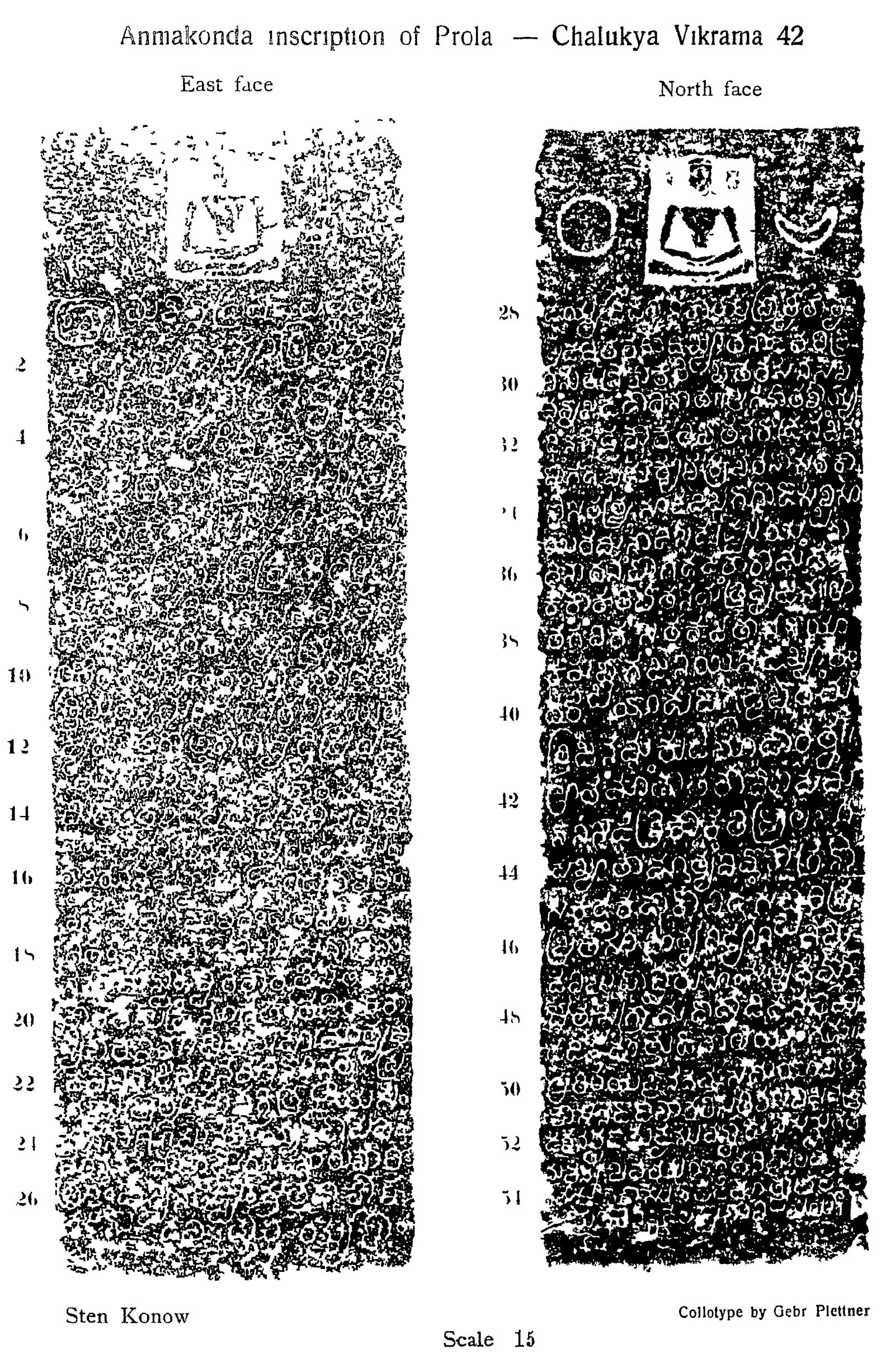
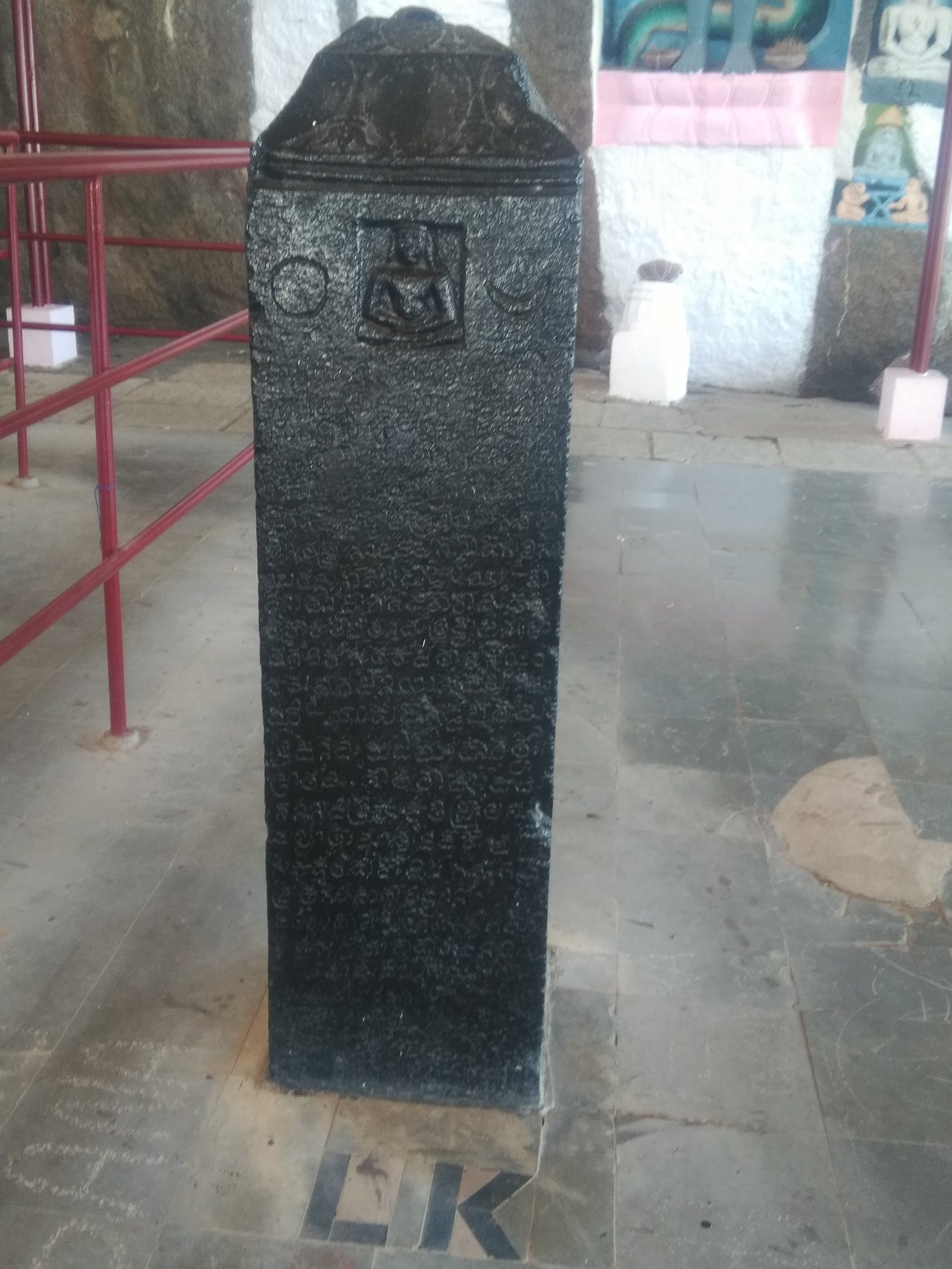
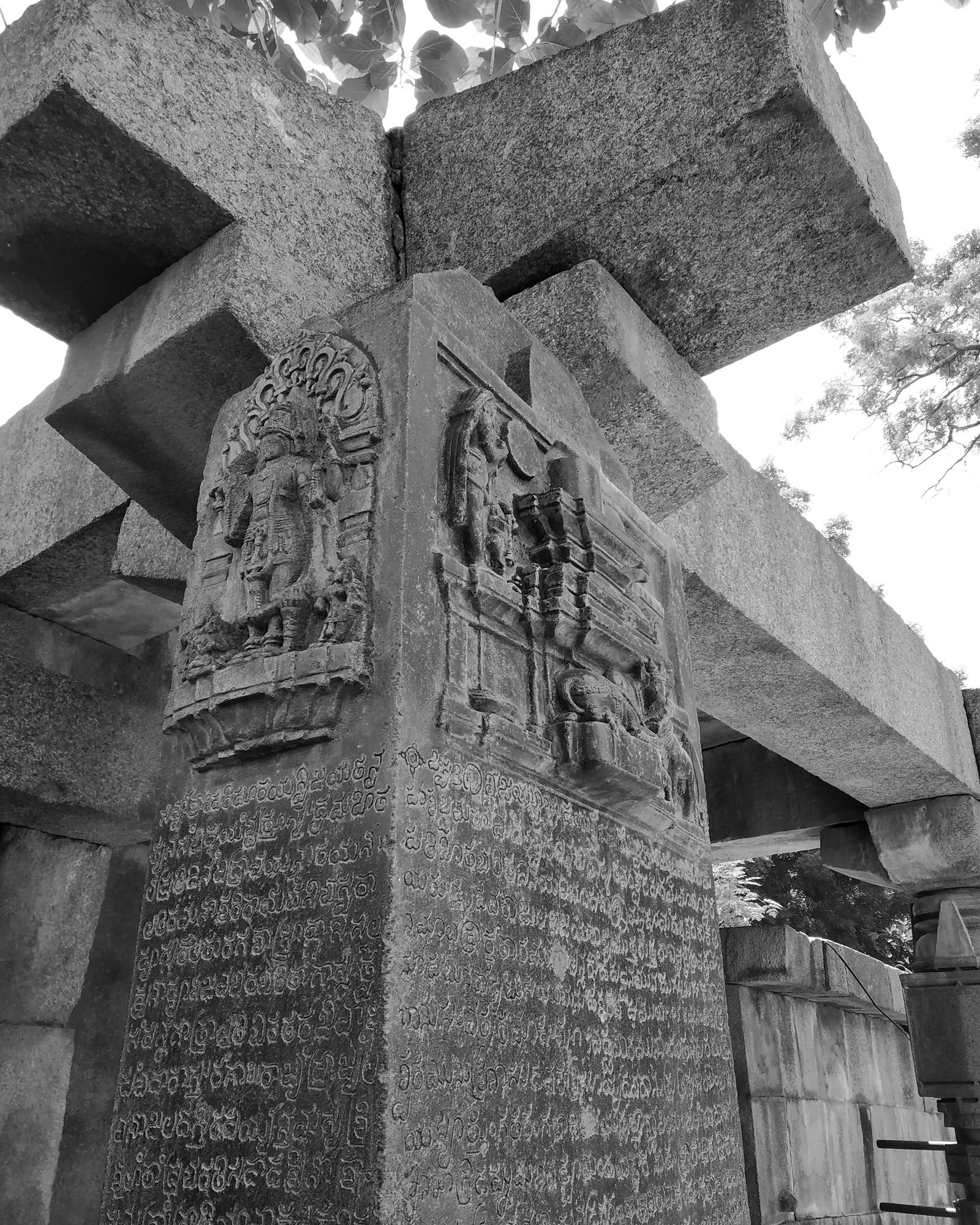
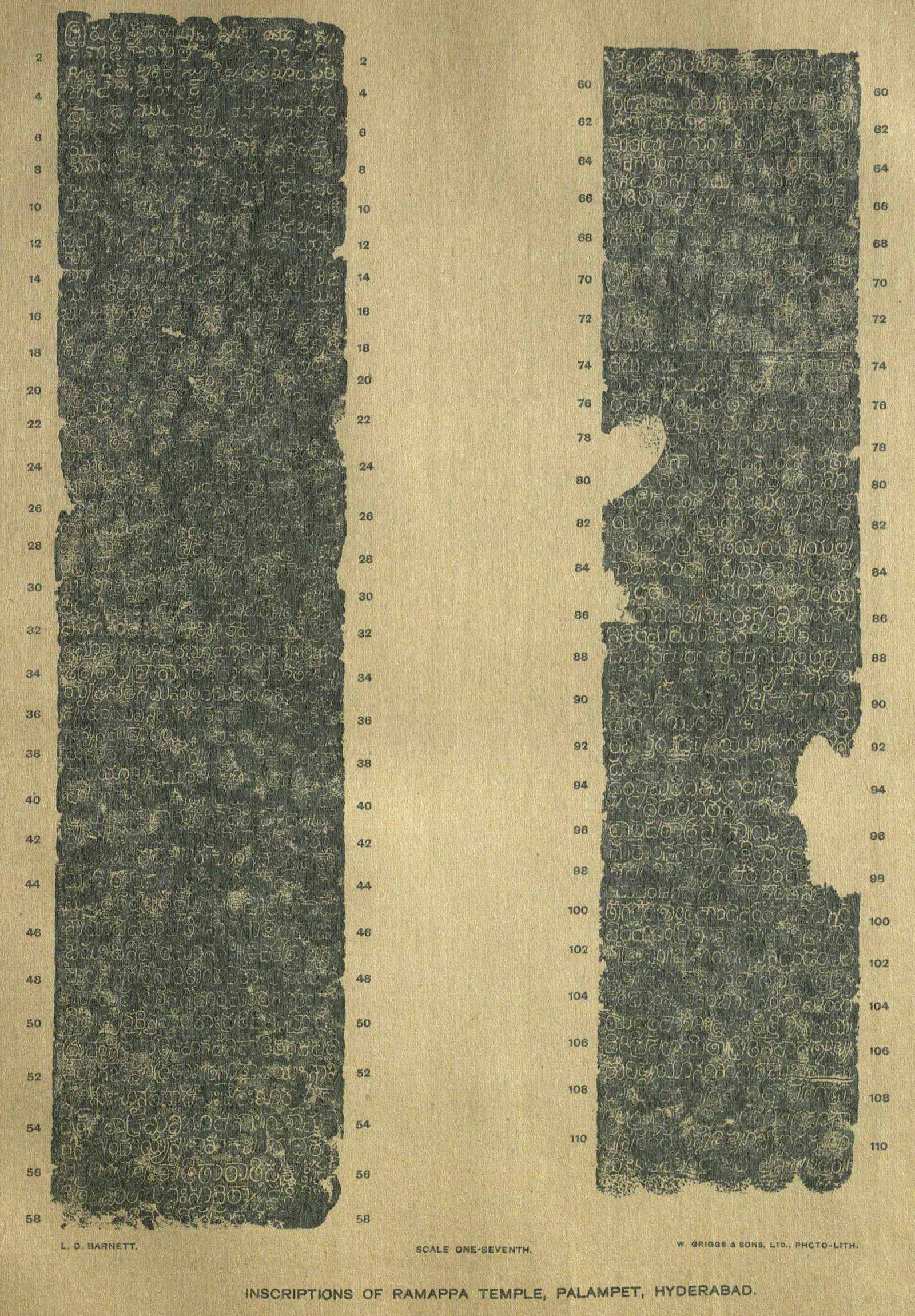
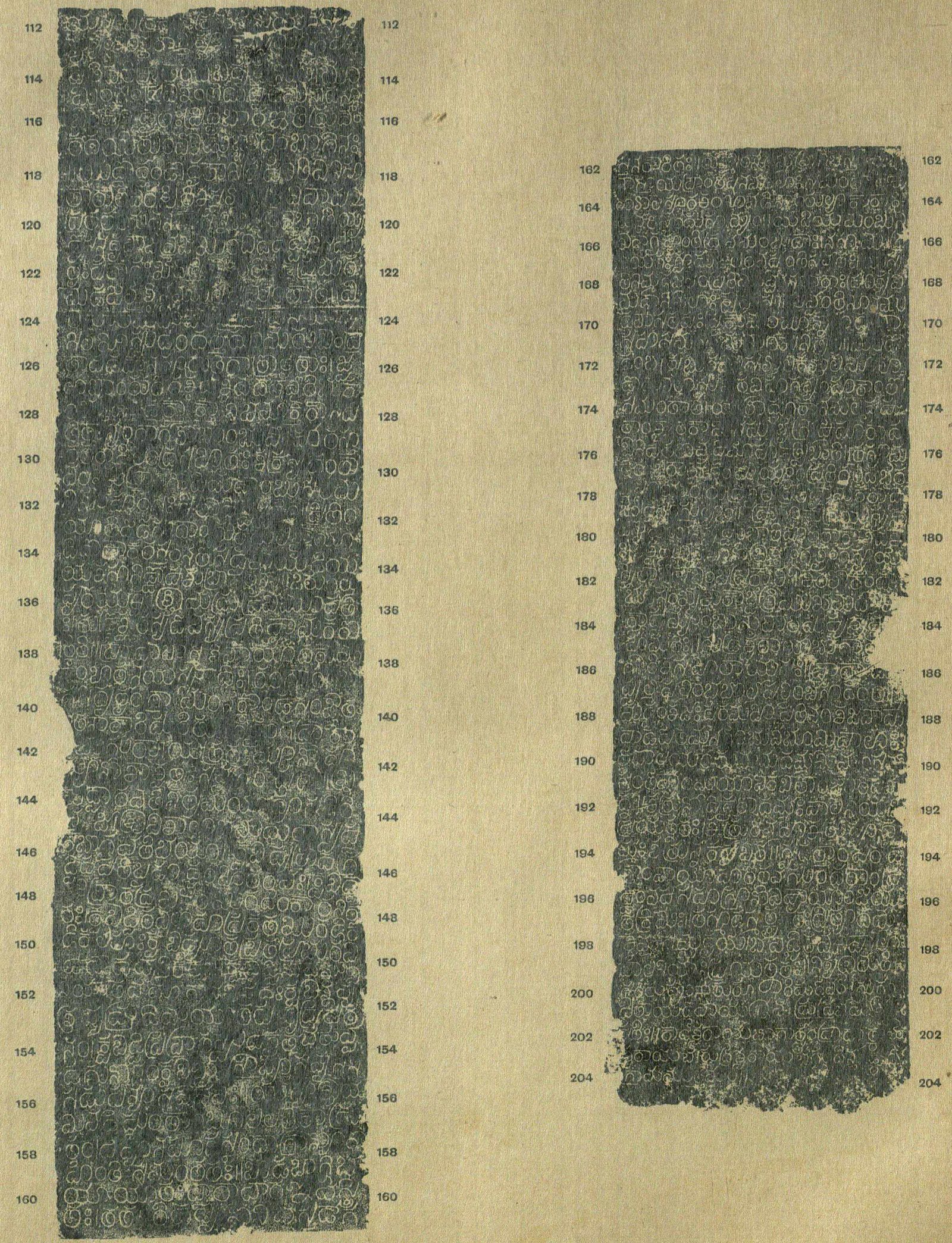
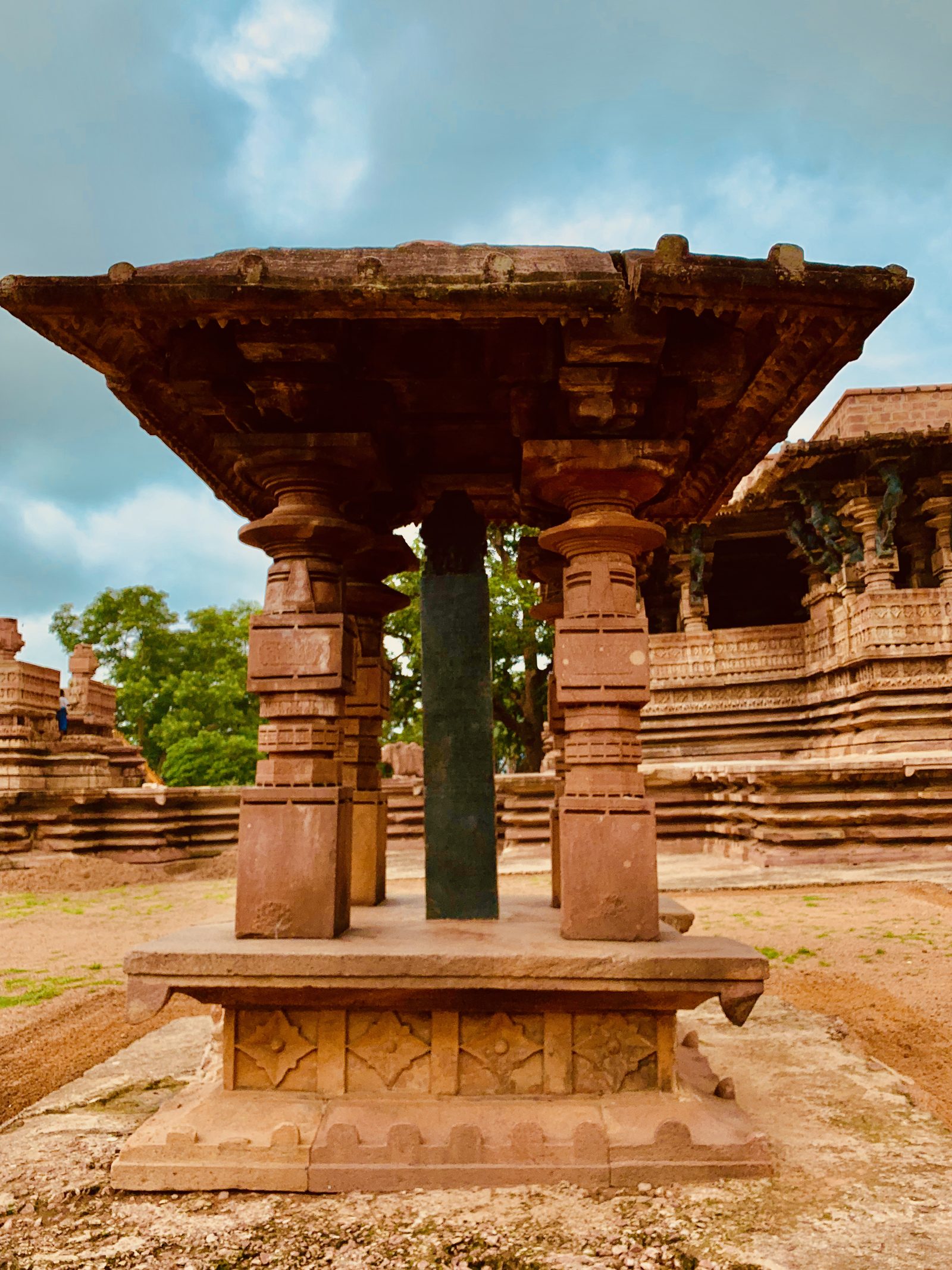
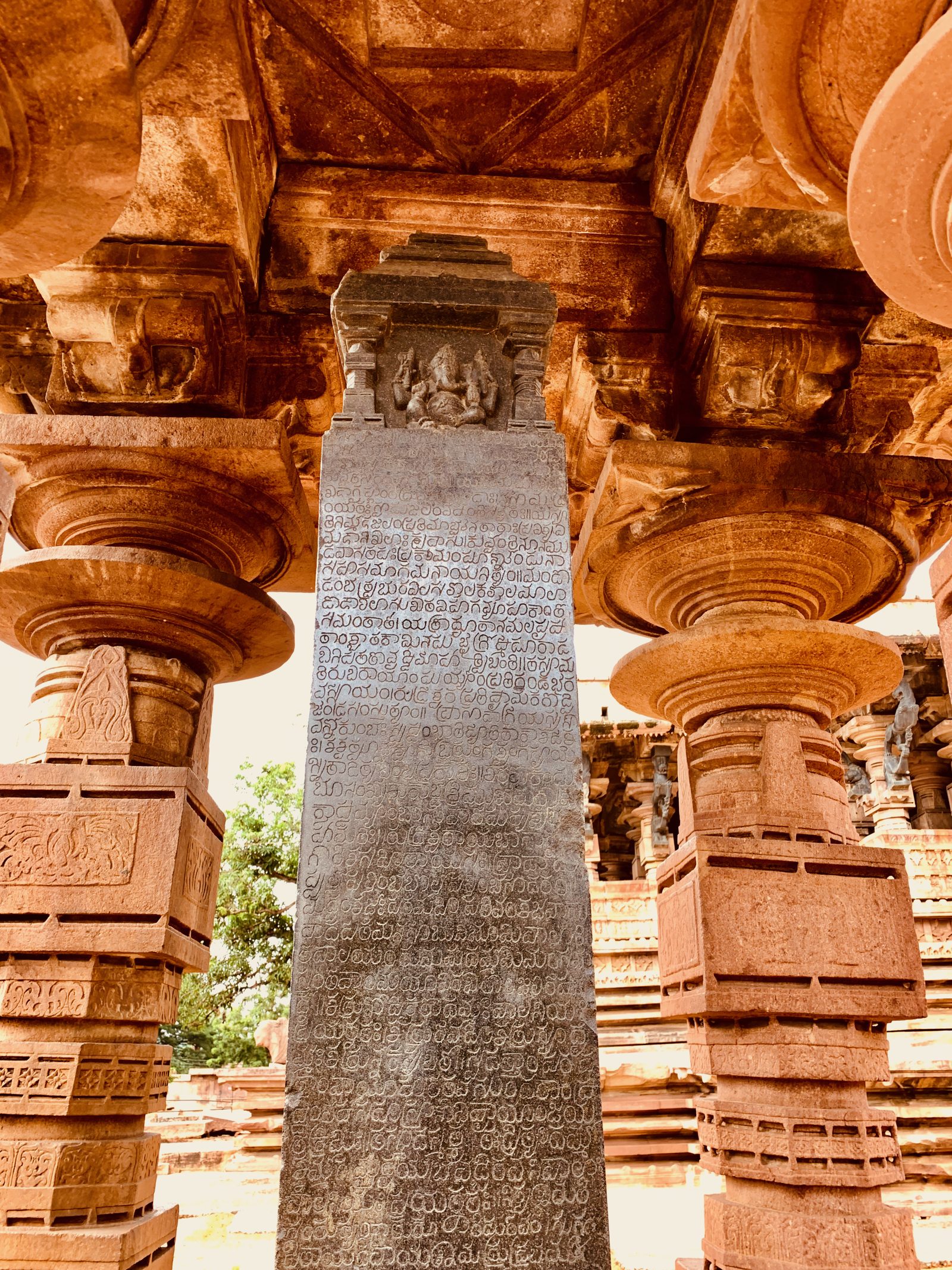
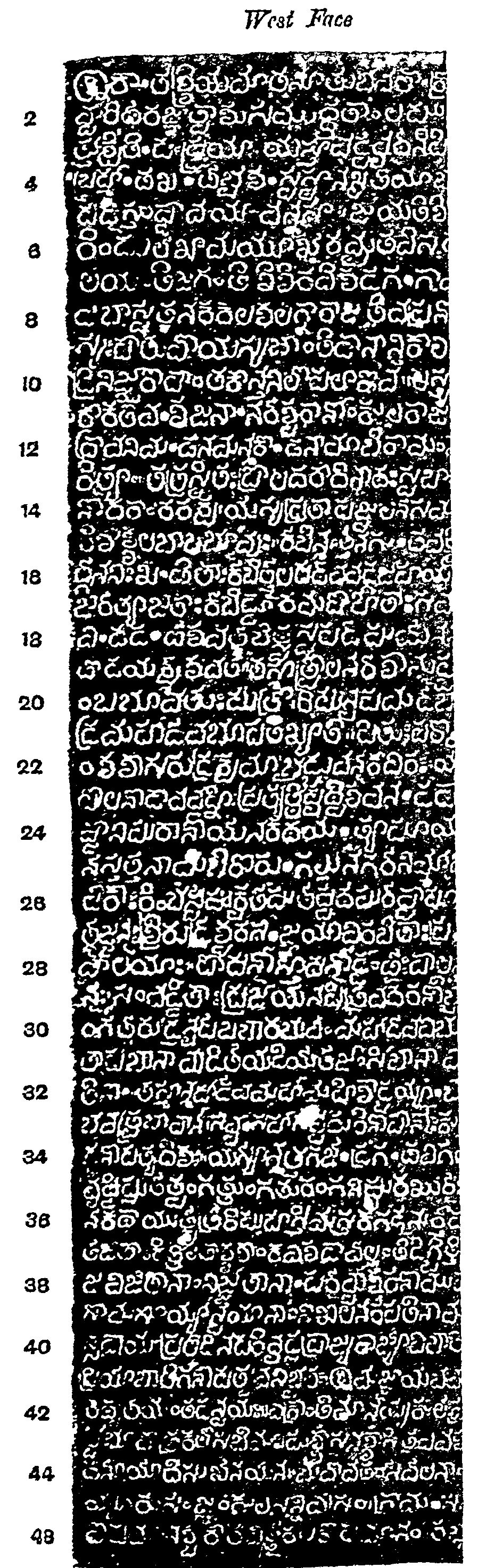
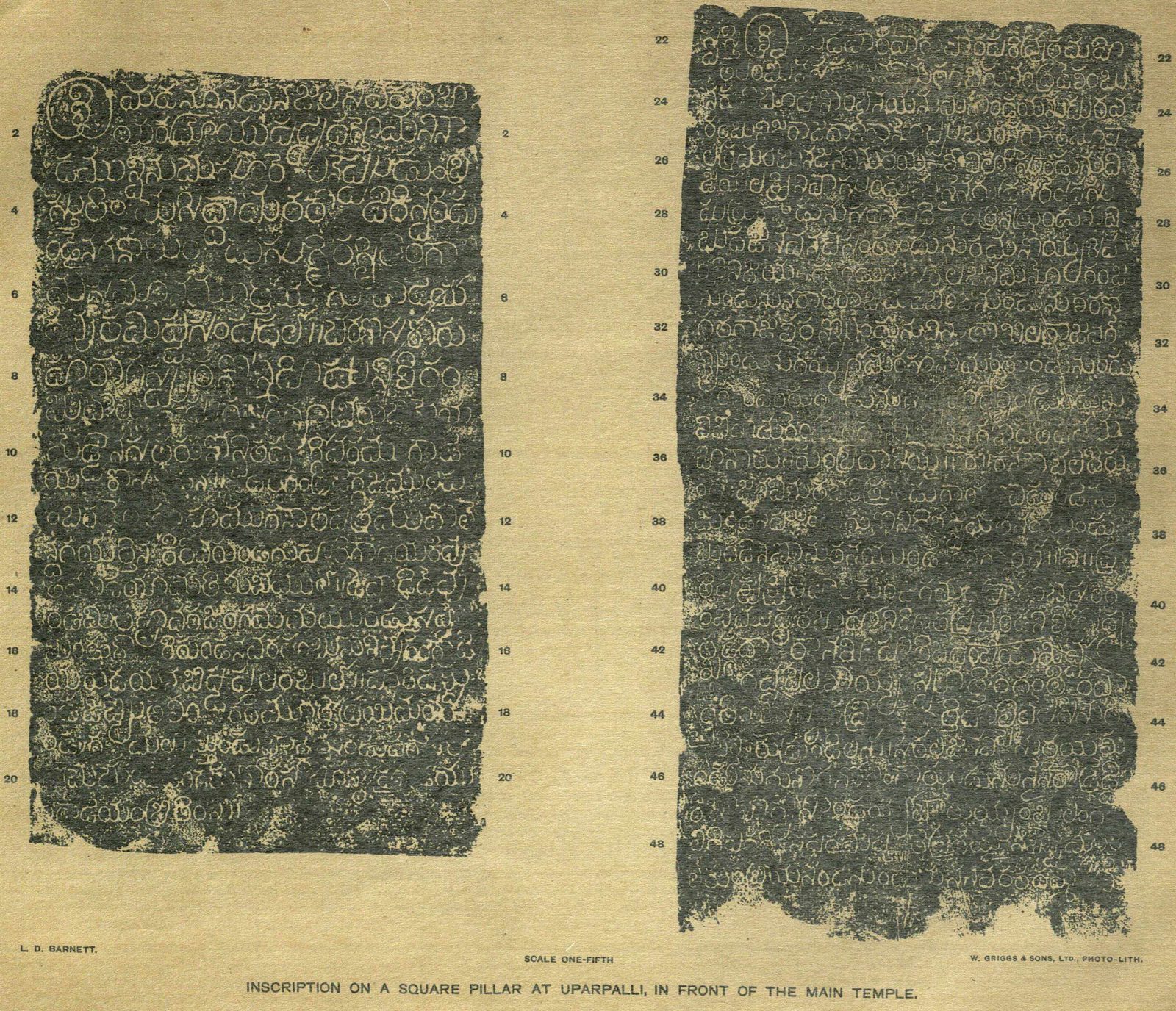
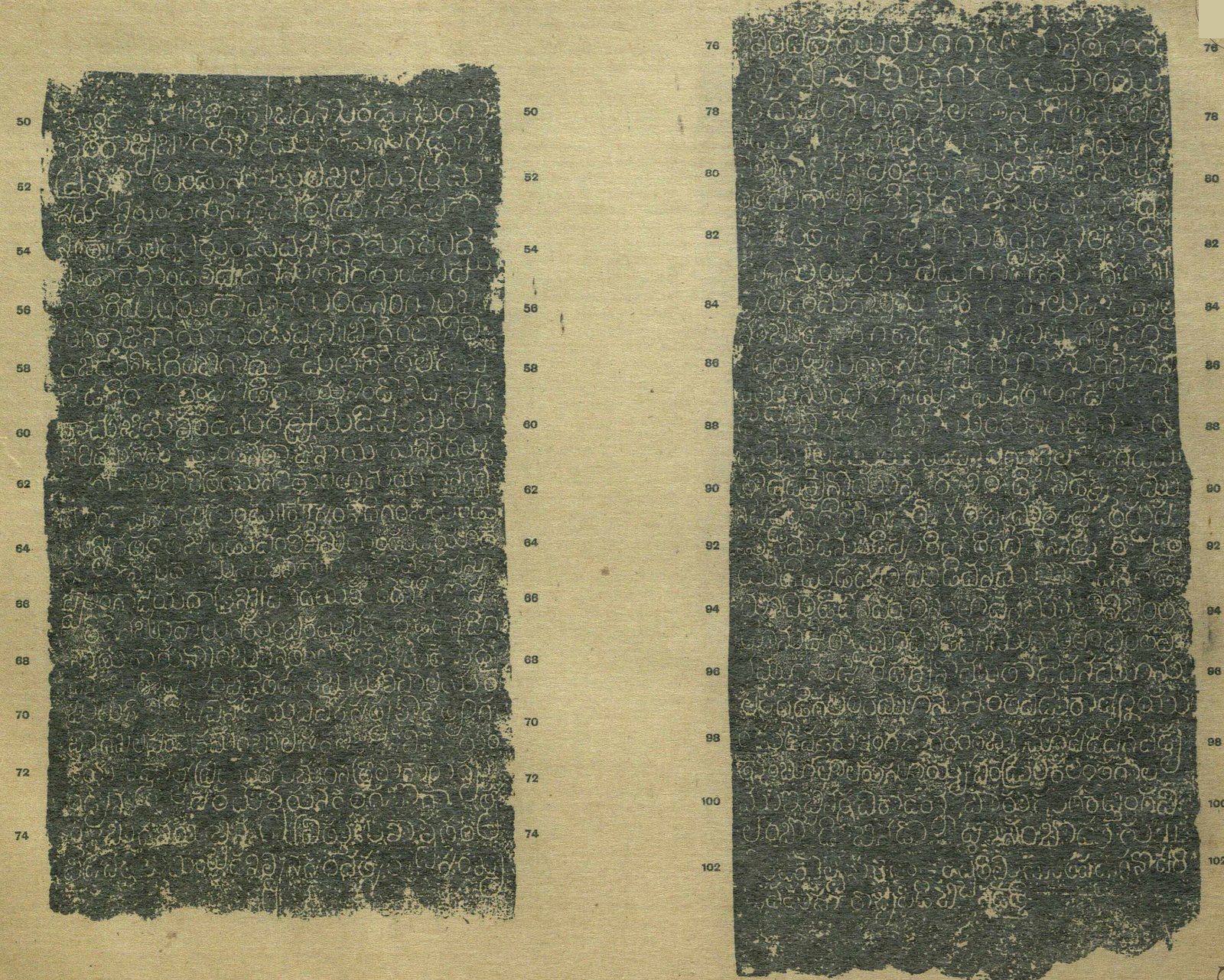
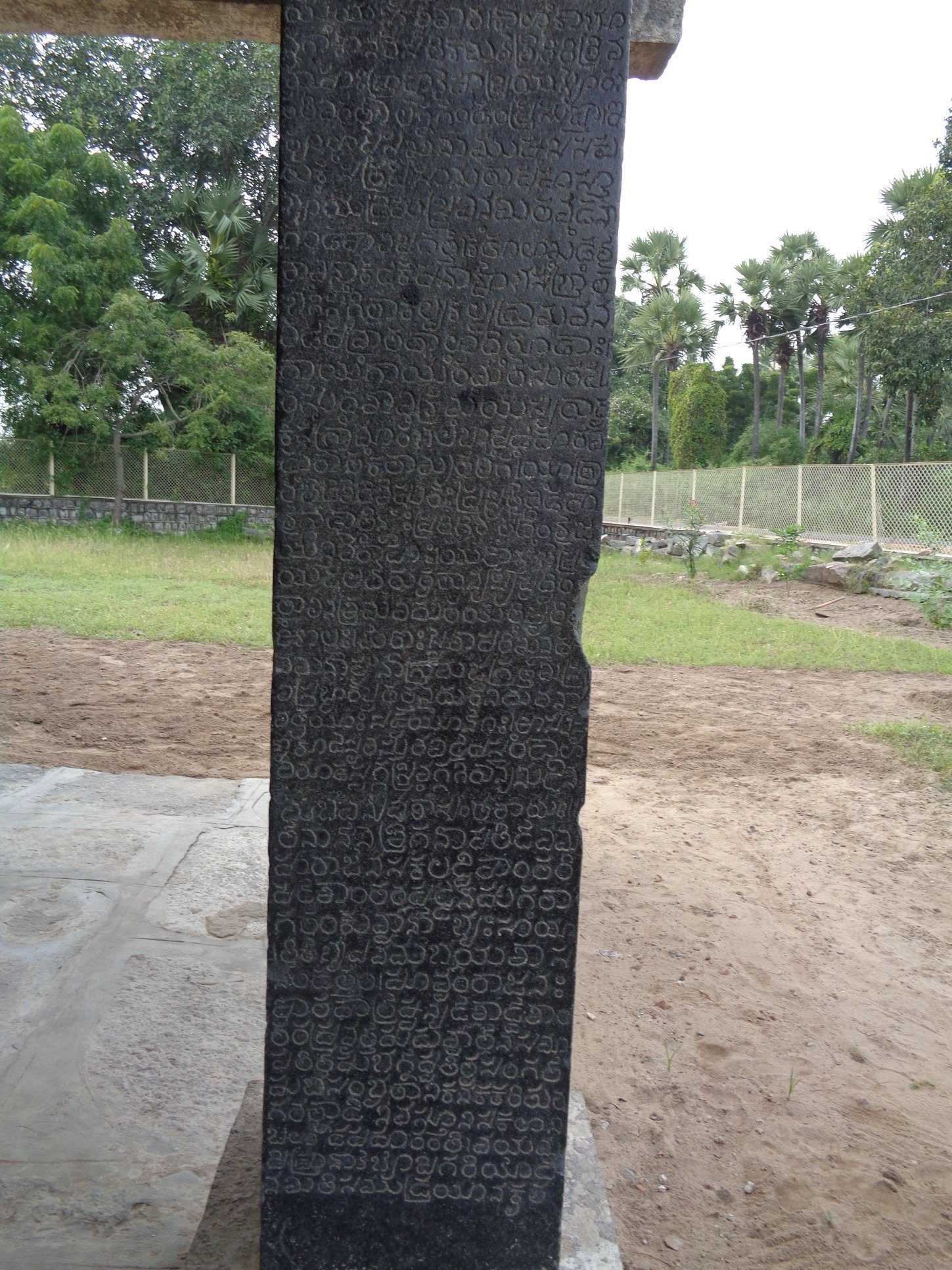
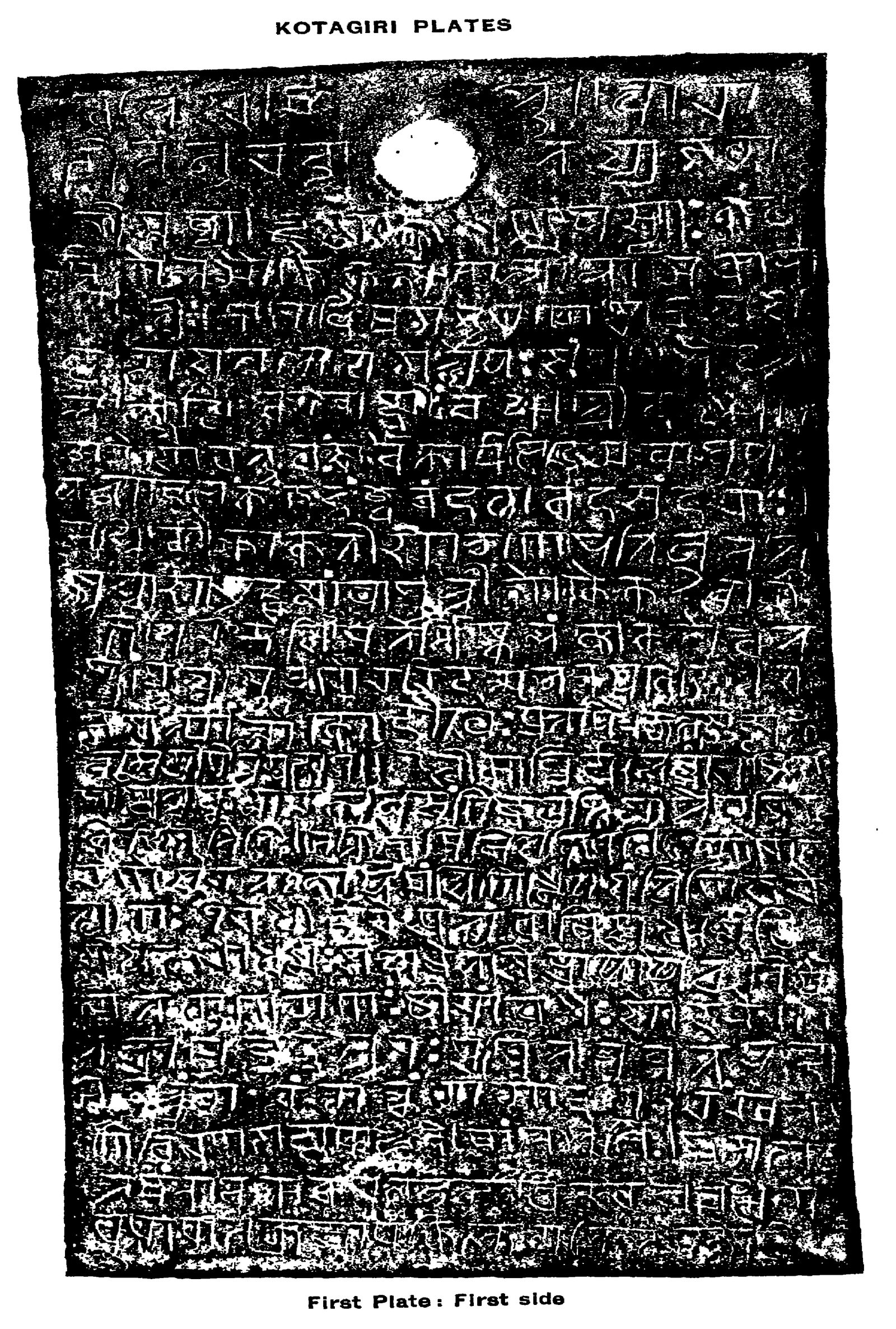
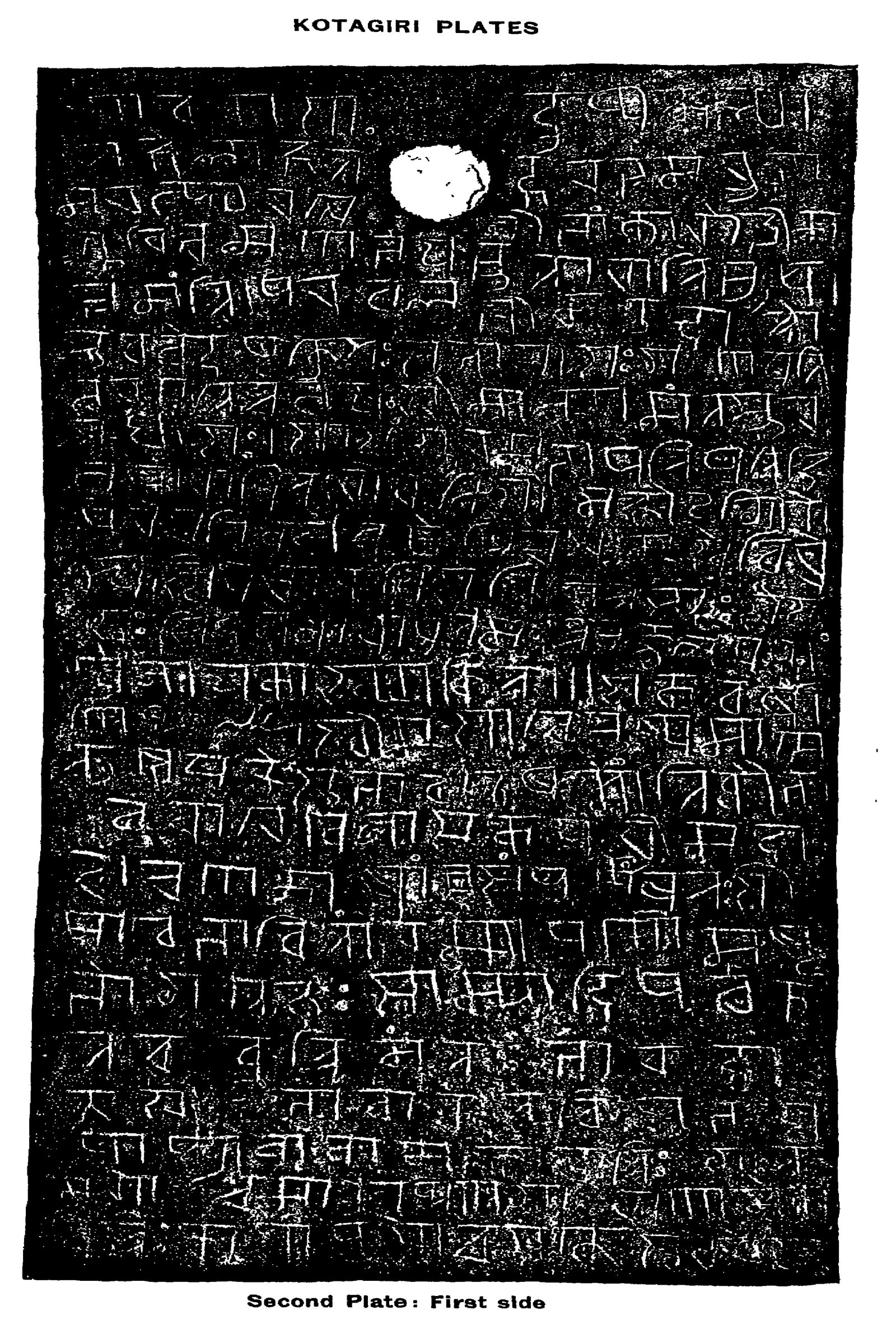
No records match these filters.