Kondaparthi Temples
Kondaparthi, a village near Warangal, was the home of the Malyala generals of the Kakatiyas. In 1203 the general Malyala Chaunda built the Chaundesvara temple and a tank there. In 1241 Malyala Kata built temples of Siva and Kesava, which formed a triple shrine with a temple of Prolesvara.
- Period
- Kakatiya. Inscriptions of 1203 and 1241, in the reign of Ganapati Deva, record the temples
- Location
- 17.9216° N, 79.5381° EWarning: approximate
Source of the position: Geotags on Wikimedia Commons photographs of the trikuta temple ruins (P. Madhusudan, 2021). Wikidata Q6428955, the point for the village, lies about 90 m to the west
- Condition
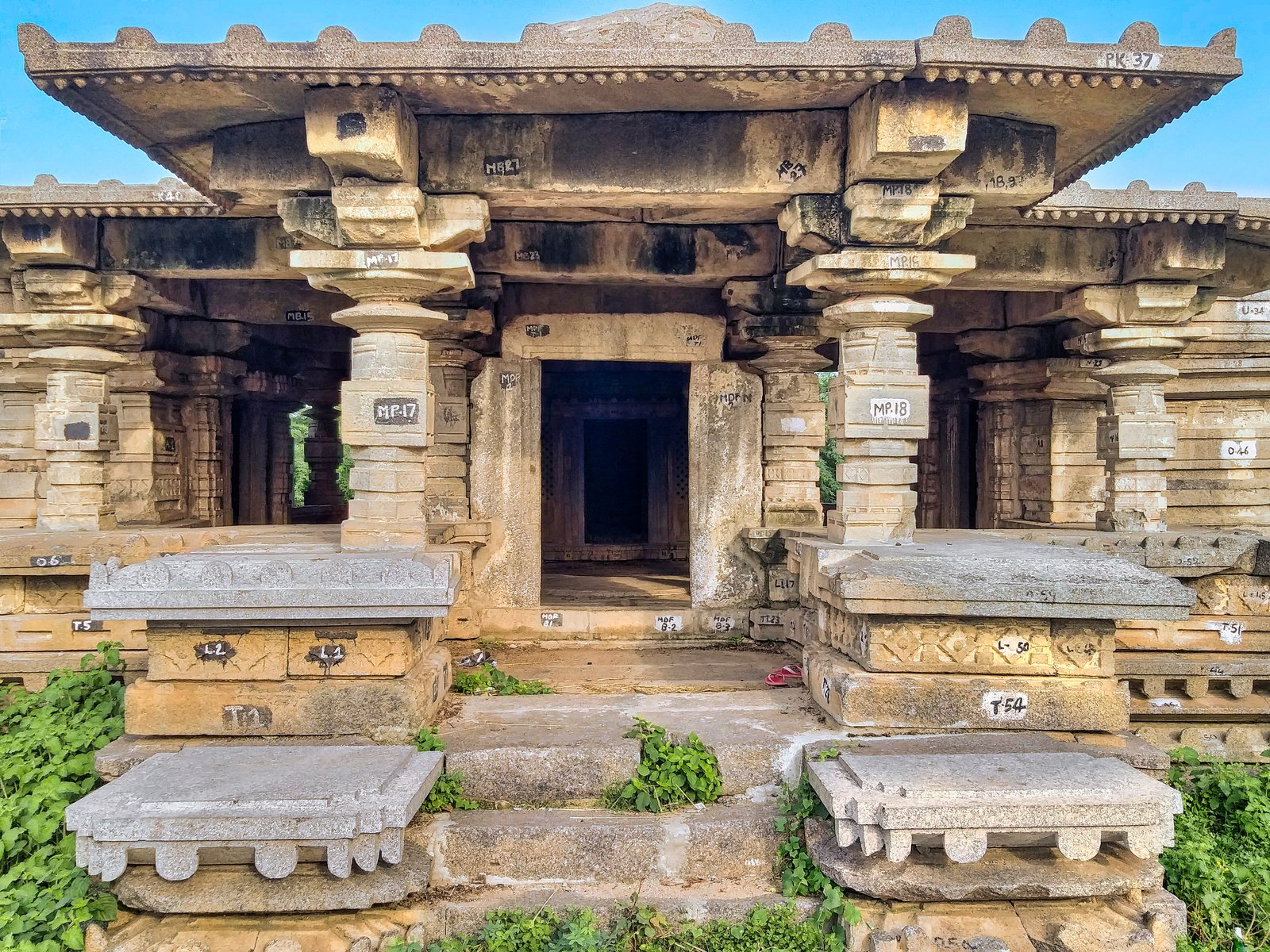
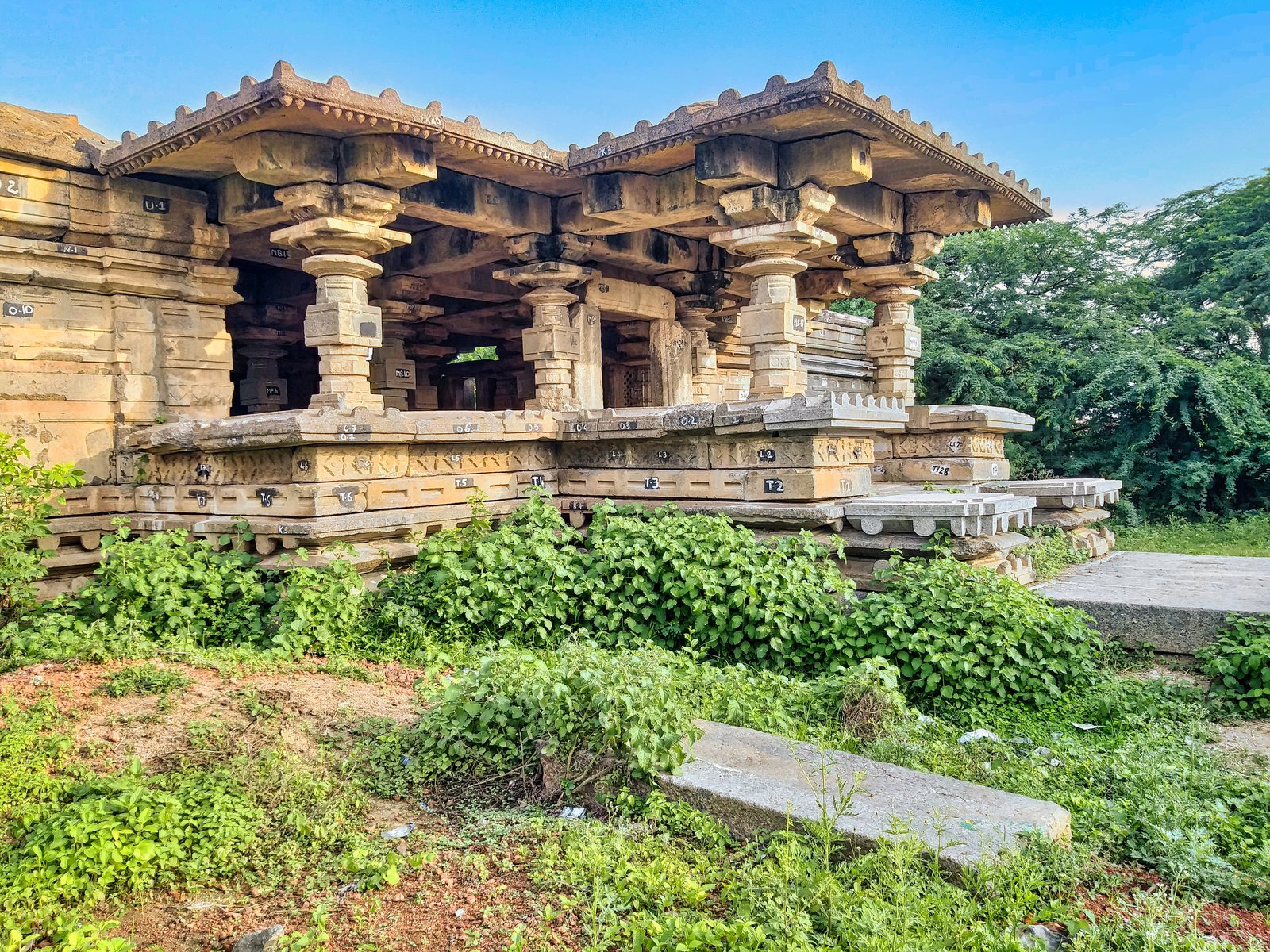
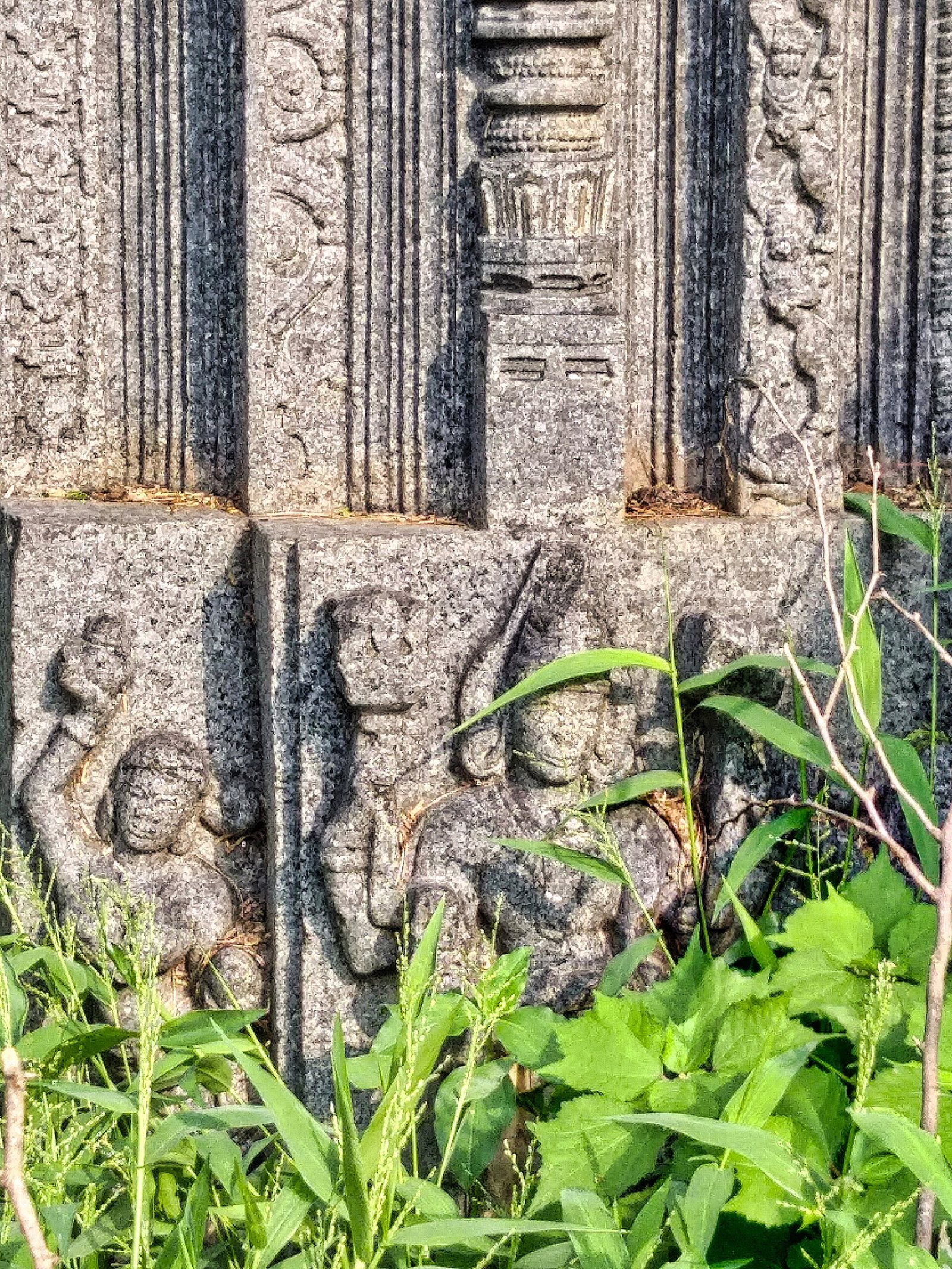
- In ruins. Photographs of 2021 show the pillared hall of the triple temple standing on its platform, with numbers painted on its stones and loose blocks beside it. A second ruined temple nearby is overgrown, with carved pilasters among the bushes.
Photographed 2021
The pillared hall of the ruined triple temple at Kondaparthi, photographed in 2021. Numbers are painted on many of its stones.
Photographed 2021
The side of the triple temple, with its turned pillars and its moulded platform, photographed in 2021.
Photographed 2021
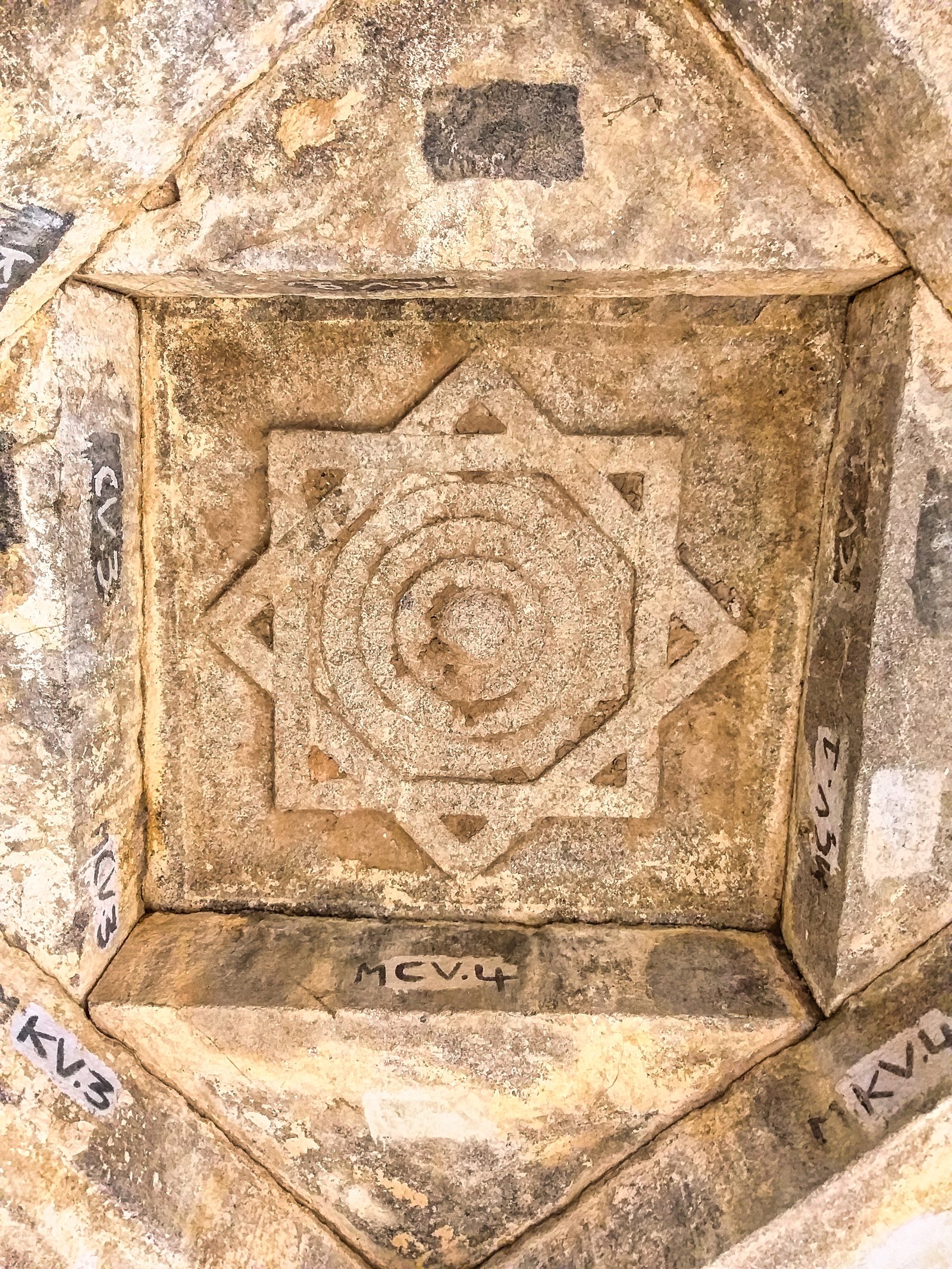
A ceiling panel in the triple temple, carved with an eight-pointed star around concentric rings.
Photographed 2021
Small reliefs of people at the foot of a carved pilaster, in the second ruined temple at Kondaparthi.
Detail
- The Malyala family of generals claimed descent from Durjaya, as the Kakatiyas did. Parabrahma Sastry names Dannaya, lord of the town of Malyala, as the earliest known member of the family.Parabrahma Sastry 1978Epigraphia Telanganica 2023
- The inscription of 1203 at Kondaparthi gives the family line. Dannaya's son was the general Sabba, and Sabba's son Kataya was made a minister by Rudra Deva.Epigraphia Telanganica 2023
- According to Parabrahma Sastry, Kata took part in the capture of Dharanikota for Rudra Deva and received the title Kota-gelpata, the conqueror of Kota. Kata's son Chaunda commanded the army of Ganapati Deva in the early years of his reign.Parabrahma Sastry 1978
- Chaunda led the Kakatiya army to Divi, an island near the mouth of the Krishna, and the island was plundered. The inscription of 1203 says that Ganapati Deva then gave Chaunda the title Dvipi-luntaka, the plunderer of the island.Parabrahma Sastry 1978Yazdani 1960Epigraphia Telanganica 2023
- Parabrahma Sastry calls Kondaparti the ancestral home of the Malyala family. A later general of the family, Malyala Gunda, appears at Bothpur in Mahbubnagar district. Sastry notes that the relation of Gunda to Chaunda is not known.Parabrahma Sastry 1978
- An inscription of 17 April 1203 records that Chaunda built a temple of Siva in Kondaparti and installed the linga there as Chaundesvara, after his own name. Chaunda gave the whole village of Narukurki to the god for its festivals and worship.Epigraphia Telanganica 2023
- The same inscription states that Chaunda granted the agrahara of Chaundapura to a body of Brahmins and built a large tank in it, named Chaunda-samudra. The inscription also names his wife Mailama.Epigraphia Telanganica 2023
- Inscriptions at Katakuru name Chaunda's wife Mailama as a daughter of the Viriyala family. Mailama consecrated temples there to Aitesvara, Annesvara and Mallikarjuna, named after her mother, her father and herself.Epigraphia Telanganica 2023
- The verses of 1203 praise the high sikhara of the temple with its golden finial, and the rampart wall around the temple. One verse says that people who gazed at the carved sculptures of the temple stood so still that they looked like sculptures themselves.Epigraphia Telanganica 2023
- The Hyderabad Corpus of 1942, edited by P. Sreenivasachar, includes the two Kondiparti inscriptions as Nos. 8 and 9. In its introduction Sreenivasachar judged their Sanskrit verse over-elaborate, but he praised the poetic observation in the verse about the onlookers.Sreenivasachar 1942
- Epigraphia Telanganica lists the inscription of 1203 twice, as No. 81 and No. 82 of Volume II, from different publications. The two entries give the same date, the same family line and the same gifts, so they appear to describe one inscription.Epigraphia Telanganica 2023
- The two entries place the stone differently. No. 81 places it on a pillar in the Venugopalaswamy temple, while No. 82 places it near the Siva temple of the village. M. Rama Rao also lists the Chaundesvara temple twice, from two different editions.Epigraphia Telanganica 2023Rama Rao 1966
- A second inscription, dated 23 February 1241, stands at the trikuta, the triple temple of the village. It records that Malyala Kata built a temple of Siva as Rudresvara and a temple of Kesava, and installed the two gods on that day.Epigraphia Telanganica 2023
- The verses describe the two new temples and the temple of Prolesvara as one triple shrine with golden finials. Kata also built a parapet wall around the three temples, with closely joined capitals of blue stone. The Warangal District volume, as summarised in Epigraphia Telanganica, takes the Prolesvara temple to have existed already.Epigraphia Telanganica 2023
- Kata gave three nivartanas of land to Rudresvara and two each to Kesava and Prolesvara. Kata also gave the three gods a small field watered by the Bellama tank and thirty nivartanas of land watered by rain.Epigraphia Telanganica 2023
- The inscription of 1241 calls Kata the son of Sabba and Acama, the parents that the inscription of 1203 gives for Chaunda's father Kataya. The two records name different wives, however: Bollama in 1203 and Kacambika in 1241.Epigraphia Telanganica 2023
- Parabrahma Sastry's book makes Kata the father of Chaunda. In one passage of his thesis of 1975, Sastry instead calls the Kata of the 1241 inscription a son of Chaunda.Parabrahma Sastry 1978Parabrahma Sastry 1975 (thesis)
- The sources also differ on the title Divi-churakara. The Katakuru inscriptions give it to Chaunda. Sastry's book says that Ganapati Deva gave it to Kata, and the inscription of 1241 calls Kata Churakara.Epigraphia Telanganica 2023Parabrahma Sastry 1978
- S. Gopalakrishna Murthy describes the Chaundesvara temple as of the thousand-pillared pattern, with reliefs on its pilasters. Three door guardians gather on either side of the shrine door, the central one being male.Gopalakrishna Murthy 1964
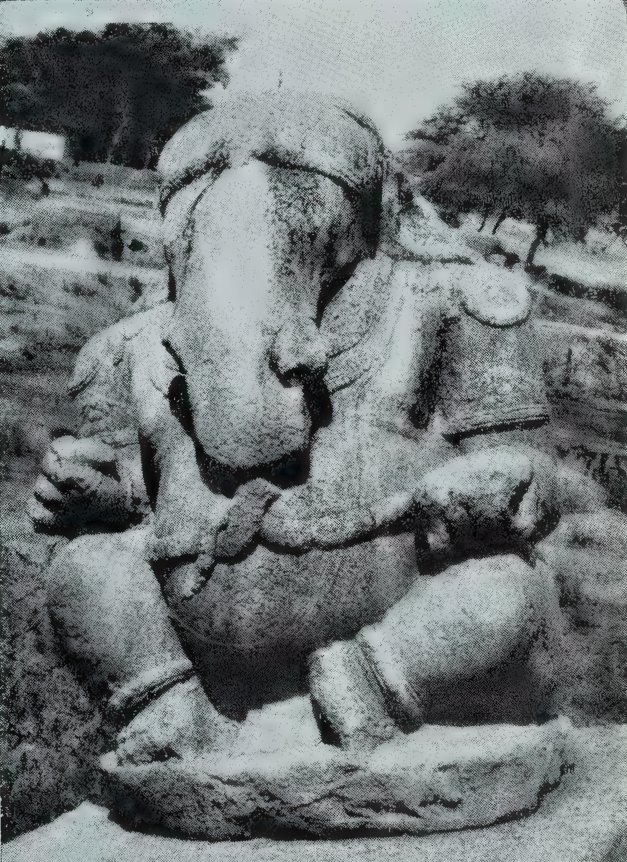
- Gopalakrishna Murthy saw a broken image of Sarasvati there, dancing with one leg in the air and the other on her swan. Near the bund of the Chaunda-samudram tank he noted a two-handed Ganesa.Gopalakrishna Murthy 1964
- Gopalakrishna Murthy counts the temples of Kondiparti among those built with a stepped, elongated pyramidal sikhara, like the Sambhunigudi at Warangal. He judges this form not a happy one.Gopalakrishna Murthy 1964
- Gopalakrishna Murthy also illustrates an Anantasayana at Kondiparti, Vishnu lying on the serpent. He finds it neatly done and thinks that the hair style of Lakshmi points to a Western Chalukya origin. He also noted the lower part of a broken image of the Sun, recognised by its horses.Gopalakrishna Murthy 1964
- Gopalakrishna Murthy compares the bracket sculptures of the Ramappa temple with the salabhanjikas that, in his words, the Kondiparti record of the Siva, Kesava and Prolesvara temples extols.Gopalakrishna Murthy 1964
- In 1343 Fasli (1933-34), R. M. Joshi of the Hyderabad Archaeological Department listed the loose sculptures of Kondiparti, six miles south-east of Warangal. In the Venugopal temple he noted a Lakshmi-Narasimha seated on a lotus, and Vishnu lying on Sesha with Lakshmi at his feet.Nizam Archaeological Report 1933-34
- Joshi also recorded door jambs with excellent carving in the ruined temple of Gopal Swami, and three damaged Nandis in the Trikuta gudi. Two elephants carved in the round lay at the foot of the inscriptions, near the north-eastern corner of the Venugopalaswamy temple.Nizam Archaeological Report 1933-34
- Joshi found more sculpture on the bund of the tank, about two miles east of the village. He listed a standing saint with folded hands, a Nandi carved with seven smaller Nandis, and a yoni carved with twenty-one small lingas. He called the yoni unique.Nizam Archaeological Report 1933-34
- A big Ganesa, partly damaged, lay at the western end of the Kondiparti tank. Joshi marked several of these pieces to be removed and others to be protected or photographed. The report adds that the Department was considering moving neglected pieces to the Museum.Nizam Archaeological Report 1933-34
- The report of the Hyderabad Archaeological Department for 1937-40 lists two inscriptions at Kondiparti, five miles from Warangal, among the inscriptions found in a survey of the district.Nizam Archaeological Report 1937-40
- Kondaparthi is older than its Kakatiya temples. A boulder called Kokkeragundu, in the big tank beside the village, carries a land grant in archaic Telugu of about the ninth century. The editors call their translation tentative.Epigraphia Telanganica 2023
- The record names witnesses, an engraver and Dhanamjaya, probably a tax collector, who was to collect the tax on the land. Telangana – Land and People explains such an officer as one who assessed the produce and the king's share.Epigraphia Telanganica 2023Goel et al. 2022
- Epigraphia Telanganica prints this entry twice, as Nos. 11 and 14 of Volume I. Its No. 24, from Indian Archaeology 1973-74, describes an inscribed boulder in the midst of a tank, of the ninth or tenth century. That record names Armakonda, identified with Hanumakonda.Epigraphia Telanganica 2023
- The Warangal District Gazetteer of 1976 lists Kondaparthi among the places in the district with megalithic burials.Warangal District Gazetteer 1976
- Telangana – Land and People names Kondaparthi among the administrative and commercial centres of the Kakatiya kingdom.Goel et al. 2022
- The Census of 1961 records a one-day festival of Sri Gopalaswamy at Kondaparthy in the month of Phalguna, attended by about 5,000 people from the village and its neighbourhood.Census 1961, Fairs and Festivals: Warangal
Historical photographs
These photographs were published a century or more ago. They show the monument as it stood before later repair and restoration.
Photographed before 1964
A two-handed Ganesa near the bund of the Chaunda-samudram tank at Kondiparti, photographed by 1964.
Photo: S. Gopalakrishna Murthy, The Sculpture of the Kakatiyas (A.P. Archaeological Series 34), Government of Andhra Pradesh, 1964, Fig. 13 · Public domain
Also recorded as
- Kondaparthi
- Kondaparthy
- Kondaparti
- Kondiparti
- Komdaparti
- Chaundesvara
- Chaundeshwara
- Chaundapura
- Chaunda-samudra
- Chaunda-samudram
- Trikuta temple
- Venugopalaswamy temple
Sources
- Warangal District Gazetteer 1976
- Census 1961, Fairs and Festivals: Warangal
- Yazdani 1960
- Epigraphia Telanganica 2023
- Nizam Archaeological Report 1933-34
- Nizam Archaeological Report 1937-40
- Parabrahma Sastry 1978
- Parabrahma Sastry 1975 (thesis)
- Rama Rao 1966
- Gopalakrishna Murthy 1964
- Sreenivasachar 1942
- Goel et al. 2022