Anumakonda Fort
The Anumakonda Fort was the citadel of the early Kakatiya capital. Mud walls join a circle of hills, and two stone gateways lead through the walls.
- Period
- Early Kakatiya, late 11th century (attributed)
- Commissioned by
- Beta II (attributed)
- Materials
- Earthen walls joining granite hills, with stone gateways
- Location
- 17.9969° N, 79.5700° EWarning: approximate
Source of the position: The midpoint of the Padmakshi temple (Wikidata Q19894997) and the Siddhesvara temple (OpenStreetMap way/280058222), which both stand inside the old citadel
- Condition
- Remains of the walls and gateways survive, according to Parabrahma Sastry and Rama Rao.
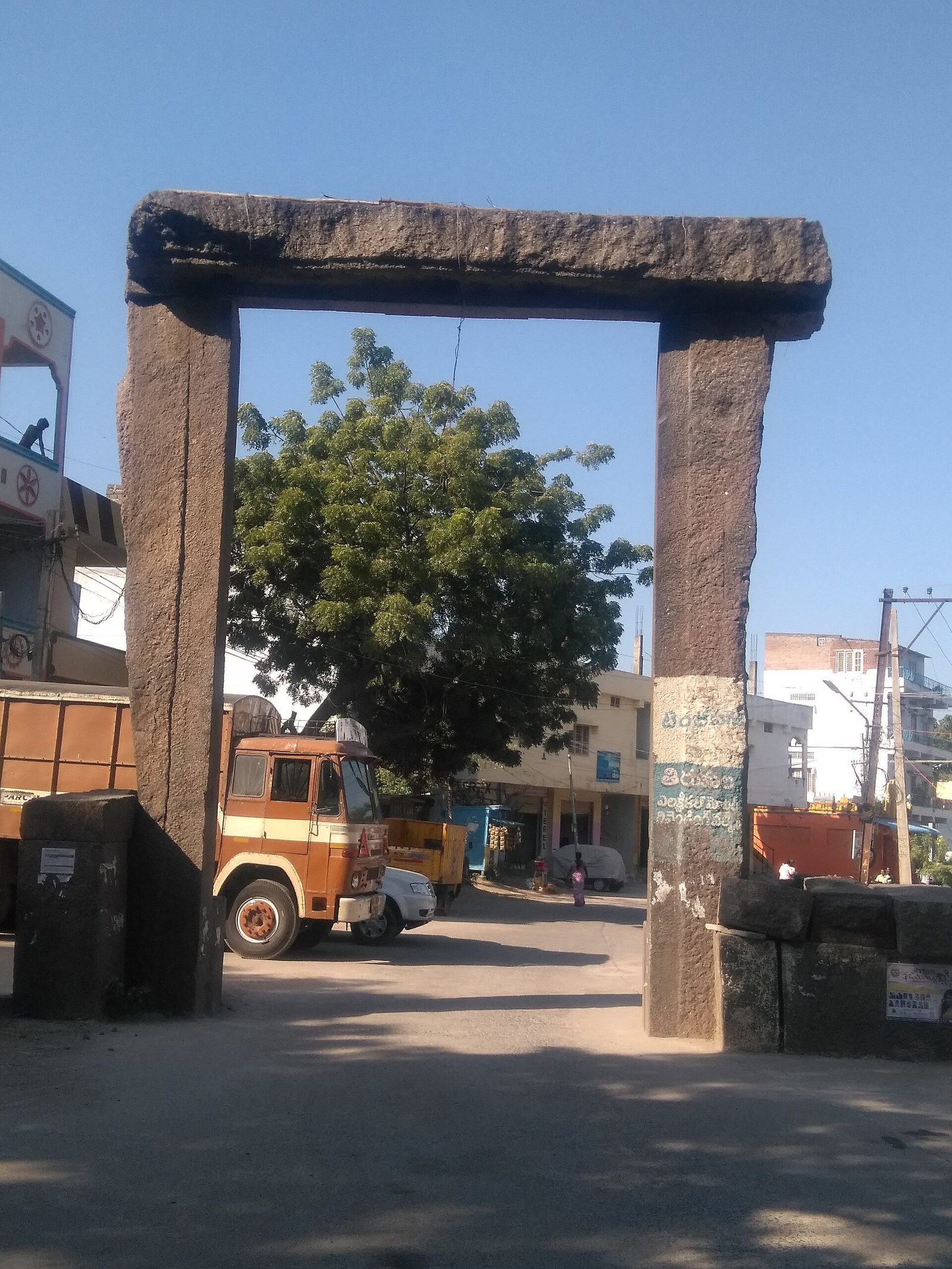
A stone gateway at Hanamakonda, known locally as the old Kakatiya Kala Thoranam. Two tall monolithic posts carry a single stone lintel. Gopalakrishna Murthy describes high stone arches like this at the entrance and exit of the Hanamakonda fort.
Detail
- Rama Rao describes a wide gap in a chain of hills. High mud walls join two big hills and two small hillocks into a fortress.Rama Rao 1966
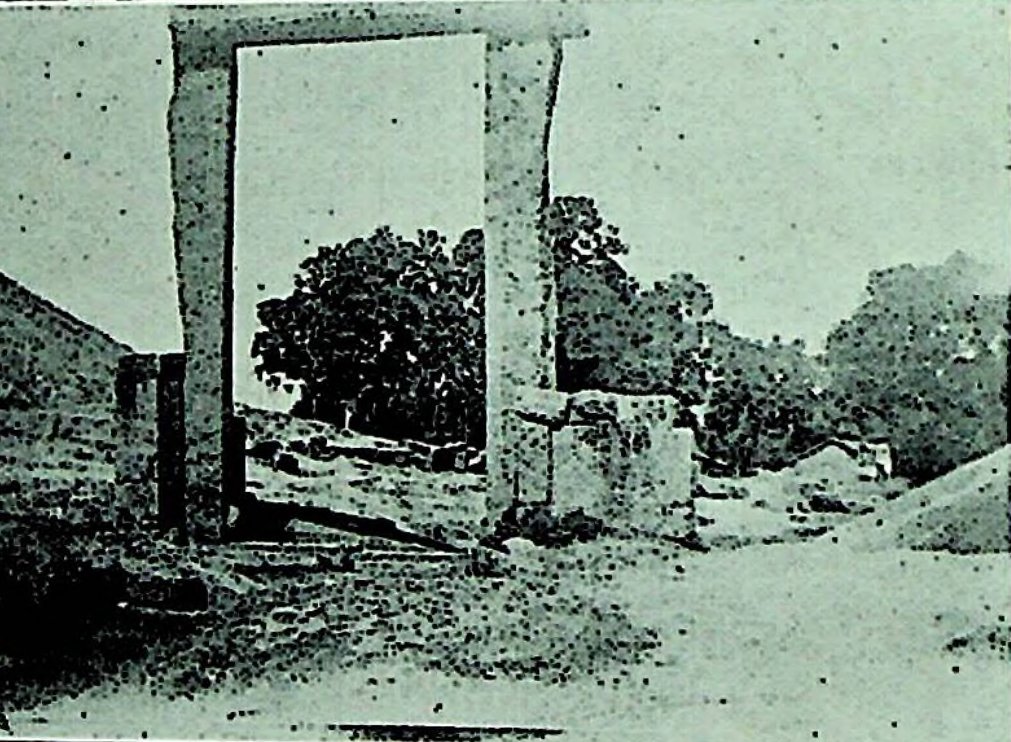
- A stone gateway leads into the citadel between two hills. A second gateway stands opposite it in another mud wall.Rama Rao 1966
- The Padmakshi hill forms one side of the citadel. The Padmakshi and Siddhesvara temples stand within the enclosure.Rama Rao 1966
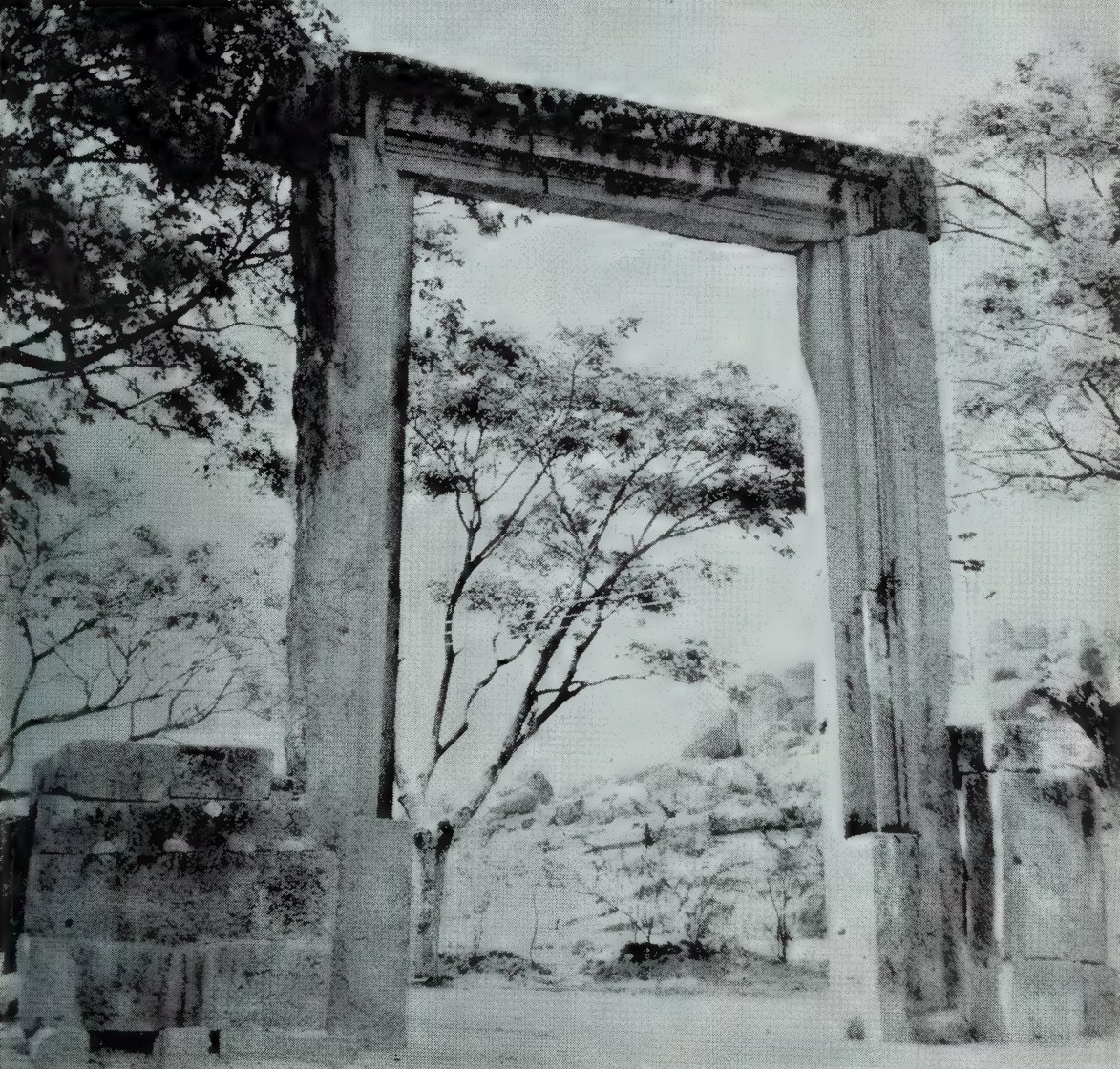
- Gopalakrishna Murthy credits Beta II with the mud wall and with the high stone arches at the entrance and exit of the fort.Gopalakrishna Murthy 1964
- Gopalakrishna Murthy sees these arches as the start of a Kakatiya tradition of grand gateways. In his view the effort began at Hanumakonda, improved at Kolanupaka and Ainavolu, and culminated in the four toranas of Warangal.Gopalakrishna Murthy 1964
- A large relief of Chamunda is carved on a boulder on the north side inside the fort.Gopalakrishna Murthy 1964
- The 1976 district gazetteer counts the hill fort at Hanamkonda among the famous Kakatiya strongholds.Warangal District Gazetteer 1976
- Malik Kafur seized the hill of Anumakonda in January 1310. Amir Khusrau says that every building of Warangal was visible from the hill.Elliot & Dowson IIIYazdani 1960
- Parabrahma Sastry counts the Betesvara and Prolesvara shrines among the early temples of Anumakonda, with the remains of an old fort. The Kazipet Darga inscription places Sivapura, the village of the Betesvara temple, south-west of Anumakonda.Parabrahma Sastry 1978Parabrahma Sastry 1975 (thesis)
- Gopalakrishna Murthy mentions a Panduranga temple on the hill at Hanumakonda. He names it, with the Thousand Pillar Temple and the Bhadrakali temple, among the temples along an old road that he traces from the Hanumakonda fort gate towards Warangal. In his review of Jain sculpture, he places its rectangular pedestal, like those of the Medarayan temple, in the period of the Jain shrines of Hanumakonda and Warangal.Gopalakrishna Murthy 1964
- Appanna Sastri writes that the mud wall of Orugallu, about four miles out from Orugallu in every direction, was joined to the Anumakonda fort. In his view the Orugallu wall was planned to fall within the defences of Anumakonda.Appanna Sastri (ed.) 1934
- Appanna Sastri describes a route by which the defenders could reach Orugallu unseen by enemies. The route entered by the great gate in front of the Padmakshi temple. It left through a large gateway behind the Siddhesvara temple.Appanna Sastri (ed.) 1934
- Appanna Sastri notes that the road to Kondaparti cut through the south side of the Anumakonda mud wall. He writes that this road was recent in 1934 and was not part of the old fort.Appanna Sastri (ed.) 1934
- Appanna Sastri lists early spellings of the town's name. The Kazipet Darga inscription has Anmakonda. The Padmakshi inscription of 1117 has Anmakunda and Ammakunde. The Thousand Pillar inscription has Anmakunda and Anmakonda.Appanna Sastri (ed.) 1934
- Appanna Sastri notes that a Draksharama record of Rudra Deva, dated 1186, spells the name Anumakonda. He finds no reason for the literary name Hanumadgiri. He thinks that scholars made it by turning the popular name Hanumakonda into Sanskrit.Appanna Sastri (ed.) 1934
- Appanna Sastri reports old legends that the town took its name from two brothers, Anumadu and Kondadu.Appanna Sastri (ed.) 1934
- Appanna Sastri reads the Kazipet Darga inscription as saying that Prola I received the Anmakonda vishaya as a permanent grant from the Western Chalukya king Trailokyamalla. He infers that Anumakonda was already the capital of a region by then.Appanna Sastri (ed.) 1934
Historical photographs
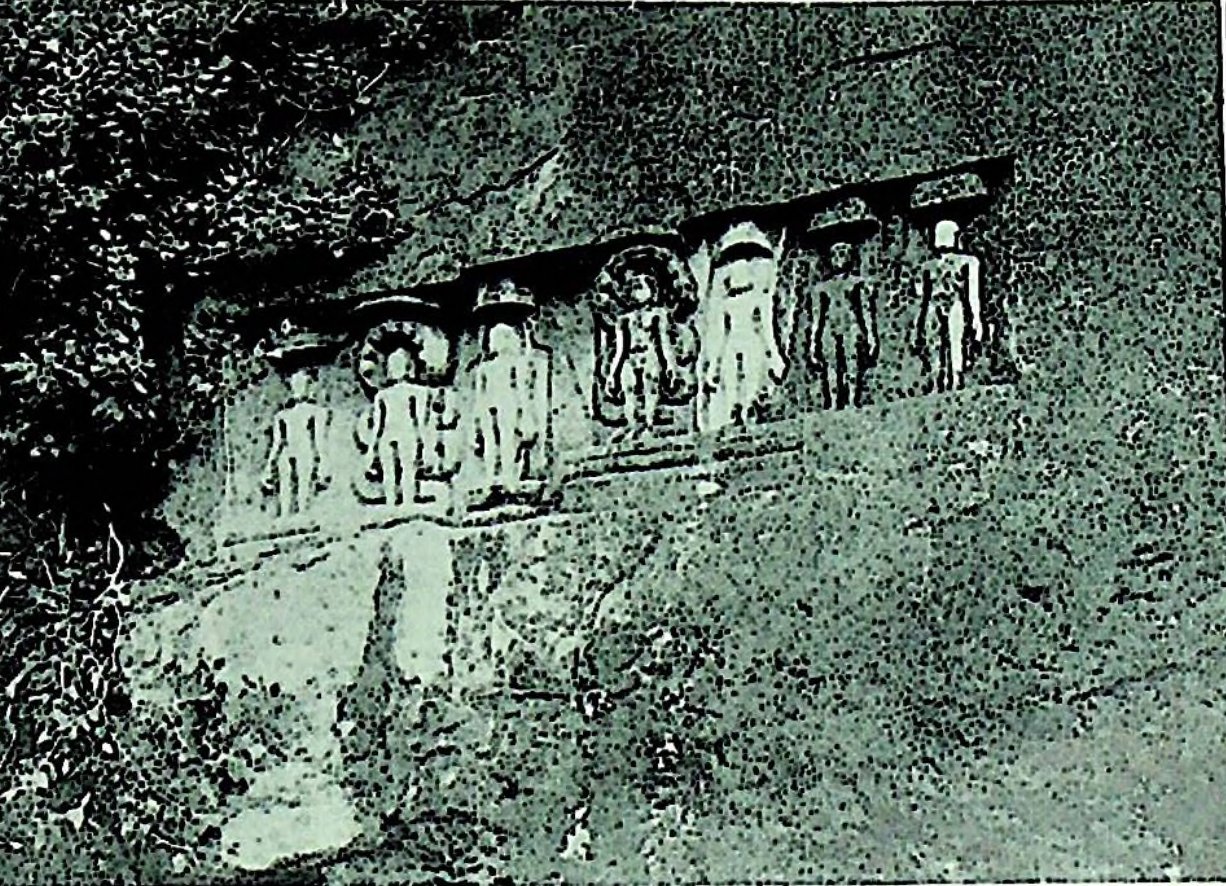
These photographs were published a century or more ago. They show the monument as it stood before later repair and restoration.
Photographed before 1934
A row of Jain sculptures carved on the northern hill inside the Anumakonda fort, as published in 1934.
Photographed before 1934
The entrance gate of the Anumakonda fort, seen at an angle with the path running through it, as published in 1934.
Photographed 1964
A stone gateway in Hanumakonda, photographed by 1964. Two plain square pillars carry a heavy lintel, and trees and a rocky hill stand behind it.
Photo: S. Gopalakrishna Murthy, The Sculpture of the Kakatiyas (A.P. Archaeological Series 34), Government of Andhra Pradesh, 1964, Fig. 1 · Public domain
Also recorded as
- Anumakonda
- Anmakonda
- Hanamakonda fort
- Hanumakonda fort
- Giri Durga
- Hanmantgiri
- An Makinda