Ekavira Temple, Mogilicherla
The ruined Ekavira temple at Mogilicherla, near Warangal, was a shrine of the goddess Ekavira, whom S. Gopalakrishna Murthy identifies with Renuka. Tradition credits it to Rudra Deva, and later chronicles and stories tie it to Rudrama Devi.
- Period
- Kakatiya. Tradition assigns it to the early years of Rudra Deva, while the state list of protected monuments of 2017 dates it to the 13th century
- Location
- 18.0136° N, 79.6561° EWarning: approximate
Source of the position: Geotags on Wikimedia Commons photographs of the temple (P. Madhusudan, 2021). The village of Mogilicherla is OpenStreetMap node 5296332118, about 600 metres to the east.
- Condition
- In ruins by 1962, with its annual festival discontinued. Photographs of 2021 show the pillared hall and the square sanctum still standing on bare rock, overgrown, with numbers painted on the pillars and beams.
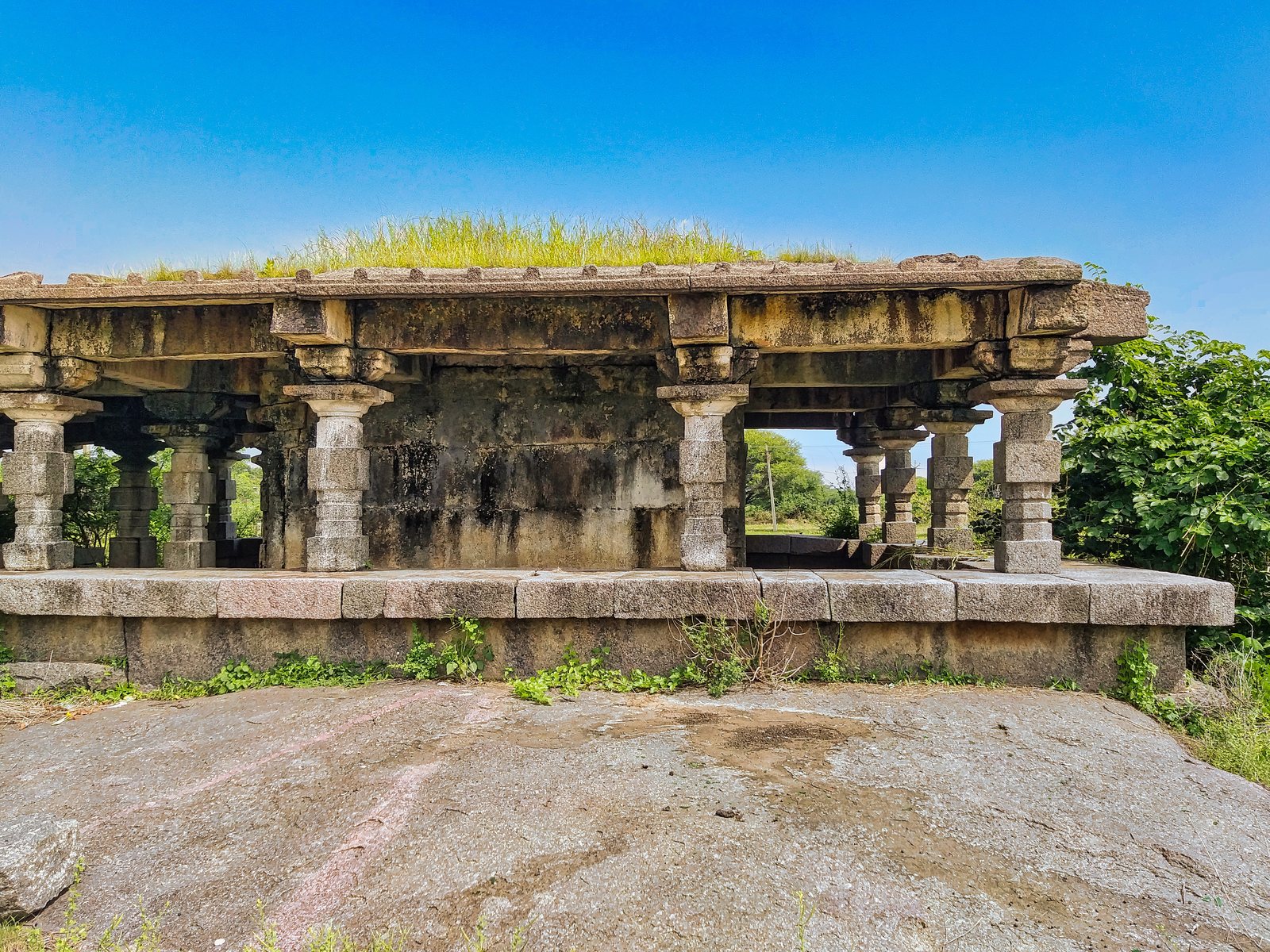
Photographed 2021
The Ekavira temple at Mogilicherla from the side, photographed in 2021. Pillars rise from the low wall around the hall, and the sanctum wall shows between them.
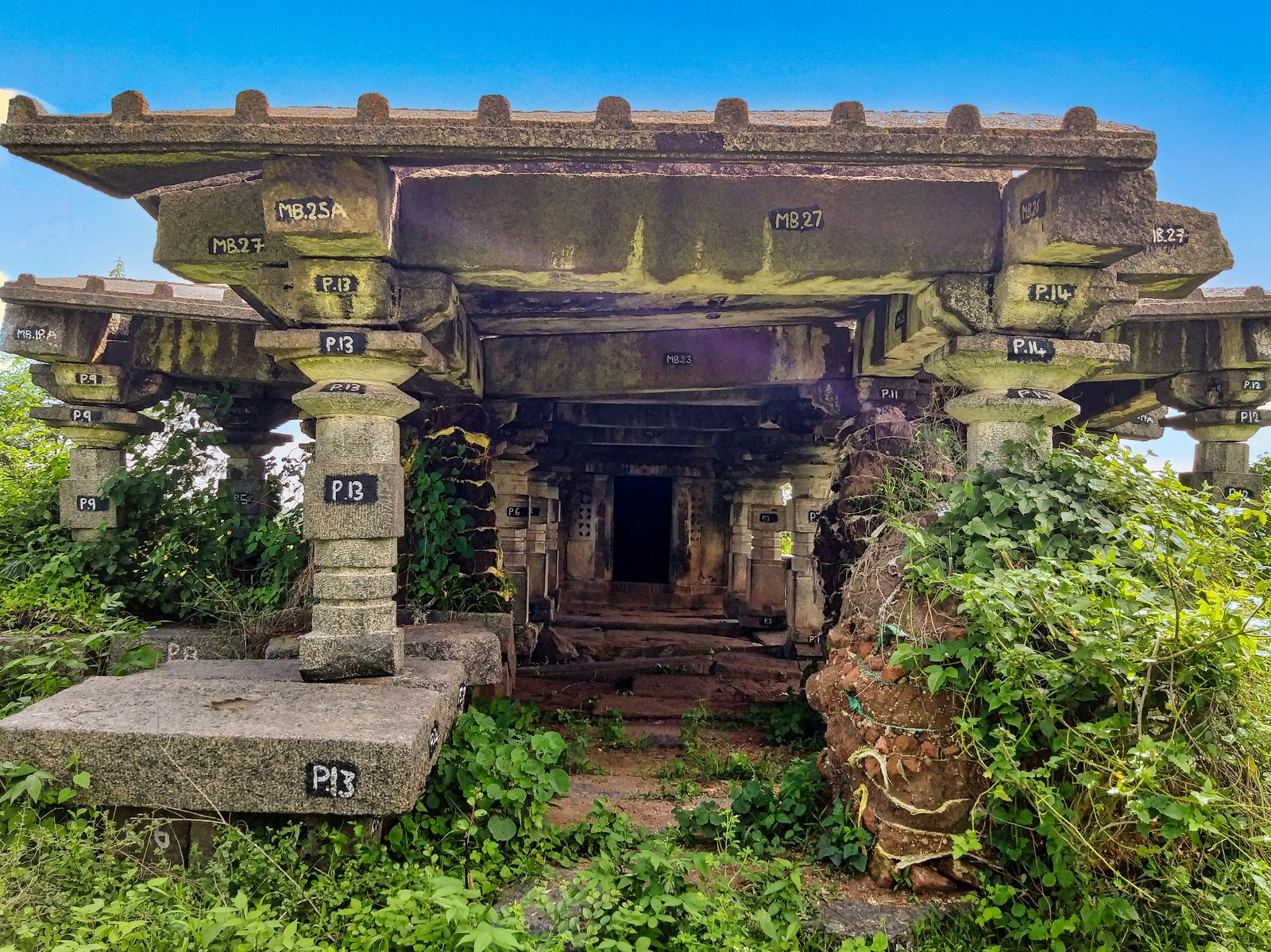
Photographed 2021
The entrance of the Ekavira temple, photographed in 2021. A porch on pillars leads through the hall towards the sanctum.
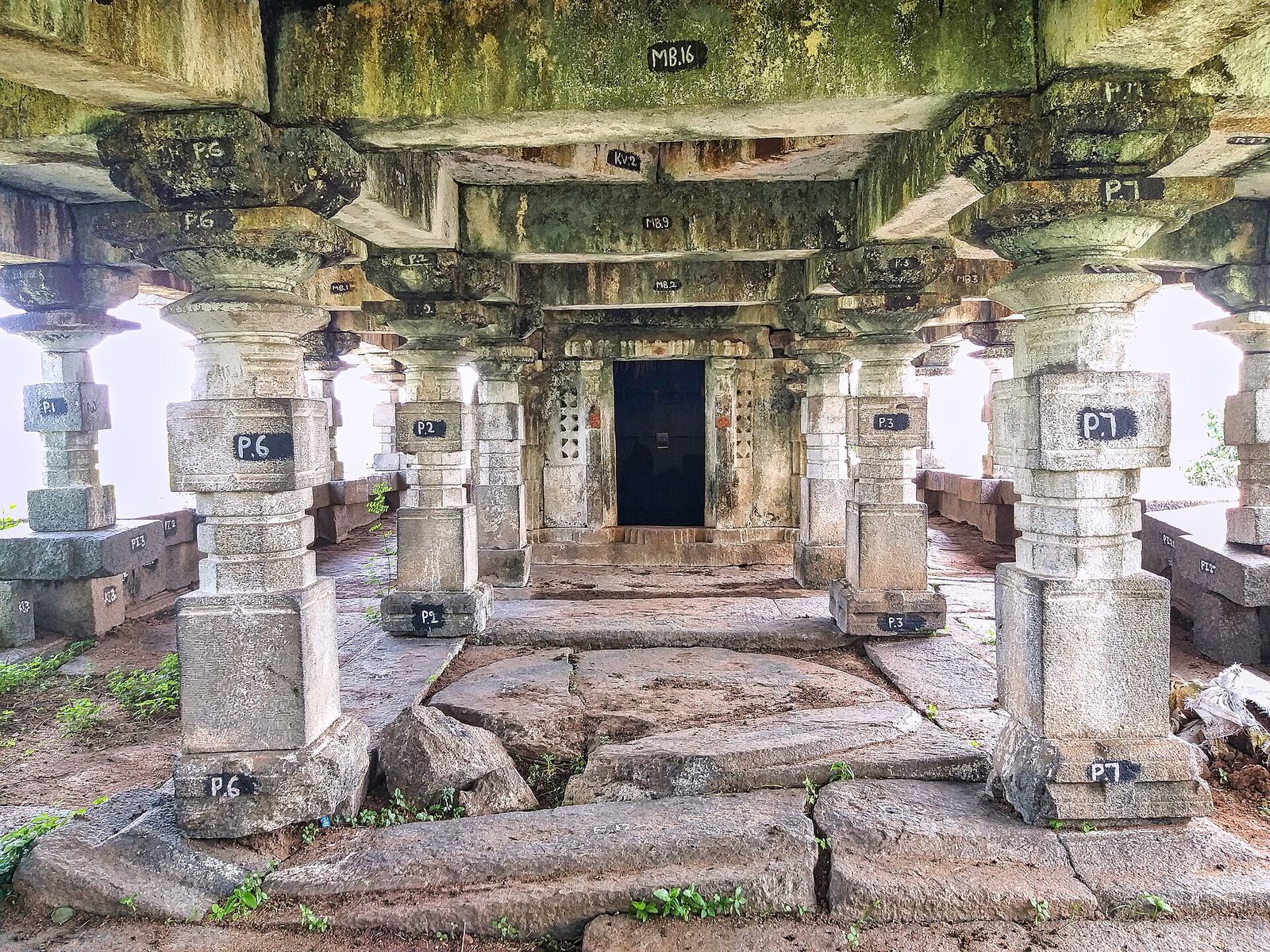
Photographed 2021
Inside the pillared hall, photographed in 2021. The sanctum doorway stands at the far end, between pierced stone screens.
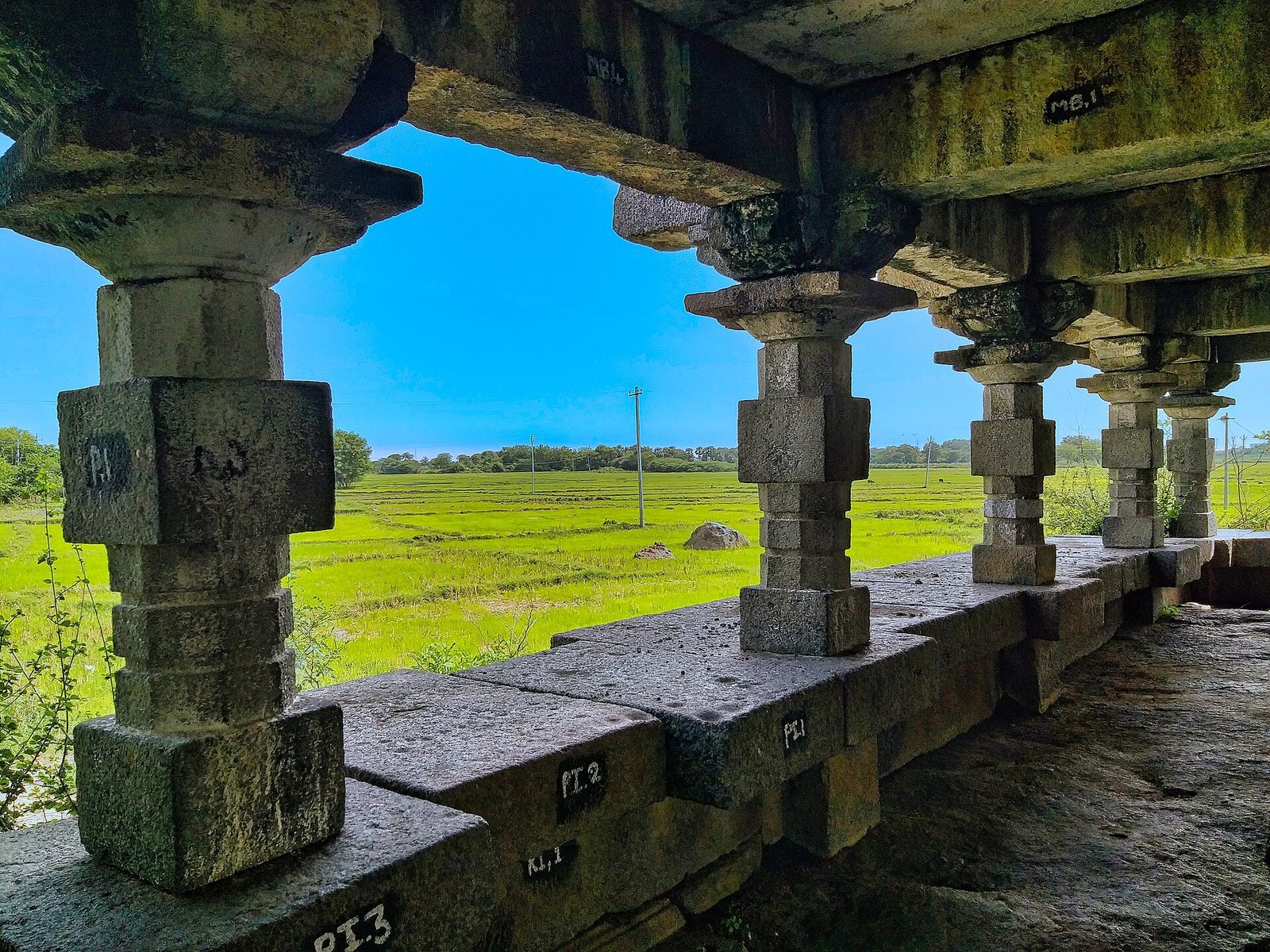
Photographed 2021
Pillars on the low wall at the edge of the hall, photographed in 2021. Rice fields lie beyond the temple.
Photographed 2021
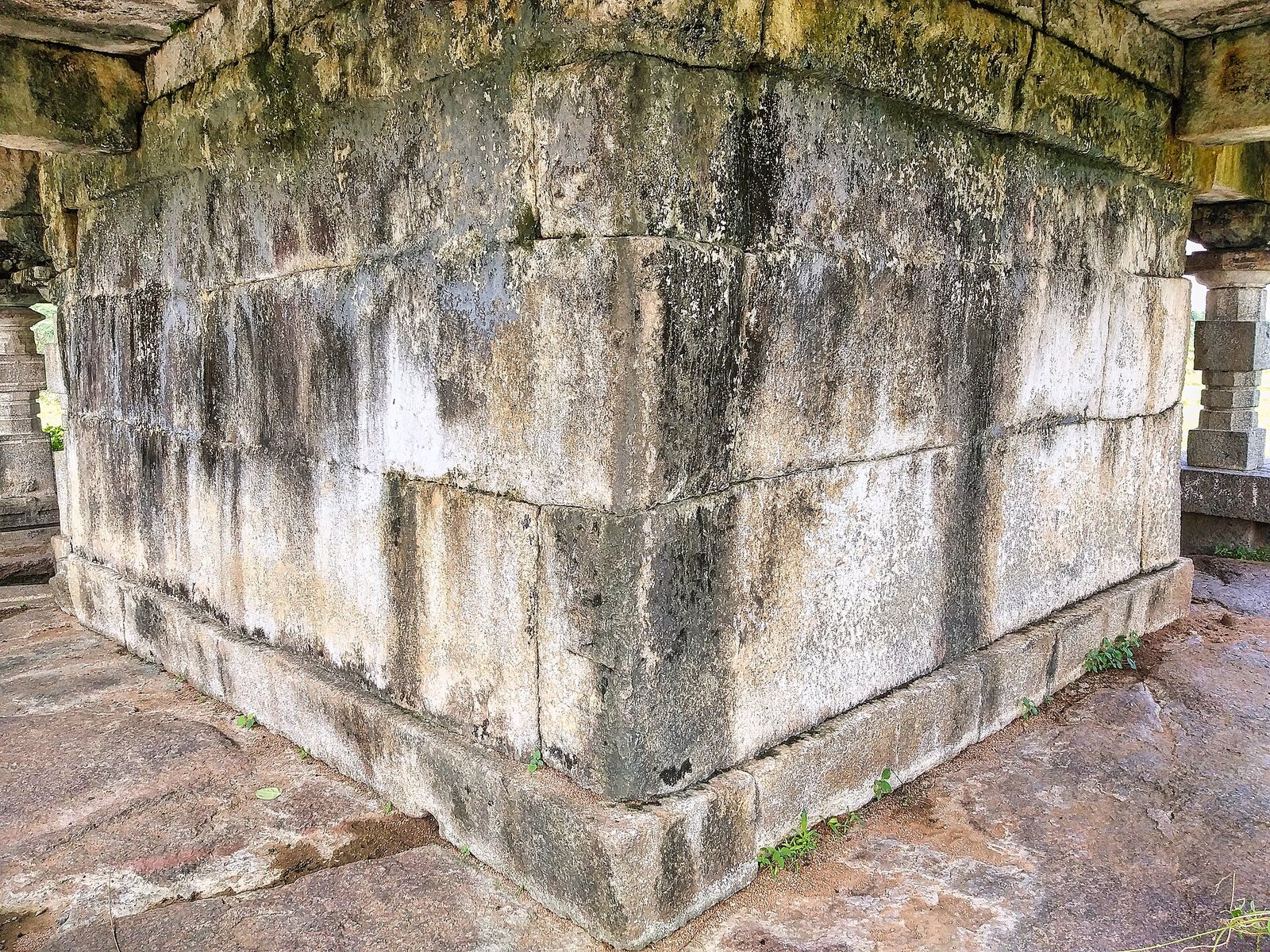
The plain outer wall of the square sanctum, inside the hall, photographed in 2021.
Detail
- The Census volume of 1964 places Mogilicherla in Warangal taluk, about 4 miles from Warangal Fort. The state's list of protected monuments of 2017 places the village in Geesukonda mandal.Census 1961, Fairs and Festivals: WarangalUNESCO additional information 2019
- The Census volume and the district gazetteer of 1976 both count the Ekavira temple among the nine big temples of Warangal district. The others include the Thousand Pillar Temple, the Ramappa temple and the Virabhadra temple at Korivi.Census 1961, Fairs and Festivals: WarangalWarangal District Gazetteer 1976
- S. Gopalakrishna Murthy identifies Ekavira with Renuka, the wife of the sage Jamadagni. In the legend that he retells, their son Parasurama cut off her head on his father's order.Gopalakrishna Murthy 1964
- In the same legend, Jamadagni could not restore Renuka's life, so he granted instead that her head would be worshipped. Murthy writes that the head is generally called Ellamma and the body Renuka or Bhudevi, and that both are worshipped as forms of Ekavira.Gopalakrishna Murthy 1964
- The state's list of protected monuments of 2017 names the monument the "Ekaveera/Ellamma temple".UNESCO additional information 2019
- Gopalakrishna Murthy calls Kakatamma and Ekavira the family deities of the Kakatiyas. He also writes that the worship of goddesses such as Kakati and Ekavira seems to have reached its height in the time of Rudrama.Gopalakrishna Murthy 1964
- According to a tradition reported by Gopalakrishna Murthy, Rudra Deva built three temples: the Kasibugga temple near Warangal, the Mailaradeva temple at Ainavolu and the Ekavira temple at Mogilicherla.Gopalakrishna Murthy 1964
- Murthy accepts this tradition because it fits as a preparation for the Thousand Pillar Temple, which Rudra raised at Hanamakonda in 1162. He describes the three temples as examples of experiment in the early years of Rudra's rule.Gopalakrishna Murthy 1964
- The state's list of protected monuments of 2017 dates the temple to the 13th century. Epigraphia Telanganica records no inscription at Mogilicherla.UNESCO additional information 2019Epigraphia Telanganica 2023
- Gopalakrishna Murthy describes the Ekavira temple as a simple one, with a sanctum and an antechamber. A parapet wall runs around it, with a raised stone seat along its inner side.Gopalakrishna Murthy 1964
- In his description, pillars seem to rise from the parapet wall at regular intervals. The roof covers the temple and also the circumambulatory path inside the line of pillars. Murthy notes the same kind of roof in the Chalukyan temples at Alampur.Gopalakrishna Murthy 1964
- B. Murali Krishna (2024), following the classification of Y. Gopala Reddy, lists the Ekavira Devi temple at Mogilicherla among the ekakuta temples, which have a single shrine.Murali Krishna 2024
- The same article names an "Ekaveera temple in Mogiliser", apparently this temple, as an example of the sandhara plan. In this plan a wide pillared hall encloses the shrine and fully roofs the circumambulatory path.Murali Krishna 2024
- Gopalakrishna Murthy saw a crude Bhairava carved in low relief near the temple, and a very recent image meant to portray Ekavira.Gopalakrishna Murthy 1964
- Murthy gives this Bhairava a height of ten feet and suggests that it could be a very early Kakatiya work. He contrasts it with the calmer Bhairava at Kasibugga, which he thinks was made in the Hoysala spirit.Gopalakrishna Murthy 1964
- The Census volume, quoting the Andhra Prabha weekly of 1962, gives a different height. It says that a stone image of Bhairava about six feet high and images of naginis were all that remained of the ruined temple.Census 1961, Fairs and Festivals: Warangal
- Gopalakrishna Murthy suggests that the sanctum once held a headless image of the goddess. He bases this on the description of a Warangal temple in the poem Kridabhiramamu and on the image at Alampur.Gopalakrishna Murthy 1964
- The Census volume reports a saying that there was once a gold image of Ekaveera Devi about three feet high. According to the same report, nothing was known of this image by 1962.Census 1961, Fairs and Festivals: Warangal
- The Census volume reports that the annual Dasara festival at Mogilicherla had been discontinued for twenty-five years. In 1962 the temple of Narasimhaswamy was the place of worship in the village.Census 1961, Fairs and Festivals: Warangal
- Gopalakrishna Murthy writes that Rudrama won popular support through frequent pilgrimages to Mogilicherla, Vaddapalli and Ainavolu, and through her support of the festivals there.Gopalakrishna Murthy 1964
- Ekamranatha's Prataparudra Caritramu, a Telugu prose chronicle, says that Rudrama Devi held a great festival for Vinayaka of Oddepalli, Ekavira Devi of Mogilicherla, Mailara of Ainavolu and all the gods. It says that she stayed outside the city for five days.Prataparudra Caritramu (Ekamranatha)
- The chronicle continues that her half-brothers Harihara Deva and Murari Deva then gathered some followers and shut the gates of the city. According to the chronicle, Rudrama subdued them by conciliation, entered the city and had them seized.Prataparudra Caritramu (Ekamranatha)
- Cynthia Talbot dates the Prataparudra Caritramu to the first half of the sixteenth century. She reads it as a later memory of the Kakatiyas, not as a record of events.Talbot 2001
- Goel and his co-authors (2022) quote a statement that Rudramba had gone to Mogalicherla to worship Ekavira when her two step-brothers, Harihara Deva and Murari Deva, closed the gates of Warangal Fort.Goel et al. 2022
- P. V. Parabrahma Sastry, in his thesis of 1975, reports this revolt from the Pratapa Charitra without naming Mogilicherla. He thinks it not improbable that some members of the royal family revolted against the queen.Parabrahma Sastry 1975 (thesis)
- A tradition recorded in the Census volume under Inole says that Rudra Deva, Ganapati Deva and Rudrama Devi worshipped daily at shrines near Warangal. These shrines included Mylaru Deva of Inole and Ekaveera Devi of Mogilicherla.Census 1961, Fairs and Festivals: Warangal
- The same tradition says that Ganapati Deva and Rudrama Devi rode to these temples daily, and that they paid special visits before a war.Census 1961, Fairs and Festivals: Warangal
- The Census volume also reprints a popular story from the Andhra Prabha weekly of 1962. The article calls Mogilicherla an obscure village that had been a prominent city at the height of Kakatiya rule. It says that Rudrama Devi visited the temple daily.Census 1961, Fairs and Festivals: Warangal
- In this story the Kakatiya rulers worshipped Ekaveera Devi before every war. Rudrama Devi was keeping a vow at the temple when a Yadava army attacked Mogilicherla, and the Kakatiyas captured the Yadava king Mahadeva.Census 1961, Fairs and Festivals: Warangal
- The same story credits a carved panel on a pillar of the temple to the minister Annaiah. As a boy, Annaiah had spent his days with the artisans at the temple site and became a skilled carver. In the story, the panel showed Rudrama Devi chasing the king of Devagiri.Census 1961, Fairs and Festivals: Warangal
Also recorded as
- Ekavira
- Ekaveera
- Ekavira Devi
- Ekaveera Devi
- Ekaveera temple
- Ekaveera/Ellamma temple
- Ellamma temple
- Renuka
- Mogilicherla
- Mogilcherla
- Mogalicherla
- Mogilcharla
- Mogiliser