Mattewada Temples
Mattewada is an old quarter of Warangal, between Hanumakonda and the Warangal fort. Gopalakrishna Murthy describes old temples and sculptural fragments along the Mattewada road, and the carved doorway of its Ramalingesvara temple. Inscriptions of the reign of Ganapati Deva found here record gods set up for the weavers and gifts by merchant guilds.
- Period
- Kakatiya. Two inscriptions of the reign of Ganapati Deva were copied at Mattewada, and one of them is dated 1228
- Location
- 17.9775° N, 79.5955° EWarning: approximate
Source of the position: OpenStreetMap node 2712708517, tagged Ram Lingeshwara Temple. No source ties this point to the Ramalingesvara temple described by Murthy. OpenStreetMap places named Matwada lie about 1 km to the north, near 17.987, 79.598, and a Sri Bhogeshwara Swamy Temple is mapped at 17.9863, 79.5944.
- Condition
- Murthy wrote in 1964 that the small temples on the Mattewada road had been renovated over the centuries, while sculptural fragments lay under trees and in fields. The District Census Handbook of 1986 calls some old temples here dilapidated.
No copyright-free photograph of this site is available yet. Offer a photograph you took
Detail
- Parabrahma Sastry writes in his thesis of 1975 that the market of the Kakatiya capital was called Mathiya. He places it between the old town of Anumakonda and the new town of the Orugallu fort.Parabrahma Sastry 1975 (thesis)
- According to Parabrahma Sastry, this place is now called Mattewada, and it forms the heart of modern Warangal, where business still takes place. Telangana – Land and People also says that the market of Orugallu was called Mathiya, and that the name changed to Mattewada with time.Parabrahma Sastry 1975 (thesis)Goel et al. 2022
- Parabrahma Sastry adds that one of the Warangal inscriptions treats the capital complex of Anumakonda, Mattewada and Orugallu as a single sthala. He describes the sthala as a unit of about twenty villages.Parabrahma Sastry 1975 (thesis)Parabrahma Sastry 1978
- Gopalakrishna Murthy writes that a road was laid from the Hanumakonda fort gate to the temple of Swayambhunatha in Warangal, with several temples on either side. Murthy imagined that this road ran along the high road in Hanumakonda to the Warangal station, and then along the Mattewada road.Gopalakrishna Murthy 1964
- Murthy writes that numerous old temples still stood on either side of the Mattewada road in his day. He adds that all the small temples on the road in Mattewada had been renovated over the centuries.Gopalakrishna Murthy 1964
- According to Murthy, the sites of these temples and the hundreds of sculptural fragments under the trees, in deserted temple courts and in the fields, prove that the road was once a line of temples.Gopalakrishna Murthy 1964
- In a footnote Murthy observes that the straight road from the Hanumakonda fort gate to the present entrance of the Warangal fort shows no temples or temple ruins. He suggests that the old road led to the northern gate, and that the town on that side was probably destroyed in the war.Gopalakrishna Murthy 1964
- Murthy describes the tower of the Sambhunigudi in Warangal as a stepped and elongated pyramid. He thought that this form copied in brick the stepped stone towers of the Jain temples of the Kadamba region.Gopalakrishna Murthy 1964
- Murthy names the temples in Mattewada among those built in this pattern, together with temples in Hanumakonda, Kasibugga and Warangal. Murthy adds that this form is not a happy one.Gopalakrishna Murthy 1964
- Murthy names the Ramalingesvara temple of Mattewada as one of the small temples around Warangal whose architraves echo those of the Swayambhu temple. The architrave above its doorway shows Brahma, Kumara, Siva and Ganapati dancing.Gopalakrishna Murthy 1964
- According to Murthy, each dancing god has a pair of drummers and time-keepers on either side, and the vehicles of the gods are left out entirely.Gopalakrishna Murthy 1964
- Murthy dates the carving by its style to the time of Ganapati Deva. He thought that the door frame came from an older temple, because the name Ramalingesvara does not appear in the records of that period found at Mattewada.Gopalakrishna Murthy 1964
- Murthy later compares the architraves of the Gautamesvara temple at Manthani with the Ramalingesvara architrave of Mattewada. He calls the panel at Mattewada plain. At Manthani the dancing gods stand in separate arches under hanging mango creepers.Gopalakrishna Murthy 1964
- The District Census Handbook of Warangal says that Hanumakonda, Mathwada and Girmajipet were hamlets that served as religious centres in the Kakatiya period. The handbook adds that some old temples still stand in these hamlets in a dilapidated condition.District Census Handbook 1986
- An inscription of the reign of Ganapati Deva is cut on the four sides of a stone pillar at Mattewada. The corpus of 1940 found the pillar standing near the house of Ramanna. Epigraphia Telanganica lists the record under Girmajipeta, with Mettewada as the place where it was found.Sreenivasachar 1940, Part IIEpigraphia Telanganica 2023
- Epigraphia Telanganica also quotes the Annual Report on Indian Epigraphy for 1957-58. That report describes the pillar as lying in the courtyard of the house of Kedari in Ellamma bazar.Epigraphia Telanganica 2023
- The record is dated on a Thursday, the tenth day of the bright half of Phalguna in the year Sarvajit. The corpus of 1940 gives the probable date as 16 February 1228, and notes that this day was a Wednesday.Sreenivasachar 1940, Part IIEpigraphia Telanganica 2023
- In the reading of the corpus, Ramgala-Manni-setti and his son Enni-setti set up the god Salesvara. The god Ganapatesvara was set up in the name of King Ganapati Deva, and Sakalesvara in the name of all the devotees.Sreenivasachar 1940, Part IIEpigraphia Telanganica 2023
- The 1957-58 report explains that Salesvara was named after the weavers. The record grants shares of income for the worship of the three gods. Anyone who refused to pay was declared a traitor to Siva and was put outside the community.Epigraphia Telanganica 2023Sreenivasachar 1940, Part II
- The record calls Ganapati the destroyer of the kings of Lada, Choda and Kataka, and the seventh emperor. A footnote in the corpus says that M. H. Krishna translates the word for destroyer as plunderer.Sreenivasachar 1940, Part IIEpigraphia Telanganica 2023
- The Early History of the Deccan reads this inscription of Mattevada as saying that Ganapati plundered a Chola capital, which was in all probability Kanchi. Parabrahma Sastry gives the same reading.Yazdani 1960Parabrahma Sastry 1978
- On the third side, the nakharamu, the merchant guild, of Ciramatti gives a share of income for the worship of the god Nakaresuka. On the fourth side, the god Salesura of Orukallu receives grants at the big tanks of Vavilala and Vitukati.Sreenivasachar 1940, Part IIEpigraphia Telanganica 2023
- Epigraphia Telanganica explains that Orukallu is the modern Warangal, and that Ciramatti was probably one of the divisions of the city. In its remarks on another Warangal record of 1228, the corpus calls Ciremathiya a division of the city like Matiya-vada.Epigraphia Telanganica 2023Sreenivasachar 1940, Part II
- Epigraphia Telanganica also lists a record from Nagunur, in the Karimnagar district, that sets up Salesvara, Ganapatisvara and Sakalesvara for the saliyas, the weavers. That record carries the same lunar date, the tenth day of Phalguna in the year Sarvajit.Epigraphia Telanganica 2023
- Epigraphia Telanganica converts the date of the Nagunur record to 2 March 1228. The Nagunur record names its builders as Nijaramgala-Malli-Setti and his son Venni-Setti. It places the gods at Matiya-sthala, situated between the three cities.Epigraphia Telanganica 2023
- Epigraphia Telanganica places the Nagunur stone near the images in front of the Sakti temple outside that village.Epigraphia Telanganica 2023
- Parabrahma Sastry calls the record the Girmijipet epigraph of 1228. He writes that the weavers of Mattiya-sthala installed the god Salesvara, and that they named Mallisetti and his son Vennisetti to install the gods on their behalf.Parabrahma Sastry 1978
- Parabrahma Sastry takes this sthala to be the sthala of the towns of Anumakonda, Orugallu and Mattevada. He concludes that the weavers there formed a corporate body that looked after their own affairs.Parabrahma Sastry 1978
- A second inscription of the reign of Ganapati Deva is cut on a broken stone pillar. The corpus of 1940 found this pillar lying in the compound of Mr. Venkatasvami Naidu at Mattewada.Sreenivasachar 1940, Part IIEpigraphia Telanganica 2023
- The record says that the guild of traders in the five metals made a gift to the god Somanatha. The whole merchant body also gave dues on cart-loads of sandal and on areca nuts. The fourth side names the god as Somanatha of Matiya-vada.Sreenivasachar 1940, Part IIEpigraphia Telanganica 2023
- Epigraphia Telanganica quotes a catalogue of 1964, which adds that the guild of merchants in scents also made a gift. Much of the stone is lost, and the corpus could read only parts of each side.Epigraphia Telanganica 2023Sreenivasachar 1940, Part II
- Epigraphia Telanganica lists a further record of gifts to Somanathadeva of Mathiyavada by several guilds, on a conical stone inside the Kush Mahal in the Warangal fort. Under the same number it quotes the Annual Report on Indian Epigraphy for 1957-58.Epigraphia Telanganica 2023
- That report describes a broken pillar in front of the Khush Mahal, with gifts to Somanathadeva of Matiyavada by guilds of merchants. The report says that this record had been published in the corpus as No. 11, the number of the Venkatasvami Naidu pillar.Epigraphia Telanganica 2023Sreenivasachar 1940, Part II
- Epigraphia Telanganica lists a Kannada inscription on a stone near the Bhogeswara temple at Mattewada. The record mentions Jain ascetics of the Kondakunda line and Tribhuvana Chandra, a disciple of Govardhana, and ends with a gift.Epigraphia Telanganica 2023
- Under the same entry, Epigraphia Telanganica quotes the Annual Report on Indian Epigraphy for 1958-59. That report describes a red stone pillar lying in the Bhogeswara temple, inscribed in Sanskrit and Kannada.Epigraphia Telanganica 2023
- In that reading the pillar is a nisidhi, a Jain memorial pillar, set up for Tribhuvana Chandra Bhattaraka of the Mulasamgha and the Kondakunda line. Epigraphia Telanganica gives no date or dynasty for this record.Epigraphia Telanganica 2023
- The Settlement Report of the Warangal taluk, of 1893, calls Mutwara the chief market town. The report says that the town was a great centre of trade during the Hindu dynasty.Warangal Settlement Report 1893
- The same report quotes Marco Polo on the kingdom of Mutfili, and adds in brackets that Mutfili is now known as Mutwara. Henry Yule identifies Mutfili with Motupalle, a port in the Guntur district.Warangal Settlement Report 1893Yule and Cordier 1903, Vol. II
- In 1898 A. Claude Campbell wrote that Karimabad and Matwara, a mile north-west of Warangal, were in ancient times the two principal suburbs of the city. He adds that most of the carpet weavers and a colony of silk weavers lived at Matwara.Campbell 1898
Historical photographs
These photographs were published a century or more ago. They show the monument as it stood before later repair and restoration.
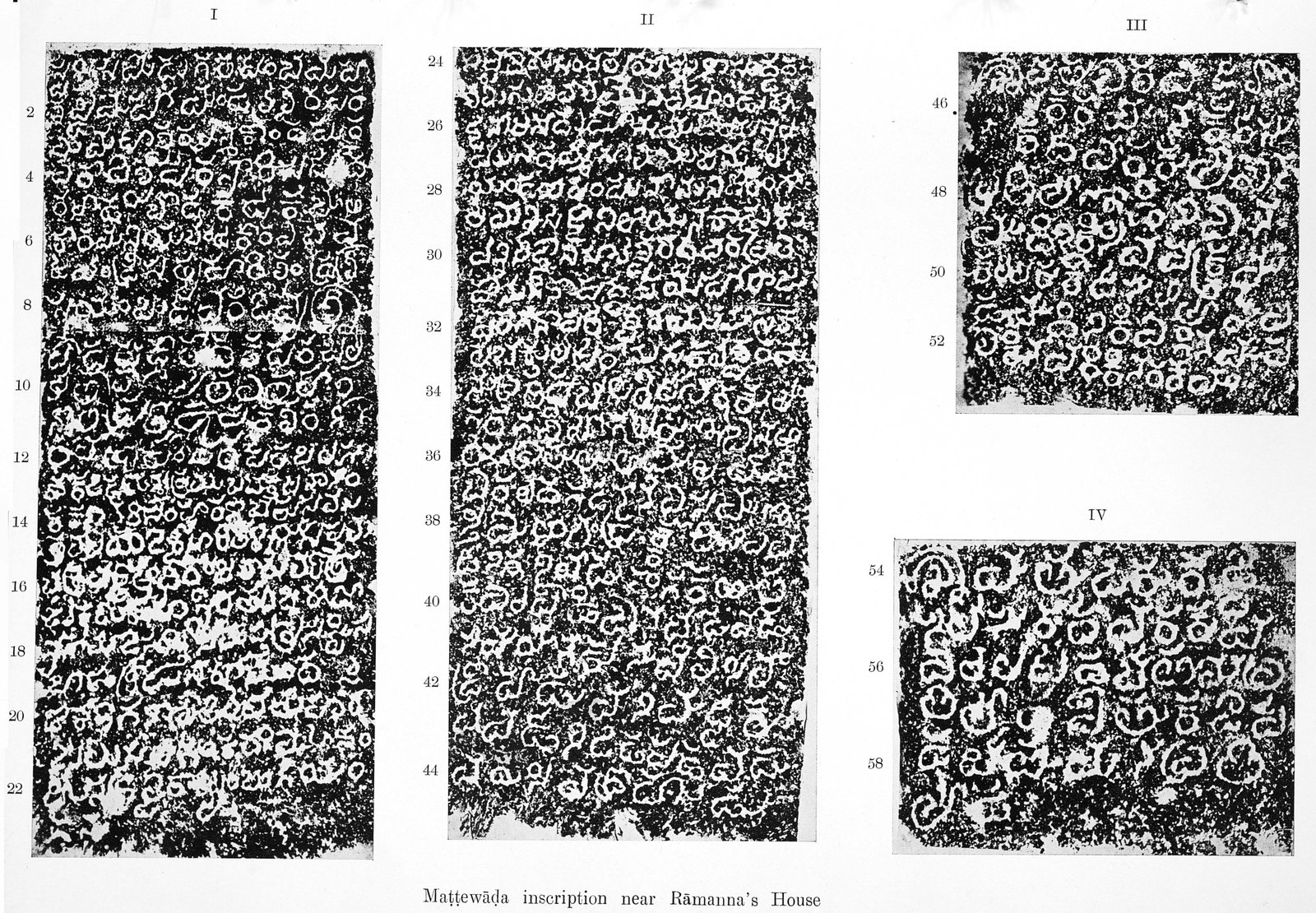
Photographed before 1940
An inked impression of the four sides of the pillar near Ramanna's house at Mattewada, published in 1940. The record of 1228 sets up the gods Salesvara, Ganapatesvara and Sakalesvara.
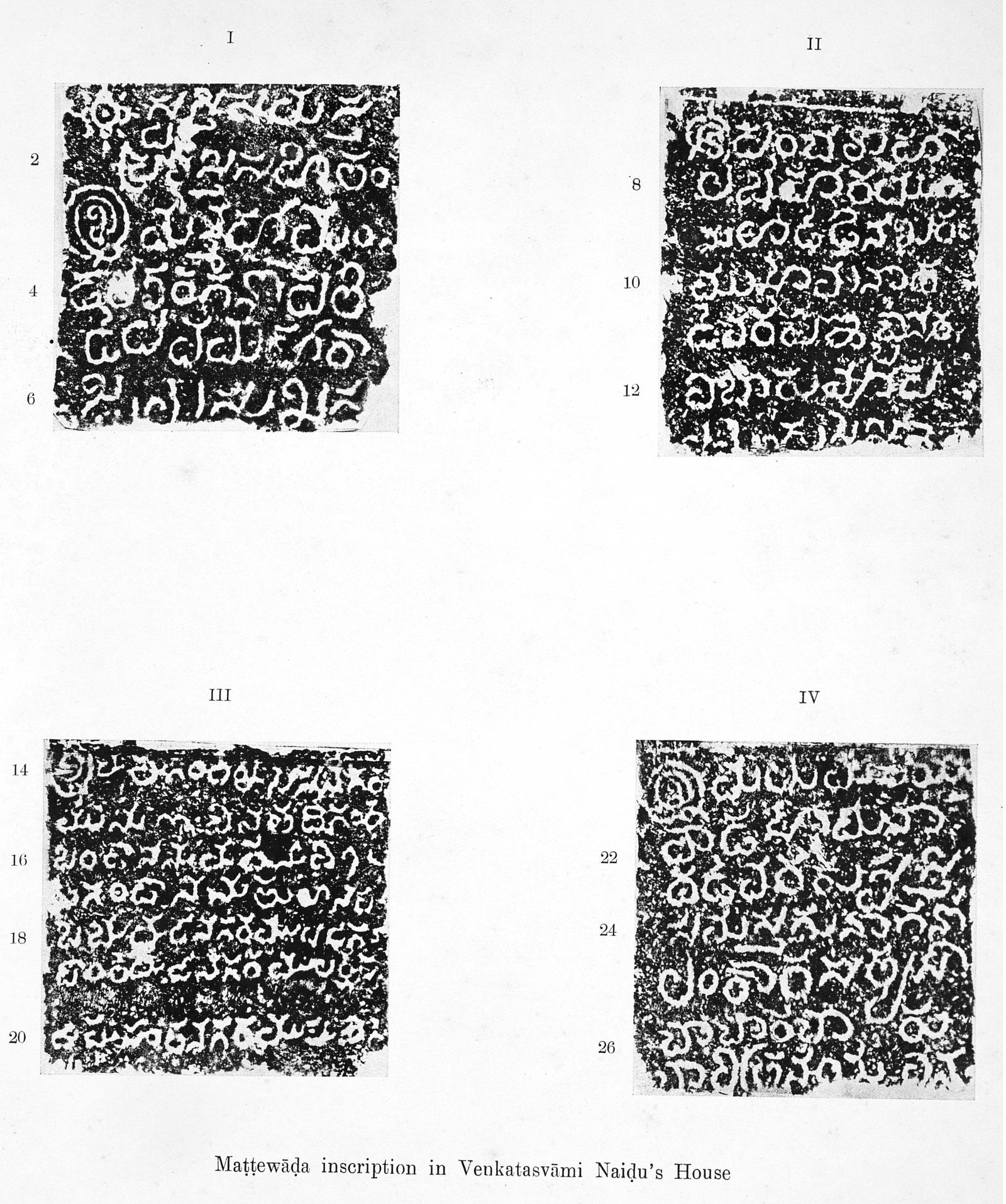
Photographed before 1940
An inked impression of the broken pillar in the compound of Venkatasvami Naidu at Mattewada, published in 1940. The record names the god Somanatha of Matiya-vada and the gifts of merchant guilds.
Also recorded as
- Mattewada
- Mettewada
- Mattevada
- Matwada
- Mathwada
- Metwada
- Matwara
- Mutwara
- Matiya-vada
- Matiyavada
- Mathiyavada
- Mathiya