InscriptionsHow to read a Kakatiya inscription
Part 4 of 5
Read one yourself
A seven-step method, tried on the Ramappa pillar of 1213, with two alphabet charts from 1134 and 1356.
About 3 min to read
Read it yourself
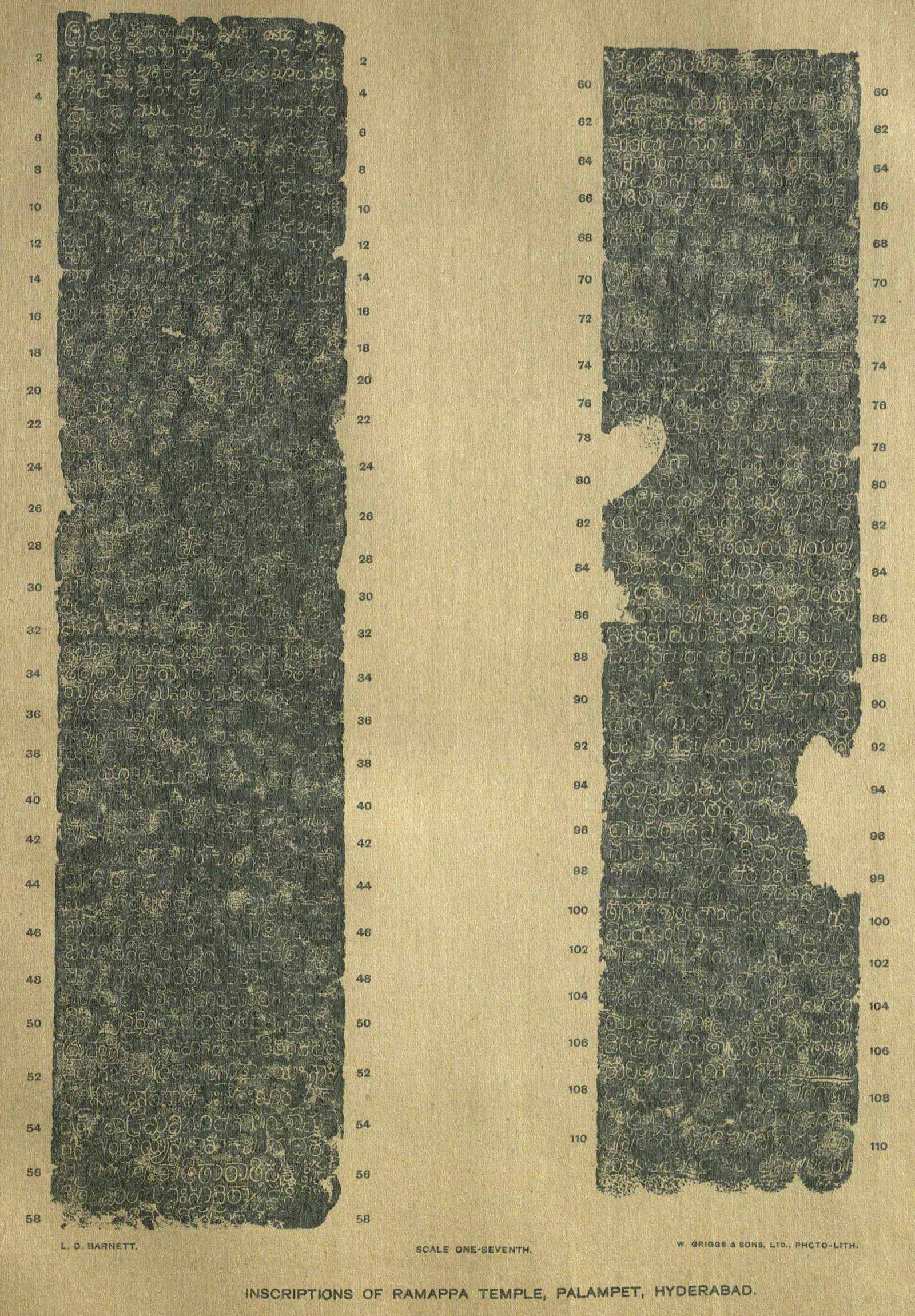
Estampage (ink impression)
This estampage shows lines 1 to 110 of the Sanskrit inscription of Recherla Rudra on a black basalt pillar at the Ramappa temple, Palampet. Barnett describes the letters as fairly good Telugu characters of the type usual in the period. The book prints the plate at one-seventh of the original size, with the caption "Inscriptions of Ramappa Temple, Palampet, Hyderabad".
Estampage published in L. D. Barnett (ed.), Inscriptions at Palampet and Uparpalli, Hyderabad Archaeological Series No. 3 (1919). Photo-lithograph by W. Griggs & Sons. G. Yazdani took the estampages in 1916. Plate: "Inscriptions of Ramappa Temple, Palampet, Hyderabad", scale one-seventh. · Public domain · This record in the database
Estampage (ink impression)
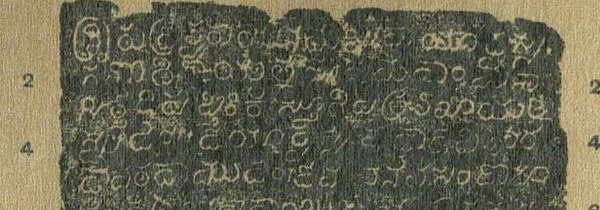
The first lines of the Ramappa pillar of 1213, cut from the estampage above. Line 1 begins at the top left with the sign for śrī.
Estampage published in L. D. Barnett (ed.), Inscriptions at Palampet and Uparpalli, Hyderabad Archaeological Series No. 3 (1919). Photo-lithograph by W. Griggs & Sons. G. Yazdani took the estampages in 1916. Plate: "Inscriptions of Ramappa Temple, Palampet, Hyderabad", scale one-seventh. · Public domain · This record in the database
Estampage (ink impression)
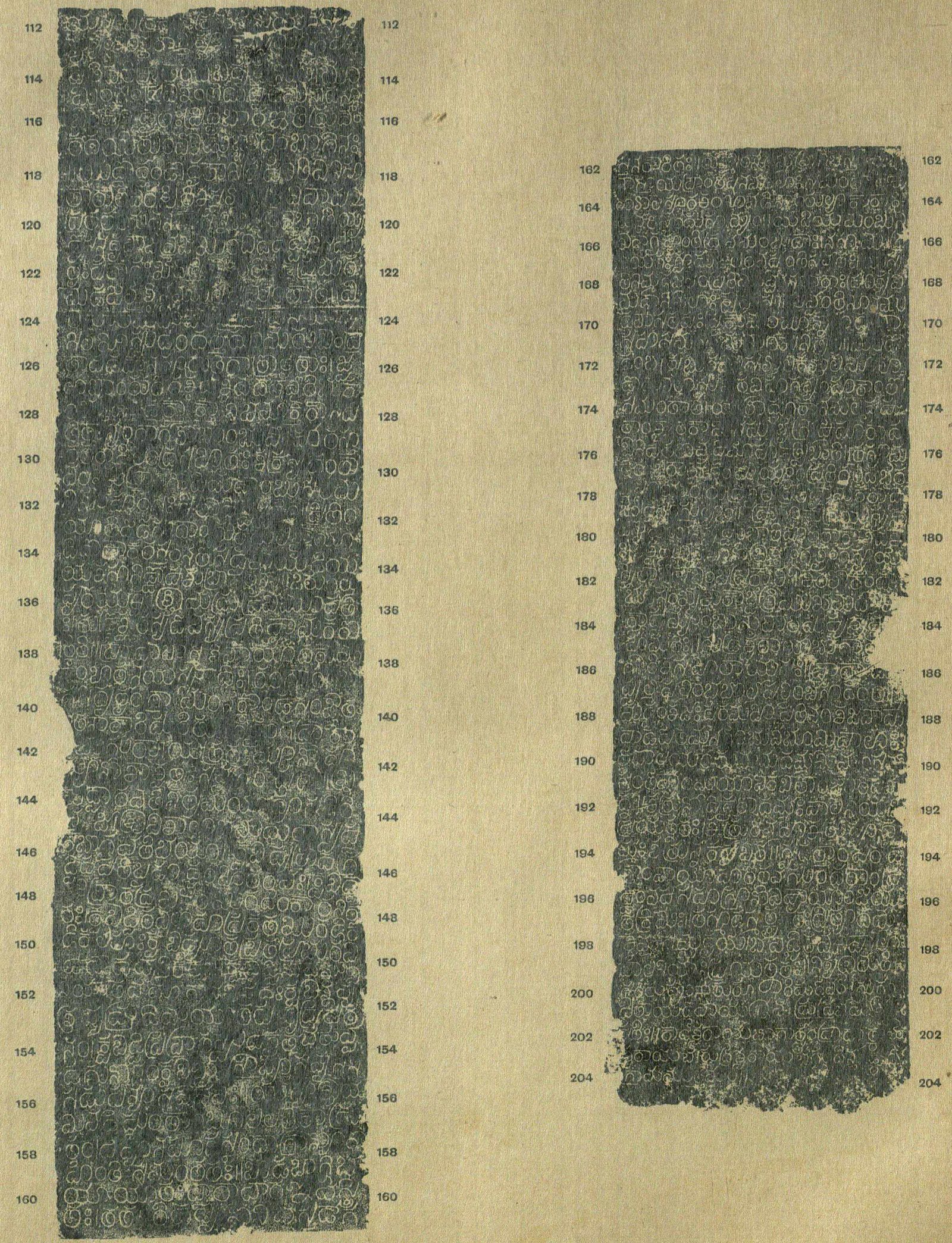
This estampage continues the Ramappa pillar inscription from line 112 to line 204. Lines 183 and 184 in the right-hand column give the date of the grant. Barnett reads Saka 1135, the year Srimukha, Chaitra bright eighth day, Sunday, and equates it with 31 March 1213.
Estampage published in L. D. Barnett (ed.), Inscriptions at Palampet and Uparpalli, Hyderabad Archaeological Series No. 3 (1919). Photo-lithograph by W. Griggs & Sons. G. Yazdani took the estampages in 1916. Second page of the plate "Inscriptions of Ramappa Temple, Palampet, Hyderabad" (unnumbered continuation). · Public domain · This record in the database
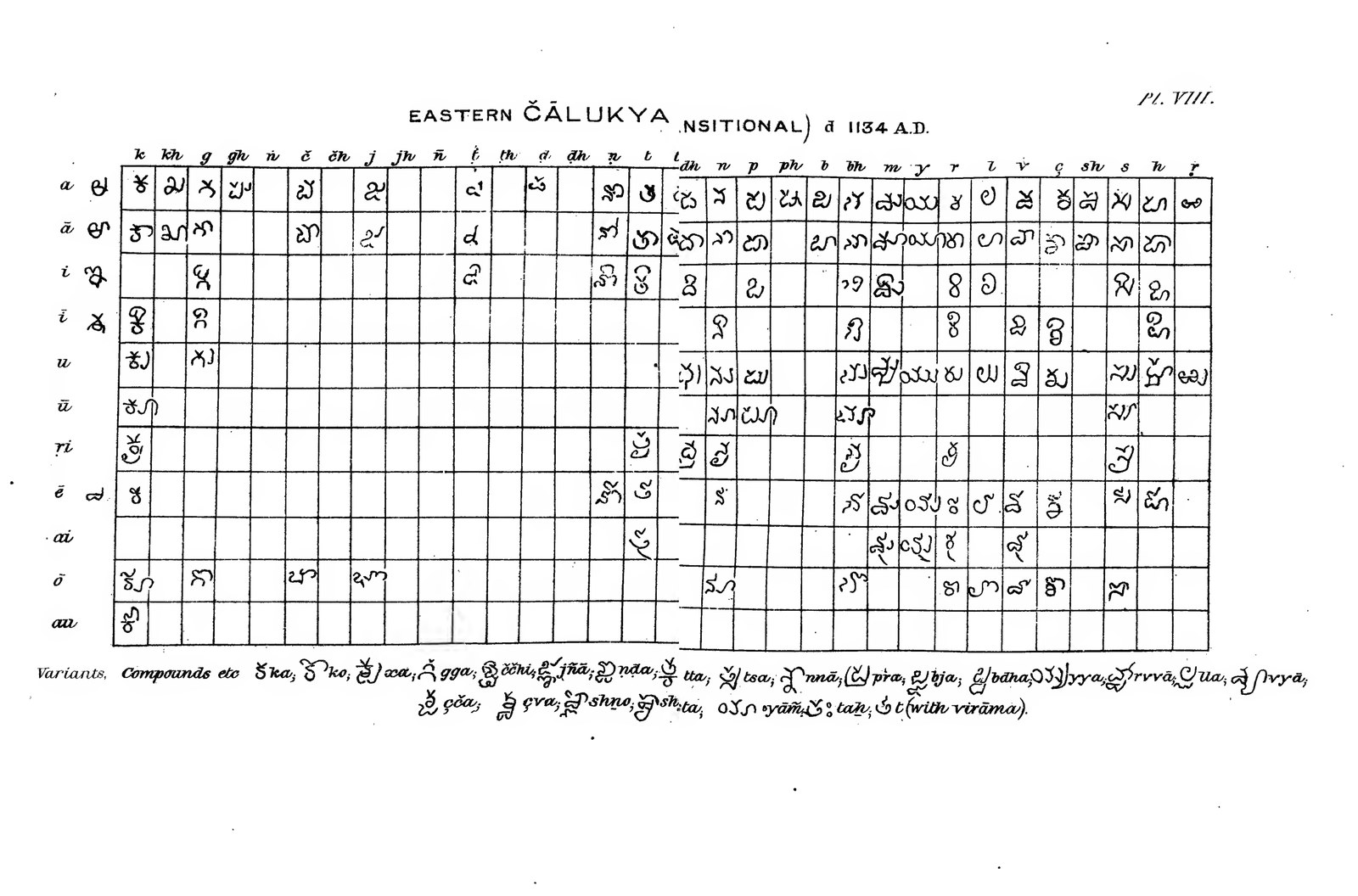
Plate from a published report
Burnell called this alphabet Eastern Chalukya (transitional) and dated it to 1134. Each column is a consonant and each row a vowel, so each cell shows how one syllable was written.
A. C. Burnell, Elements of South-Indian Palaeography, 2nd edition (1878), Plate VIII. The scan's two pages are joined here. · Public domain
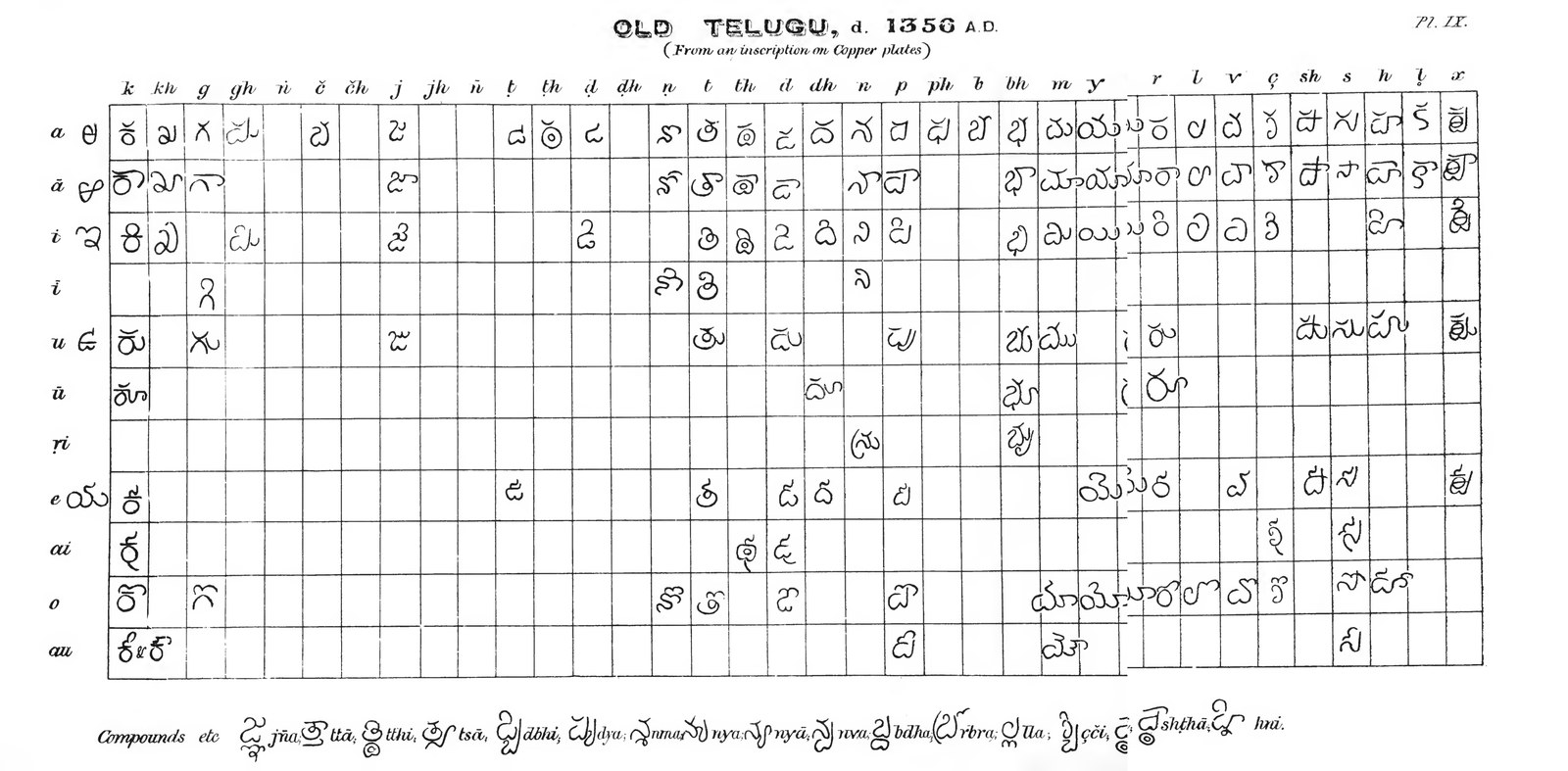
Plate from a published report
Burnell called this alphabet Old Telugu and dated it to 1356, from an inscription on copper plates. The letters are close to those of the later Kakatiya records, and many are close to modern Telugu.
Readers can learn to recognise the letters of a Kakatiya record themselves. Epigraphists use a simple method. They begin with the words that they can predict, learn the letter shapes from those words, and build a table of letters as they go.
The method has seven steps.
- Work from a clear image. An estampage, or a photograph taken in low, slanting light, shows shallow strokes best.
- Identify the script. Nagari letters hang from a flat line at the top, as in Hindi. Telugu and Kannada letters are rounded and have no such line.
- Use the date of the record. Before about 1150 the letters follow the shared Telugu-Kannada script. Later records use the Telugu letters of their period.
- Look for the words that you can predict. Most records open with an invocation, give the date with the word Saka and a year, name the king and the donor, and close with verses of blessing and curse. Each word that you find teaches you new letter shapes.
- Build your own table. Write the modern letters in a grid, and draw each old shape beside its modern form as you identify it. A vowel after a consonant is written as a sign attached to it, and a cluster of consonants is written one below the other.
- Read letter by letter and line by line. The stone has no spaces between words. Write the letters in a row first, and divide them into words afterwards. Mark a doubtful letter with a question mark and a lost letter with dots.
- Expect the old spellings described in the part on letters and languages, and compare your reading with the editor's text. The Inscriptions page links each record to its page in Epigraphia Telanganica.
Parabrahma Sastry 1978Barnett 1919Epigraphia Telanganica 2023 · Read more on this
Try the method on the Ramappa pillar of 1213. In the close view at the top of this section, line 1 begins at the top left with a large looped sign. That sign is śrī, the word that opens most records.
The 1919 edition reads the opening as Śrī-Rudreśvarāya namaḥ, written in modern Telugu as శ్రీరుద్రేశ్వరాయ నమః. The words mean 'salutation to the glorious Rudreśvara', the god of the temple. Compare each letter of the modern words with the shapes on the stone, and add them to your table.
Barnett 1919 · Hyderabad Archaeological Series 3 (1919), Text, first side, line 1
A second anchor lies in lines 183 and 184, on the second estampage of the pillar above. These lines give the date: Saka 1135, the cyclic year Śrīmukha, the month Madhu (Chaitra), the eighth day of the bright fortnight, and Sunday.
The editor works these details out as Sunday, 31 March 1213. The poet also gave the Saka year in words, as earth, moon, worlds and arrows, which the editor reads as 1135.
Barnett 1919 · Hyderabad Archaeological Series 3 (1919), introduction, on lines 183-184
The two charts at the top of this section come from A. C. Burnell's Elements of South-Indian Palaeography (1878). In each chart, every column is a consonant and every row a vowel. Each cell shows how that syllable was written.
Burnell dated the first chart to 1134, when the early Kakatiya chiefs ruled, and the second to 1356, a generation after the fall of Warangal. The letters of the Kakatiya records lie between the two. Tap a chart to open it at full size, and keep it open beside an estampage while you read.
Burnell 1878 · Burnell 1878, Plates VIII and IX
G. H. Ojha's Plate 50 charts the letters of two Kakatiya records. The upper part comes from the Anumakonda inscription of Rudra Deva, the Thousand Pillar inscription, which Ojha dates to Saka 1084, 1162 CE. The lower part comes from a Chebrolu inscription of Ganapati Deva's time, Saka 1135, 1213 CE. Ojha found that many of these letters closely resemble modern Kannada or Telugu letters.
Ojha 1918Fleet 1882 · Ojha 1918 p. 88 (in Hindi) and Plate 50; IA XI p. 12 and Plate I · Record ii-hanumakonda-3