InscriptionsHow to read a Kakatiya inscription
Part 3 of 5
Dates
The Saka era, current and expired years, the sixty-year cycle, months, tithis and weekdays, with worked examples and a year converter.
About 7 min to read
How to read a date
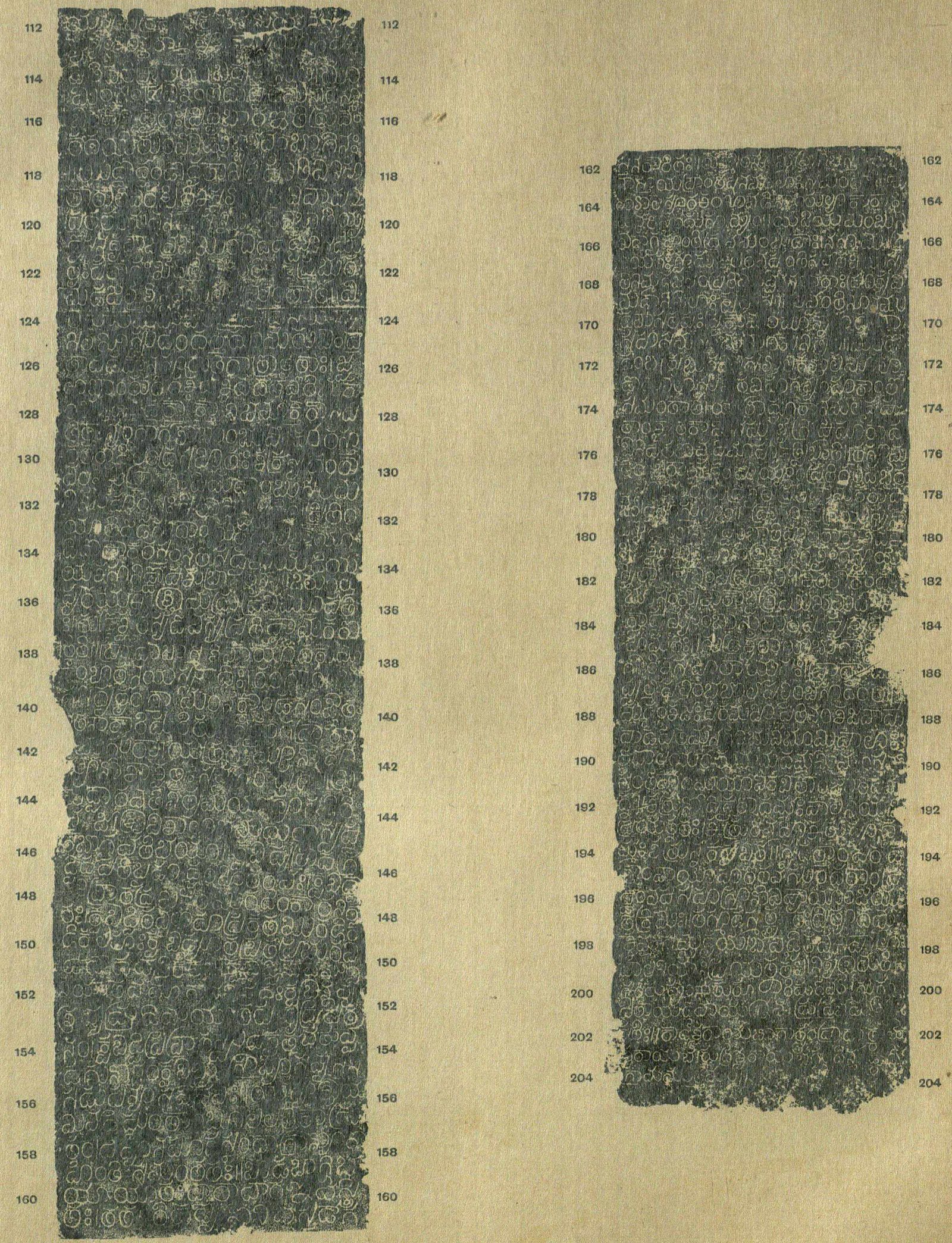
Estampage (ink impression)
This estampage continues the Ramappa pillar inscription from line 112 to line 204. Lines 183 and 184 in the right-hand column give the date of the grant. Barnett reads Saka 1135, the year Srimukha, Chaitra bright eighth day, Sunday, and equates it with 31 March 1213.
Estampage published in L. D. Barnett (ed.), Inscriptions at Palampet and Uparpalli, Hyderabad Archaeological Series No. 3 (1919). Photo-lithograph by W. Griggs & Sons. G. Yazdani took the estampages in 1916. Second page of the plate "Inscriptions of Ramappa Temple, Palampet, Hyderabad" (unnumbered continuation). · Public domain · This record in the database
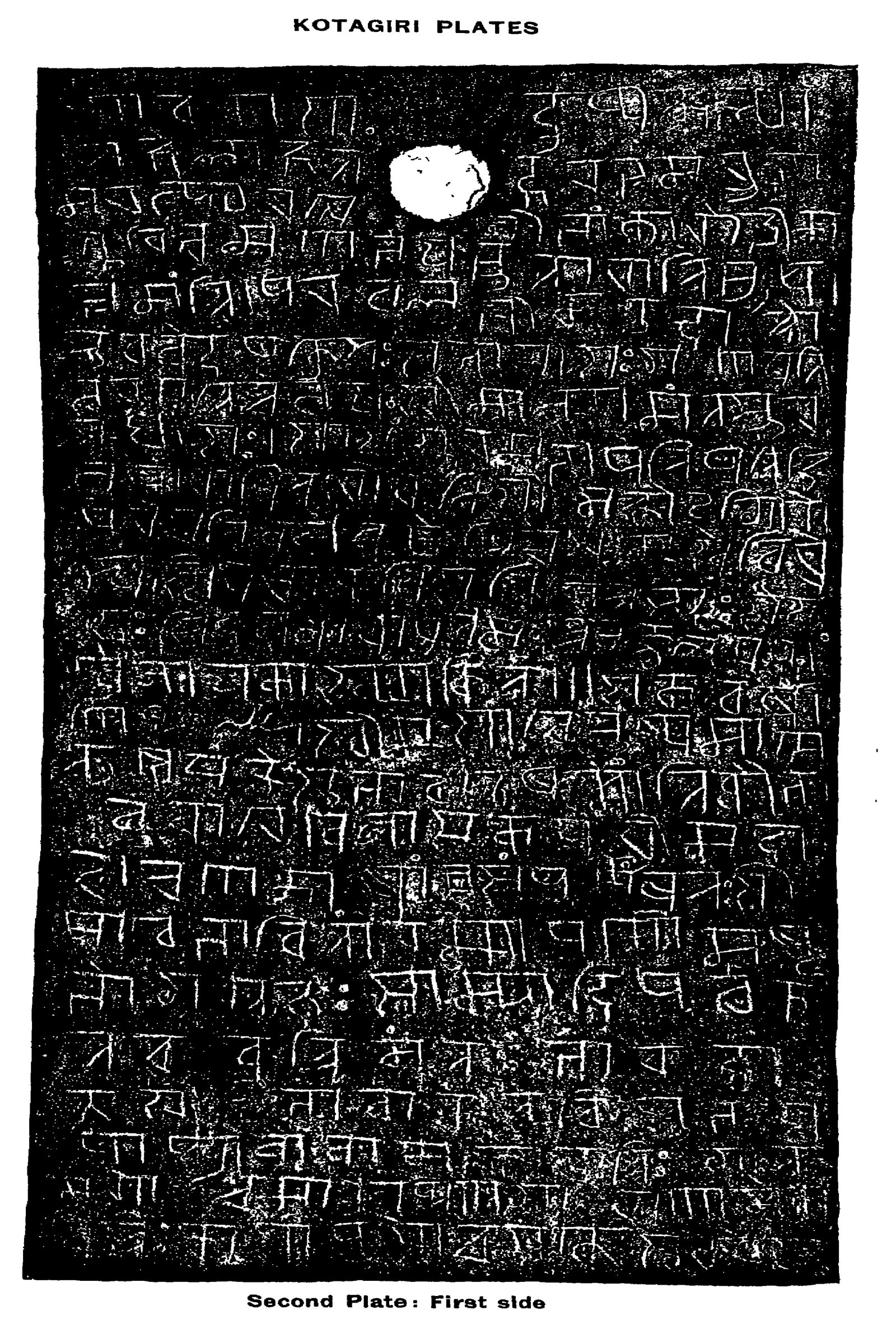
Estampage (ink impression)
This side of the second plate begins at line 53 and includes lines 65 to 68, which give the date. The editors read Saka 1195, the year Srimukha, Pushya, dark fortnight, sixth day, Sunday. They equate it with 31 December 1273. The book labels the plate "Second Plate: First side".
Plate published in S. Hanumant Rao, revised by H. Krishna Sastri, The Kotagiri Plates of the Reign of the Kakatiya Queen Rudramamba, A.D. 1273, Hyderabad Archaeological Series No. 6 (1925). Plate: "Kotagiri Plates. Second Plate: First side". · Public domain · This record in the database
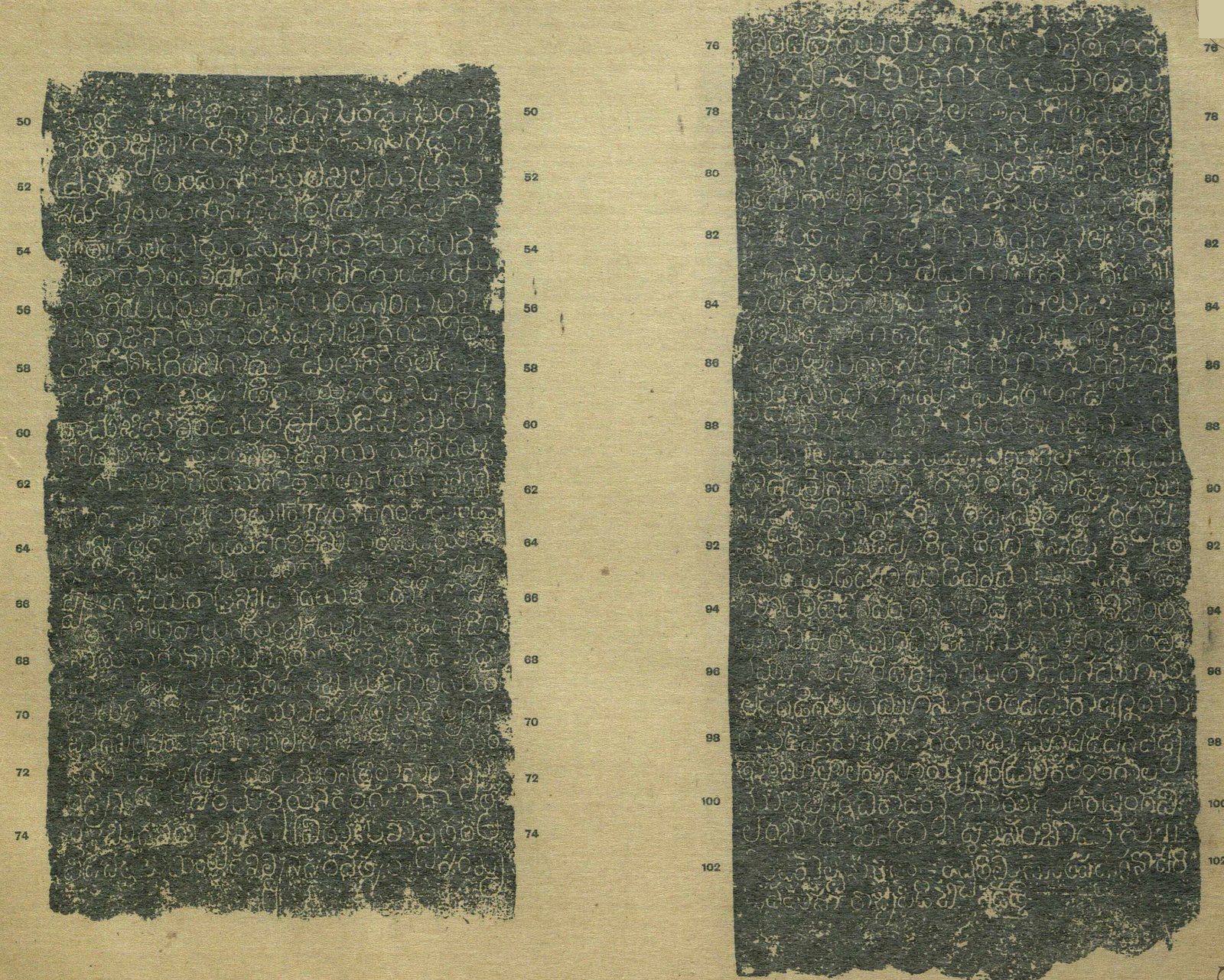
Estampage (ink impression)
This estampage shows lines 50 to 102 of the Uparpalli pillar inscription. Lines 76 to 78 give the date as Saka 1157, the year Manmatha, Magha bright fifteenth day, Thursday. Barnett equates the date with 24 January 1236. The book prints this plate sideways, and the image here is turned upright.
Estampage published in L. D. Barnett (ed.), Inscriptions at Palampet and Uparpalli, Hyderabad Archaeological Series No. 3 (1919). Photo-lithograph by W. Griggs & Sons. G. Yazdani took the estampages in 1916. Second page of the plate "Inscription on a square pillar at Uparpalli, in front of the main temple" (unnumbered continuation, printed sideways). · Public domain · This record in the database
Most Kakatiya records count years in the Saka era. Some early records count years in the Chalukya-Vikrama era instead. F. Kielhorn equates year 42 of that era with Saka 1039 for the Padmakshi pillar of 1117.
Epigraphia Telanganica 2023Epigraphia Indica IX · EI IX p. 259 (Kielhorn's note on the date) ↗ · Record ii-anmakonda
More detail
Sewell and Dikshit date the Chalukya-Vikrama era from Saka 998, 1076 CE, to Saka 1084, 1162 CE. Its year 0 is Saka 998-99 current, and their table calls its first month doubtful. C. P. Brown's tables of 1850 put the first year of a Chalukya era at Saka 938, 1016 CE. Burnell thought such Chalukya eras too uncertain to discuss.
Sewell and Dikshit 1896Brown 1850Burnell 1878 · Sewell and Dikshit 1896 p. 46, and Table II, Part iii, p. cvi; Brown 1850 p. 2; Burnell 1878 p. 75
A Saka year began in spring. Robert Sewell's examples place the start of the year in March. He also warns that a bare Saka number can cover parts of two CE years.
Sewell 1932 · Sewell 1932, Notes (ii), front matter
A Saka year without a month falls across two years of the Common Era. The Motupalli pillar gives only Saka 1166, the year Krodhin. E. Hultzsch wrote that this expired year corresponds to 1244-45.
Epigraphia Indica XII · EI XII p. 189 ↗ · Record ii-motupalli-bapatla
To convert a Saka year, add 78 for a date between spring and December. Add 79 for a date in January, February or early March. The examples below show both cases.
Indian records count a year either as current or as expired. The two counts differ by one year. Sewell gives this warning, and Kielhorn marks the Padmakshi year as Saka 1039 expired.
Sewell 1932Epigraphia Indica IX · Sewell 1932, Notes (ii); EI IX p. 259 ↗
More detail
Scholars disagree about which count was usual. Sewell and Dikshit write that Saka years may be taken as expired unless the contrary is proved. Burnell wrote that counting the current year was the most usual practice in India. He found the word atita, which means expired, rare except in Western Chalukya inscriptions.
Sewell and Dikshit 1896Burnell 1878 · Sewell and Dikshit 1896 p. 40, Art. 70, note 1, and p. 42; Burnell 1878 pp. 72-73
Most records also name the year in a cycle of sixty years. Each year of the cycle has a name, such as Srimukha, Pingala, Chitrabhanu or Virodhi. The name repeats every sixty years.
The cycle name lets a reader test the Saka number. The Ramappa gift of Saka 1135 and the Kotagiri grant of Saka 1195 both fall in a Srimukha year, exactly sixty years apart.
Barnett 1919Kotagiri plates 1925 · HAS 3 p. 2 ↗; HAS 6 p. 9 ↗ · Record ii-palampet-warangal
Sewell and Dikshit give a rule for the southern cycle. Add 11 to the current Saka year and divide by 60. The remainder is the number of the year in the cycle, counting Prabhava as 1. The southern cycle has followed this rule since about Saka 828 to 831, 905 to 909 CE.
Sewell and Dikshit 1896 · Sewell and Dikshit 1896 p. 37, Art. 62, and Table XII, p. cxxi
Burnell gives a quick check. In South India each cycle begins in a year of the Common Era that ends in 7, such as 907 or 967. C. P. Brown's tables of 1850 also give 967 CE, Saka 889, as Prabhava.
Burnell 1878Brown 1850 · Burnell 1878 p. 74, note 3; Brown 1850 p. 1
C. P. Brown warned in 1863 that writers took more care over the cycle name than over the number. He found the number often wrong, but seldom by more than three years. One example is Saka 1119, the year Pingala, which some inscriptions write as 1118.
Brown 1863 · Brown 1863, Preface p. ii
The Thousand Pillar year, Saka 1084, is a Chitrabhanu year. Kielhorn notes that the expired Saka year 1144 was also Chitrabhanu, and 1144 lies exactly sixty years later.
Fleet 1882Epigraphia Indica IIIEpigraphia Telanganica 2023 · ET II p. 181 (Kielhorn on the Bahal inscription, EI III) ↗ · Record ii-hanumakonda-3 · Record ii-bahal-inscription
More detail
J. F. Fleet translated the Thousand Pillar date as the Saka year 1084 being current. By the southern rule of Sewell and Dikshit, however, Chitrabhanu falls in Saka 1084 only when the year is read as expired. The cycle name and Fleet's wording therefore disagree.
Fleet 1882Sewell and Dikshit 1896 · IA XI p. 16, translation of line 6; Sewell and Dikshit 1896 p. 37, Art. 62 · Record ii-hanumakonda-3
The cycle name once corrected a famous misreading. Earlier editors read the Thousand Pillar year as Saka 1054 and Saka 1064. The scholar Rice saw that neither year fits Chitrabhanu, but he wrongly placed the record in the ninth century. Fleet then read the year as Saka 1084.
Fleet 1882Epigraphia Telanganica 2023 · ET II pp. 62-63 ↗ · Record ii-hanumakonda-3
Next the record gives the lunar month, such as Chaitra, Magha or Pushya. Each month has a bright fortnight, called sukla or suddha, and a dark fortnight, called bahula or krishna.
Barnett 1919Kotagiri plates 1925Parabrahma Sastry 1975 (coins) · HAS 3 pp. 2, 16 ↗; HAS 6 p. 9 ↗; pvs-coins-1975 p. 7
The tithi is the numbered lunar day within the fortnight. The Ramappa date falls on the eighth tithi of the bright fortnight of Chaitra. Barnett reports that this tithi ended about ten hours after sunrise on that Sunday.
A tithi is the time that the moon takes to gain 12 degrees on the sun. A tithi can therefore begin at any hour of the day or night, according to Sewell and Dikshit. The Ganapesvaram inscription of 1231 gives the tithi of Gauri in the bright fortnight of Vaisakha, Saka 1153, the year Khara.
Sewell and Dikshit 1896Epigraphia Indica III · Sewell and Dikshit 1896 p. 3, Art. 7, and p. 31, Art. 52; EI III p. 84 ↗ · Record ii-ganapesvaram
More detail
S. B. Dikshit explained that the tithi of Gauri could mean the third or the fourth tithi. He calculated that the third tithi ended on Monday, 7 April 1231, and the fourth on Tuesday, 8 April 1231.
Epigraphia Indica III · EI III p. 84 ↗ · Record ii-ganapesvaram
The weekday comes last. Bhanuvara means Sunday in the Kotagiri plates. Guruvaramu means Thursday at Uparpalli. Vaddavara means Saturday in the Thousand Pillar inscription.
Kotagiri plates 1925Barnett 1919Epigraphia Telanganica 2023 · HAS 6 p. 9 ↗; HAS 3 p. 16 ↗; ET II p. 70 ↗
Some records add an event of the sky, such as a solar eclipse or the Uttarayana-samkranti. The Padmakshi pillar was set up on the day of Uttarayana-samkranti, which Kielhorn places on Monday, 24 December 1117.
Epigraphia Indica IXEpigraphia Telanganica 2023 · EI IX p. 259 ↗; ET II p. 36 ↗ · Record ii-anmakonda
More detail
An eclipse can fix the date of a grant that gives only a regnal year. The Nandamapundi grant was made on a lunar eclipse in the 32nd year of the Eastern Chalukya king Rajaraja I. Kielhorn placed that year from about August 1053 to August 1054.
Epigraphia Indica IV · EI IV p. 303
Kielhorn found only one lunar eclipse between June 1053 and April 1055. He concluded that the grant was in all probability made on that day, Sunday, 28 November 1053. Sewell and Dikshit quote H. Jacobi, who held that the eclipses in inscriptions were often calculated in advance, not actually seen.
Epigraphia Indica IVSewell and Dikshit 1896 · EI IV p. 303; Sewell and Dikshit 1896 p. 23, Art. 40a
Editors calculate the tithi and then test the weekday. Barnett reports that the Uparpalli tithi was current at sunrise on Thursday, 24 January 1236. Thursday is also the weekday in the record.
When the weekday fails, editors say so. The Meruru record of 1197 names a Monday, but its editors note that the date fell on a Wednesday.
Epigraphia Telanganica 2023 · ET II p. 103 ↗ · Record ii-meruru
This site uses the weekday to choose the date of the Chandupatla record. The record gives Saka 1211, Virodhi, the twelfth tithi of the bright fortnight of Margasira, and a Friday.
Epigraphia Telanganica 2023 · ET III p. 81 ↗ · Record iii-chandupatla
Parabrahma Sastry equates the Chandupatla date with Friday, 25 November 1289. A modern biography gives 27 November 1289 instead. A calendar check shows that 27 November 1289 was a Sunday, so the site keeps 25 November.
Epigraphia Telanganica 2023Punjala 2016 · ET III p. 82 ↗; punjala2016 annexure; weekday computed from the Julian day number · Record iii-chandupatla
Worked example 1: the Thousand Pillar Temple inscription. The record gives the date as Saka 1084, Chitrabhanu, Magha, bright fortnight, thirteenth tithi, Vaddavara.
Fleet 1882Epigraphia Telanganica 2023 · ET II p. 66 and p. 70 ↗ · Record ii-hanumakonda-3
| Element | The record says | Reading |
|---|---|---|
| Era and year | Saka 1084 | The year number in the Saka era |
| Cycle year | Chitrabhanu | A name in the sixty-year cycle |
| Month | Magha | A lunar month that falls in January or February |
| Fortnight | Bright (sukla) | The half of the month when the moon grows |
| Tithi | 13 | The thirteenth lunar day of the bright fortnight |
| Weekday | Vaddavara | Saturday |
| CE year | 1084 + 79 | 1163, because Magha falls before the new Saka year begins in spring |
| Result | Saturday, 19 January 1163 |
Sources: Fleet 1882Epigraphia Telanganica 2023Sewell 1932 · ET II p. 62 (ARIE 1957-58) and p. 70 (Inscriptions of Warangal District) ↗
The Annual Report on Indian Epigraphy for 1957-58 and Inscriptions of Warangal District both equate this date with 19 January 1163. A calendar check confirms that 19 January 1163 was a Saturday.
Epigraphia Telanganica 2023 · ET II p. 62 and p. 70 ↗; weekday computed from the Julian day number · Record ii-hanumakonda-3
More detail
Worked example 2: the Kotagiri copper plates. Verse 15 gives the year Srimukha, the month Pushya, the dark fortnight, the sixth tithi and Sunday. Line 65 gives the Saka year 1195.
Kotagiri plates 1925 · HAS 6 p. 5, text lines 61-68, and p. 9 ↗
The second Kotagiri plate on this page carries the date in lines 65 to 68.
Kotagiri plates 1925 · HAS 6 plate, second plate first side ↗
| Element | The record says | Reading |
|---|---|---|
| Era and year | Saka 1195 | The year number in the Saka era |
| Cycle year | Srimukha | The same cycle name as the Ramappa year, Saka 1135 |
| Month | Pushya | A lunar month that falls in December or January |
| Fortnight | Dark (krishna) | The half of the month when the moon wanes |
| Tithi | 6 (shashthi) | The sixth lunar day of the dark fortnight |
| Weekday | Bhanuvara | Sunday |
| CE year | 1195 + 78 | 1273, because this Pushya falls in December |
| Result | Sunday, 31 December 1273 |
Sources: Kotagiri plates 1925 · HAS 6 p. 2 (date from Swamikannu Pillai's Indian Ephemeris) ↗
The 1925 editors took the equation from the Indian Ephemeris of L. D. Swamikannu Pillai. They give the result as Sunday, 31 December 1273.
Worked example 3 is shorter. The Ramappa pillar gives Saka 1135, Srimukha, Chaitra bright eighth, Sunday. Barnett fixes the day as Sunday, 31 March 1213. The date falls after the spring start of the Saka year, so 1135 plus 78 gives 1213.
The second Ramappa estampage on this page shows the date in lines 183 and 184.
Barnett 1919 · HAS 3 p. 2 and plate ↗ · Record ii-palampet-warangal
Year converter
This converter turns the year of a record into a year of the Common Era. Each step shows its rule and the printed page that gives the rule.
The converter offers the eras of Kakatiya and Chalukya records. These are the Saka era, the Chalukya-Vikrama era, the sixty-year cycle and regnal years. Hijri and Fasli years are also included.
The sixty year names
The second column follows Table XII of Sewell and Dikshit. The third column gives the spellings that C. P. Brown printed in 1850 for the Telugu and Kannada countries. Brown notes that Vijaya and Jaya frequently change places. Sewell and Dikshit 1896, Table XII, p. cxxi · Brown 1850, pp. 1–2
| No. | Sewell and Dikshit | Brown (1850) |
|---|---|---|
| 1 | Prabhava | Prabhava |
| 2 | Vibhava | Vibhava |
| 3 | Sukla | S′ucla |
| 4 | Pramoda | Pramóduta |
| 5 | Prajapati | Prajótpatti |
| 6 | Angiras | A′ngirasa |
| 7 | Srimukha | Srímukha |
| 8 | Bhava | Bháva |
| 9 | Yuvan | Yuva |
| 10 | Dhatri | Dhátu |
| 11 | Isvara | I′s′wara |
| 12 | Bahudhanya | Bahudhánya |
| 13 | Pramathin | Pramádi |
| 14 | Vikrama | Vicrama |
| 15 | Vrisha | Vishu |
| 16 | Chitrabhanu | Chitrabhánu |
| 17 | Subhanu | Swabhánu |
| 18 | Tarana | Tárana |
| 19 | Parthiva | Párthiva |
| 20 | Vyaya | Vyaya |
| 21 | Sarvajit | Sarvajit |
| 22 | Sarvadharin | Sarvadhári |
| 23 | Virodhin | Viródhi |
| 24 | Vikrita | Vicriti |
| 25 | Khara | Khara |
| 26 | Nandana | Nandana |
| 27 | Vijaya | Vijaya |
| 28 | Jaya | Jaya |
| 29 | Manmatha | Manmatha |
| 30 | Durmukha | Durmukhi |
| 31 | Hemalamba | Hévilambi |
| 32 | Vilamba | Vilambi |
| 33 | Vikarin | Vicári |
| 34 | Sarvari | Sárvari |
| 35 | Plava | Plava |
| 36 | Subhakrit | Subhacrit |
| 37 | Sobhana | Sóbhacrit |
| 38 | Krodhin | Kródhi |
| 39 | Visvavasu | Visvávas |
| 40 | Parabhava | Parábhava |
| 41 | Plavanga | Plavanga |
| 42 | Kilaka | Kílaca |
| 43 | Saumya | Saumya |
| 44 | Sadharana | Sádháraná |
| 45 | Virodhakrit | Viródhicrit |
| 46 | Paridhavin | Parídhávi |
| 47 | Pramadin | Pramádicha |
| 48 | Ananda | A′nanda |
| 49 | Rakshasa | Ráxasa |
| 50 | Anala | Nala |
| 51 | Pingala | Pingala |
| 52 | Kalayukta | Kálayucti |
| 53 | Siddharthin | Siddhárthi |
| 54 | Raudra | Raudri |
| 55 | Durmati | Durmati |
| 56 | Dundubhi | Dundubhi |
| 57 | Rudhirodgarin | Rudiródgári |
| 58 | Raktaksha | Ractáxi |
| 59 | Krodhana | Kródhana |
| 60 | Kshaya | Xaya |