InscriptionsHow to read a Kakatiya inscription
Part 1 of 5
What an inscription says
What the records are, who set them up, and the nine parts of a typical record.
About 7 min to read
What the inscriptions are
Photograph of the stone
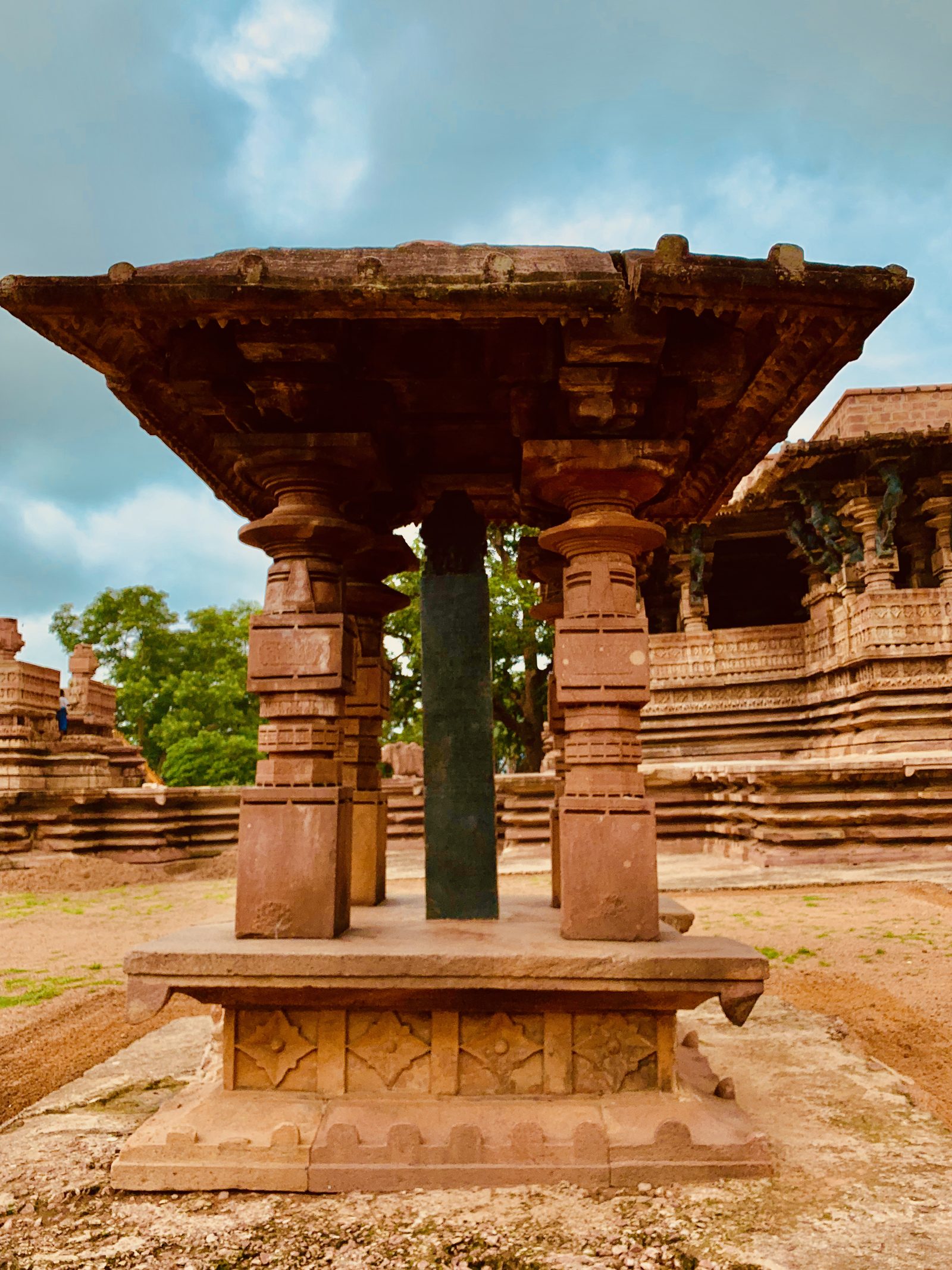
The Ramappa inscription pillar stands in a small pavilion to the north-east of the temple. Recherla Rudra, a general of the Kakatiya king Ganapati, set up this Sanskrit record in 1213.
Photo: Ms Sarah Welch, via Wikimedia Commons · CC0 · This record in the database
Estampage (ink impression)
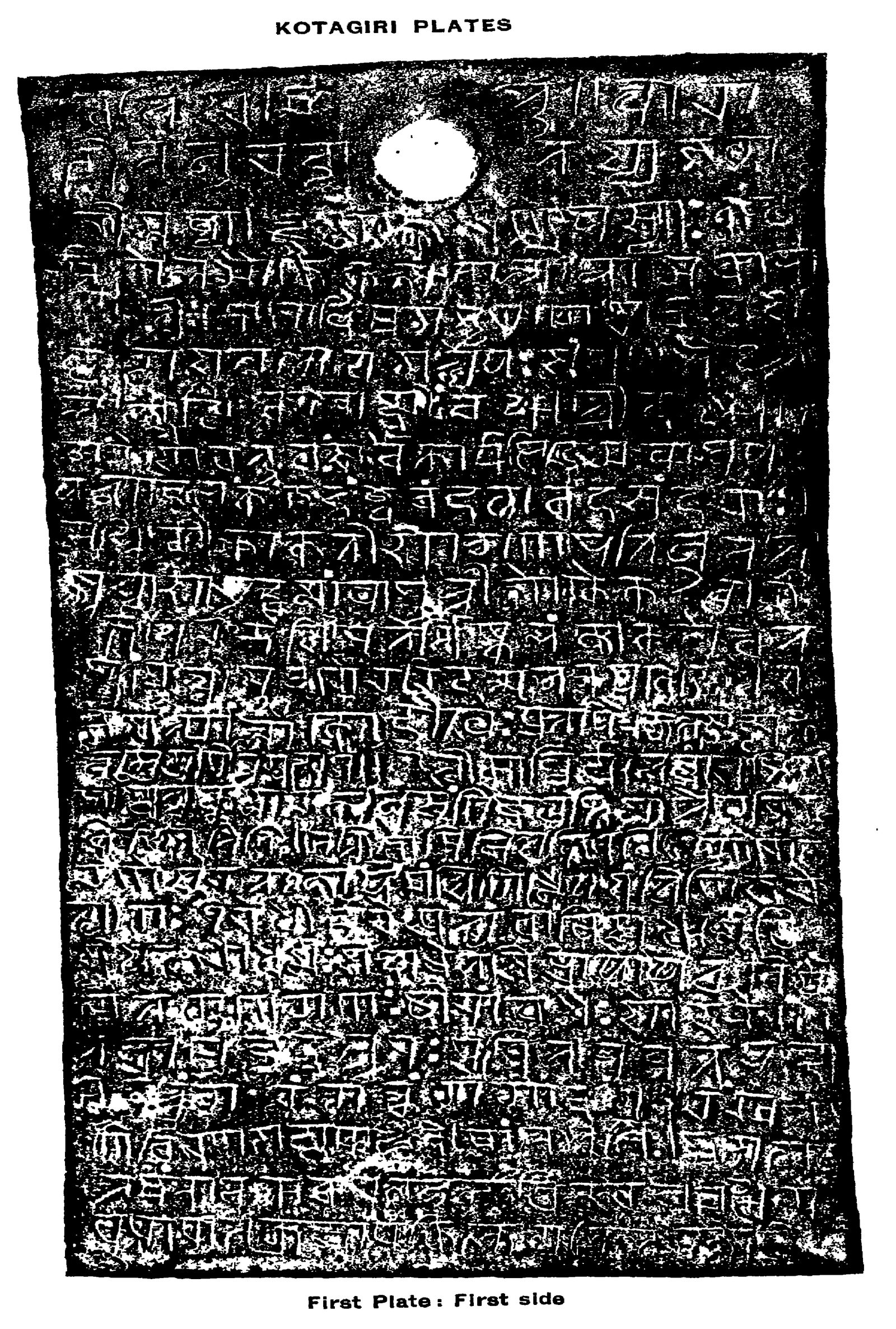
The image shows the first side of the first of three copper plates found in a tank at Birkur in Bodhan taluk. The editors say that the letters largely resemble modern Devanagari. The white disc is the hole for the heavy metal hoop that held the three plates together. The book labels the plate "First Plate: First side".
Plate published in S. Hanumant Rao, revised by H. Krishna Sastri, The Kotagiri Plates of the Reign of the Kakatiya Queen Rudramamba, A.D. 1273, Hyderabad Archaeological Series No. 6 (1925). Plate: "Kotagiri Plates. First Plate: First side". · Public domain · This record in the database
The Kakatiya period left two kinds of written records. Most texts were cut into stone pillars, slabs, temple walls and rock faces. A smaller number were engraved on sets of copper plates.
Parabrahma Sastry 1975 (thesis)Parabrahma Sastry 1978 · pvs1975 pp. 5-9 (Sources: copper plate grants and lithic records); pvs1972 pp. 3-7
Telugu writers call a stone inscription a sila-sasanam. A grant on copper plates is a tamra-sasanam.
Parabrahma Sastry 1981 (Telugu)Parabrahma Sastry 1975 (coins) · pvs-sasana-sahityam p. 3 (silasasanalu) and p. 6 (on stone or on copper sheets); pvs-coins-1975 p. 3, title of T. Krishnamurty's article 'Dayagajakesari Khamdavalli Tamra Sasanamu'
P. V. Parabrahma Sastry counted about a dozen copper-plate records that refer directly to the Kakatiya rulers. In his 1975 thesis he wrote that the stone records number more than one thousand. His 1978 book gives the number as nearly one thousand.
Parabrahma Sastry 1975 (thesis)Parabrahma Sastry 1978 · pvs1975 pp. 5-8 (table of 12 copper-plate records) and pp. 8-9; pvs1972 p. 6
Epigraphia Telanganica, published in 2023, compiles 2,396 inscriptions of the whole Telangana region, from the first century to the Nizams. Volume II covers the Kakatiyas up to Ganapati Deva, with 425 inscriptions and 164 variant editions. Volume III covers Rudrama Devi and Prataparudra, with 402 inscriptions and 116 variants.
Epigraphia Telanganica 2023 · Epigraphia Telanganica Vol. I, General Introduction, pp. 7-9 ↗
The database on this site holds 1,863 records extracted from Epigraphia Telanganica. Of these, 715 records match a Kakatiya ruler or a Kakatiya subordinate family. Each record is taken from its own entry in the published volumes.
Kings set up some of these records. Rudra Deva set up the inscription at the Thousand Pillar Temple in Anumakonda in 1163. The inscription records the gods that he installed and the village that he gave for their worship.
Epigraphia Telanganica 2023 · ET II pp. 62-71 ↗ · Record ii-hanumakonda-3
Women of the royal family set up others. Mailama, the sister of Ganapati Deva, set up the Bayyaram tank inscription. Epigraphia Telanganica notes that women servants of the king also gave cows for perpetual lamps in temples.
Epigraphia Telanganica 2023 · ET I General Introduction pp. 8-9 ↗; ET II p. 317 ↗ · Record ii-bayyaram-yellendu-taluk
Generals and subordinate chiefs set up many more. The general Recherla Rudra set up the inscribed pillar at the Ramappa temple in Palampet in 1213.
Barnett 1919 · HAS 3 pp. 1-2 ↗ · Record ii-palampet-warangal
Merchants and villagers also made gifts. In 1090 the merchant body of Anmakonda gave one mana of oil every day for a lamp, according to the Kazipet pillar. In 1289 a servant named Puvula Mummadi made the gift recorded at Chandupatla.
Epigraphia Telanganica 2023 · ET II Kazipet entries (Corpus II pp. 25-31) ↗; ET III pp. 81-82 ↗ · Record ii-kazipet-warangal · Record iii-chandupatla
Parabrahma Sastry explains why a donor had a gift written on stone. The donor wanted nobody to disturb the gift. The donor also wanted the temple managers and the herdsman who supplied ghee to keep the service going for generations.
Parabrahma Sastry 1981 (Telugu) · pvs-sasana-sahityam pp. 9-10
Not every building received an inscription. Parabrahma Sastry notes that a rule of the Dharmasastras forbade a donor to praise his own good deeds. For that reason some temples and tanks carry no inscription.
Parabrahma Sastry 1981 (Telugu) · pvs-sasana-sahityam p. 6
The parts of a typical record
Photograph of the stone
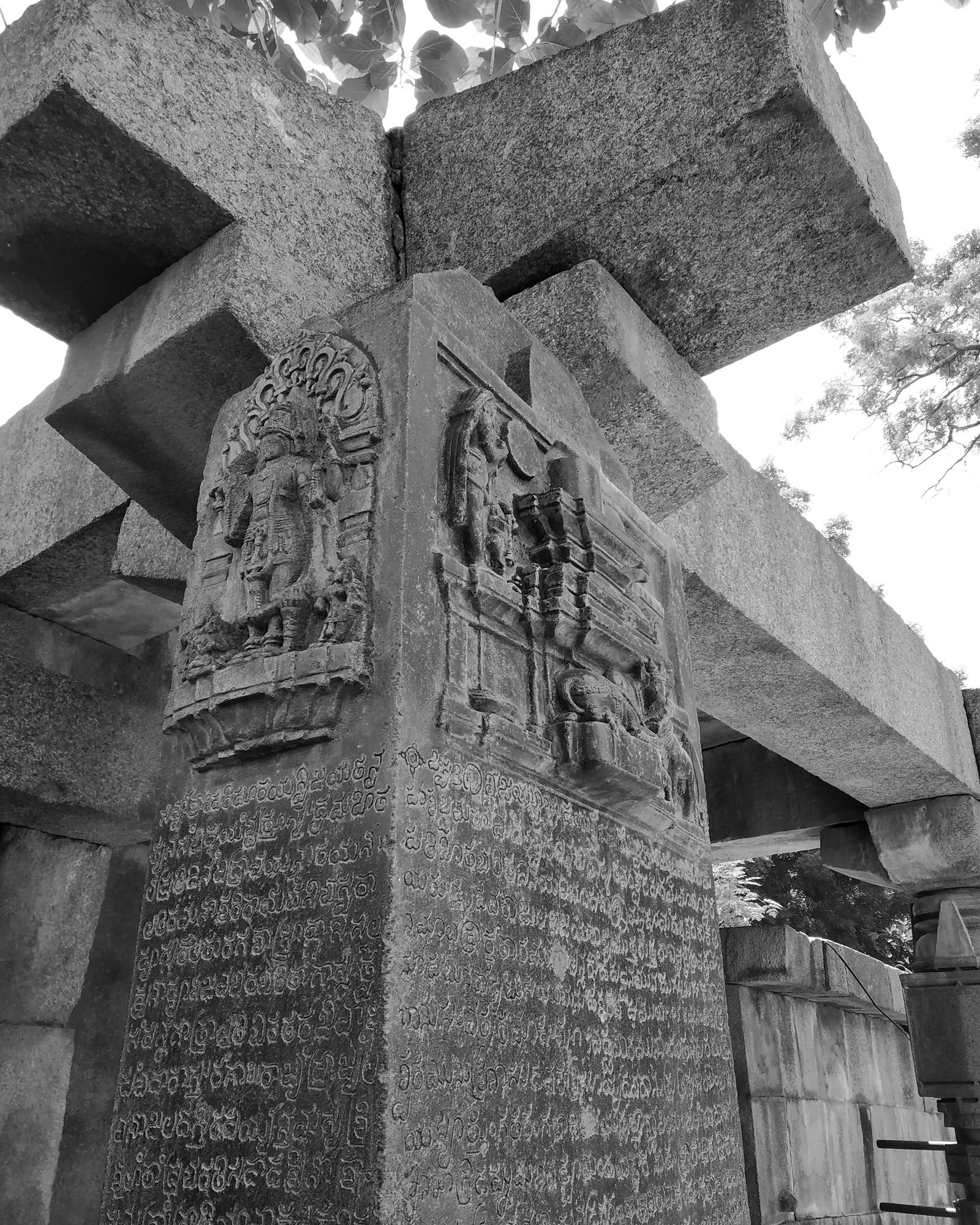
The inscription of the Kakatiya king Rudradeva stands at the Thousand Pillar Temple in Hanamkonda. The record is dated Saka 1084, which is 19 January 1163. Carved panels of gods sit above the text on each face.
Photo: Torchtelangana, via Wikimedia Commons · CC BY-SA 4.0 · This record in the database
Photograph of the stone
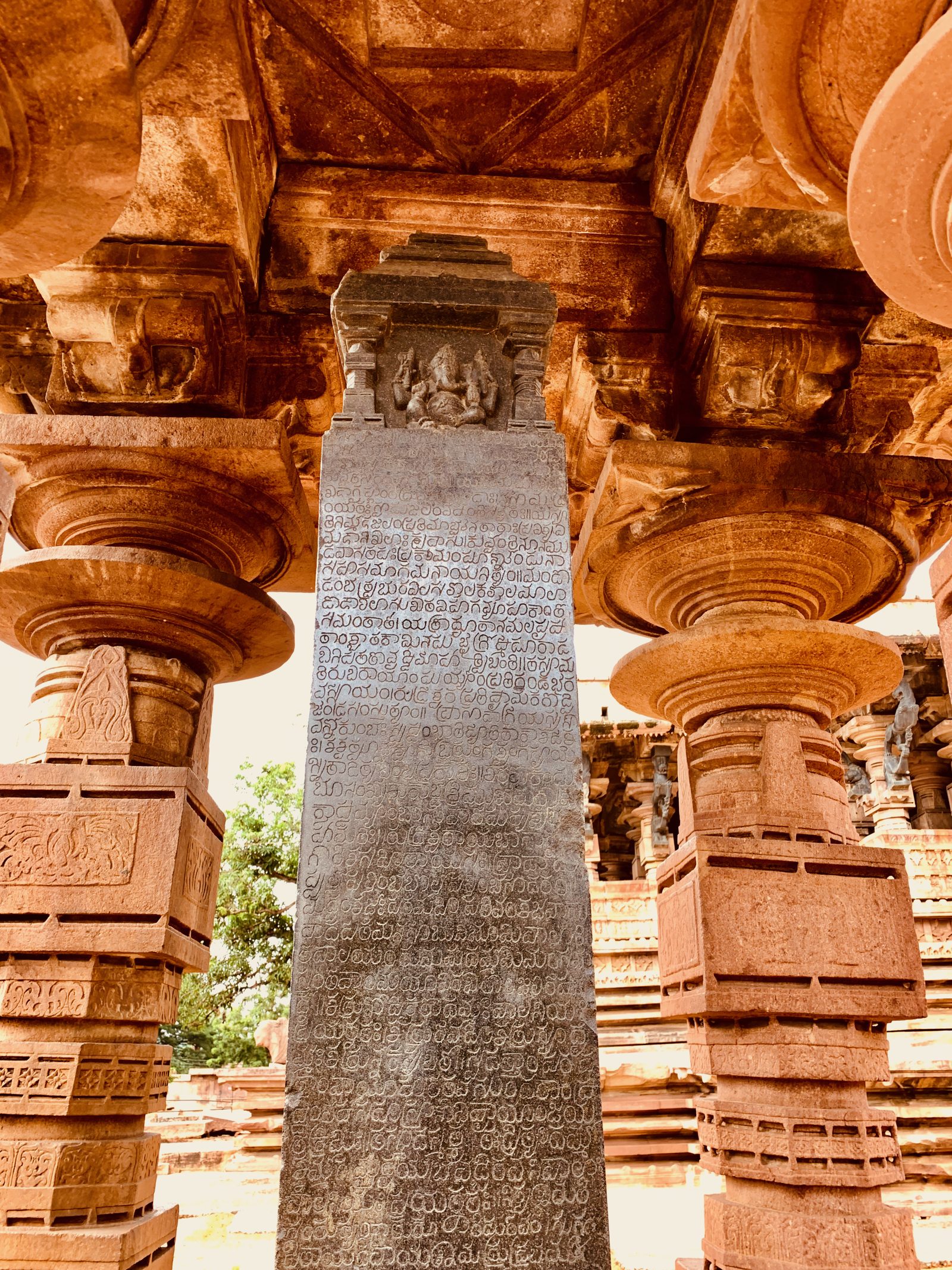
Each of the four faces of the Ramappa pillar has a carved panel at the top. This face shows Ganesa. Barnett (1919) lists a linga, a cow and calf, and the sun and moon on the other faces.
Photo: Ms Sarah Welch, via Wikimedia Commons · CC0 · This record in the database
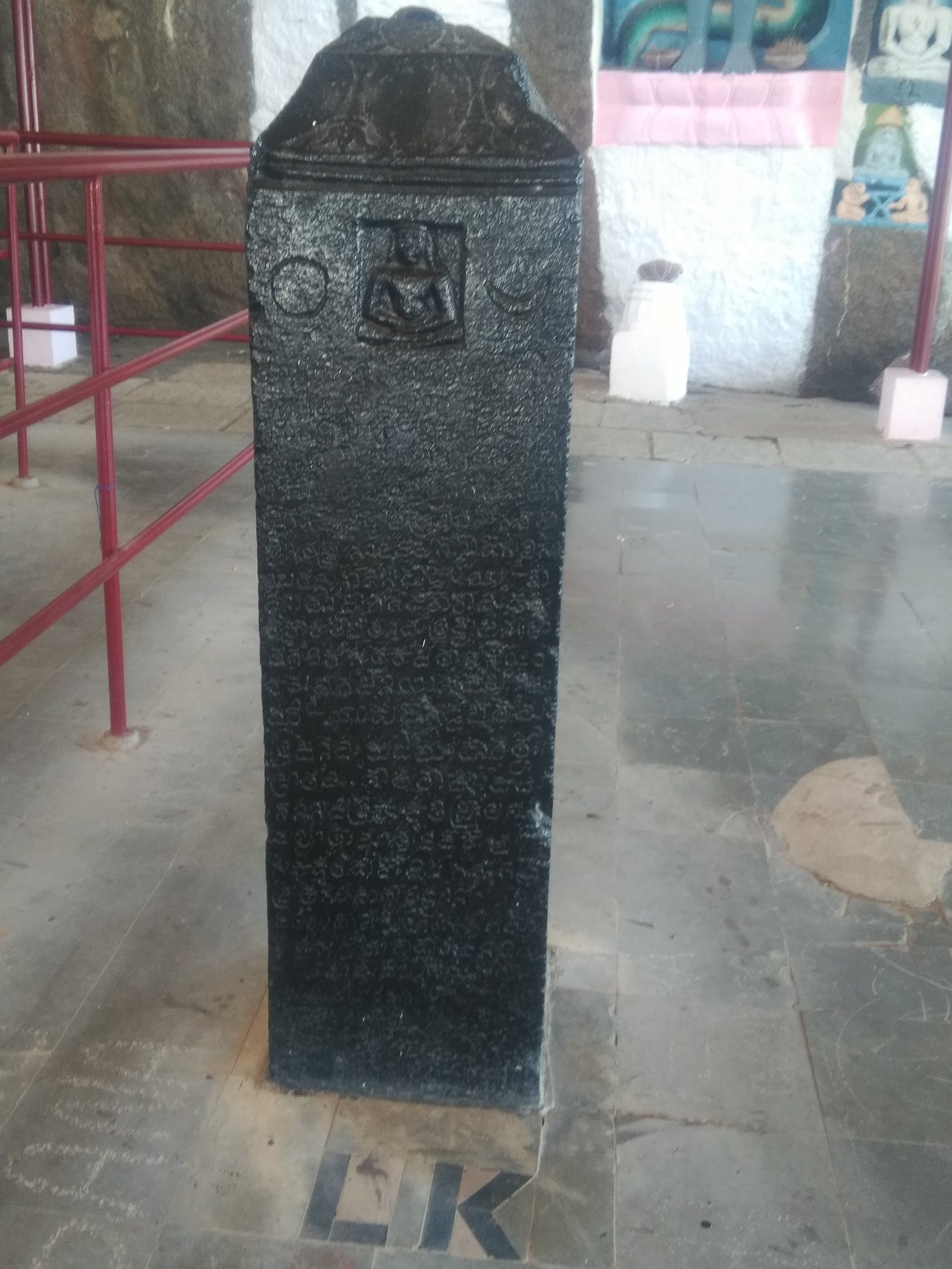
Photograph of the stone
The north face of the pillar at the Padmakshi temple shows a seated Jaina teacher between the sun and the moon. Mailama, the wife of a minister of Prola II, set up this Kannada record in 1117.
Photo: Pakideadithya, via Wikimedia Commons · CC BY-SA 4.0 · This record in the database
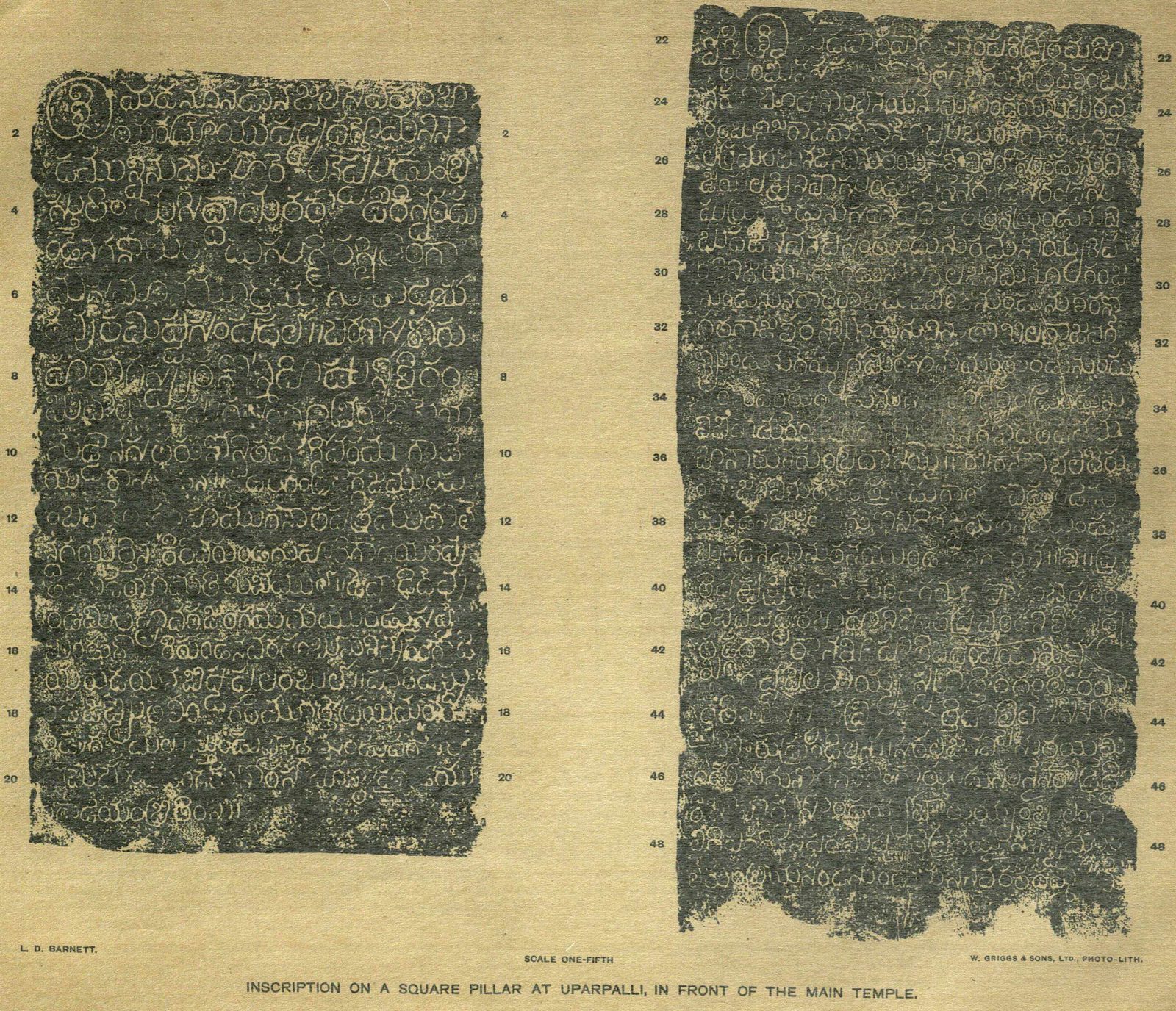
Estampage (ink impression)
This estampage shows the opening lines of the Telugu inscription on a square pillar in front of the main temple at Uparpalli. The record belongs to the reign of Ganapatideva and praises Kataya, a minister of Recherla Rudra. Barnett calls the script "Telugu of the period, of a regular and well-shaped type". The plate is one-fifth of the original size.
Estampage published in L. D. Barnett (ed.), Inscriptions at Palampet and Uparpalli, Hyderabad Archaeological Series No. 3 (1919). Photo-lithograph by W. Griggs & Sons. G. Yazdani took the estampages in 1916. Plate: "Inscription on a square pillar at Uparpalli, in front of the main temple", scale one-fifth. · Public domain · This record in the database
| No. | Part | Example |
|---|---|---|
| 1 | invocation | Om and Hail (Thousand Pillar inscription) |
| 2 | praise of the king and family tree (prasasti) | lines 20 to 163 of the Thousand Pillar inscription |
| 3 | date | Saka 1135, Srimukha, Chaitra (Ramappa pillar) |
| 4 | donor | Sura of the Viryala family (Kotagiri plates) |
| 5 | gift | the village of Matticheruvala (Thousand Pillar Temple) |
| 6 | purpose | worship, lamps and offerings in a temple |
| 7 | boundaries of the land | a landmark in each of the eight directions (Mangallu plates) |
| 8 | verses of blessing and curse | a taker of granted land is born as a worm |
| 9 | names of the poet and the engraver | Achintendra, poet of the Thousand Pillar inscription |
Sources: Epigraphia Telanganica 2023Fleet 1882Parabrahma Sastry 1981 (Telugu)Kotagiri plates 1925Barnett 1919 · ET III p. 81 ↗; ET II p. 66, lines 1-16 ↗; pvs-sasana-sahityam p. 6; ET II p. 63 ↗; HAS 6 p. 2, verses 3-13 ↗; HAS 3 p. 2 ↗; pvs-sasana-sahityam p. 118; HAS 6 p. 2 ↗; ET II p. 65 and p. 70 ↗; ET II p. 292 ↗; ET II p. 19 ↗; HAS 6 p. 9, verse 16 ↗; HAS 3 p. 11, verse 51 ↗; ET II p. 66, line 16, and p. 70 ↗
Most Kakatiya records follow a fixed order. A short record may leave parts out. The Chandupatla stone of 1289 has no invocation and no curse verses.
Epigraphia Telanganica 2023 · ET III p. 81 ↗ · Record iii-chandupatla
Parabrahma Sastry notes that the invocation and the curse verses are customary in all inscriptions except epitaphs and similar records.
Epigraphia Telanganica 2023 · ET III p. 81 ↗ · Record iii-chandupatla
Indian law-books laid down what a royal grant had to contain. A. C. Burnell, writing in 1878, listed the clauses. A grant gives the family tree of the donor, the nature of the gift with its receiver, purpose, conditions and date, curses on anyone who breaks it and, rarely, the names of witnesses.
Burnell 1878 · Burnell 1878 p. 108
1. The invocation opens the record. The Thousand Pillar inscription begins with Om and Hail. It then praises Vishnu as the Boar, the god Ganesa and the goddess Sarasvati.
Fleet 1882Epigraphia Telanganica 2023 · ET II p. 66, lines 1-16 ↗ · Record ii-hanumakonda-3
The Ramappa pillar begins with Sri Rudresvaraya namah, which means obeisance to the blessed Rudresvara. The Bayyaram tank inscription begins with Sri Mahadevaya namah. The Kotagiri plates begin with Svasti, which means hail.
Barnett 1919Epigraphia Telanganica 2023Kotagiri plates 1925 · HAS 3 p. 2, text line 1 ↗; ET II p. 317 ↗; HAS 6 p. 3, text line 1 ↗ · Record ii-palampet-warangal · Record ii-bayyaram-yellendu-taluk
The Motupalli pillar of Ganapati Deva, of 1244-45, opens with an invocation of Svayambhudeva. E. Hultzsch cites the Prataparudriya to show that Siva under this name was the family god (kula-devata) of the Kakatiya dynasty.
Epigraphia Indica XII · EI XII p. 188 ↗ · Record ii-motupalli-bapatla
2. The praise of the king and the family tree come next. Scholars call this part the prasasti. Parabrahma Sastry writes that kings had their own greatness written into their records in the form of prasasti.
Parabrahma Sastry 1981 (Telugu) · pvs-sasana-sahityam p. 6
In the Thousand Pillar inscription, lines 20 to 163 give the genealogy and the praise of Rudra Deva. The Kotagiri plates praise Queen Rudramamba in one verse. The plates then praise the family of the donor in ten verses.
Fleet 1882Kotagiri plates 1925Epigraphia Telanganica 2023 · ET II p. 63 ↗; HAS 6 p. 2, verses 3-13 ↗ · Record ii-hanumakonda-3
More detail
The Eastern Chalukya grants of Vengi have a family tree of their own kind. Burnell found that from the end of the seventh century they list the kings in order, with the years that each king reigned. He valued them for their historical character. The Western Chalukya grants, by contrast, name only the parents of the king.
Burnell 1878 · Burnell 1878 p. 109
3. The date follows. The Ramappa pillar dates its gift to Saka 1135, the cycle year Srimukha, the eighth day of the bright fortnight of Chaitra, a Sunday. The part of this guide on dates explains each element.
Barnett 1919 · HAS 3 p. 2 ↗ · Record ii-palampet-warangal · Read more on this
4. The record names the donor, often with the donor's family and overlord. Parabrahma Sastry states that no inscription lacks the name of its donor. The Kotagiri plates name Sura of the Viryala family, a subordinate of Queen Rudramamba.
Parabrahma Sastry 1981 (Telugu)Kotagiri plates 1925 · pvs-sasana-sahityam p. 118; HAS 6 p. 2 ↗
5. The gift is the core of the record. Rudra Deva gave the large village of Matticheruvala for the worship of Siva, Vishnu and the Sun at the Thousand Pillar Temple.
Fleet 1882Epigraphia Telanganica 2023 · ET II p. 65 and p. 70 ↗ · Record ii-hanumakonda-3
Gifts for lamps are common. In 1079 King Beta gave land for a perpetual lamp at Hanamkonda, and the record fixes twelve manikas of ghee for the lamp. In 1245 a Viryala chief gave thirty cows for a lamp in Warangal. A cowherd named Dhammaya took the cows and agreed to supply the ghee.
Epigraphia Telanganica 2023 · ET II p. 36 ↗; ET II p. 232 ↗ · Record ii-hanumakonda-warangal · Record ii-warangal-3
Some gifts were incomes or coins. At Terala in 1292 a donor gave the tax income of a village to the god Siddhesvara. In the Uttaresvara grant Prataparudra gave 100 nishkas, which were gold coins, to the scholar Viddanacharya.
Parabrahma Sastry 1975 (coins) · pvs-coins-1975 p. 11 and Appendix p. 21 · Record iii-uttaresvara-grant
6. The record states the purpose. Many gifts paid for worship, lamps and offerings in a temple. At Bhutpur in 1259 the chief Malyala Gunda built a tank and named the tank after his mother.
Many gifts were made for the merit of another person. At Chandupatla, Puvula Mummadi gave land so that Rudrama Devi and the general Mallikarjuna Nayaka might reach the world of Siva.
Epigraphia Telanganica 2023 · ET III pp. 81-82 ↗ · Record iii-chandupatla
7. Land grants describe the boundaries of the land. The Mangallu copper plates of about 956 name a landmark in each of the eight directions around the village. The Kotagiri plates describe their village as marked with four boundaries.
Epigraphia Telanganica 2023Kotagiri plates 1925 · ET II p. 19 ↗; HAS 6 p. 9, verse 16 ↗ · Record ii-mangallu-2
More detail
Burnell noticed that the details of the gift and the boundaries are most often written in the local language, even when the rest of a grant is in Sanskrit. The Nandamapundi grant of the Eastern Chalukya king Rajaraja I, of 1053, is an example. F. Kielhorn found it in Sanskrit except for the boundaries in lines 80 to 88, which are in Telugu.
Burnell 1878Epigraphia Indica IV · Burnell 1878 pp. 113-114; EI IV p. 301
Some records name witnesses. The Karimnagar copper plates of 1246 settle a dispute over a canal. The plates record that elders of three villages gave evidence, and the plates list the witnesses in Telugu.
Epigraphia Telanganica 2023 · ET II pp. 241-242 ↗ · Record ii-karimnagar-3
8. Verses of blessing and curse come near the end. The Ramappa pillar says that a person who takes away granted land is born as a worm in dung for sixty thousand years.
Barnett 1919 · HAS 3 p. 11, verse 51 ↗ · Record ii-palampet-warangal
The same verse appears in the Kondiparti inscription of 1203 and in the Kotagiri plates. Another common verse says that protecting a gift earns more merit than giving it. Editors often print these lines only as the usual imprecatory verses.
Epigraphia Telanganica 2023Kotagiri plates 1925 · ET II p. 127, verses 45-46 ↗; HAS 6 p. 9, verses 18-25 ↗; ET II p. 36 ↗ · Record ii-kondiparti-warangal
9. Some records end with the names of the poet and the engraver. The ascetic Achintendra, a disciple of Advayamrita, composed the verses of the Thousand Pillar inscription.
Epigraphia Telanganica 2023Fleet 1882 · ET II p. 66, line 16, and p. 70 ↗ · Record ii-hanumakonda-3
At Bhutpur in 1259 the scholar Isvara Suri received land for composing the Sanskrit text. A man named Oddaya engraved the record. The Guduru pillar of 1124 names its engraver, the sutradhari Kommoju.
Epigraphia Telanganica 2023Parabrahma Sastry 1981 (Telugu) · ET II p. 292 ↗; pvs-sasana-sahityam p. 118 · Record i-guduru
More detail
Burnell found little uniformity in these names. A grant may name the composer, the writer or the engraver, or none of them. Line 92 of the Nandamapundi grant names three people. The executor (ajnapti) is the Katakadhiraja, the author of the verses is Nanniyabhatta, and the writer is Gandacharya.
Burnell 1878Epigraphia Indica IV · Burnell 1878 p. 114; EI IV p. 303
Kielhorn added a caution about the same grant. The letters of lines 1 to 49 differ from those of the later lines, and he judged that the first three plates came from a somewhat earlier grant. The names of the writer, and probably of the poet, therefore cannot refer to lines 1 to 49.
Epigraphia Indica IV · EI IV p. 301
Engravers sometimes made mistakes. Parabrahma Sastry reports that three of the twenty-four lines at Chandupatla are illegible because of the engraver's negligence.
Epigraphia Telanganica 2023 · ET III p. 81 ↗ · Record iii-chandupatla
Many stones also carry emblems above the text. The Ramappa pillar shows a linga, a cow and calf, the sun and moon, and Ganesa, one on each face. The Kotagiri plates hang on a metal hoop that bears a boar, the Kakatiya emblem.
Barnett 1919Kotagiri plates 1925 · HAS 3 p. 1 ↗; HAS 6 p. 1 ↗