Chaya Someswara and Pachala Someswara Temples, Panagal
Two large temples stand at Panagal, near Nalgonda: the triple-shrined Chaya Someswara and the four-shrined Pachala Someswara. The sources disagree about who built them. Inscriptions at Chaya Someswara record gifts made in the Kakatiya kingdom in 1267 and 1290.
- Period
- Disputed: Kakatiya in the view of M. Rama Rao, and Telugu Choda, earlier than Rudra Deva, in the view of S. Gopalakrishna Murthy. Kakatiya-period inscriptions of 1267 and 1290 stand at Chaya Someswara
- Materials
- Stone, with black stone for carved pillars, door screens and sculpture
- Location
- 17.0775° N, 79.2954° E
Source of the position: Wikidata Q5088609 (Chaya Someswara temple). The Pachala Someswara temple is Wikidata Q7121969, at 17.0797, 79.2882, about 800 metres to the west-north-west.
- Condition
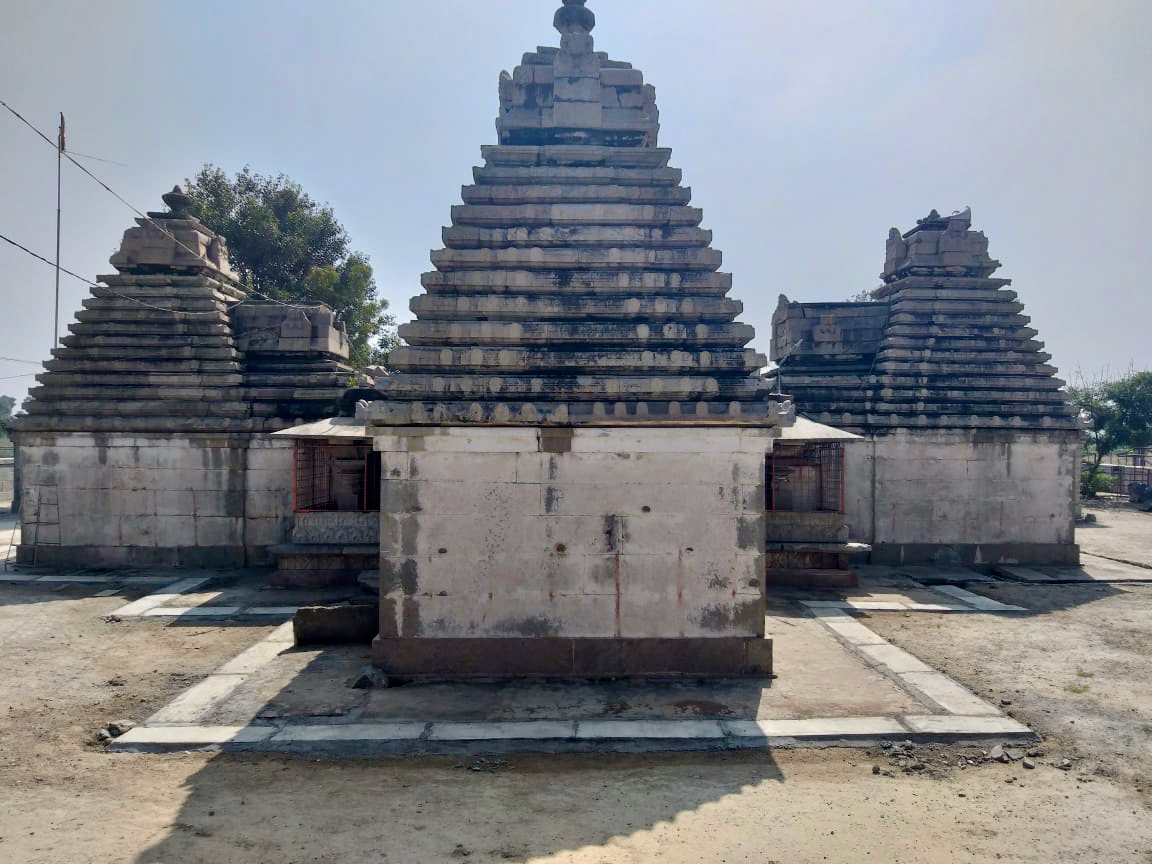
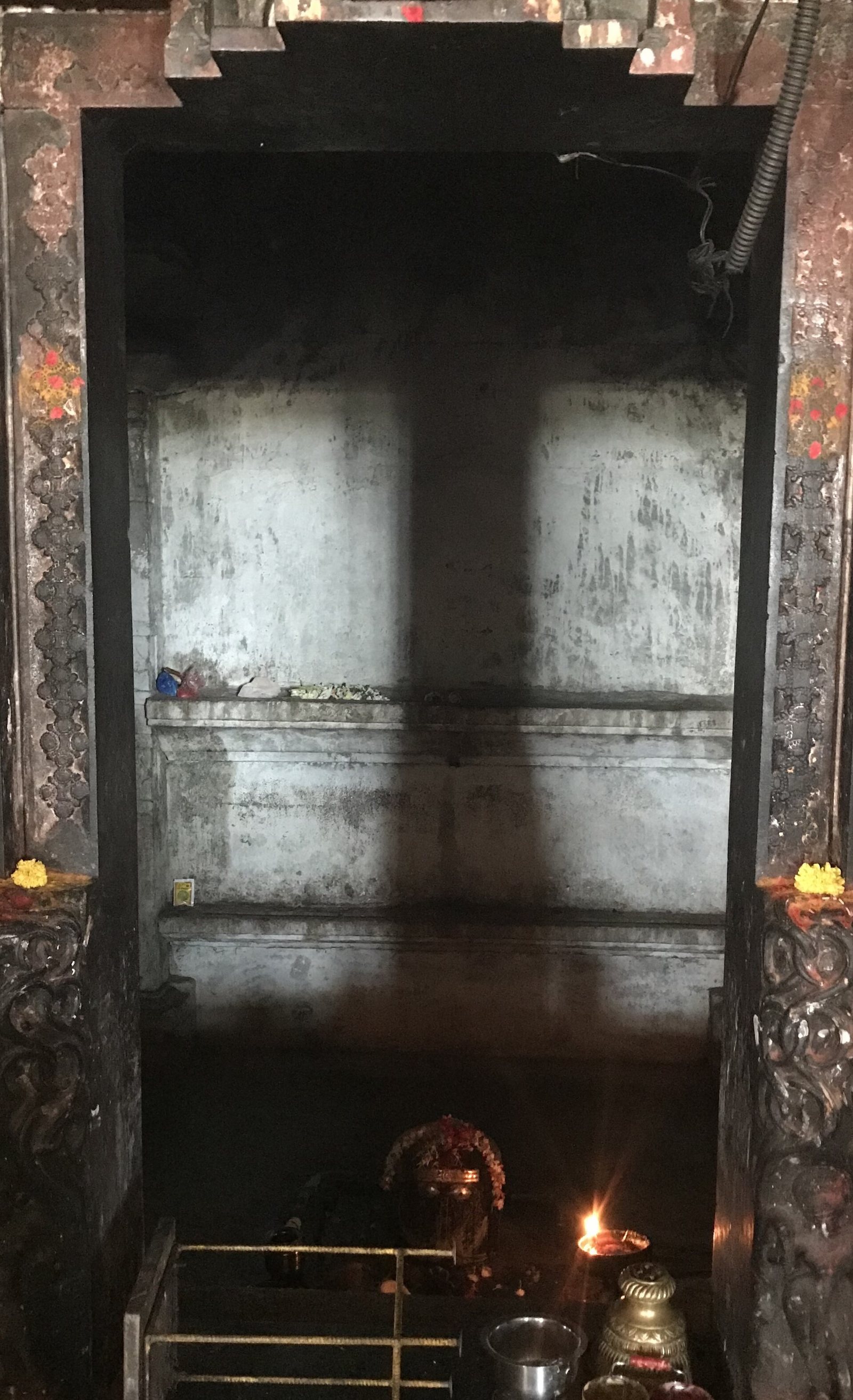
- Both temples stand. Photographs of 2018 show lamps and offerings in the sanctum of Chaya Someswara, and photographs of 2021 show its three stepped towers and the carved walls and halls of Pachala Someswara.
Photographed 2021
The Chaya Someswara temple, photographed in 2021. Each of the three shrines of the triple temple has its own stepped tower.
Photographed 2018
The back wall of the sanctum of Chaya Someswara, photographed in 2018. A dark band of shadow falls on the wall above the linga.
Photographed 2021
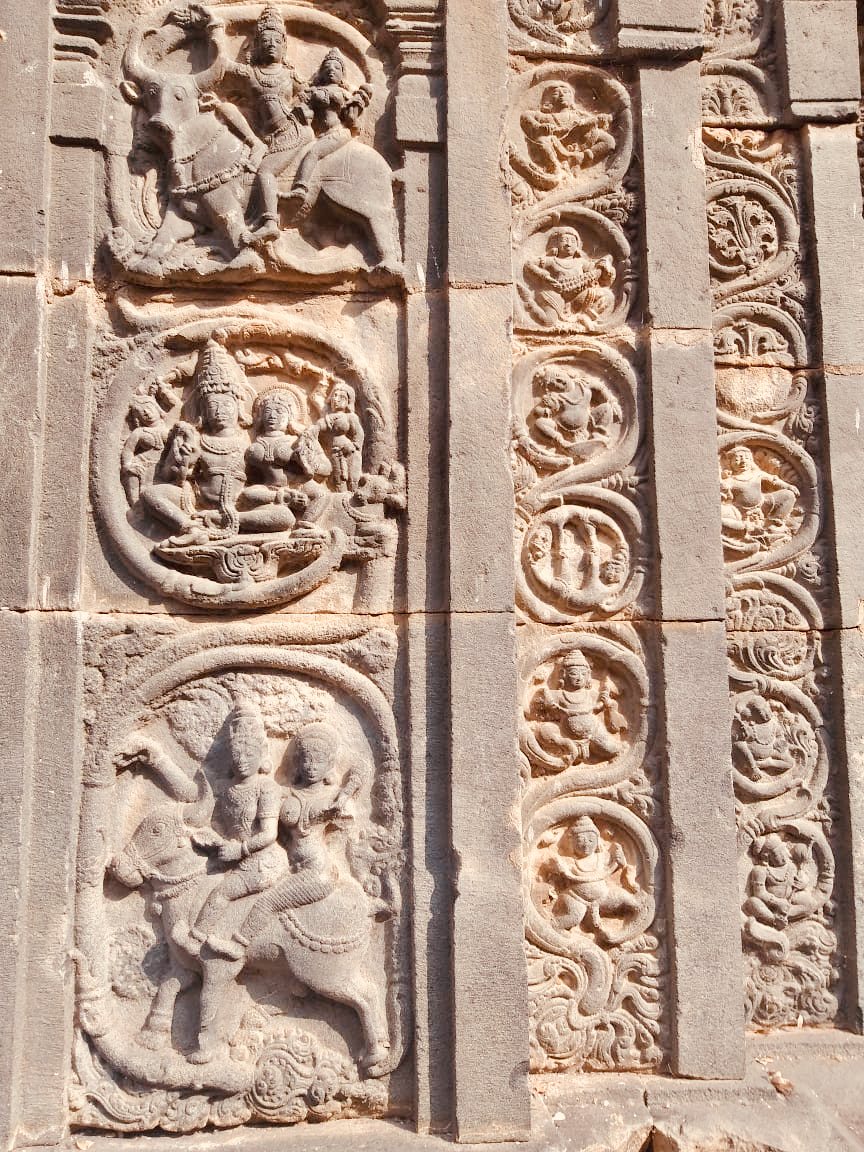
Vertical bands of scrollwork with small sculptures on the outer wall of Pachala Someswara, photographed in 2021. The report of 1927-28 called this vertical arrangement a new feature.
Photographed 2021
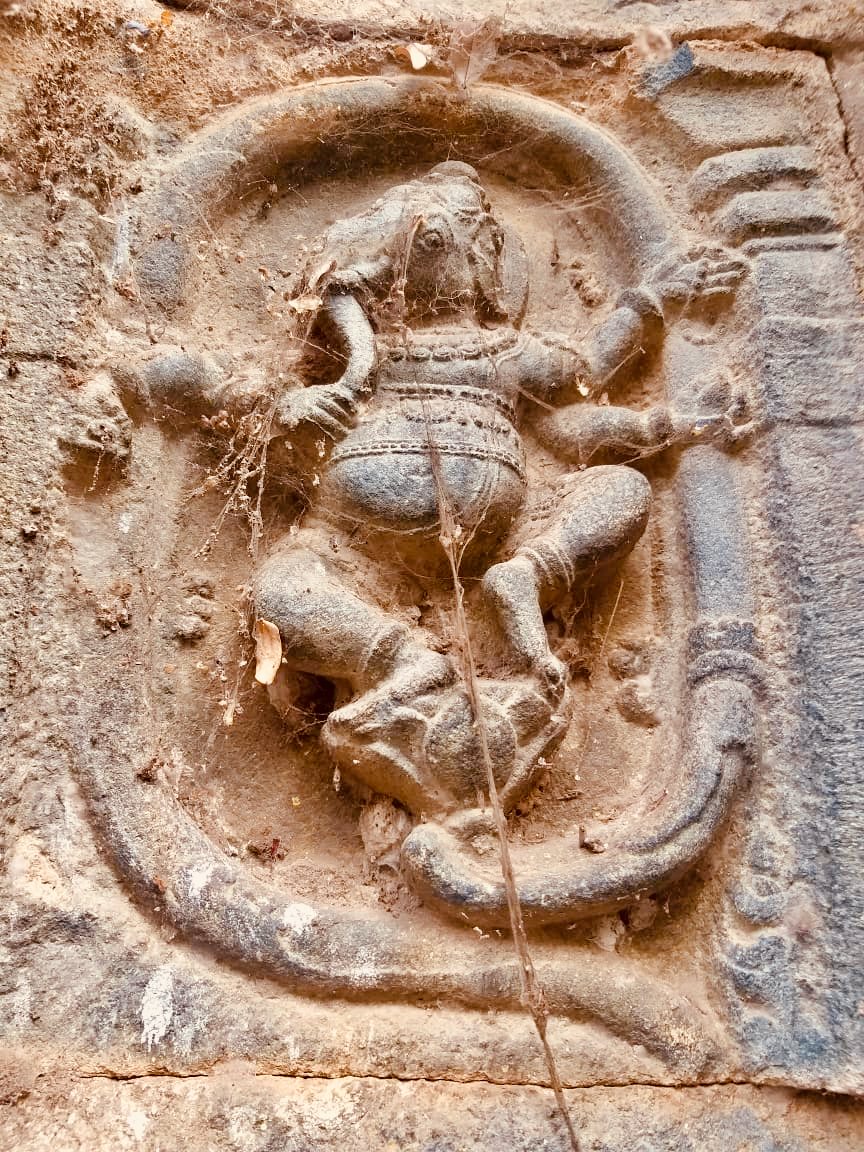
A relief of Ganesha dancing, at Pachala Someswara, photographed in 2021. The report of 1927-28 praised the comic sense of the Ganesha carvings at this temple.
Detail
- Panagal lies about two miles north-east of Nalgonda. The inscriptions spell its name Panugallu, Panagallu or Panugal, and the Hyderabad surveys of 1900 and 1927-28 call it Pangal.ASI 1900Nizam Archaeological Report 1927-28Epigraphia Telanganica 2023
- Before the Kakatiyas, Panugallu was a capital of the Telugu Chodas of Kanduru, who ruled Kandurunadu under the Western Chalukyas. Telangana – Land and People and Parabrahma Sastry name Koduru and Panugallu as their capitals.Goel et al. 2022Parabrahma Sastry 1978
- According to Parabrahma Sastry, the Kakatiya chief Prola II reinstated the Choda chief Udaya Choda, son of Gokarna, in the kingdom of Panugallu. The Early History of the Deccan also says that Prola II restored the kingdom to Udayaditya of Nalgonda-Panugal.Parabrahma Sastry 1978Yazdani 1960
- Rudra Deva later fought the Chodas of Kanduru. Parabrahma Sastry’s thesis says that Rudra marched on Udaya Choda’s capital, most likely Panugallu, and that Udaya Choda sued for peace by offering his daughter to Rudra.Parabrahma Sastry 1975 (thesis)
- Parabrahma Sastry also writes that a locality of Warangal was named Panugamtivada after Panugallu, a town that Rudra captured. Telangana – Land and People says that Rudra Deva built a large tank, Rudrasamudram, at Panagallu to mark his victory.Parabrahma Sastry 1978Goel et al. 2022
- M. Rama Rao describes the Chaya Someswara temple as standing in the fields about a mile east of the village. It is a triple shrine. Three shrines open to the north, east and west from a common hall, and a roofed porch faces south.Rama Rao 1966
- The hall has sixteen pillars and a Nandi. Rama Rao describes the stepped towers of the three shrines as intact. Each tower has twelve steps below a Nagara top.Rama Rao 1966
- The temple stands in a partly ruined compound of large stone blocks, with entrances on the east, south and west. Rama Rao counts six small subsidiary shrines inside the compound.Rama Rao 1966
- Rama Rao writes that the western shrine holds the linga of Somesvara on a pedestal in a deep pit filled with water. He describes a square beam of shadow on the wall above the linga, visible throughout the day.Rama Rao 1966
- Rama Rao names this play of shadow, together with the intact stepped towers, as the reasons for the temple’s importance.Rama Rao 1966
- The survey of 1900 calls the temple the old temple of Mahadeva known as Chable Somesvara Svami. The survey noted traces of seven smaller buildings in its enclosure, and Telugu inscriptions on a pillar, in a stepwell and on the southern gate.ASI 1900
- The Hyderabad report for 1927-28 describes a temple to the south of the tank embankment, associated with the name Sailasomeshvara. It had shrines to the north, east and west, a portico seven steps high to the south, and a cistern to the north.Nizam Archaeological Report 1927-28
- The plan in that report matches Rama Rao’s description of Chaya Someswara, but the report does not use the name Chaya. The plates of the same report show a Somesvara temple at Pangal.Nizam Archaeological Report 1927-28Rama Rao 1966
- The two sources judge the towers differently. The report of 1927-28 calls the spire of this temple modern, made of receding tiers worked out in plaster. Rama Rao, writing in 1966, describes the stepped towers as intact.Nizam Archaeological Report 1927-28Rama Rao 1966
- The report of 1927-28 calls the second temple Panchisvara. The report describes it as desolate but rich in sculpture. Its hall is 85 feet long and 40 feet deep, and rows of carved pillars divide it into four aisles.Nizam Archaeological Report 1927-28
- Three shrines open from the west side of the hall and one from the east. The report thought that the temple was never finished. The middle shrine on the west side was left as an empty chamber.Nizam Archaeological Report 1927-28
- The pillars and ceilings carry scenes from the Ramayana and the Puranas, such as the abduction of Sita and the churning of the ocean. The ceiling also shows Siva dancing and the Eight Gods with their vehicles. A large Nandi is placed in the middle of the hall.Nizam Archaeological Report 1927-28
- The report notes that the scrolls on the outer walls run in vertical lines, with small sculptures set between them. The report calls this a new feature, because Deccan temples usually arrange such sculptures in horizontal bands.Nizam Archaeological Report 1927-28
- The report also thought that the spires of this temple had been rebuilt in modern times, while the carved base and lower walls were largely preserved.Nizam Archaeological Report 1927-28
- B. Murali Krishna gives the Pachala Someswara temple as the best example of the four-shrined temple, the catushkuta.Murali Krishna 2024
- The sources disagree about who built the temples. M. Rama Rao includes the Chaya Someswara temple among his select Kakatiya temples. He lists its triple shrine with those of Pillalamarri, Palampet and Hanumakonda as examples of the Kakatiya style.Rama Rao 1966
- S. Gopalakrishna Murthy writes that the Telugu Chodas built trikuta temples, one of them at Panagal, the capital of Udaya Choda. He notes that the stepped pyramidal temples of Panagal are believed to be earlier than Rudra Deva.Gopalakrishna Murthy 1964
- Gopalakrishna Murthy gives a reason from the plan. In the Chaya Somanatha trikuta, two pillars before each shrine appear to form an antechamber. He regards this as an earlier feature, also found at Vardhamanapura.Gopalakrishna Murthy 1964
- On the Pachala Someswara temple, Gopalakrishna Murthy writes that its sculpture differs so plainly from the Kakatiya habit that the Kakatiyas could not have built it. He points to Chola features, such as the dishevelled hair of Nataraja and the shape of his trident.Gopalakrishna Murthy 1964
- Gopalakrishna Murthy also notes that the gods of the directions appear here with their consorts on their vehicles, which is rare in Kakatiya sculpture. He credits the Panagal carvings of the goddess fighting a demon to a subsidiary Chola dynasty of Panagal.Gopalakrishna Murthy 1964
- The foreword of the same book takes another view. Its author, the Director of Archaeology Mohd. Abdul Waheed Khan, names the temple complex at Pangal with those at Ramappa and Nagulpad as masterpieces of the Kakatiya period.Gopalakrishna Murthy 1964
- P. Sreenivasachar, in his corpus of 1942, also lists the temples of Panugal among the best temples of the Kakatiya times that have survived.Sreenivasachar 1942
- Parabrahma Sastry calls the temples of Anumakonda, Palampet, Pillalamarri, Nagulapadu and Ghanpur galleries of Kakatiya art. He writes that the temple at Panugallu near Nalgonda represents late Chalukya art instead.Parabrahma Sastry 1978
- Murali Krishna writes that the Telugu Chodas of Kandur built the Pachala Someswara temple.Murali Krishna 2024
- A damaged inscription of 1124 lies in the Pachala Someswara temple. The inscription records that Mailambika, the mother of Udayaditya, Bhima and Gokarna, granted an agrahara to 108 Brahmins.Epigraphia Telanganica 2023
- A second side of the same stone lists levies on goods probably sold in the local market, such as salt, paddy, betel leaves, pepper, cotton and saris. Telangana – Land and People and Parabrahma Sastry describe a Panugallu record of Mailamba with a similar list, but date it to 1122.Epigraphia Telanganica 2023Goel et al. 2022Parabrahma Sastry 1975 (thesis)
- An undated record of the reign of Rudra Deva is set in the wall near the doorway of a Somesvara temple. The tantrapala Mallinayaka gave wet land behind the Udayaditya tank and dry land to the god Abhinava Somanatha, for the merit of Rudra Deva.Epigraphia Telanganica 2023
- The Early History of the Deccan calls this Malli Nayaka the war minister of Rudra Deva.Yazdani 1960
- An inscription of 25 May 1267 stands in the Chaya Someswara temple. Sarngapanideva, a son of the Yadava king Singhana, gave land behind the Udaya-samudram and a second tank to the god Chaya Somanatha.Epigraphia Telanganica 2023
- The editions differ on the size of this gift. One gives six marturs behind each tank, and the other gives twelve marturs behind the Udaya-samudram and six behind the second tank.Epigraphia Telanganica 2023
- The record calls Sarngapanideva the lord of Panugallu in the Kakatiya kingdom of Rudrama Devi, who is named Manuma Rudradeva. It also says that he lifted the earth out of the Muslim deluge.Epigraphia Telanganica 2023Yazdani 1960
- Epigraphia Telanganica and the Early History of the Deccan suggest that Sarngapanideva had seized the fort of Panugal during a Seuna invasion. They suggest that he then accepted Rudrama Devi as his overlord so that he could keep it.Epigraphia Telanganica 2023Yazdani 1960
- An inscription of 16 May 1290 is cut on a pillar in the compound of the Chaya Someswara temple. Immadi Mallikarjuna Nayaka gave wet land behind the Udayaditya-samudra to the god Chaya Somanatha, for the merit of the king Kumara Rudradeva, that is, Pratapa Rudra.Epigraphia Telanganica 2023
- The donor’s father, Mallikarjuna Nayaka, bore the title Rayasthapanacharya, and his grandfather Bolla was a minister of the king. The Early History of the Deccan notes that the poet Anantasuri composed the record.Epigraphia Telanganica 2023Yazdani 1960
- Parabrahma Sastry uses this inscription to show that the donor’s father, Mallikarjuna-nayaka, was a general of Rudrama Devi.Parabrahma Sastry 1975 (thesis)
- Panugallu was also a seat of Kakatiya governors. Parabrahma Sastry writes that Ganapati Deva first stationed the Kayastha chiefs at Panugallu. Gangaya Sahini later ruled a region from Panugallu to Valluru in the Cuddapah district.Parabrahma Sastry 1978Goel et al. 2022
- Parabrahma Sastry also counts Panugallu, the old capital of a branch of the Choda chiefs of Kanduru, among the big trade centres of the Kakatiya period.Parabrahma Sastry 1975 (thesis)
- The temples stand near the Pangal tank, whose dam is called Udaya Samudram in a Telugu inscription. That inscription, with a Persian version, records that the dam was rebuilt in 1551 under Ibrahim Qutb Shah.Nizam Archaeological Report 1927-28
- In 1936-37 the Hyderabad Archaeological Department moved a Telugu inscription found lying at Pangal to the Hyderabad Museum. Sculptures from Pangal also went to the museum, among them Siva as Bhikshatana and a panel of the seven mother goddesses.Nizam Archaeological Report 1936-37
Historical photographs
These photographs were published a century or more ago. They show the monument as it stood before later repair and restoration.
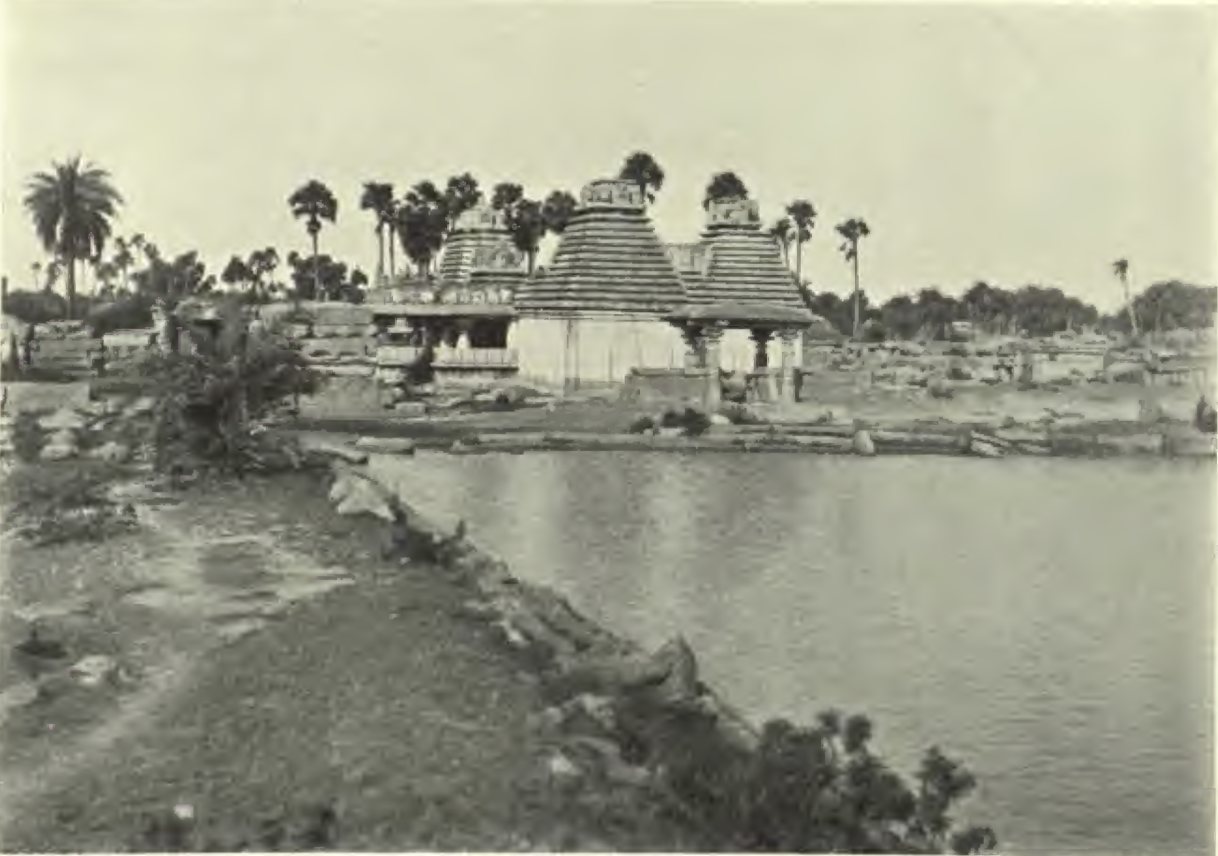
Photographed before 1929
A temple at Pangal with three stepped towers, photographed for the Hyderabad Archaeological Department by 1929. The plate calls it the Somesvara temple at Pangal. A pool lies in front of it.
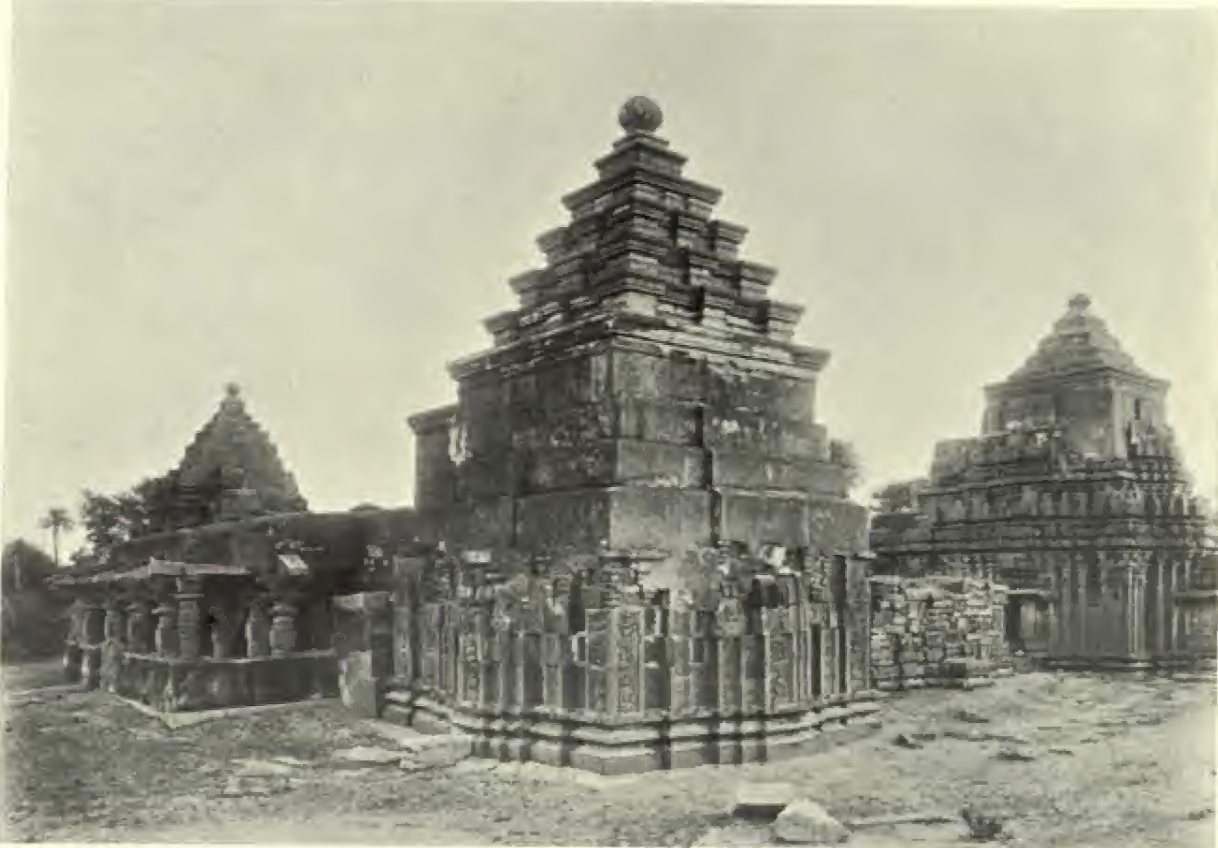
Photographed before 1929
The temple now called Pachala Someswara, photographed by 1929. The plate calls it the Panchesvara temple at Pangal. Its lower walls are richly carved, and its tower rises in plain stepped layers.
Also recorded as
- Panagal
- Panugallu
- Panagallu
- Panugal
- Pangal
- Panungallu
- Chaya Someswara
- Chaya Someshwara
- Chhaya Somesvara
- Chaya Somanatha
- Chayala Somesvara
- Chable Somesvara
- Sailasomeshvara
- Pachala Someswara
- Pacchala Somesvara
- Pachala Someshwara
- Panchesvara
- Panchisvara
- Udaya Samudram