Nagulapadu Temples
Nagulapadu is a ruined town on the Musi river, south of Suryapet, in present-day Suryapet district. The older sources place it in Nalgonda district. Two temples of the Recherla chiefs stand there, with inscriptions of the reign of Ganapati Deva. Gopalakrishna Murthy saw the high point of Kakatiya decorative sculpture in the carving at Nagulapadu.
- Period
- Kakatiya. Inscriptions of 1234 to 1303, in the reigns of Ganapati Deva and Pratapa Rudra, stand at the site
- Materials
- The pillars and ceiling of the southern temple are of black stone
- Location
- 16.9969° N, 79.6145° EWarning: approximate
Source of the position: Geotags on Wikimedia Commons photographs of the two temples (P. Madhusudan, 2021). The point is the midpoint of the two groups of geotags
- Condition
- In 1926-27 the roofs of the hall and porches of the northern temple had fallen, and so had the roof of the porch of the southern temple. Photographs of 2021 show the northern temple in ruins on its platform. They show the southern temple in worship, with white plastered towers over its shrines.
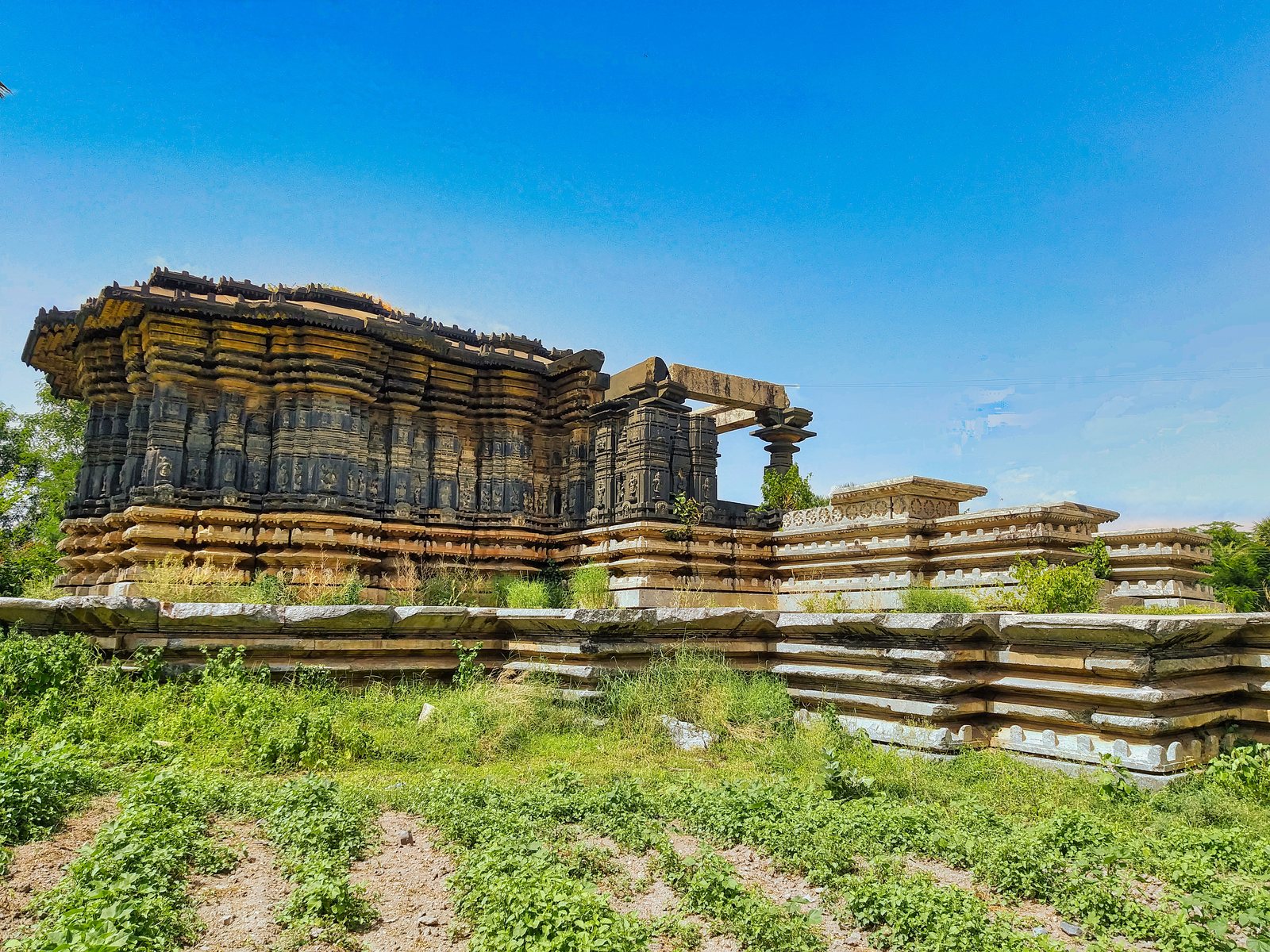
Photographed 2021
The northern temple at Nagulapadu, photographed in 2021. The sanctum and its carved outer walls still stand on the high platform. The hall in front has lost its roof.
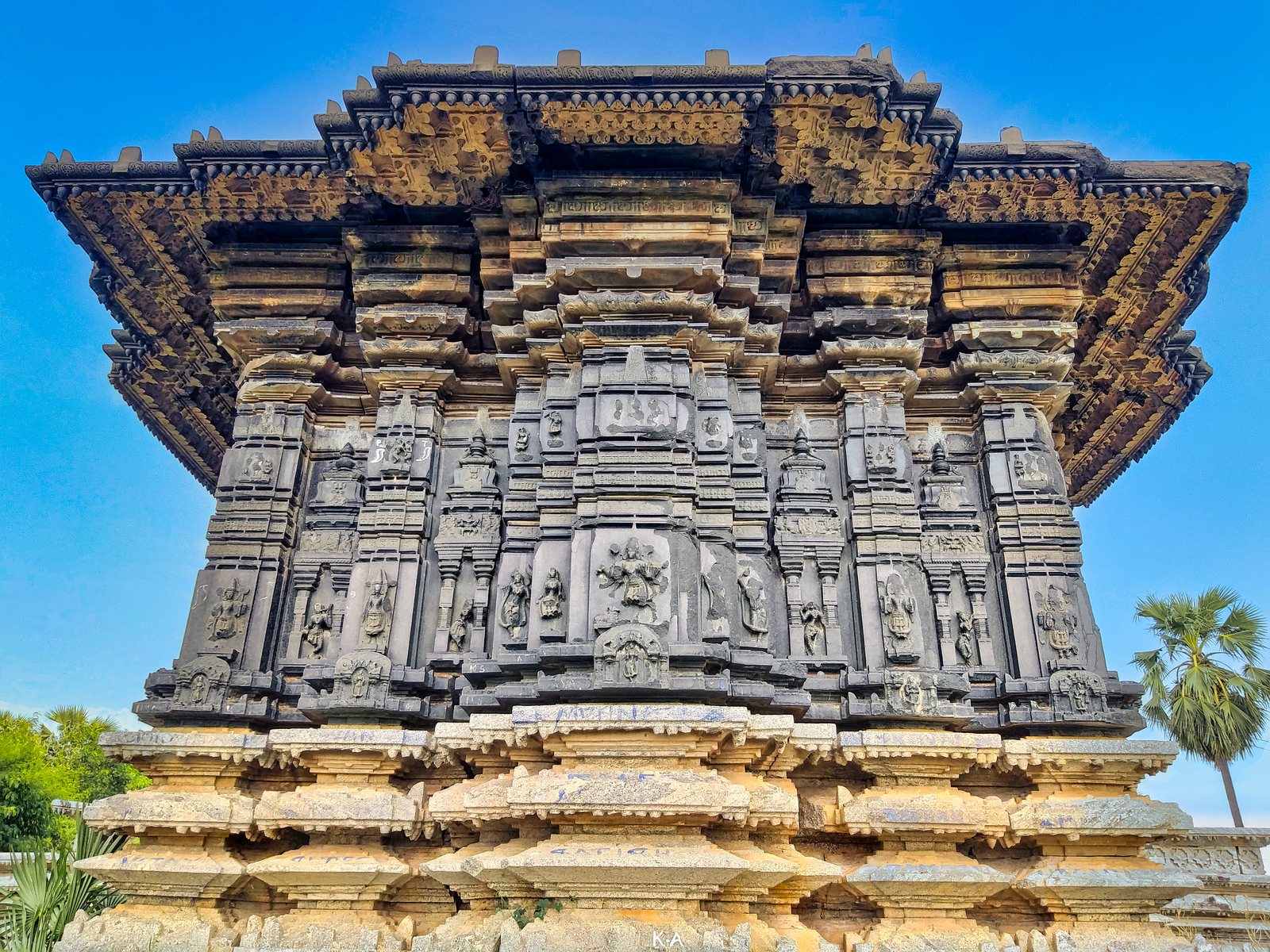
Photographed 2021
An outer wall of the northern temple. Projecting pilasters carry small carved deities in niches, under a deep cornice with rows of buds.
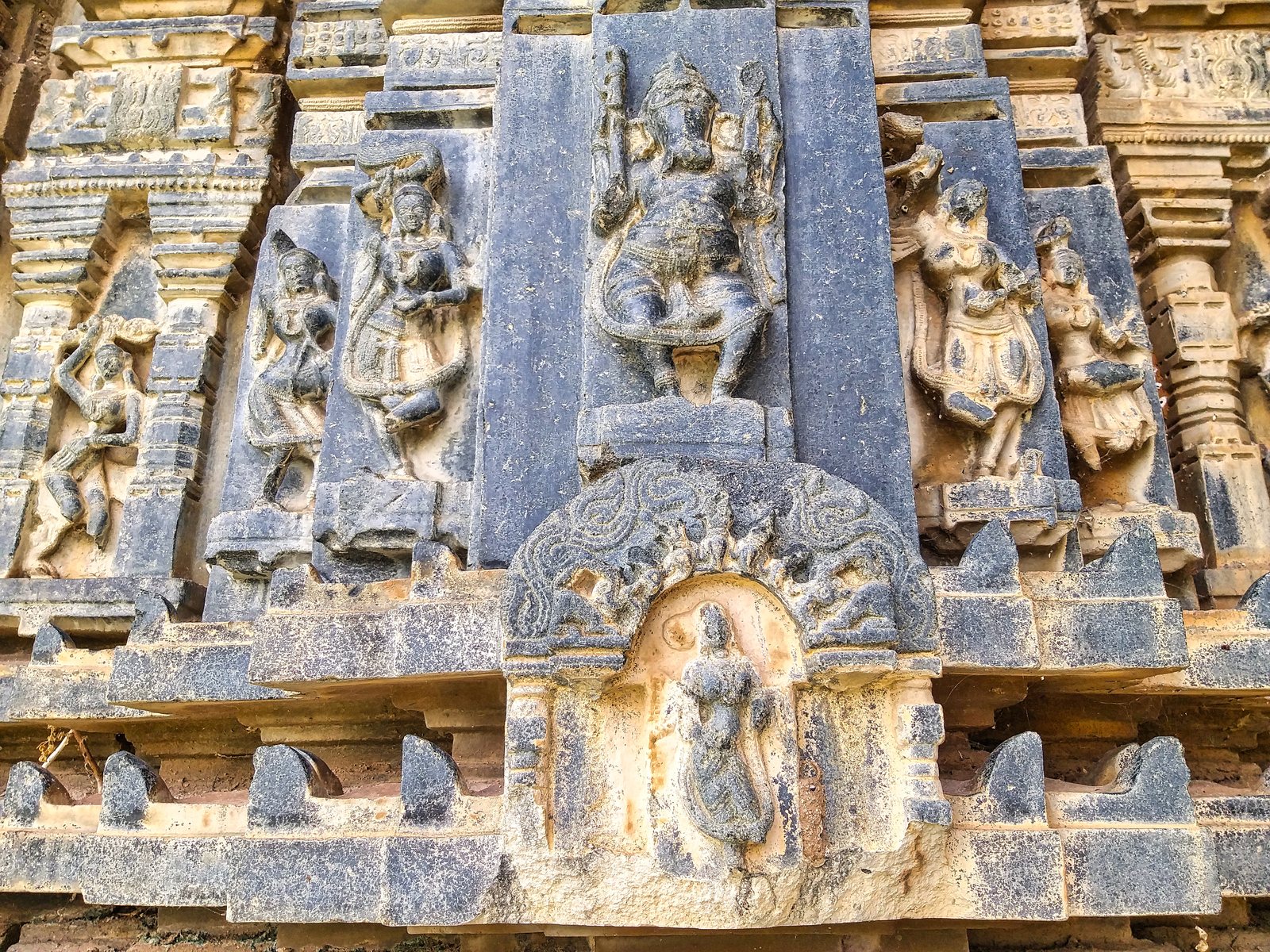
Photographed 2021
A detail of the outer wall of the northern temple. Ganapati, the elephant-headed god, is carved between dancers, above a small sculpture set in an arch.
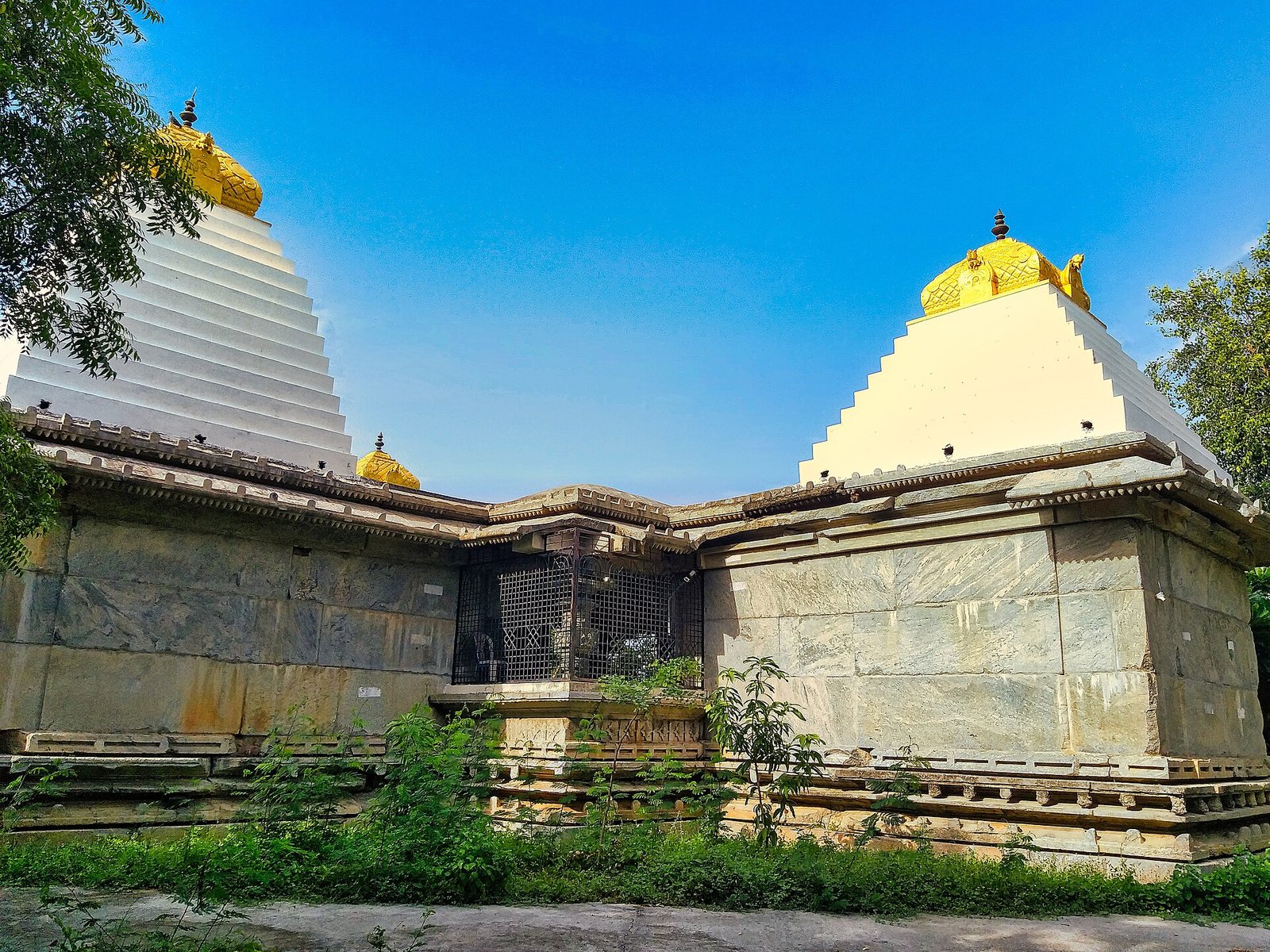
Photographed 2021
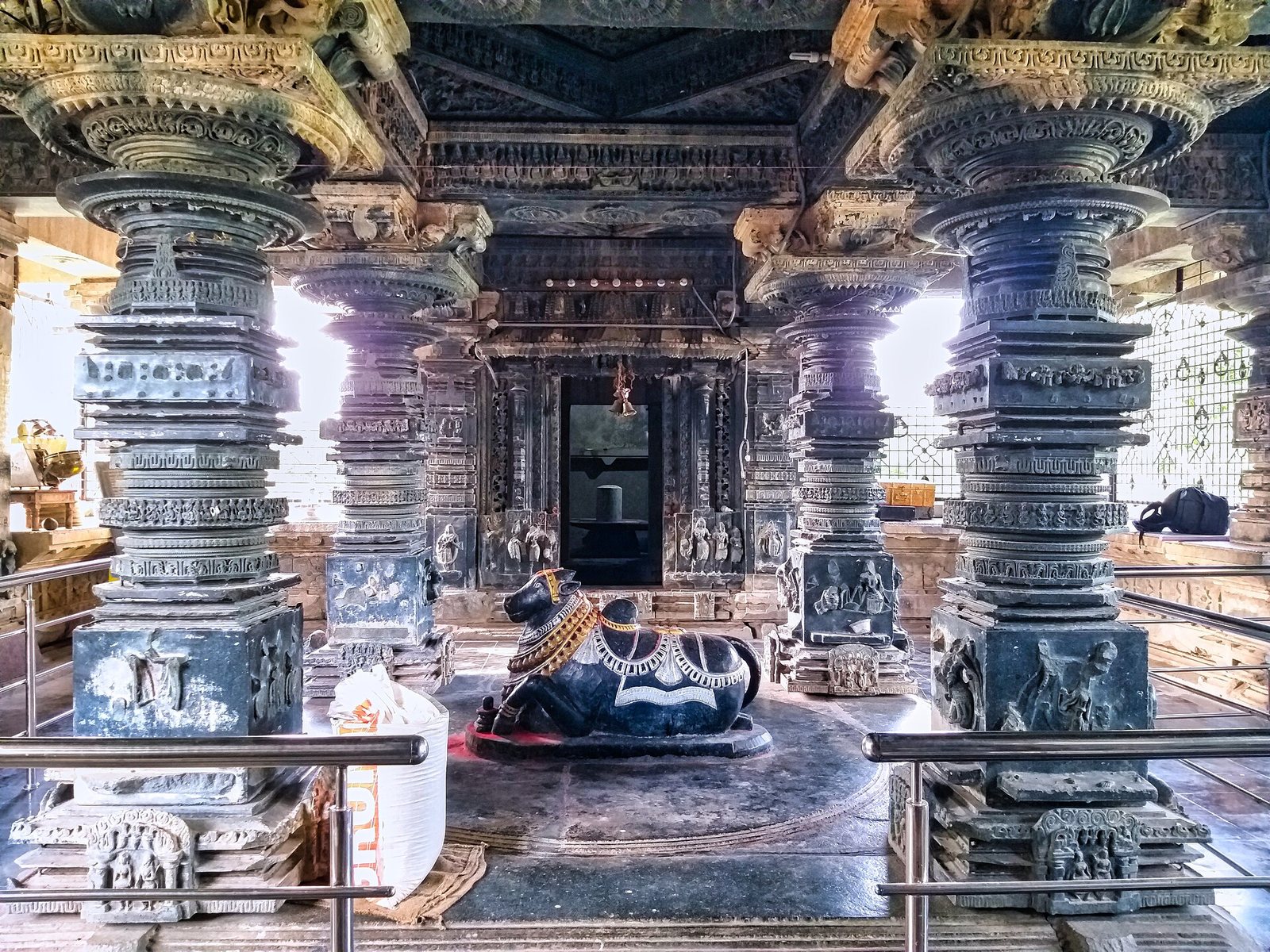
The southern temple, the triple shrine of Namesvara, Aytesvara and Katesvara, photographed in 2021. Its outer walls are plain, and white plastered towers now rise over the shrines.
Photographed 2021
Inside the hall of the southern temple. Carved pillars of black stone stand around the image of Nandi, in front of one of the three shrines.
Detail
- Nagulapadu stands on the east bank of the Musi river, about 16 miles south of Suryapet. The Hyderabad Archaeological Department described it in 1926-27 as a once important town, defended by a high mud wall.Nizam Archaeological Report 1926-27
- By 1926-27 the town was almost deserted. Two temples stood close together near the middle of the ruined town, with a small mosque between them. The report dates the mosque to the Bahmani period on grounds of style.Nizam Archaeological Report 1926-27
- An inscription of 13 April 1234, in the reign of Ganapati Deva, is set in the wall of the southern temple. It records that the Recherla chief Katreddi, son of Aytamba, set up the gods Namesvara, Aytesvara and Katesvara.Epigraphia Telanganica 2023
- Katreddi set up the three gods for the merit of his father Nami Reddi, his mother Aytasanamma and himself. He gave them 11 marturus of land under the Museti canal and the Nama-samudram and Visvanatha-samudram tanks.Epigraphia Telanganica 2023
- The 1926-27 report calls Katreddi a descendant of the Namireddi of the Pillalamarri inscriptions. Parabrahma Sastry writes that later members of this Recherla family settled at Nagulapadu, in the same taluk as Pillalamarri, and built temples and tanks there.Nizam Archaeological Report 1926-27Parabrahma Sastry 1978
- M. Rama Rao summarises an inscription of 1195 at Pillalamarri. In it, Nami Reddi gave land under the Visvanatha-samudram tank in the village of Nagulapadu to the god Namesvara.Rama Rao 1966
- Katreddi's sons Namaya, Kamaya and Mallaya later gave more land to the triple shrine of Namesvara, Aytesvara and Katesvara. Epigraphia Telanganica dates these grants to 1264 and 1267 in one entry, and to 1324 in another.Epigraphia Telanganica 2023
- An inscription beside a doorway of the northern temple is dated 28 December 1258. In it, Recherla Kami Reddi, son of Ayitambika, divided the Nama-samudram tank into two shares. He gave his share to a god, for the merit of King Ganapati Deva.Epigraphia Telanganica 2023
- A record of the same day, listed under the village of Annavaram, says that Kami Reddi set up the god Kamesvara in Nagulapadu. One edition places it on a pillar lying on the road between the temples and the village. Another places it near the breach of the Devatala tank.Epigraphia Telanganica 2023
- The 1926-27 report reads the tablets beside the antechamber door of the northern temple differently. It says that they record the building of the temple by Recherla Kamireddi in 1258.Nizam Archaeological Report 1926-27
- A later inscription beside the entrance of the northern temple, dated 5 March 1482, names Ramaraju as the ruler. It records that Akkana built a pedestal for the Kamesvara linga.Epigraphia Telanganica 2023
- The report describes the northern temple on a high platform, with flights of steps on three sides. The roofs of its porches and hall had fallen, but the antechamber and the sanctum stood intact.Nizam Archaeological Report 1926-27
- The report calls the outer walls of the northern temple a splendid display of 13th-century sculpture. Projecting pilasters divide the wall surface, and they carry fine mouldings and delicate carving.Nizam Archaeological Report 1926-27
- The southern temple has three shrines around a common hall, with a porch on the east. In 1926-27 its outer walls were plain, and the report judged that the temple was never finished. The report places the inscription of 1234 in this temple.Nizam Archaeological Report 1926-27
- The pillars and ceiling of the hall of the southern temple are of black stone and richly carved. The fallen roof slabs of the porch show gods on their mounts, Siva with Nandi, and warriors with clubs and maces. An architrave shows archers in chariots drawn by small ponies.Nizam Archaeological Report 1926-27
- The report also notes a small ruined third temple near the town wall to the north-west, and a domed tomb of an unnamed Muslim martyr.Nizam Archaeological Report 1926-27
- The report for 1927-28 publishes plans of the northern and southern temples. It also notes the huge stone slabs, up to 12 or 14 feet long, used in the floors of the temples at Palampet, Pillalamarri and Nagulapadu.Nizam Archaeological Report 1927-28
- Gopalakrishna Murthy writes that Recherla Katreddi raised a temple of the thousand-pillared type at Nagulapadu in 1234. He judges that its outer walls mark the high point of decorative sculpture in Kakatiya temples of this type.Gopalakrishna Murthy 1964
- In his view, the base of this temple avoids the monotonous horizontal tiers of the temples at Hanumakonda, Pillalamarri and Palampet. Rows of medium-sized buds replace the outsized half-moon ornament. Dancers set in arches break the two stepped tiers at the foot of the pilasters.Gopalakrishna Murthy 1964
- Gopalakrishna Murthy also finds a fault. The carvers gave the sculptures on the door architraves parallel bodies and legs, and the rows of legs look monotonous. He adds that the decoration of pillars and pilasters reached its peak at Nagulapadu.Gopalakrishna Murthy 1964
- The sources differ on which temple carries the finest carving. Gopalakrishna Murthy gives the carved outer walls to Katreddi's temple of 1234. The 1926-27 report places the inscription of 1234 in the plain southern temple and the carved walls on the northern temple.Gopalakrishna Murthy 1964Nizam Archaeological Report 1926-27
- An inscription of 1 May 1303, in the reign of Pratapa Rudra, stands near the two temples. The eighteen communities of the town granted dues to the god Mallinatha of Nagulapadu, for the merit of the king. The editions also read the name as Malinatha.Epigraphia Telanganica 2023Nizam Archaeological Report 1926-27
- The record of 1303 sets the dues of merchants, toddy-tappers, herdsmen, goldsmiths, weavers and potters. Sreenivasachar cites it as a list of the eighteen communities of a town, though a damaged one.Epigraphia Telanganica 2023Sreenivasachar 1942
- An inscription on the northern temple, dated 13 November 1544 under the Qutb Shahis, records that Yelid Khan surveyed the sugar-cane and betel gardens and the tax-free fields of the area around Nagulapadu. It also fixes a local measure of land.Epigraphia Telanganica 2023
- Parabrahma Sastry names Nagulapadu among the famous temples built in the Kakatiya period. He calls the temples at Anumakonda, Palampet, Pillalamarri, Nagulapadu and Ghanpur galleries of Kakatiya art.Parabrahma Sastry 1978
- Sreenivasachar also lists the temples at Nagulapadu among the best temples of the Kakatiya period that survive.Sreenivasachar 1942
Historical photographs
These photographs were published a century or more ago. They show the monument as it stood before later repair and restoration.
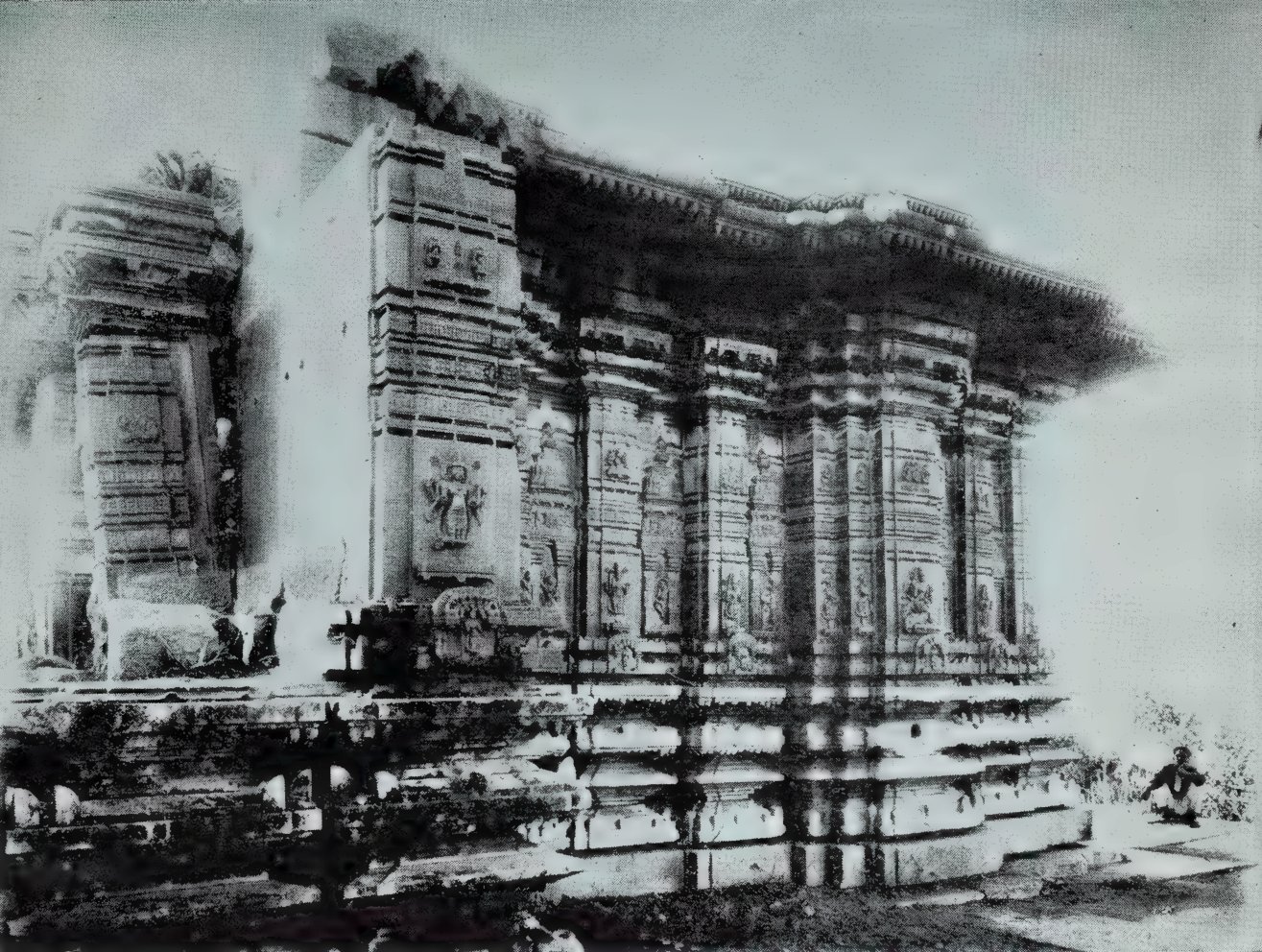
Photographed 1964
A temple at Nagulapadu, published by Gopalakrishna Murthy in 1964 to show its carved outer walls. Carved pilasters and niches cover the walls of the sanctum.
Photo: S. Gopalakrishna Murthy, The Sculpture of the Kakatiyas (A.P. Archaeological Series 34), Government of Andhra Pradesh, 1964, Fig. 30 · Public domain
Also recorded as
- Nagulapadu
- Nagulapahad
- Nagulpad
- Nagulapad
- Namesvara
- Nameswara
- Aytesvara
- Katesvara
- Kateswara
- Kamesvara