Nagunur Temples
Nagunur, a village about six miles north-east of Karimnagar, has the ruins of a large group of temples. The largest is a triple-shrined Siva temple of red stone. Records at the village run from the Western Chalukya period to the reign of Ganapati Deva.
- Period
- Western Chalukya and Kakatiya periods. Dated records at the village run from 1112 to 1228
- Materials
- Red stone for the outer walls of the big Siva temple, grey granite inside, and polished black stone for some pillars
- Condition
- In ruins. In 1927-28 the big Siva temple was out of worship and judged too damaged for conservation. Photographs of 2021 show its walls standing with numbers painted on the stones, and a second triple temple being rebuilt with new stone.
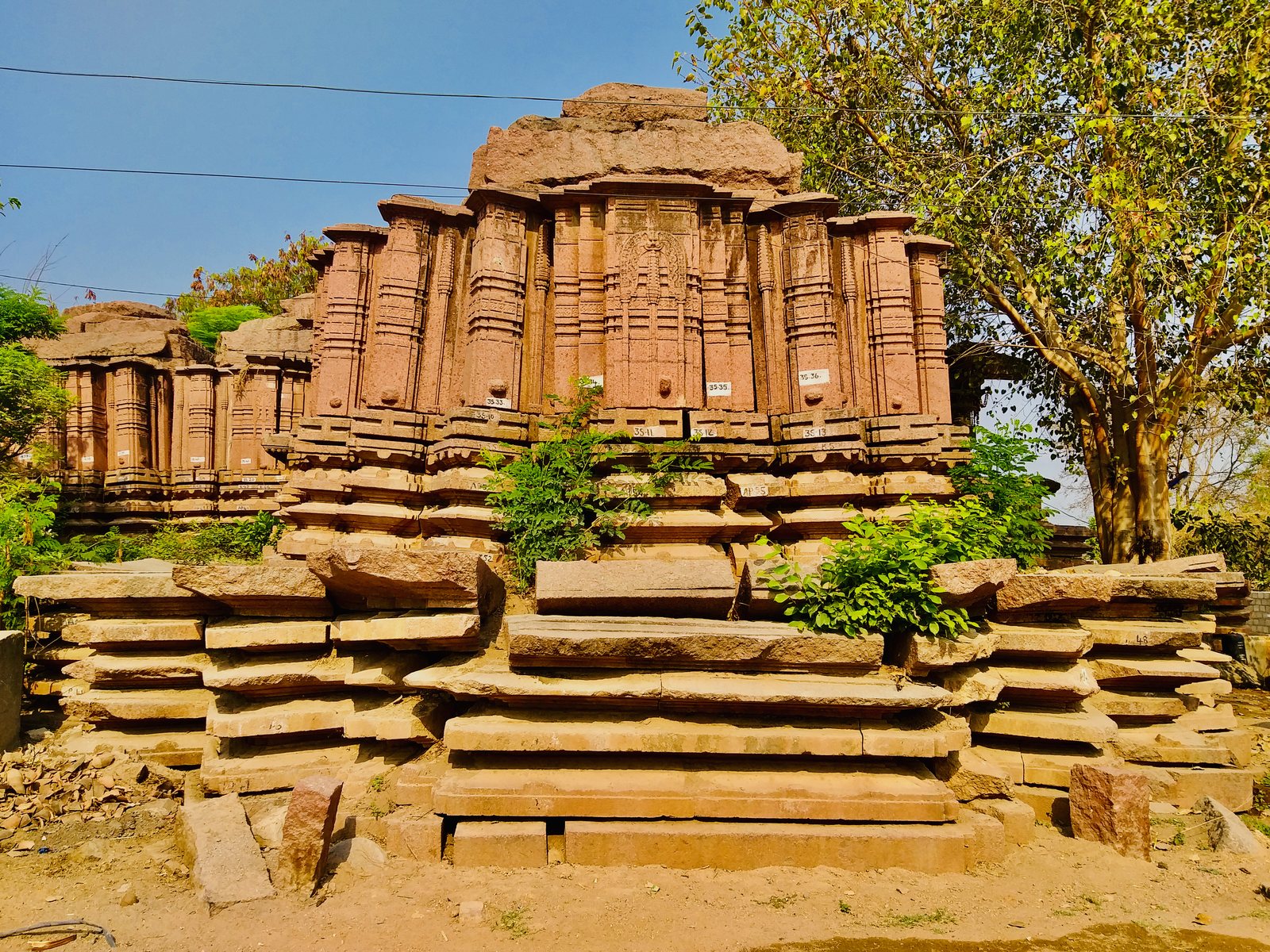
Photographed 2021
One shrine of the big Siva temple, photographed in 2021. Huge flat blocks of red stone lie on top of the walls instead of a tower, as the report of 1927-28 also noted. Painted numbers mark the stones.
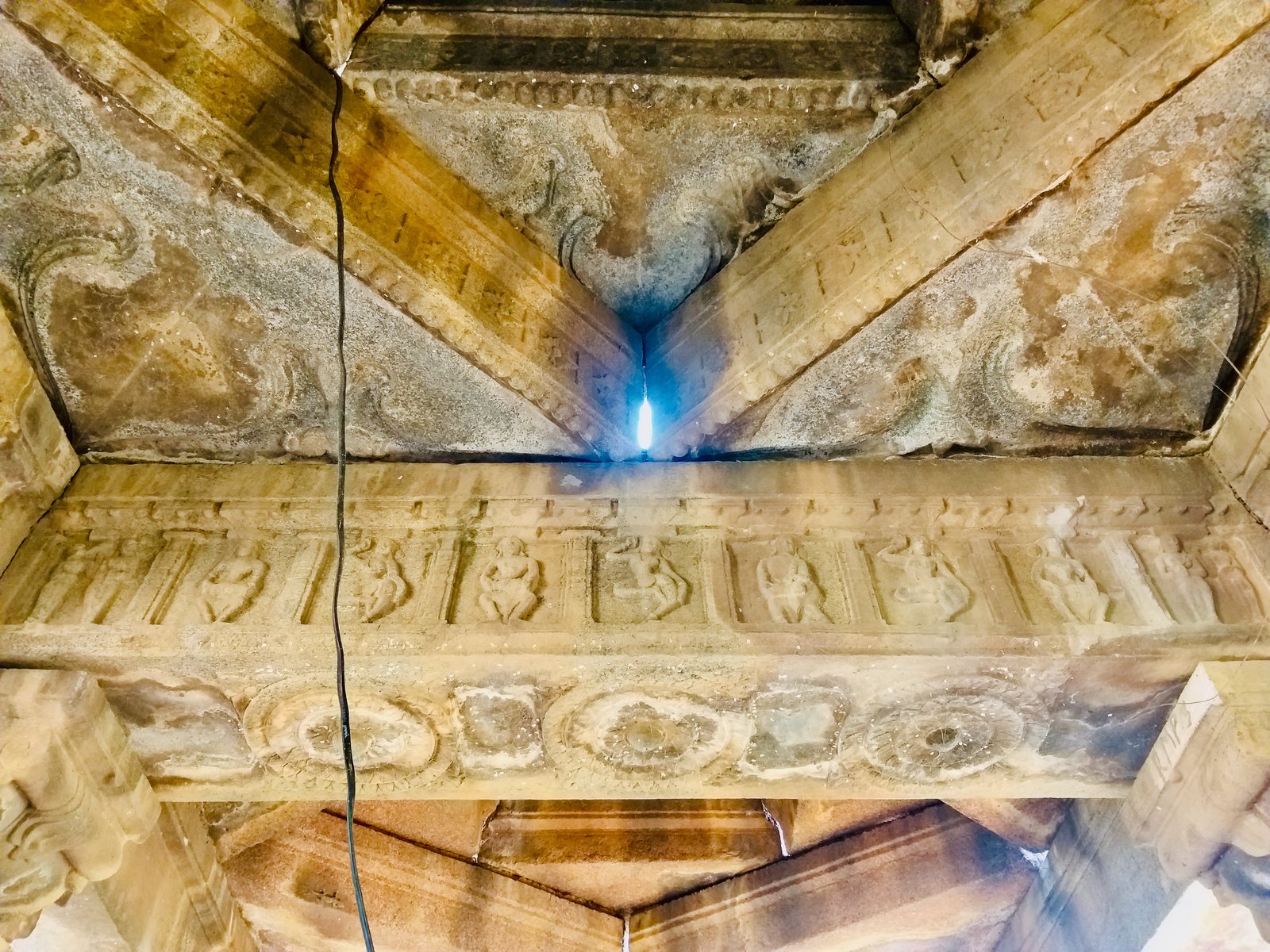
Photographed 2021
A carved beam in the hall of the big Siva temple. The 1927-28 report describes such beams, with dancers and drummers in square panels and three lotuses on the underside.
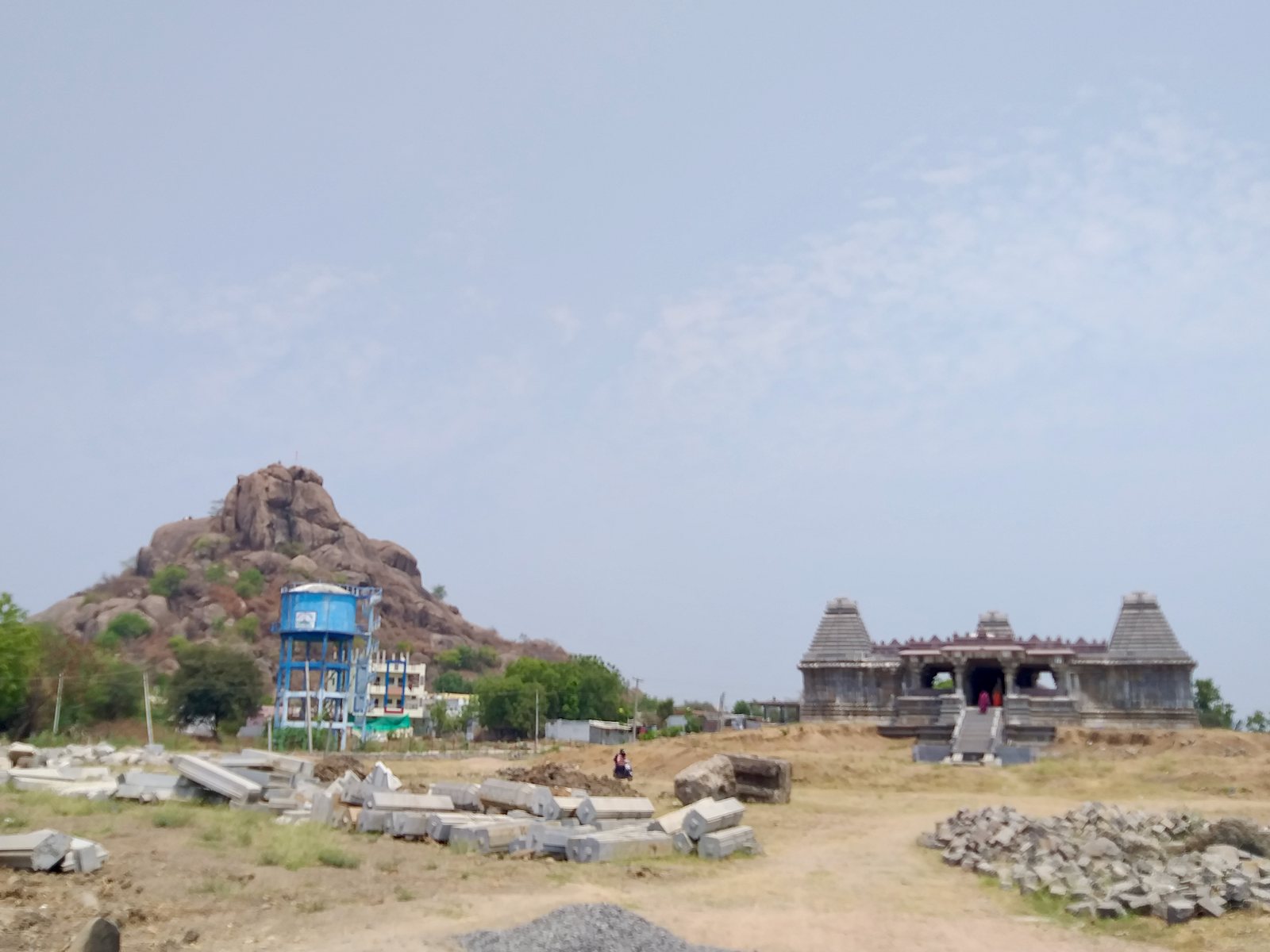
Photographed 2021
A second triple temple at the east of Nagunur, photographed in 2021 while it was being rebuilt. Newly cut stones lie in the foreground.
Detail
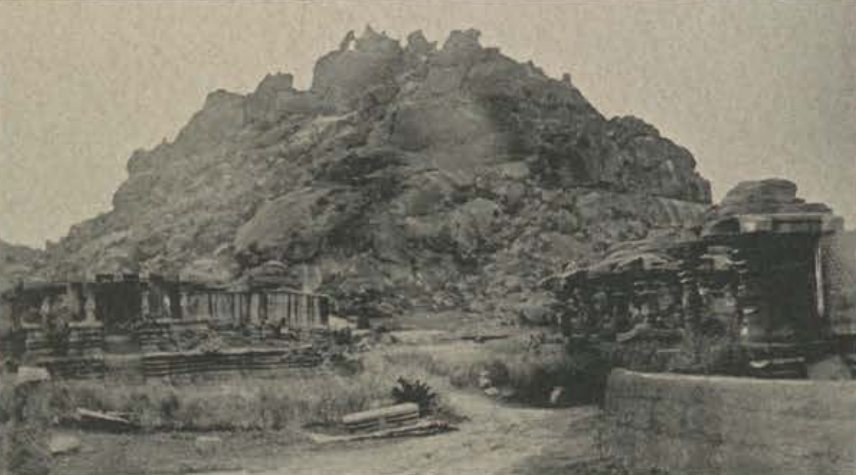
- The survey of 1900 lists Naganur, six miles north-east of Karimnagar, with five or six old ruined Chalukyan temples still standing and traces of as many more. The survey names the principal temple as Rajesvara, a triple-shrined temple, with a tall Garuda column close beside it.ASI 1900
- The Hyderabad Archaeological Department described the site in its report for 1927-28. The report calls the principal monument a big Siva temple with three shrines, like the great temple at Hanamkonda. The temple is star-shaped in plan, like the Chalukyan temples of the Deccan, and its entrance faces north.Nizam Archaeological Report 1927-28
- According to the report, red stone from a nearby quarry was used for the outer walls, and grey granite for the pillars, beams, ceilings and door frames inside. There were no towers over the shrines, only huge blocks of red stone, and the report suggests that the work on the temple may never have been finished.Nizam Archaeological Report 1927-28
- A porch on the north leads into a hall of sixteen carved pillars. Three shrines with lingas open off the hall to the east, south and west. The inner faces of the beams over the central pillars are carved with dancing women and drummers.Nizam Archaeological Report 1927-28
- The door frames of the antechambers and shrines carry four-handed door guardians and women with fly-whisks. On the door of the western antechamber, one woman carries a child on her hip. The report compares the carving of the pillars and door frames with that of the Uparpalli temple.Nizam Archaeological Report 1927-28
- In 1927-28 the big temple was not in worship. The floor of its western shrine had sunk and the walls had tilted, so the report judged the temple too damaged for conservation. In front of the big temple stood the remains of two smaller temples, a broken Nandi and a large Nandi pedestal.Nizam Archaeological Report 1927-28
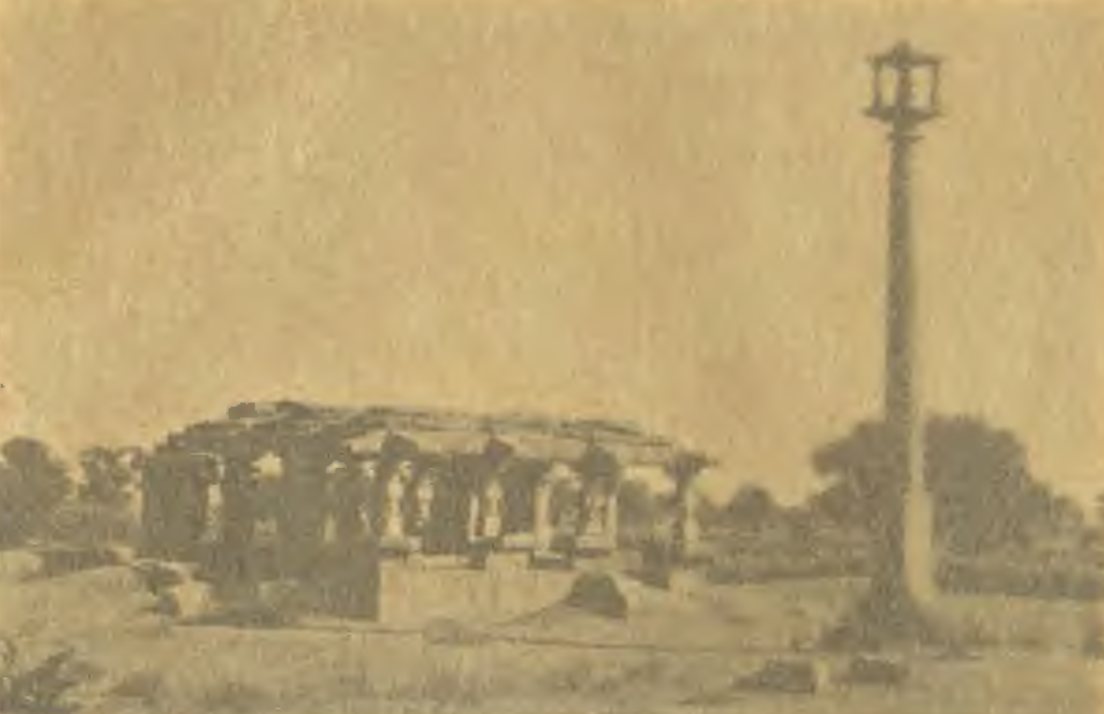
- North-east of the big temple, across the road, stood a ruined hall with four polished black stone pillars. The report thought that the hall had been put together with stones from another temple. South of the hall stands a single stone pillar about thirty-five feet high, with a small seated Garuda under a little pavilion at its top.Nizam Archaeological Report 1927-28
- From this pillar the report infers that the original temple there was dedicated to Vishnu. Two more such pillars stand to the east. Another ruined temple stands on rising ground on the way from Karimnagar, and carved slabs and pillars lie scattered in the village and the fields.Nizam Archaeological Report 1927-28
- An inscription on a stone near the Birannagudi at Nagunur is dated Saka 1035, which the editor converts to 25 December 1112. The inscription states that a Mahamandalesvara named Pandarasar built the temple of Ravvisvara and gave it lands watered by tanks.Parabrahma Sastry (ed.) 1974
- The preface of the Karimnagar volume of inscriptions says that the Chalukyas of Vemulavada built Jain temples at places such as Vemulavada, Sanigaram and Nagunuru. Parabrahma Sastry also notes several Jain remains at Nagunuru.Parabrahma Sastry (ed.) 1974Parabrahma Sastry 1978
- In the 12th century Nagunur was the seat of a chief named Dommaraja. Parabrahma Sastry calls him the lord of Nagunuru and names him, with Medaraja and Mailigi, among the enemies of Rudra Deva. Telangana – Land and People calls Dommaraja the leader of a tribe of Sabbi-malam, with his headquarters at Nagunur.Parabrahma Sastry 1978Goel et al. 2022
- Four hero stones lie near the Nakkalagudi at Nagunur. Three of them record that warriors named Kelan, Narappati and Samgama won victories in the presence of Dommaraju.Parabrahma Sastry (ed.) 1974
- The fourth record is dated in the year Pramadi of the Chalukya Vikrama era, and the sources read it in different ways. Epigraphia Telanganica places the stone in a ruined temple and takes the record to describe a fight in which Dommaraju defeated Medaraju Jagadeva. Epigraphia Telanganica also notes that the date does not work out correctly.Epigraphia Telanganica 2023Parabrahma Sastry (ed.) 1974
- The Karimnagar volume reads the same record as a victory of Medaraju Jagadeva, who seems to have fought on the side of Dommaraju. The Early History of the Deccan dates the record to 1159 and reads it as a victory of Medaraja and Jagaddeva, with an army of 80,000, over an enemy who is not named. The Early History suggests that this enemy was Rudra Deva himself.Parabrahma Sastry (ed.) 1974Yazdani 1960
- Parabrahma Sastry also takes the year to be 1159. He reads the record as a victory of Jagadeva, the son of Medaraja, and suggests that the enemy in these war records was Rudra Deva.Parabrahma Sastry 1978
- Rudra Deva’s Anumakonda inscription of 1162 says that he put Dommaraja to flight and took his town. The Early History of the Deccan places that town in the Karimnagar district, and Parabrahma Sastry calls Dommaraja the lord of Nagunuru. Parabrahma Sastry adds that a quarter of Warangal called Nagara was named after the town of Dommaraja.Yazdani 1960Parabrahma Sastry 1978
- Parabrahma Sastry writes that Rudra Deva made his minister Gangadhara the governor of the whole Sabbi-nadu, and that Gangadhara built temples in his capital Nagunuru. Telangana – Land and People also places Gangadhara’s headquarters at Nagunur. The Karimnagar volume of inscriptions, edited by Parabrahma Sastry, gives the name of the capital as Nagaruru.Parabrahma Sastry 1978Goel et al. 2022Parabrahma Sastry (ed.) 1974
- Gangadhara’s own inscription, dated Saka 1092, is cut on a pillar at Karimnagar. The 1927-28 report converts the date to 13 January 1171, while Parabrahma Sastry gives the year as 1170. According to the report, this pillar and a smaller inscribed pillar were said to have been brought from Nagunur.Nizam Archaeological Report 1927-28Epigraphia Telanganica 2023Parabrahma Sastry 1978
- Gopalakrishna Murthy writes that, according to Gangadhara’s Karimnagar record, twenty-four forms of Vishnu were carved in the Vishnu temple of Nagunur. Murthy adds that these images are no longer to be seen there.Gopalakrishna Murthy 1964
- The Census volume of 1964 says that two inscriptions of Nagunur are kept in the Karimnagar municipal office. The volume names one as a record of Arikesari of the Chalukyas of Vemulavada and the other as a record of the minister Gangadhara. The volume adds that Gangadhara is said to have built the temples here.Census 1961, Fairs and Festivals: Karimnagar
- Gopalakrishna Murthy writes that a father and son, Malli Setti and Venni Setti, built a trikuta, a temple of three shrines, at Nagunur. Murthy names its gods Harisvara, Ganapesvara and Sakalesvara. M. Rama Rao lists the same builders and gods under the reign of Ganapati Deva.Gopalakrishna Murthy 1964Rama Rao 1966
- Murthy describes single dancers with drummers on the inner faces of the beams of its hall, dancing deities on the doors of the antechambers, and a mother holding a child on the door frames. Murthy adds that the Nandi of the temple had been thrown out with its pedestal.Gopalakrishna Murthy 1964
- The inscription of the two builders is on a stone near the images in front of the Sakti temple outside the village. Epigraphia Telanganica dates the inscription to 2 March 1228, in the reign of Ganapati Deva, and reads the name of the first god as Salesvara.Epigraphia Telanganica 2023
- The record says that Malli Setti and his son Venni Setti set up three gods on behalf of the saliyas, the weavers. Ganapatisvara was named after King Ganapati Deva, and Sakalesvara after all the devotees. The two men also granted the gods a small levy on the saris that were sold.Epigraphia Telanganica 2023
- The record names the place of the gods as Matiya-sthala. Epigraphia Telanganica also lists a record from Mattewada in Warangal that sets up the same three gods for the weavers. That record carries the same date in the lunar calendar, the tenth day of Phalguna in the year Sarvajit.Epigraphia Telanganica 2023
- Parabrahma Sastry names the temples at Nagunuru among the famous temples of the Kakatiya period, with those at Palampet, Pillalamarri, Ghanpur and Nagulapadu. Rama Rao’s list of 1966 also records many old temples at Nagunur. Gopalakrishna Murthy says that single stone pillars were set up at Nagunur, Kolanupaka and Bekkallu during the Kakatiya period.Parabrahma Sastry 1978Rama Rao 1966Gopalakrishna Murthy 1964
- According to a tradition recorded in the Census volume of 1964, the name comes from Nalugunuru, meaning four hundred, after the four hundred carved pillars of its temples. Another belief holds that there were once four hundred temples. The volume says that the remains spread over about fifteen acres.Census 1961, Fairs and Festivals: Karimnagar
- Telangana – Land and People tells the story of Samakka and Sarakka, Koya heroines who resisted the Kakatiyas. The book says that their images have been found as hero stones in and around the temples of Nagunur.Goel et al. 2022
Historical photographs
These photographs were published a century or more ago. They show the monument as it stood before later repair and restoration.
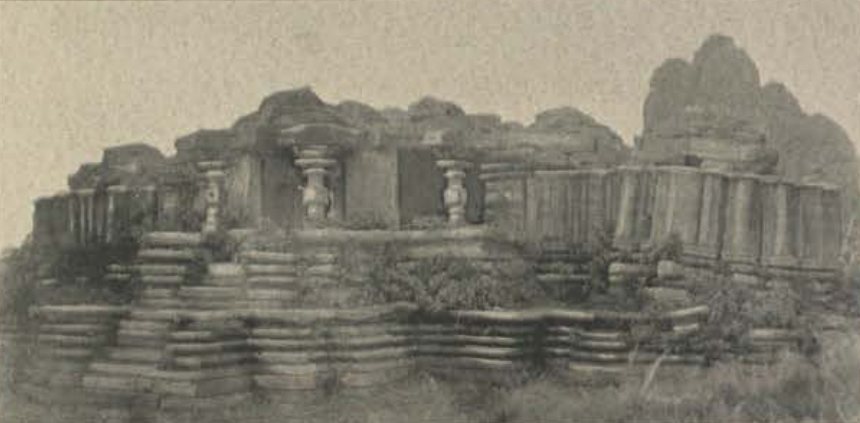
Photographed before 1898
A temple at Nagunur, photographed before 1898. Campbell’s caption reads "Temple at Angnoor, Elgandal". Nagunur then lay in the Elgandal district.
Photo: unknown photographer, Glimpses of the Nizam's Dominions (A. Claude Campbell), 1898, p. 474 · Public domain
Photographed before 1898
Ruined temples below a rocky hill at Nagunur, photographed before 1898. Campbell gives the same caption, "Temple at Angnoor, Elgandal".
Photo: unknown photographer, Glimpses of the Nizam's Dominions (A. Claude Campbell), 1898, p. 474 · Public domain
Photographed before 1929
The ruined Vishnu temple at Nagunur and the tall pillar beside it, photographed by 1929. The 1927-28 report describes a small seated Garuda under the pavilion at the top of the pillar.
Photo: Hyderabad Archaeological Department, Annual Report of the Archaeological Department of H.E.H. the Nizam's Dominions for 1927-28, Plate IX · Public domain
Also recorded as
- Nagunur
- Nagunuru
- Nagunoor
- Nagnur
- Nagnoor
- Nignur
- Naganur
- Naganuru
- Nagaruru
- Angnoor
- Nalugunuru
- Trikutalayam